FW
RICOH Ri 1000 Direct to Garment Printer Named CES 2019 Innovation Award Honoree
AnaJet, a Ricoh company, clinches prestigious CES Innovation Award Honoree designation for second straight year, this time for the newly released RICOH Ri 1000, a full-featured prosumer DTG printer available at an affordable price
Tustin, Calif. – AnaJet, a Ricoh company and global leader in the direct to garment (DTG) industry, today announced that it has been named a CES 2019 Innovation Awards Honoree for the newly released RICOH Ri 1000 Direct-to-Garment (DTG) printer. Products entered in this prestigious program are judged by a preeminent panel of independent industrial designers, independent engineers and members of the trade media to honor outstanding design and engineering in cutting edge consumer electronics products across 28 product categories.
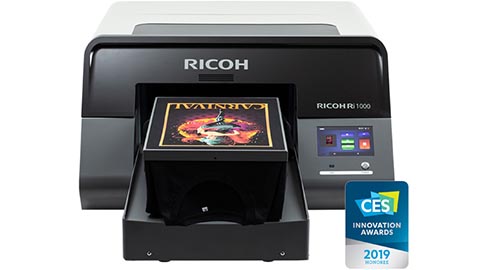
The next-generation RICOH Ri 1000 delivers advanced DTG printing at an affordable price.
“We were incredibly excited to learn that we were named a CES Innovation Award Honoree for the second year in a row,” said Paul Crocker, Marketing Director, AnaJet, Inc. “Last year, we won with the Ri 100, a highly compact, all-in-one, desktop DTG printer. This year we followed up with the RICOH Ri 1000, which has a decidedly more robust feature set, but is still available at an affordable price point for the prosumer market.”
In addition to quick print speeds and high image resolution up to 1200 x 1200 dpi, the RICOH Ri 1000 is a stand-out from its competition because of its “walk-up ready” design. Maintenance for the machine is largely automated, including white ink agitation, self-cleaning functions, and continuous monitoring of ink supply and air levels. For maintenance functions that are not automated, the RICOH Ri 1000’s built-in Interactive Operation Guide alerts users, sending them reminders to complete necessary tasks. The result is a machine that requires minimal maintenance and is kept in an active state, ready to print at any time.
For further ease of use and added versatility, the RICOH Ri 1000 also features magnetized quick-change platens that easily snap on and off the machine without the need for additional tools. Quick-change platens in multiple styles and sizes up to 16 inches by 19.6 inches allow for maximum versatility with virtually no downtime between setups.
The prestigious CES Innovation Awards are sponsored by the Consumer Technology Association (CTA)™, the owner and producer of CES 2019, the global gathering place for all who thrive on the business of consumer technologies, and have been recognizing achievements in product design and engineering since 1976.
Entries are evaluated on their engineering, aesthetic and design qualities, intended use/function and user value, unique/novel features present and how the design and innovation of the product directly compares to other products in the marketplace.
Products chosen as CES Innovation Honorees reflect innovative design and engineering in some of the most cutting edge tech products and services coming to market.
The RICOH Ri 1000 was announced in the US on October 18, 2018 and is expected to begin shipping to US customers in Winter 2018. International availability will be announced at a later date. The machine will be displayed at CES 2019, which runs January 8-11, 2019, in Las Vegas, Nevada.
For details on Ricoh’s full line of DTG printers, consumables, and accessories, please visit www.RicohDTG.com.
EFI Introduces Next-generation Single-pass Reggiani BOLT Textile Digital Printer

The brand-new, next-generation, single-pass EFI™ Reggiani BOLT textile digital printer from Electronics For Imaging, Inc. (Nasdaq:EFII) made its debut this week during an open house event at the EFI Reggiani facility in Bergamo, Italy. The advanced, ultra-high-speed digital single-pass printer has the potential to revolutionize the textile printing market, providing users with high uptime and reliability, outstanding performance, superior printing uniformity and accuracy, long printhead life and minimal maintenance needs. The EFI Reggiani open house has created huge interest in global textile market opportunities, with nearly 300 customers and journalists attending to see the new BOLT in action.
“The innovative development of our new single-pass printer comes from Reggiani’s speed of innovation in digital textile printing, its 70 years of history, and our proprietary knowledge of high-volume analog rotary printing,” said EFI Reggiani Vice President and General Manager Adele Genoni. “Our EFI colleagues’ proven, worldwide expertise in single-pass technology and, most importantly, EFI Reggiani’s serious commitment to listening to and addressing our textile customers’ needs, have allowed us to achieve incredible results with our newest print technology. The EFI Reggiani BOLT re-writes the rules of digital textile single-pass printing, delivering superior throughput and quality with a highly competitive return on investment for customers. We are excited to bring this technology to our customers and see their businesses succeed and grow.”
Cutting-edge printhead technology and high-performance ink delivery
The BOLT offers an innovative, low-maintenance, fast-startup recirculation printhead that delivers better, more-uniform printing with superior uptime. Thanks to its cutting-edge printhead concept and high-performance ink delivery system, the BOLT has throughput speeds of up to 295 feet per minute (more than 86,100 square feet per hour) at a 600 x 600 dots per inch (dpi) resolution. It features high-end grayscale imaging in drop sizes from 5 to 30 picoliters, and also provides premium-quality 600 x 4,800 maximum-dpi resolution printing, allowing customers to address the full range of design needs. The printhead has been developed in partnership with a leading printhead manufacturer, and will be available exclusively for EFI Reggiani.
High-end capabilities, with reduced downtime
The EFI Reggiani BOLT meets growing requirements for high-quality, ecologically sustainable digital textile imaging in apparel, décor and other markets. Paired with an EFI Fiery® digital front end (DFE) print server offering unique, high-speed processing capabilities on demand, the BOLT printer is a robust, industrial platform designed for 24/7 operation and continuous productivity that drives high-volume throughput while reducing the cost per meter. Additional new features and enhancements on the printer include:
Enhanced maintenance features – The printer’s contactless wiping system prolongs printhead life and quality. Plus, the printer comes with an assisted alignment system for its test calibration scan unit, and features extractable printing beams for easier maintenance.
Extended color gamut and superior imagequality – Thanks to EFI expertise in color management and flexible color configurations, customers can easily reproduce a wider variety of work, including designs featuring plain colors, geometric patterns, fine lines, deep blacks and smooth gradients.
Proprietary IP combining digital and rotary technologies – One or more analog printing stations, which may be easily connected as an optional feature, can be integrated into the digital printer for special effects.
Efficient, high-powered EFI Fiery technology
The Reggiani BOLT is a Fiery Driven™ printer, featuring an EFI Fiery DFE with RIP and color management technologies running on Fiery XB bladed hardware for maximum performance. Fiery technologies for the printer give textile printing businesses the ability to successfully produce highly challenging jobs with the finest detail, demanding colors, smooth gradients and more. EFI color scientists developed special algorithms and custom screening for this Fiery system to deliver vivid print results, including high saturation without losing detail, and superior color even when using the fastest print mode.
Fiery technologies for the new Reggiani BOLT printer also will include a 1-year subscription to EFI Fiery DesignPro, a powerful textile and fashion design suite that runs inside designers’ Adobe® Creative Cloud® applications. Fiery DesignPro reduces the time needed to create color books, repeats, colorways and prepare files for production to minutes instead of hours. Together, the new Reggiani BOLT single-pass printer and Fiery technologies address key market trends as customers face pressure for faster time-to-market, quick fashion cycles, shorter print runs and more customization.
EFI Reggiani high-speed innovation in digital printing for textiles
The BOLT printer is the newest in an important series of EFI Reggiani innovations. In the last 15 months, the team has developed a totally renewed range of digital scanning printers with cutting-edge technologies, launching a new model every quarter to offer customers solutions to whatever their requirements may be for easily scalable textile printing. The list of EFI Reggiani advancements includes two recent launches – the COLORS digital printer, which provides unparalleled performance with up to 12-colour printing, and the TERRA pigment ink with binder solution featuring in-line polymerization, a process that speeds up customers’ printing with one of the industry’s greenest production technologies.
Sanko orders 48 Zinser 72XL machines
Saurer, the ring-spinning specialist, is supplying 48 ZinserImpact 72XL compact spinning machines with a total of 82 944 spindles to Sanko Textiles, one of the largest certified organic cotton yarn and certified organic knit fabrics producers in Turkey. The tradition-rich Turkish textiles company is thus one of the first customers worldwide to use this new generation of machines.
“We have been relying on Saurer’s leading technologies for years,” said Hakan Konukoğlu, Sanko Holding board member. “The new ZinserImpact 72XL is an important building block in our future modernisation strategy.”

Hakan Konukoğlu, Member of board, Sanko Holding (4.f.l.), Gökhan Aydın, Strategy and Business Development Manager, Sanko Textiles (3.f.l.), Clement Woon, CEO of Saurer (5.f.l.) and members of the Saurer management team. © Saurer Group
Sanko was founded in 1904 and produces around 250 tons of yarn per day and employs a total of 2,520 people in its spinning and knitting division. With its Textiles Innovation Center, founded in 2000, Sanko is constantly developing new textiles, such as the successful yarn brand Zeugma and others. Sanko is one of the pioneers in processing of organic cotton: In 2002, the company commissioned one of the world’s first certified spinning mills for this material.
Now, the company says it wants to further enhance its competitive advantage with Saurer’s most modern generation of ring-spinning machines. It is investing in a flexible and highly efficient overall solution consisting of roving and compact spinning machines. The roving is supplied by six ZinserSpeed 5A with a total of 1,152 spindles. Equipped with the RoWeLift transfer station, the RoWeClean tube-cleaning system, the RoWeStore empty-tube store and effective doffing technology, the roving frames are said to guarantee maximum cost-effectiveness. The ZinserSpeed 5A are connected to the compact spinning machines via the Autoflow FlexFlow system. This makes the assignment of the roving frames to the ring-spinning machines more flexible and opens up potential for optimisation in operational planning, according to the manufacturer.
The 48 ZinserImpact 72XL machines, each with 1,728 spindles, have been tailored to the spatial situation on site. The central FlexiDrive of the ZinserImpact 72XL is designed to ensure consistent yarn quality over the entire machine length. The self-cleaning compact spinning technology, Impact FX, is said to guarantee the most economical and top quality thanks to its constant compact power. The machines are equipped with the CS1 S premium spindle to further reduce noise emissions, vibrations and energy consumption in the high-speed range.
The new Zinser compact spinning mill will go into operation this year.
ACIMIT’s third-quarter orders remain stable
 The ACIMIT survey shows that the textile machinery orders index for the period of July to September 2018, remained stable. The value of index stood at 108.3 basis points (2015 basis= 100).
However, orders gathered by the Italian machinery manufacturers show contrasting trends. In Italy, the index stood at an absolute value of 121.9 basis points, i.e. a 30% increase compared to the period from July to September 2017. On the other hand, in terms of foreign markets, the index actually fell by 2%, with an absolute value of 107.4 basis points.
This data prompted ACIMIT president Alessandro Zucchi to comment, “In many primary foreign markets, our manufacturers have experienced a slowdown for the first nine months of the year. In China, above all, our main export destination, trade tensions with the United States have in fact halted investment plans for many textile manufacturers. Despite the uncertainty that characterizes many markets, I believe that for our industry 2018 will close at levels in line with those of the previous year.”
Digitalisation Steals the Show!
Digitalisation is the new mantra for the next phase in textile production. It is slowly and steadily entering every aspect of textile machinery industry, and the recently-held ITMA Asia showed a glimpse of the digital era waiting to happen in textile production, reports ITJ Editor.
From ginning to garmenting, digitalisation is taking over the entire production system in the textile industry, slowly and steadily. The industry is well on its way to digital, paperless production systems, and the technology suppliers are gearing up with their expert systems.
ITMA Asia + CITME 2018, which downed the shutters recently after five days of hectic activities itself, revealed how a wide range of solutions for automation and sustainable production was presented. Talks of digital platform hung in the air everywhere in the eight halls that over 1,700 textile machinery companies occupied. In spinning, Rieter struck the keynote of digitalisation with the launch of a new digital platform -- Digital Spinning Suite. Says Dr Norbert Klapper, CEO of Rieter Group: “With the new Digital Spinning Suite platform, Rieter writes a new chapter in the digitalisation of spinning mills. The platform makes it possible to operate and control spinning mills with just a few clicks. It visualises potential improvements for the entire spinning process at a glance. The Digital Spinning Suite offers more flexible and more accurate functionality than any other available solution; it is open to third-party applications.”
He added, “The new platform with the Rieter rotor spinning system was presented at ITMA Asia; in 2019, this solution will also be available for ring, compact and air spinning systems. From mid-2019, the existing Rieter digital systems UPtime and SPIDERweb will also be migrated to the Digital Spinning Suite.”
“UPtime adds intelligence to the planning of maintenance tasks in spinning mills. Based on the monitored parameters and big data analytics, the system collects performance-critical data, identifies deviations including causes and indicates potential future errors or even failures. UPtime optimises the maintenance of spinning mills in terms of predictive maintenance,” said Dr Klapper.
Says Arun Mohta, owner of Pee Vee Textile, a user of UPtime: “UPtime is a step towards Industry 4.0. Nowadays, it gets difficult to find skilled people on whom we can rely for maintenance. Thanks to UPtime, we can keep a record of machine history, avoid production loss and reduce maintenance costs due to failing components thanks to a preventive maintenance approach.”
Talking of T-DATA, Truetzschler’s web-based monitoring system, Ralf Muller, Sales Director (India), throws up the challenge, demonstrating the functionality of the system through a digitalised data system: “Delve into the world of the first mobile production, fault and quality monitoring solution for spinning preparation. You want to monitor your production? By just using your smartphone or tablet? No problem for T-DATA: High-end sensor technology made by Truetzschler provides a new dimension in data quality.” “With the new MY PRODUCTION app for T-DATA, users from Truetzschler know what currently is running in your production – anywhere and at any time. Discover a way to be best informed practically anywhere in the world, and to take action if needed.”
He continued: “With this, one can access production data in an easy and quick way by defining charts and favourite shortcuts on the dashboard. They can use intuitive web interface to easily create individual tables and charts with machines and data of interest. It has never been easier to optimise settings and reduce downtimes or to monitor trends in production and malfunctions. One can also analyse your production process efficiently by viewing data over a specific period, and then compare and analyse fault logs by a few mouseklicks.”
Every machine of production line that is equipped with T-DATA sends its data to a central PC via gateway automatically. A high performance database stores the data and gives one worldwide data access or limited to the spinning mill. It is also possible to connect one or multiple spinning mills.
KARL MAYER, has brought to reality its dream of “conquering the digital world – with KM.ON”. It launched KM.ON – a new brand for delivering digital solutions at a market leader level – and it also showcased its own software start-up. KM.ON stands for “digital driven innovation”. This brand brings together the digital solutions portfolio of the KARL MAYER Digital Factory, a new software start-up, and the entire KARL MAYER Group. KARL MAYER is systematically driving the topic of digitalisation forward in order to seize the opportunities offered by the upheavals of our time. “Digitalisation is a basic component of our company strategy. With our corporate start-up, the KARL MAYER Digital Factory, we have a software company at our disposal that can act quickly and customer-oriented on the market. Another integral part of KARL MAYER’s digitalisation strategy is its participation in ADAMOS, a strategic alliance of German global market leaders in machine construction and the Software AG. On the basis of the ADAMOS technology, and as part of this network for developments, KARL MAYER is living up with the product portfolio of the new KM.ON brand to its claim of being a global market leader also in terms of digital Solutions,“ says KARL MAYER’s Managing Director, Arno Gärtner.
The KARL MAYER Digital Factory is a pioneering company operating alongside this innovative market leader. It employs a team of software specialists and technology experts in a new, creative environment away from the main company headquarters. When speaking about the objectives, Maximilian Kürig who, together with Antonia Gottschalk is one of the managing directors, says, “This new venture should develop efficient digital solutions quickly and flexibly for the benefit of our customers and deliver them under its own, new umbrella brand,” since “Digital solutions are expanding the possibilities of considerably improving the efficiency of our customers’ production processes and giving them unparalleled competitive advantages.” KM.ON’s digital portfolio of services will support customers in selected areas and is made up of eight solution categories.
Bring it to Life is the motto under which the Oerlikon Manmade Fibers Segment tried to transform itself into a digital machinery and plant manufacturing company showcasing its power as one of the innovation leaders for the production of chemical fibres. En route to the digital yarn factory, technologies such as artificial intelligence, machine learning or innovative HMI (Human Machine Interface) solutions promise the bridging between material and data flow – for customer value. These topics were also the central point of the “Oerlikon Innovation Forum” at which presentations in English and Chinese were held several times a day for visitors of the
exhibition.
The scenario of the future: textile production – from the supply chain through to dispatch – is autonomously controlled in the fully-networked Factory 4.0. The product being created controls and monitors the processes itself using embedded sensors. The manufacturing or order status is known at all times, raw materials are automatically reordered, wear and maintenance are planned as integral parts of the production process and error processes are identified, alleviated or displayed. This should cut costs, convert production lines more flexibly and help reduce downtimes and waste. For this, the machine construction sector has to provide correspondingly intelligent and Web-enabled production systems. No easy feat, as this requires interfaces between all systems involved and the collation, channeling and evaluation of tremendous volumes of data in real time.
Oerlikon Manmade Fibers Segment wants to face those technical development challenges and has high standards. “We want to become the textile machine construction trendsetter for technologies of this kind,” says CEO Georg Stausberg. The first steps on this journey have already been taken. The Plant Operation Center (POC) for process monitoring enables the collation of existing production data in a central location and to make these data available. HMI based services such as process monitoring via a service online app on smart phones and tablets were introduced as well as an assistance system based on mixed-reality glasses (Microsoft HoloLens). The system supports predictive maintenance concepts and enables virtual 360-degree tours through spinning systems. At ITMA Asia + CITME 2018, the company gave an insight to this as well as an outlook for new developments for the digitalisation of the process chain “From Melt to Yarn, Fibers and Nonwoven”. The digital future solution AIM4DTY provides help with the identification of possible error causes in texturing machines to help reduce quality risks. Here, machine learning is being used: The system recognises and is being “trained” using trend charts and their respective errors. An example: In the texturing machine, the UNITENS monitoring sensor continually measures the yarn tension at all positions. An error is generated if a measurement value does not lie within the prescribed tolerances. In a lot of cases, the form of the graphs can provide information on the error causes and ultimately provide targeted and efficient response to these. A manual analysis and optimisation is nearly impossible with more than 125,000 graphs per day. With the automated solution AIM4DTY, the information is instantly available to customers, therefore allowing them to immediately optimise the quality during running production. It also ensures that predictive maintenance is now a reality.
According to the CEO, the Oerlikon Manmade Fibers Segment already started establishing new ideas and mindsets a few years ago, are working between disciplines, departments, areas and companies. An important step was the acquisition of the newly integrated partner AC-Automation who has substantiated know-how in large-scale automation, transport, packaging and warehouse logistics and end product automated quality control. “Together with our process competencies and digital data handling we not only want but will offer further innovative Industries 4.0 solutions for our customers – all the way to the digitalisation of the complete process chain”, promises Stausberg.
Digitalisation is spreading fast in technical textiles and nonwovens too. Says Laurent Jallat, Division Head of Marketing, Nonwoven Division, Andritz Perfojet SAS, France: “ Companies have high expectations of the greater plant efficiency and increased profitability that can be gained by networking machines and applying such technologies as Smart Sensors, Big Data Analytics, and visualisation using Augmented Reality. ANDRITZ has pooled its many years of experience and developed attractive overall solutions for existing and new plants, marketed and sold under a new umbrella technology brand:Metris.”
“With the Metris products and solutions, ANDRITZ provides its customers with solutions that fully meet their digital challenges. The use of ANDRITZ IIoT solutions avoids unforeseen shutdowns and damage, while improving the plant’s overall availability. When the operating components are used for the maximum period possible, much less spare parts need to be kept in stock. With its remote support service, ANDRITZ can provide comprehensive advice on customers’ equipment. This predictive maintenance forecasts the probability of future functional issues and displays where they will occur,” added Jallat.
Says Jallat: “The Metris mission is to always set the focus on customer needs, taking digital technologies as a tool to meet them, and thus optimise customers’ most important KPIs: Quality, performance, and costs. Based on the strategic IIoT technologies grouped under the Metris brand, Smart Sensors, Big Data, and Augmented Reality, evolving digital technologies will also increase the autonomy and respective efficiency of smart/dark manufacturing.”
Saurer, a textile machinery giant, presented its new “senses” control centre at ITMA Asia+CITME.” senses are the digital senses that a textile company needs to make use of raw materials, time, personnel, energy and capital efficiently and profitably. With senses, operators as well as mill and company management will discover new productivity potential and synergy effects. Anyone who has valid information about their own performance can establish advantageous partnerships and communicate successfully with the markets. senses is the gateway to a new world of plannable success. The new software from Saurer is non-proprietary. It not only evaluates the production and quality data of Saurer textile machines, but also integrates machines from other manufacturers into the innovative information and control system.
Digitalisation and sustainability go hand in hand. Uster firmly believes in it.Managing a spinning mill with quality in mind is the way to ensure sustainable business success.
Fast and effective data analysis related to specific mill processing can make a massive difference to a mill’s current prosperity and future sustainability. Understanding and managing quality is now accepted as an essential prerequisite for successful management of a spinning mill.
Says Joachim Maier, Marketing Manager, Uster Technologies: “Specifications and systems must be in place to check and control every aspect which impacts on customer satisfaction – balanced with a production cost regime that ensures an acceptable level of profits for the mill. Only a systematic data-driven management approach can help here. But data-driven alone is not enough: analysis and expert interpretation are needed to make best use of the mass of information being produced.”
Talking in length with a demonstration on a digital wall, Maier says mill management begins and ends with USTER QUALITY EXPERT. “Part of the USTER QUALITY EXPERT package, Assistant Q is entrusted with the mission of supporting spinners in ‘managing a spinning mill with quality in mind’. Assistant Q comes with 24-hour attendance, guaranteed reliability and an unlimited capacity for work, delivering the following benefits: Immediate notification of quality issues, possible causes and best remedies based on accumulated experience over several years; Evaluation of yarn performance and prognosis grades, based on built-in application experience, and tutorial sessions for USTER QUALITY EXPERT users,” he adds.
Adds, Maier, “Assistant Q is a new ‘employee’ with 65 years’ know-how and spinning mills choosing the Total Testing Center™ will automatically be taking on a valuable new ‘employee’. One with the Think Quality genes and 65 years of application experience.”
USTER QUALITY EXPERT is more than a data system: it is a management tool in which fibre, sliver, roving and yarn measurements are combined with online testing data – in effect providing total coverage of spinning processes. This breakthrough innovation begins a new era, supporting mill management with the goal of achieving profitable operations sustainably and zero quality claims.
Quality and production data from laboratory and online systems are stored centrally, but reports are available for multiple users from different departments. The benefits multiply as new information sources are added and every new instrument connection will unlock new possibilities for quality analysis in the system.
Says Uwe Lenkeit, Area Sales Manager, Neuenhauser, a German company: “Today Automation is an important topic for each textile producer. Different issues make an automation necessary, high fluctuation, labour costs, big factories and long transport ways, requirements from Government and so on. For this reason automation is practiced since years and changed a lot recently. Neuenhauser is a global leader in automation for spinning mills. Customers from today have different motivations to make investments for automation. They want to optimise their production and logistic, improve the quality of the products and increase the efficiency of their machines. With a wide portfolio of automation products Neuenhauser matches these targets. The automatic transport of roving bobbins has become a standard today in spinning mills and also the automated transport of cones from winding or OEspinning is widely used. Beside this, Neuenhauser offers solutions for different packing styles like palletising, box packing or poly bag packing, which helps to increase the efficiency a lot.”
One of the highlights of the steadily growing Stoll Software Solutions division was the presentation of the new software solution knitelligence at ITMA Asia. The company’s knitelligence is a modular system that combines all of Stoll’s software solutions under one platform that covers the entire value chain of flat-knit production.
From design to production, knitelligence can be easily integrated into existing customer processes. “The topic networking and digitalisation of processes is in the focus and is intended to cast a spell over the visitors of the Stoll exhibition stand. In order to best illustrate the new software solutions, there will be live demonstrations for the visitors,” the company says.
On knitelligence: Stoll’s CEO, Andreas Schellhammer says: “Digitalisation within knitwear production has been a key area of focus for Stoll – this is most exemplified within our new software solution Stoll-artwork – an Adobe Photoshop extension tool for which an optimised pattern development process can be implemented and communication between the designer and machine technician can be improved. Stoll-artwork is one of the eight software solutions of knitelligence. With knitelligence, the current benefits include increased efficiency, productivity, and quick response times that ultimately provide an entire end-to-end solution from design to production.”
Stoll plans to continue adding more digital solutions to knitelligence so that the company remains competitive in the industry and caters to the future needs that trend forecasts have indicated. With that being said, it is more than an accurate assumption that the industry will be laser focused on end-user perspective – B2B companies working together virtually to support the end consumer.
The digitalisation collaboration is even transcending boundaries. Very recently, Monarch, a leading supplier of high-end circular knitting machines, and Belgium-based BMSvision have entered into a co-operation agreement for the development, marketing, installation and service of a state-of-the-art Manufacturing Execution System (MES) for the circular knitting industry.
In India, digitalisation fever has started gripping the industry. Says a spokesperson of B&R India: “With digitalisation, manufacturing industry in India is undergoing changes in all areas rights from machine development to factory shop floors. Companies have understood the importance of IT/OT convergence and many have already started taking steps in this direction. Automation has long changed manufacturing and digitalisation is further changing the way factories operate. Textile industry too is looking at digitalisation as an enabler for quality improvement and cost competitiveness.”
Speciality products to fuel digitalisation are delivered all over the world including in India through a spate of innovations. “With every process in textile industry getting automated, the trend is moving toward smaller machines demanding for a high volume of data to be transmitted at increasingly fast speed. To fulfill this requirement, LAPP offers UNITRONIC data communication cables and ETHERLINE cables, high-quality data communication systems for ETHERNET technology,” says Marc Jarrault, Managing Director, LAPP India Pvt Ltd. The digital printing industry is also not far behind to complement systems with digitalisation. Efi Reggiani has come out with EfiTM Go!, a mobile app that allows printer operators to monitor the status of multiple and hetergeneous EFI inkjet printers and jobs using their smart phone or tablet. The app created more flexibility and allows the user to multi-task creating a more efficient workplace and achieve higher productivity. Deshboard provides full visibility into the users print operations with insightful data to understand production trends, maximise equipment usage for higher profitability and efficiency, and enable timely data-driven decision making.
Production planning is a complex area of any manufacturing operation. In textiles, planning is complicated as there exists different types of fibres, yam counts, spinning systems, preparation methods, and end products. All of these factors, combined with the customer’s demands for correctly filled orders and short delivery times, make the production planning process more complicated. In addition, effective production planning in the textile industry has become more and more critical as intense foreign competition has impacted the market The textile industry is gradually developing expert system applications to increase production, improve quality and reduce costs. Such systems are surfacing in a variety of areas throughout the textile manufacturing process.
Says a SAP expert: “A digital transformation journey is an intensive process, especially when applied to textiles – an industry built upon the finer details (e.g., dye stock management, workforce coordination, equipment monitoring). Supply chain visibility, strong partner collaboration, predictive information and analysis are all key requirements for success. If done correctly, a digitally-transformed textile business will be well-suited to manage and exceed customer expectations, adopt a transparent, omnichannel value chain, and identify profit-generating customer relationships and business segments – all crucial requirements in our increasingly demand-driven economy. Research suggests that those who embrace this challenge and execute a digital strategy outperform average industry standards by as much as 10 per cent.”
WW Holding to solidify growth by acquiring more brands
WW Holding, which has become the largest luxury bag and luggage manufacturer, serving more than 300 brands worldwide, seeks to gain more notable brands in the midterm to solidify its growth. With production capacities in China, and expanded facilities in Vietnam, Thailand and Cambodia, the powerhouse Taiwanese management-led entity works with more than a hundred material manufacturers while nurturing close ties with global exporter Guang Der Group Holding.
Applying virtual reality software in its design process last year, WW Holding significantly reduced the cost and time to obtain design and material approvals from clients. All product information and production plans can now be securely and conveniently sent online for agile feedback and collaboration. Its long-standing partnership with Nike, which involves production, distribution and retail activities, has also bolstered its niche expertise and research and development (R&D) capabilities. Reinvesting a significant part of its earnings into R&D, WW Holding now seeks more partners to create synergies that promote growth.
Consumer behavior differs between younger and older generations in China
International brands haven’t read the Chinese market correctly. Mass-market fashion in China has not followed the traditional western-consumer model, where cheap clothes are bought by shoppers from Walmart or Target or Primark. In China, nearly all value-end of the market is now found online.
Moreover, young Chinese consumers are far less brand conscious than generally assumed. They are accustomed to choosing based on looks alone, traditionally from small sellers selling nameless, unbranded clothes at wholesale clothing markets. International mass-market brands have lost out partly due to the first-mover advantage of domestic brands, which produce cut-price fashion at ultra-fast speeds.
So the young generation doesn’t necessarily like foreign brands just for namesake, compared to the older generation. With the older generation, the semiotics of a purchase and what it would mean to people around them and their social standing were more important than the actual functionality of a product. This is not seen nearly as much with Chinese millennials.
However at the luxury end of the market, there is a huge premium on a Made in Europe label. Even here, many international companies entering the Chinese market have mistakenly regarded big eastern-seaboard cities like Shanghai as being representative of the rest of the country – which is far from being the case.
US, China talks to focus on ways to end the US tariffs
President Donald Trump and Chinese President Xi Jinping are scheduled to meet in November at the G20 summit in Argentina. They will discuss ways to end the US tariffs on $250 billion in Chinese goods and the $110 billion in reciprocal import duties China imposed on US goods. The two countries will also sign a deal at the summit to avoid escalating the tariffs on $200 billion in Chinese goods once January rolls in. If no deal is made, new import duties will be levied on yet another $267 billion in Chinese goods.
This fourth tranche of import duties would likely hit a broader swathe of consumer goods such as apparel and personal electronics. Retailers and their suppliers are also trying to mitigate the tariff impact on shoppers in 2019. The nation’s largest retailer Walmart is trying to take out cost where it can to lessen any price increases. David Murphy, a partner at trade-focused legal firm GDLSK, has suggested various ways for importers and shippers to offset the tariff impact. These include sharing the cost of tariffs between importers and shippers and removing third-party fees from the landed costs of Chinese goods. Importers could also get waivers if Chinese-made components are assembled in and shipped from a third country to the U.S. or the third country's components are just assembled in China.
Synthetic fiber manufacturers to focus on Asia-Pacific market
Manufacturers of synthetic fibers are likely to focus on the Asia Pacific market owning to fewer regulations and rising demand. The demand for these fibers is considerably high in North America thus making it the leading market for synthetic textile fibers trailed by Latin America and Europe in the exact order The market is likely to mature over the coming years owing to environmental regulations in the region and the rising use of green fibers.
Synthetic textile fibers are abundant in nature as they are not dependent on any agricultural crops. Some of synthetic textile fibers are stain and rot resistance, easy to wash and dry, are resistant to pests and insects, and they pick up dyes very easily. The other factors that are expected to drive the demand for synthetic textile fiber market are its durability and low cost.
New spun-dyed laminates from Sympatex
Sympatex will launch a new line of spun-dyed laminates. These apparel innovations from Sympatex, made with fully recyclable textile surface materials, combine the advantages of both raw material recycling processes and spun-dyed technology. With this dye technology, water consumption can be reduced around 75 per cent, while decreasing the use of chemicals by as much as 90 per cent.
The articles, which are ideally-suited for outdoor and ski applications, and even for the fashion world, are 100 per cent water- and wind-proof, in addition to optimally breathable, thus offering further proof that it’s possible to combine sustainability and performance in a single product.
With this spun-dyed technology, instead of adding the dye to the finished textile product, it’s mixed into the raw material granulate. This not only improves the penetration intensity of the dye in the thread. The process also offers significant advantages with respect to color harmony and the reproducibility of the hue.
Dye processes used by the textile industry account for around 20 per cent of the world’s industrial water contamination. This is despite the fact that polyester dye technologies, which conserve significantly more water than traditional dye processes, while massively reducing the use of chemicals, have been available for some time.