FW
Denim capacity expansion plans for Kanoria Chemicals & Industries
"Kanoria Chemicals & Industries, which manufactures two million meters of denim fabric per month plans to ramp up its capacity to 27 million meters per month in the next three years. “We serve all mainstream brands such as: Otto Group, Inditex, TCP, TEDDY, H&M, Levis, VF Corp, and niche markets of the world with our wide range of denim,” Ashish Agarwal, Group CEO. KCIL produces denim fabric in the weight range of 4 oz to 15 oz. “Our fabrics are made of 100 per cent cotton denim, cotton stretch, cotton mercerised, cotton poly stretch, cotton rigid, over dyed,” he says. The company operational for the last two years also has a state-of –the-art plant in Ethiopia."
 Kanoria Chemicals & Industries, which manufactures two million meters of denim fabric per month plans to ramp up its capacity to 27 million meters per month in the next three years. “We serve all mainstream brands such as: Otto Group, Inditex, TCP, TEDDY, H&M, Levis, VF Corp, and niche markets of the world with our wide range of denim,” Ashish Agarwal, Group CEO.
KCIL produces denim fabric in the weight range of 4 oz to 15 oz. “Our fabrics are made of 100 per cent cotton denim, cotton stretch, cotton mercerised, cotton poly stretch, cotton rigid, over dyed,” he says. The company operational for the last two years also has a state-of –the-art plant in Ethiopia. The company’s product development team works round the clock to feed to large appetite of the fashion industry.
From a miner’s uniform to fashion garments
Talking about denim fabric trends in India, Agarwal says, “Denim fabric, in the last few decades has shifted from being the miner’s work wear to fashion product.” The fabric has undergone several innovations. The recent trend is of stretch comfort jeans with more structure in weaving for domestic market. International brands are opting for stretch fabrics, light weight and dark shades with coating, pitching, printing on high end fabrics. Recycle, cotton made in Africa, BCI are few sustainable denims in demand in the European market.
“Stretch denim usually incorporates an elastic component such as elastane into the fabric to allow a degree of stretchability,” Agarwal explains. “This requires dedicated effort which only a few out of the total 55 denim companies have. The rest merely copy the product from others,” he adds.
High scope for development
The scope for denim wear is increasing and its worldwide market share has increased unpredictably in the last few decades Agarwal points out. “India is a leading denim fabric manufacturer in the world with a capacity of about 1,500 million meters per annum. The country’s denim fabric manufacturing capacity, in 2006, was 260 million meters per annum and currently is 1,500 million meters, with another 150 million meters in the pipeline, currently 75 to 85 per cent of the capacity is consumed domestically ,” he informs
Demand-supply gap
The country has about 55 denim fabric mills with a capacity ranging from 10 million meters per annum to 110 million meters per annum. Almost 85 per cent of this is dominated by men, with 10 per cent coming from women segment and 5 per cent kids segment. Of late, denim production is more than demand, creating a push rather than pull situation. “To add to this, GST and demonetization has impacted the business. However, demand will increase every year by not less than 10 per cent CAGR,” Agarwal observes.
World manmade yarn exports down 36 per cent in Q2
World manmade yarn exports dropped 36.28 per cent in the second quarter. The drop was 36.25 per cent if compared to the corresponding period last year. Manmade filament yarn exports fell 32.25 per cent over the previous quarter and 24.50 per cent over the corresponding period of last year. Manmade staple fiber yarn exports witnessed a drop of 47.41 per cent over the previous quarter and a 45.75 per cent drop over the corresponding period of the last year.
India’s manmade yarn exports grew 3.02 per cent in the second quarter over the previous quarter and compared to the same period last year the growth climbed to 28.88 per cent. Under total manmade fiber exports, India’s synthetic filament yarn exports accounted for a share of 95 per cent.
Synthetic filament yarn exports from China grew 12.43 per cent over the previous quarter and 33.09 per cent over the corresponding period last year. Turkey’s manmade yarn exports grew 3.91 per cent over the same period last year but from the previous quarter there was a fall of 7.67 per cent.
Mexico is the top export market for USA's synthetic filament yarn. The other top export markets are Canada, El Salvador, United Kingdom and China.
US cancels duty-free benefits on 50 Indian imports
The office of the United States Trade Representative (USTR) has revoked duty-free concessions on import of at least 50 Indian products, mostly from the handloom and agriculture sectors. The federal register notification mentioned 90 products that were so far subject to duty-free provisions under the Generalised System of Preferences (GSP).
President Donald Trump issued a presidential proclamation recently, leading to the removal of these products from the privilege, beginning November 1. These products may continue to be imported subject to regular most favoured nation duty-rates, a news agency reported.
In 2017, the duty-free export to the United States by India, the largest beneficiary of the GSP, under the scheme was to the tune of more than $5.6 billion. The list conveys that a large number of small and medium businesses could be impacted, in particular handloom and agricultural sector, the report said.
Products from Pakistan, Ecuador, Brazil, Thailand, Suriname, Turkey, the Philippines, Argentina and Indonesia have also been removed from the GSP list.
US-China trade war weakens factory activity, export orders across Asia
The intensifying trade war between Washington and Beijing weakened factory activity and export orders weakening across Asia last month. In a sign conditions for exporters and factories were deteriorating, manufacturing surveys showed marginal growth in China, a slowdown in South Korea and Indonesia and a contraction in activity in Malaysia and Taiwan.
These figures follow weaker-than-expected industrial production data from Japan and South Korea, with output in the latter shrinking the most in over 1-1/2 years. By contrast, the US ISM manufacturing survey for October was expected to show a much faster growth pace than in Asia, albeit a tad slower than in September, supporting the outlook for further Federal Reserve Rate hikes.
Worryingly, the prospects for higher US rates could feed back more market pain for the region's externally vulnerable economies — Indonesia, India and the Philippines, which have already been forced to raise rates to mitigate a sell-off in currencies, stocks and bonds.
Patagonia expands partnership with HeiQ
Swiss textile technology innovator HeiQ and sustainable outdoor clothing brand Patagonia have expanded their partnership. Patagonia will begin using HeiQ fresh tech odor control in its fall 2019 collection. Odor control technology in active wear helps humans to be close to others without having to worry about bad smell.
HeiQ fresh tech is a family of highly versatile and effective odor-preventing and odor-absorbing textile technologies that continue to be effective even after prolonged use and frequent washings. This product family comprises technologies that either prevent odor from emerging, absorb odor from the surroundings, or take both into action.
Patagonia, based in the US, is committed to reducing greenhouse gas emissions, defending clean water and air, and divesting from dirty technologies. Its mission is to build the best product, cause no unnecessary harm, use business to inspire and implement solutions to the environmental crisis.
The approach Patagonia takes toward product design demonstrates a bias for simplicity and utility. Patagonia-inspired fleece jackets have been popping up on runways over the past several years. Patagonia grew out of a small company that made tools for climbers. Alpinism remains at the heart of a worldwide business that still makes clothes for climbing – as well as for skiing, snowboarding, surfing, fly fishing, and trail running.
Hanes net sales up three per cent
Third quarter net sales of Hanes increased three per cent. Constant-currency organic sales, which increased for the fifth consecutive quarter, were up more than one per cent. GAAP operating profit declined one per cent. Adjusted operating profit increased one per cent.
Champion sales increased 30 per cent in the third quarter on a constant-currency basis with strong double-digit growth in the United States, Asia and Europe on top of strong double-digit growth in the year-ago quarter. Excluding the mass channel, global Champion constant-currency sales increased 40 per cent.
While operating margin declined 50 basis points to 13.9 per cent on a reported GAAP basis, the pro forma adjusted operating margin excluding the bankruptcy charge increased 50 basis points to 15.8 per cent as a result of organic growth, pricing actions, integration synergies and new acquisition contributions that more than offset increased brand and growth investment.
Hanes used its free-cash generation to pay down debt in the third quarter, lowering its debt leverage to 3.8 times on a net debt-to-ebitda basis. Innerwear basics sales decreased, with socks and panties sales down and men’s underwear sales up. All three categories had point-of-sale growth. Products featuring innovation now account for 20 per cent of basics sales.
Textile body to oversee import of textiles in Ghana
A textile import management body has been constituted by the government to oversee all textiles imports into the country. The management body would oversee the vetting of the designs, management of quantities, etc. A textiles anti-piracy taskforce which has been constituted would undertake monitoring exercises on all markets to ensure due diligence is done.
The new import regime does not seek to ban imports. It only seeks to sanitise the textile industry to ensure that the Ghanaian industry is protected from fake imports. The town hall meeting was used to sensitise textile workers on the implementation of the Textile Industry Reforms Programme.
The minister outlined some policies to be implemented by his ministry to enhance the competitiveness of the local textiles industry. He introduced tax stamp for locally manufactured and genuinely imported textiles, designated entry corridor and revision of task force as some of the policies.
Fall in world cotton production likely this year
Global production of cotton is expected to decrease in 2018-19. Although Brazil and West Africa are expected to see an uptick in planted area, they are unlikely to be significant enough to offset losses in Australia, China, India and the United States.
The decline in global ending stocks continues as well, down 22 per cent from 2014-15. The trend is expected to continue next year, with the projected six per cent decrease further eroding stocks.
Due to uncertainties in the world economy and trading market, the global consumption forecast for 2018-19 has been revised downward to 27.5 million tons. Demand for Indian cotton is robust from China as a trade war is prompting the world's top consumer to avoid imports from the United States.
Indian cotton prices are ruling 10 per cent lower than international prices. The minimum support price is up 26 to 28 per cent, notwithstanding favorable monsoon conditions.
Cost makes brands dither on using organic cotton
After years of BCI cotton, organic cotton, laser technologies and more, it still costs brands to make and sell environmentally-friendly jeans. The reason some good innovations are still relatively expensive is critical mass hasn’t yet been reached. Brands show interest in sustainable alternatives, but cost is always a concern.
Companies are focused on the price of the fiber instead of looking at the total garment price. This micromanaging of pricing at each step makes it very hard. The only way to get around the issue of price is for all of the links in the supply chain to come together and really try to build the right price that’s fair to start accelerating change.
Educating the consumer about the innovation, and making it available at a price they’re already comfortable with paying, may make it easier to sell sustainable denim at a higher price down the road. In the future, if a brand needs to increase the price, consumers will understand why.
Rather than fixate on cost, the industry needs to shift its message to focus on value. Price is associated with value, and if the right value is provided, consumers will pay the price. So consumers need to be given what they want and at a good value.
Mexico, Turkey emerge new manufacturing destinations
"As per a new McKinsey study, western brands are finding it easier to produce in low-cost countries due to the rising costs in China. For brands selling in the US, Mexico has emerged as the most suitable option while for labels selling in Europe, Turkey is a prime manufacturing destination. According to McKinsey, labor costs in China in 2005, which were about one-tenth of the US, are now about one-third. This rise has resulted in labor in some “nearshore” countries being cheaper—than in China. For instance, making a pair of jeans in Mexico and importing it into the US costs about 12 per cent lesser. For a company looking to import its jeans into Germany, Turkey is 3 per cent cheaper than China."
 As per a new McKinsey study, western brands are finding it easier to produce in low-cost countries due to the rising costs in China. For brands selling in the US, Mexico has emerged as the most suitable option while for labels selling in Europe, Turkey is a prime manufacturing destination.
Benefits of nearshoring
According to McKinsey, labor costs in China in 2005, which were about one-tenth of the US, are now about one-third. This rise has resulted in labor in some “nearshore” countries being cheaper—than in China. For instance, making a pair of jeans in Mexico and importing it into the US costs about 12 per cent lesser. For a company looking to import its jeans into Germany, Turkey is 3 per cent cheaper than China.
Although producing the same pair of jeans cost 20 per cent less in Bangladesh; Turkey and Mexico are preferred due to their shorter delivery times from those countries. The shorter lead times yield a number of benefits, creating an added economic bonus.
New technologies to speed up deliveries
Fashion companies are embracing new technologies to speed up deliveries. McKinsey assumed a hypothetical scenario where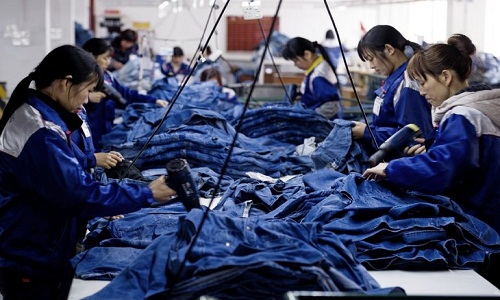 all major technologies currently in development were implemented, and worked with a university in Aachen, Germany, and the Digital Capability Center Aachen to calculate the cost savings in time and labor for producing a pair of jeans.
Based on their calculations, to produce the jeans in China with automation and import them into the US, the final cost ends up being around $11.40. But to produce them in Mexico with automation and import them into the US, the cost would be about $10, plus the assorted benefits of the shorter lead time, too.
Slow pace of growth
Experts agree these changes are happening but are likely to take a long time. China has built up a manufacturing infrastructure and capacity that other countries just can’t match. Some brands are already moving a share of production to nearby countries, but a large-scale shift might not be possible until those countries are able to build up factories to handle the workload.
The vast majority of this work currently happens in Asia, particularly in China, especially in the case of any specialised fabrics. Companies may assemble finished garments in Mexico or Turkey, but they buy and import all their materials from much further overseas. With shipping costs and duties rising, many Western brands are likely to keep their production in Asia.
A shift from China
Clothing and footwear brands are being pushed to look outside China and nearer to home for manufacturing. In a highly competitive market that’s splitting ever more into winners and losers, a fast, flexible supply chain is increasingly an advantage. It allows brands to respond better to the needs and wants of today’s demanding, internet-enabled shoppers, and that’s why brands including Nike, Adidas, Levi’s are changing the way they make their products—and investing in things like automation and moving production nearshore.
Ultimately, it’s not so much a question of whether garment production will move away from China and closer to Western markets, rather it will be how much of the supply chain will be rerouted, and when.