FW
US: PCE for clothing and footwear declines by 0.6 per cent
According to Bureau of Economic Analysis (BEA) figures, real personal consumption expenditures (PCE) for clothing and footwear declined to $2.62 billion in September, to $402.94 billion—a 0.6 per cent drop from August. Overall real PCE, which includes adjustment for inflation, rose by 0.3 percent in September, reflecting an increase of $33.5 billion in spending for goods and a $3.5 billion increase in spending for services. Within goods, motor vehicles and parts was the leading contributor to the increase, with strong contribution from recreational goods and vehicles.
Clothing and accessories stores, along with general merchandisers, posted small sales gains in September compared to the previous month, with weather and politics blamed for the stymied growth, the U.S. Census Bureau’s Monthly Retail Trade report showed earlier this month.
The BEA report showed personal income increased by $35.7 billion, or 0.2 percent, in September, while disposable personal income (DPI), an important barometer for retail spending, rose by $29.1 billion, or 0.2 percent. Real DPI increased 0.1 percent in September.
The PCE price index increased 0.1 per cent in the month, as the core index, which excludes the volatile food and energy sectors, was up 0.2 percent. BEA noted the increase in personal income in September primarily reflected increases in wages and salaries, government social benefits and rental income partially offset by a decrease in proprietors’ income. Personal outlays increased by $57.9 billion in September, while personal saving was $975.7 billion. The personal saving rate—personal saving as a percentage of disposable personal income—was 6.2 percent.
Indian apparel industry plagued by volatile prices, fabric-sourcing challenges
 Fabric sourcing, till a few years ago, was one of the most challenging tasks. But increasing options of fabric sourcing, advanced technologies and awareness about quality have improved the conditions for fabric sourcing; though some challenges still prevail and industry continues to struggle with those issues.
The procurement of synthetic fabrics or yarns is more of a concern than cotton yarn or fabric. There are some yarns or blends that are not available in India, like Cashmere in wool. Additionally the man-made fibre sector attracts a lot of duties which increases the costs of these fiber manufacturers. Local Indian producers then often quote high and unexplained prices. Import duties on fabrics, is another cause of concern as it increases the price of fabrics; especially linen and imported silk.
Need to control price volatility
Garment manufacturers using cotton fabric are almost helpless when it comes to price volatility as prices increase anytime  without any strong and valid reason.
Though in past 10 years, situation in sourcing of Indian fabric has improved, the main challenge of sourcing cotton and cotton blends yarn still exist like before. When prices of yarn increase, suppliers prefer to deliver it at current rate to gain extra profits though they are supposed to deliver it first to the buyer to whom he has already agreed upon earlier at lower prices. Such issues need to be addressed as they not only delay fabric development but also the overall efficiency of the business.
Low fabric quality a bane
As for quality, apart from good vendors, fair price, strong check, trial runs are being adopted by many apparel manufacturers. However, whenever there is a tilt towards cotton export, yarn manufacturers or suppliers increase prices without any reason. There is no way to control illogical price hiking. Some exporters see it as market dynamics and manage accordingly. Chinese or imported fabric quality is better. Most buyers approve Indian fabric as there is no other viable option and prices of Indian fabrics are a little lower. Therefore, Indian companies need to adopt similar advanced infrastructure like China.
AEPC organises the Fabric of Unity to commemorate the Indian Textiles Industry
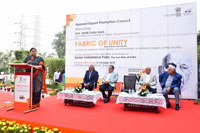 AEPC, to mark the unveiling of the ‘Statue of Unity’ in Gujarat on October 31, 2018, organised the ‘Fabric of Unity", an event to commemorate the Indian textiles industry. Smriti Zubin Irani, Union Minister of Textiles, Government of India graced the event attended by EC Members of AEPC, Officials from Ministry of Textiles and senior representatives from the textiles councils and associations, representatives from brands, ETI, ATDC students, NGOs working in this sector.
Integrating the entire industry
Incorporated in 1978, AEPC is the official body of apparel exporters in India that provides invaluable assistance to Indian exporters as well as importers/ international buyers who choose India as their preferred sourcing destination for garments. In recent years AEPC has worked tirelessly to integrate the entire industry - starting at the grass root level of training the workforce and supplying a steady stream of man power to the industry; identifying the best countries to source machinery and other infrastructure and brokering several path breaking deals for its members, and finally helping exporters to showcase their best at home fairs as well as be highly visible at international fairs the world over.
Speaking at the event HKL Magu, Chairman, AEPC said “Indian textiles have played an important role in the Indian freedom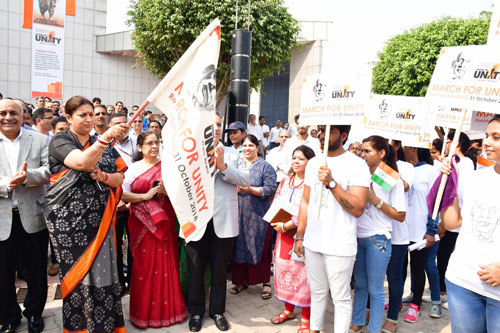 movement and what can be a better example of Unity in diversity than the Indian textile heritage. The Fabric of Unity is an event to celebrate this. This year happens to be AEPC's 40th year of service for promoting apparel exports around the world. We feel proud to be working on some very important initiatives to promote inclusion and sustainable apparel eco system. ”
Smriti Zubin Irani, Minister of Textiles said, “AEPC has organised this Fabric of Unity event in which industry, workers, and volunteers took the pledge to work for the betterment of the nation. In continuation to this spirit of the Unity Pledge - to contribute to the nation building as an unified entity, AEPC can take this concept of Fabric of Unity forward by showcasing the rich history of the diverse fabric and textiles traditions of India at AEPC premises. ”
Encouraging skilled workers into the organised sector
Irani revealed that Prime Minister, Narendra Modi has gifted a package of Rs. 6,000 crore especially to the textile and apparel council AEPC with a desire to encourage the skilled workers and people into organised sector. He also wished the Indian textile Industry to bring about newer heights in the world economy.
Irani hoped that AEPC will work hard towards achieving this target. She also requested to extend the concept of Fabric of 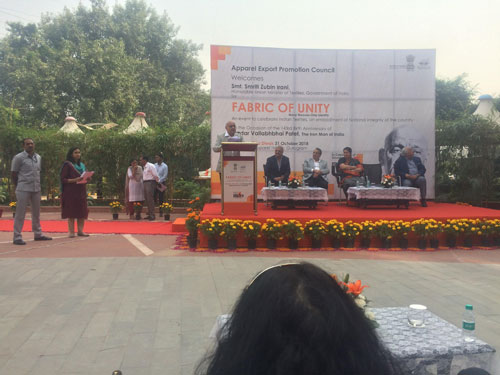 Unity to every office of AEPC and every member of AEPC, “only then can we bring Sardar Ballabh Bhai Patel’s dream come true. Patel formulated solutions one by one, weaving the warp and weft of unity on the axis of a single thread,” she said.
Intex to transform South Asia into a textile and garment powerhouse
"The 4th edition of Intex South Asia, to be held in Sri Lanka from November 14-16, 2018, is the biggest and only international textiles sourcing show that brings together the entire supply-chain and value-chain for the textiles and apparel industry under one networking platform. A show for yarns, apparel fabrics, denim fabrics, clothing accessories and allied services, Intex focuses on transforming the South Asia region into a textile and garment powerhouse."
 The 4th edition of Intex South Asia, to be held in Sri Lanka from November 14-16, 2018, is the biggest and only international textiles sourcing show that brings together the entire supply-chain and value-chain for the textiles and apparel industry under one networking platform. A show for yarns, apparel fabrics, denim fabrics, clothing accessories and allied services, Intex focuses on transforming the South Asia region into a textile and garment powerhouse.
Creating stronger ties under a single platform
Intex strengthens intra-regional trade, helping manufacturers and buyers take advantage of opportunities developing in the South Asia region by combining their strengths and joining hands to create stronger business ties under one trading platform.
Buyers from over 21 countries comprising India, Pakistan, Bangladesh, Nepal, Dubai, UK, Italy, Australia, Austria, Spain, Germany, Hong Kong, Taiwan, Malaysia, Uganda and Nigeria, etc, will converge in Colombo for Intex South Asia to create new and strengthen South Asian and international business ties.
Insights to move up the value chain
Intex’s seminars and business forums provide market insights to support the industry’s efforts to upgrade, move up the value chain, better understand intra-regional trade, leverage better FX practices and help manufacturers gain a competitive edge.
Showcasing textile innovations and trendy collections
In 2017, Intex South Asia presented a unique offering - ‘Fashion Fiesta’, an exclusive networking event along with a fashion extravaganza. Over 500 buyers and invitees from different regions and countries along with international exhibitors witnessed a fashion show which saw leading international Press Release Colombo, Sri Lanka companies like The Woolmark Co., Reliance Industries Ltd., Taiwan Textile Federation, Mekotex from Pakistan, etc. showcase their textile innovations and trendy collections.
A venue to tackle visitor influx
The 4th edition of Intex South Asia exhibition will be held at the premier exhibition venue of Sri Lanka – BMICH. With its state of the art facilities, halls, convention rooms and halls - the Bandaranaike Memorial International Hall is the preferred venue for trade exhibitions, conferences, award functions, business meetings, etc. With plenty of parking space available at the BMICH, the venue caters to any influx of dignitaries or visitors to any event or exhibition.
About the organiser
Incorporated in 2004, Worldex India Exhibition & Promotion Pvt. Ltd. is headquartered in Mumbai, the commercial and financial hub of India and has a branch office in New Delhi and network offices in China, and Thailand. Worldex India Exhibition & Promotion Pvt. Ltd. is a trade promotion organisation that markets, represents and organises trade shows, seminars, conferences, buyer seller meets and inbound & outbound trade missions in India South-east Asia and European markets, through close industry connects and support from leading Government Agencies, Export Councils, Chambers of Commerce, Federations and Trade Associations.
Titas underscores the primacy of need for ‘Global Smart Value Chain’
"Organised by the Ministry of Economic Affairs’ Bureau of Foreign Trade and the Taiwan Textile Federation from October 16-18, 2018 in Taipei, the 22nd Edition TITAS 2018 “Taipei Innovative Textile Application Show” focused on smart textiles, sustainable environmental protection, and functional applications. It attracted participation from 12 countries entailing a total of 456 exhibitors in 1,003 booths. Many distinguished local and international luminaries from the industrial, government, academic, and research sectors attended the opening ceremony of the show. "
 Organised by the Ministry of Economic Affairs’ Bureau of Foreign Trade and the Taiwan Textile Federation from October 16-18, 2018 in Taipei, the 22nd Edition TITAS 2018 “Taipei Innovative Textile Application Show” focused on smart textiles, sustainable environmental protection, and functional applications. It attracted participation from 12 countries entailing a total of 456 exhibitors in 1,003 booths.
Many distinguished local and international luminaries from the industrial, government, academic, and research sectors attended the opening ceremony of the show. The participation included the trade bodies/ associations/ support service institutes viz. Industrial Technology Research Institute, Taiwan Textile Research Institute, Southern Taiwan Textile Research Alliance, Taiwan Technical Textile Association & other 15 textile related associations representing various segments of Taiwan’s textile chain.
Insightful seminars and presentations
The show included a slew of activities such as insightful seminars, product presentations besides presentations on new fibers & technologies. The topics for these seminar included ‘The Evolution Tendency Of Smart Textiles’, ‘Japanese Functional Finishing Mark’, ‘ISKO Responsible Innovation Approach’, ZDHC & Functional Testing Of Textile Products & latest trend of innovative textiles to name a few.
In addition, around 1,000 one-on-one business meetings were held between show exhibitors and over 100 invited representatives from international brands/ retailers.
TTF in collaboration with the Taipei Sewing Machine Association (TSMA) presented the latest developments in smart manufacturing including automatic sewing machines & smart sewing systems and solutions.
Pavilion for smart textiles
Titas in its 22nd year of its edition underscored the primacy of need for ‘Global Smart Value Chain’ besides maintaining the core products of functional, sustainable side of the business. Therefore in order to offer a more comprehensive one-stop service to both exhibitors & attendees, in collaboration with Taipei Sewing Machine Association (TSMA), this year TTF has also invited TSMA members to present the latest development in smart manufacturing including automatic sewing machines and smart sewing systems & solutions.
Smart products on display
Up on the display were products and solutions like smart thermal clothes integrating temperature control and positioning functions, textiles with temperature control and warning feature, color measurement technology breaking through traditional thinking to detect miniscule color differences software based solutions adopting IT, AI and RFID technologies.Textile technologies combining isolated microcontrollers with yarns & fibers enhanced the applications of multi-functional textiles. LED arrays displayed clothes using ESTM (Embedded smart textile module) to present a new garment image marrying art and tech to the best of it.
State support for the event
Government support for the industry was indicated with the presence of Mei-Hua Wang, MOEA Deputy Minister who made a special appearance at the opening ceremony. Among other special guests who attended the show included Jang-Hwa Leu, Director General of Industrial Development Bureau, MOEA; Yung-Jan Chan, 2018 women’s Tennis Association world rankings number one player in women’s doubles alongwith her sister/ partner Hao-Ching Chan who was a gold medalist of women’s tennis competitions at the 2014 Asian games in Incheon; Douglas Hsu; Honorable Chairman, TTF and Cheng- Tien Chan, Chairman, TTF
International presence
Foreign interest in the exhibition was indicated with the presence of the Federation of Indian Chambers Of Commerce & Industry (FICCI) led a group of 10 exhibitors. A visiting delegation organised by VITAS, Vietnam attended TITAS to seek further co-operation with Taiwan’s textile enterprises, Southern Taiwan Textile Research Alliance
Battle to automate China’s domestic knitwear manufacturers
China’s domestic knitwear manufacturing industry is now ready for digitalisation and automation by way of complete garment knitting - also known as seam free knitting or Wholegarment knitting, or knit & wear - depending on who’s battle camp you are in.
This was one of the key messages presented by the world’s leading flat knitting machine builders at last week’s ITMA Asia + CITME, which was held at the National Exhibition and Convention Centre (NECC) in Shanghai. The show hosted over 1,600 exhibitors and was expected to attract around 100,000 visitors.
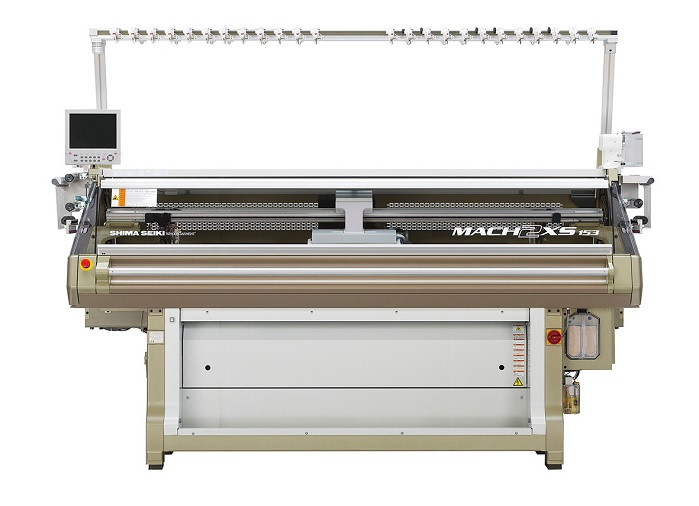
Shima Seiki’s flagship MACH2XS machine. © Knitting Industry
Until fairly recently China was at the beating heart of the world’s knitwear manufacturing and exporting industry with its huge labour pool and low labour costs. Now with rising labour costs and labour shortages that heart has slowed down a little. As a knitwear exporting country, it is still significant but is smaller than it once was, and a lot of production has moved to countries like Vietnam and the now booming Bangladesh.
The situation in China’s domestic manufacturing industry is quite different however, with consumers wielding real spending power with domestic fashion brands.
Japanese solution
In an interview with Knitting Industry in Shanghai last week, Ikuto Umeda, Director of Sales Headquarters at leading Japanese flat knitting machine builder Shima Seiki, explained: “With rising living standards and booming demand, China’s domestic needs in terms of knitwear and other apparel cannot be met conventionally. Production needs to change, and China has to deal with it. China has to adopt Industry 4.0.”
Shima Seiki’s solution is its Total Fashion System, a complete digital system which, the company says, maximises profits while achieving zero inventory loss, zero leftover stock, zero lost sales opportunity and most importantly zero waste through smart, speedy and sustainable production.
The automation part comes in the shape of the company’s WHOLEGARMENT knitting technology, a pioneering seam free knitting solution, which is now gaining real traction in the Chinese domestic market. Shima has been selling its flagship MACH2XS and MACH2S machines in significant numbers over the past three years, and a range of machines was on show in Shanghai.
German solution
The case for the digitalisation and automation of China’s domestic knitwear manufacturing industry was reinforced by Raymond Chu, Chairman of Chemtax Industrial Co. Ltd., representative in China for leading German flat knitting machine builder Stoll. “The competition has been selling its seam-free technology well in the China market in recent years and machines from the Chinese builders are getting better. Accordingly, we have reactivated our Stoll Knit & Wear programme and are introducing new models, such as our new ADF Knit & Wear machine.”
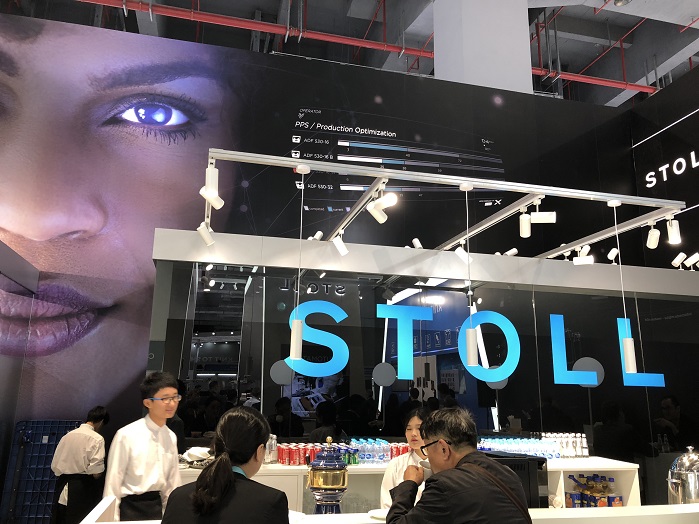
In Shanghai, Stoll exhibited the ADF 830-24 W knit & wear machine. © Knitting Industry
In Shanghai Stoll exhibited the ADF 830-24 W knit & wear machine, the first knit & wear model in the company’s new generation ADF range. The machine is currently available in knit & wear format in gauges E6.2 and E7.2 and will soon be available in gauge E9.2. Also, on show was a redesigned CMS 830 HP knit & wear machine in gauge E9.2.
Chinese puzzle
If further evidence was needed of the imminent digitalisation of China’s domestic knitwear manufacturing industry, then visitors needed to look no further then Chinese machine builder Cixing.
Cixing as a company recently split with a new player emerging in Beworth, a flat knitting machine builder which claims to employ 700 people and have an annual production capacity, just one and a half years after its incorporation. Accordingly, Cixing’s booth at ITMA Asia + CITME was not as large as at previous exhibitions but there was a big emphasis on its European Steiger brand, with Steiger technology occupying much of the booth.
At the entrance to the Cixing booth there was a cordoned off area housing six machines, which could only be entered by being accompanied by a designated Cixing staff member. Of the six machines, one was a Steiger JAUNS 3.130SC 14M fully-fashioned intarsia machine and the others were all Steiger KS3-72C-II models in a range of gauges – 7.2, 9.2, 10.2, 11.2 and 12.2.
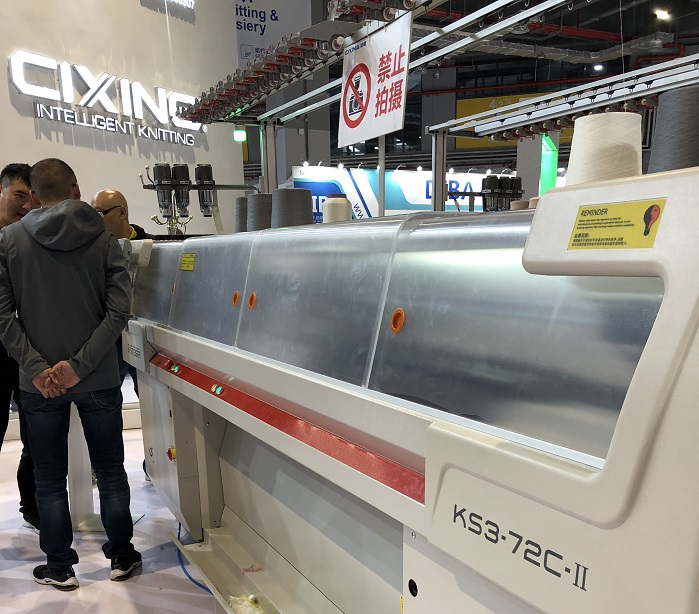
The KS3-72C is a brand-new range of complete garment knitting machines which Cixing staff and Cixing-Steiger product catalogues claim are actually four-needlebed machines. To date, only Japanese technology leader Shima Seiki has developed a four needlebed machine. According to Daniel Chen, a Regional Sales Manager at Cixing, who escorted me on a tour of the booth, the machines were definitely four needlebed machines with needles and selector jacks on all four needlebeds.
The normal clear Perspex safety covers on the machines were semi-opaque making it impossible to see inside the machines. However, when individual machines stopped for faults and the guards were opened, it was clear that the machines were v-bed machines with transfer type beds on top. Garments on display also showed that alternate needles knitting had been employed and not four needlebed knitting, as claimed by Cixing.
So, what was all the smoke and mirrors about? Well, it seems that Cixing has also sensed the imminent automation opportunity in the Chinese domestic market – no surprise there. But it appears it is not quite ready with its four-needlebed technology. This was a signal to its rivals and to China’s domestic manufacturers that it will be ready soon - rumours say that Cixing does have a four needlebed machine in development but that development is still at quite an early stage.
Shima Seiki started developing four needlebed knitting technology way back in the 80s and so its original patents have long expired. However, the Japanese company has innumerable patents around its digital knitting technology and advanced Wholegarment knitting techniques and is likely to defend these vigorously.
Whatever happens in the battle to automate, it is clear that China’s domestic manufacturers will adopt complete garment knitting solutions soon. However, this is likely to be a mix of advanced four needlebed technology and alternate needle v-bed machines – four needlebed offers the ultimate in complex seam free garments whilst v-bed alternate needle knitting offers more flexibility at a lower cost, allowing the user to switch between seam free production and conventional shaped knitwear production.
The lines have been drawn – now let battle commence.
Digital Textile Printing Conference 3.0 set for December
Research Triangle Park, N.C. – The Digital Textile Printing Conference 3.0 is scheduled for Dec. 5-6 at the
Sheraton Imperial Hotel in Durham, N.C.
A joint production of the American Association of Textile Colorists and Chemists (AATCC) and the Specialty Graphic Imaging Association (SGIA), the conference will offer presentations by experts which will cover the latest industry trends, the newest digital textile ink and printing technology developments, key market drivers, global market conditions, color management and workflow developments, design software, digital manufacturing and
integration, micro-factories and other topics.
Digital Printing
The sessions include:
“Digital Textile Print Renews an Industry,” by Mark Hanley, IT Strategies
“Designing for Digital Textile Printing,” by Debbie McKeegan, TexIntel
"Print on Demand: Exploring the Market Opportunities,” by Kristen Dettoni, Pattern Pod
“The Evolution of Customization,” by J. Flint Davis, WeaveUp, Inc.
“Embrace Your Digital Reality… A New Paradigm in Creating Digital Print Files,” by Kristen Ritter, Gerber Technology
“Integrated Color Management: The X-Factor of Digital Textiles,” by Duncan Ross, AVA CAD CAM Group Ltd.
“Print Clarity Test on Digitally Printed Textiles: A Quantitative Evaluation,” by Xingyu Li, Intertek
“Replication of Screen-Printing Fabric via Ink-jet Textile Printing,” by Ming Wang, North Carolina State University
“Adobe Insight: The Future of Workflow in Digital Textile Printing,” by Mike Scrutton, Adobe
“New Print Head Technologies: Breaking Down Barriers,” by Mike Raymond, Xaar
“Pigment Inks Explained,” by Wolf Reddig, EFI
“Bespoke Experiences Made Economical: The Pigment Pretreatment Process Evolution,” by Kelly Lawrence, Lubrizol
“The Taming of Pigment Inks: How to Gain Control over Print Quality by Using Primers,” by Helmuth Haas, CHT
“Building an Apparel Micro-Factory: Real Life Lessons,” by Bill Grier, AM4U
“First Sell, Then Produce: Enabling Sustainable Capsule Production,” by Sharon Donovich, Kornit
“Reaching Full Visibility in Digital Textile Manufacturing,” by Per Bringle, Exenta
“Building the Bridge for a Stronger U.S. Supply Chain,” by Will Duncan, SEAMS
“Digital Dye Sublimation Printing for Customized Warp Knit Advanced Flexible Composites,” by Mark Sunderland, Thomas Jefferson University
“Digital Pile and Carpet Printing: Possibilities and Limitation,” by Roland Zimmer and Thomas Kloebl, Zimmer Austria In addition to the presentations, the program will feature two panels. The Dec. 5 panel will focus on
“Brand/Color Management/Digital Workflow,” and the Dec. 6 panel will address “Micro-Factory/Automation.”
Roland DG Launches Ground-Breaking Texart RT-640M Multi-Function Dye-Sublimation Printer
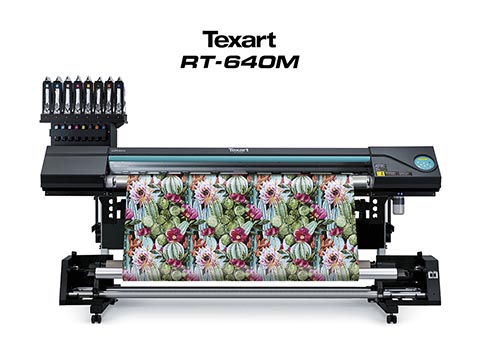
Clevedon – Responding to market demand for production flexibility in the digital textile print sector, Roland DG is excited to announce the launch of the multi-function Texart RT-640M, a ground-breaking digital dye-sublimation printer that enables direct-to-textile and indirect sublimation printing in a single, powerful device. From today the RT-640M is available across the EMEA region*.
The latest addition to Roland’s popular Texart dye-sublimation range, the RT-640M’s unique printing capabilities make it possible to print directly onto polyester-based fabrics** and onto dye-sublimation transfer paper, using the same ink and RIP. Delivering an unparalleled price to performance ratio, the RT-640M offers textile print suppliers a truly versatile digital dye-sublimation print solution.
Paul Willems, Head of Business Development and Product Management, Roland DG EMEA comments ‘Digital technology is ideally suited to today’s ‘print-on-demand’ and short-run production models and the RT-640M is the ultimate flexible digital textile print solution, enabling sign makers, sportswear manufacturers, fashion producers, interior décor suppliers and promotional goods companies to deliver agilely across a huge range of applications. Plus, its direct printing capabilities make it ideal for businesses that want to print double-sided items, such as flags and banners.’
The RT-640M makes it possible to print directly onto polyester fabrics for a huge range of applications (visual communication, fashion, sports and décor), as well as rigid items such as promotional objects, rigid boards, Chromaluxe®, ceramic tiles, stretch fabrics and more when printing on paper for indirect sublimation. The RT-640M can also be paired with a 3D vacuum oven to create sublimated 3D objects for promotional or industrial use. When printing directly to textile, the RT-640M is compatible with an impressive variety of single and double-sided polyester fabrics such as flag, mesh fabric, backlit, voile, block out and banners. A range of enhanced features ensure even tensioning and precise, accurate prints onto even the thinnest of materials.
Roland Texart ink, specially formulated for Texart sublimation devices, offers fast drying times and transfer rates, plus an exceptionally wide colour gamut which ranges from dense blacks to high intensity orange and violet, eye-catching fluorescents and soft pastel shades for vivid colours, smooth gradations and super-sharp images.
ErgoSoft Roland Edition 2 RIP software, included with the RT-640M, is widely regarded as the premier RIP software in the textile and dye-sublimation market and further accelerates productivity.
Paul Willems adds ‘The Texart RT-640M multi-function sublimation solution really is the first of its kind on the market and offers exceptional performance at an accessible price point. There is huge profit potential for savvy print suppliers in the growing digital textile print sector and the RT-640M is the ideal entry point system. At Roland, everything we do is intended to help our users explore both their creative and business potential and the RT-640M has been designed specifically to meet our users' requirements.’
To discover more about the Texart RT-640M multi-function dye-sublimation printer visit www.rolanddg.co.uk.
* Europe, Middle East, North Africa and India
** min.70% polyester and testing of exact media is recommended for best results
Apparel Manufacturing of the Future
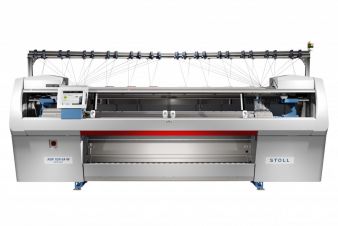 With 300 3D flatbed knitting machines, Stoll and Project I restore high-tech domestic manufacturing jobs
With 300 3D flatbed knitting machines, Stoll and Project I restore high-tech domestic manufacturing jobs with a full-scale, next generation facility that moves fully-fashioned knit production to the US and helps retailers meet demand.
Project I is an apparel manufacturing group started by fashion executives Jon Lewis and John Elmuccio with the goal of reshoring high-paying fashion jobs to the United States.
John Elmuccio
“We’re partnering to create the apparel manufacturing and supply chain facility of the future,” Elmuccio said. “The collaboration with Stoll will strengthen America’s fashion market, restore apparel production jobs using the latest technology, and revitalize the fully-fashioned knit sector.”
The driving force within the knitting industry
Between this new founded collaboration with Project I and the kick-off of the company’s 145th anniversary, Stoll consistently proves to be the driving force within the knitting industry.
Project I and Stoll’s advanced apparel manufacturing facility results in the largest single order of Stoll’s latest 3D knitting machinery and software solutions within the United States. This impactful collaboration will bring a revolutionary output of jobs and help position the US as a key player of the apparel manufacturing and supply chain market. “The apparel, fashion, and luxury markets are ripe for disruption and resurgence in the U.S.,” Lewis said. “By shortening the supply chain and locating production in the U.S., fashion brands and retailers will be able to keep pace with emerging trends and react to — not just anticipate — customer demand.”
The installation of these 300 high-tech flatbed knitting machines will happen throughout the next three years. Stoll will install the latest generation of ADF machines, which feature yarn carriers that are independent of the carriage and can move horizontally and vertically, and the latest CMS 830 C&S knit & wear (seamless knitting) machines.
Stoll will provide programming, training, manufacturing and on-site production support while guiding new and existing customers alike to Project I.
Saurer Epoca 7 pro innovative embroidery system sets new benchmark
 Saurer exhibited the Epoca 7 pro at ITMA Asia. The machine on display evoked great interest from all visitors. It was interesting to know from Mr. Simon Benzer of Saurer Embroidery that the machines on display was sold to Thailand based customer KS Perfection. Saurer is very encouraged by the positive response received at ITMA Asia this year.
Saurer Embroidery is a leading producer for shuttle embroidery systems. Extensive experience accumulated over many generations is combined with modern knowledge to help shape the future of textile production. This brand merges textile tradition with state-of-the-art technology in a symbiosis of expertise, quality and safety.
Based on more than 150 years of experience, Saurer Embroidery is the leading manufacturer of sophisticated embroidery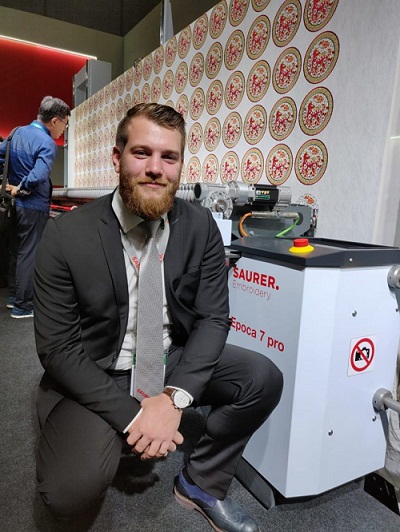 systems and provides to the embroidery industry innovative solutions from the embroidery sketch to the finished product.
The Epoca 7 pro is an innovative embroidery system setting a new benchmark. It offers an increase in productivity of up to 20% and embroidery speed of up to 700 rpm. With unique setting options and new technology features it ensures a trouble-free production of high quality embroidery.