FW
6th India International Silk Fair garners positive response
The three days long 6th India International Silk Fair (IISF) received a positive response. The over 100 exhibitors from across India got a good number of buyers. Organised by ISEPC, the fair was visited by over 145 buyers from across the world.
New and interesting products offered by some of the players were one of the reasons for the event to fetch more export orders. Socks, lingerie, undergarments, and umbrella made of Eri silk are a few of such products which witnessed increasing demand from overseas countries.
Apart from buyers interested in just silk, the event saw some other buyers who were interested in buying fabrics other than silk too who were flocking the stalls of exhibitors selling non-silk based products. L K Mishra, Janki Exports, Delhi and Ayan Sadh of Ayan Collection, Noida were some of the exhibitors in the fair who got good enquiries from the overseas buyers.
AAFA takes up a program against forced labor
The American Apparel & Footwear Association (AAFA) and the Fair Labor Association have drawn up a program aimed at fair treatment of workers in the global apparel, footwear, and travel goods supply chain. The commitment is a proactive industry effort to address potential forced labor risks for migrant workers in the global supply chain.
More than a hundred apparel and footwear companies have signed the commitment. Each signatory commits to working with its partners to create conditions where no worker pays for their job; where workers retain control of their travel documents and have full freedom of movement; and workers are informed of the basic terms of their employment before joining the workforce.
The signing companies have also agreed to work to implement these practices, to incorporate the commitment into their social compliance standards by December 31, 2019, and to periodically report the company’s actions through sustainability and/or modern slavery legal disclosures.
Through this commitment the American Apparel & Footwear Association aims to show customers that it takes the issue of forced labor seriously and is proactively working together as an industry to initiate measures to ensure these values are respected throughout the supply chain.
Creating a more transparent supply chain has long been a focus of the apparel and footwear industry and removing the possibility of forced labor is a major part of these efforts.
Pakistan seeks leather market in Japan
Pakistan wants Japan and Canada to allow duty free access for its leather garments. Currently Japanese importers of leather garments have to pay a high duty rate for the import of leather garments from Pakistan. Previously these importers and brands were using China as their manufacturing base and Pakistan was shipping finished leather to China for conversion to leather products like jackets. However, with the rise of costs in China Japanese importers have been trying for the last two years to find another production base.
Pakistan is well suited to make value added finished jackets for the Japanese market, but due to duty free access from Vietnam, it is cheaper for Japanese customers to source Pakistani finished leather and get the garments made in Vietnam. Although the FOB price offered by Pakistani exporters for the same product is more competitive import duty costs are cheaper for the Japanese importer when working through Vietnam.
Duty free access to the Japanese and Canadian market would mean Pakistan would be able to deliver more competitive and shorter lead time deliveries to them. A preferential trade agreement would make it easier for value added Pakistani products to enter the Japanese and Canadian markets.
Lycra to set up online aggregator to showcase products using Lycra fibers
Lycra will set up an online aggregator next April to showcase products of all the apparel brands that use Lycra fibers, with links to the various partner brands’ e-tail sites. The aggregator will include only Lycra-based products whose brands will have given their consent.
Lycra currently has a site accessible by the general public, Lycra.com, as well as a B2B site. The idea is to start off by combining them, so that its business can be understood more clearly from the outside. The aggregator will offer two advantages for Lycra. On one hand, it will highlight, for the general public and young consumers in particular, the huge variety of products and brands using Lycra fibres, while at the same time strengthening Lycra’s brand image. On the other, through the aggregator, Lycra will be able to handle first-hand the communication of its brand name to end-consumers, something which Lycra-using brands don’t always manage well.
This eagerness to put the Lycra brand centre-stage coincides with a change of ownership for the Lycra Corporation. The A&AT (Apparel & Advanced Textiles) division of Invista, which owns Lycra, has been involved in an acquisition bid by giant Chinese textile group Shandong Ruyi for nearly a year.
Intimate wear show in New Delhi next January
Intimasia will be held in New Delhi from January 21 and 22, 2019. This is a trade fair for intimate wear. It will feature some of the industry’s most creative, path breaking and sought after brands, delegates and visitors from the industry, design teams and symposiums and fashion shows.
Intimate wear is currently the fastest growing sector of the garment trade. The event will offer retailers a platform to expand their reach to both suppliers and national and international level buyers, widening the reach and potential growth of their brand. For intimate wear brands Intimasia will offer them the chance to showcase their product, check and scope out potential partnerships and network with both manufacturers and raw materials suppliers.
New Delhi is surrounded by six major states and connected to 86 prime cities. It is one of India’s fastest growing cities. This growth is anchored by sturdy policy, focus, favorable geographical location and fashion forward citizens, infrastructure, economic climate and business investment perception.
Delhi’s fashion forward nature is a catalyst for the high growth rate in intimate wear segment. Attractive real estate and booming tourism are also drivers of surplus cash flow, boosting per capita income and considerably increasing the consumption capacity of its inhabitants. All this clearly means a greater purchasing power than most other regions in the country, justifying the demand and consumption of designer intimate wear.
Hong Kong Polytechnic University develops intelligent fabric defect detection system
The Hong Kong Polytechnic University has developed an intelligent fabric defect detection system, called “WiseEye”, which leverages advanced technologies including artificial intelligence and deep learning in the process of quality control in the textile industry. The system effectively minimises the chance of producing substandard fabric by 90 per cent, substantially reducing loss and wastage in the production.
It helps to save manpower as well as enhance automation management in textile manufacturing. Supported by AI-based machine-vision technology, the novel WiseEye can be installed in a weaving machine to help fabric manufacturers to detect defects instantly in the production process. Through the automatic inspection system, the production line manager can easily detect the defects, thus helping them to identify the cause of the problems and fix them immediately.
WiseEye is developed by the Textile and Apparel Artificial Intelligence Research Team, which is spearheaded by Prof Calvin Wong, Cheng Yik Hung Professor in Fashion of Institute of Textiles and Clothing, PolyU.
Cambodia’s GMAC urges EU not to suspend trade preferences
The Garment Manufacturers Association in Cambodia (GMAC) has urged the European Union (EU) not to suspend trade preferences for Cambodia as these sanctions may have adverse impacts on the lives of workers and their families. The decision was made after EU notified Cambodia earlier this month that it had initiated the process for temporary withdrawal of its preferential trade treatment under the Everything but Arm (EBA) scheme for Cambodia, citing concerns over human rights and labor rights.
Around 1,000 garment and footwear factories in the kingdom directly employ about 700,000 workers with more than 85 percent being female coming from the rural provinces. It is estimated that another 2 million out of the country's total population economically depend on the sector. Every month, more than 150 million U.S. dollars is paid out as salary to these workers.
EU is an important trading partner for Cambodia, especially for the apparel and footwear sector; more than 46 percent of Cambodia's total exports of apparel and footwear is to the EU.
Fears of trade war snowballing
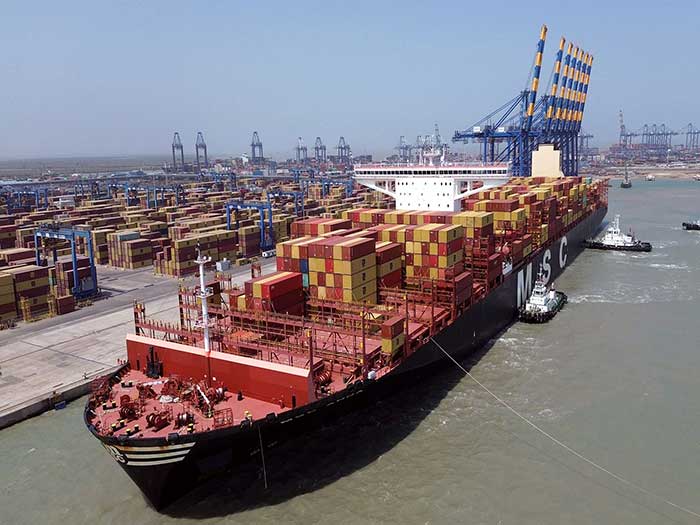
The trade war between the US and China has been likened to an approaching tsunami. American consumers would have to pay more, factories could be forced out of China or out of business, and the sophisticated supply chain China has built in recent decades could be broken.
As a link between the two countries, Hong Kong would feel the knock-on effect if the trade war means less cargo passing through the city’s ports. The US is seen as having overpushed the tariffs issue and stands to antagonise all parties, from consumers and US retailers to the whole supply chain. It is not clear what the US wants negotiations on – tariffs, the South China Sea issue, investment in Africa, intellectual property or technology transfers. The country has moved the goalposts in the political game with China from American joblessness to trade deficits and lately to currency manipulation.
America imports 41 per cent of clothing, 72 per cent of footwear and 84 per cent of accessories, such as bags, from China. China and the US have crossed swords since July when the first wave of tit-for-tat tariffs on goods kicked in. The US imposed its latest round of 10 per cent tariffs in September, on $200 billion worth of Chinese products – mostly food and consumer goods. The tariffs will jump to 25 per cent on January 1 next year.
Export challenges confront Bangladesh with dipping currencies
Bangladesh’s apparel manufacturers are facing tough competition due to a devaluation in the currencies of all emerging countries. The Indian rupee depreciated by 10.04 per cent against the dollar in the current year, while the Indonesian rupiah fell by 7.89 per cent and the Chinese yen depreciated by 4.85 per cent.
Readymade garment manufacturers in Bangladesh and exporters have called for a separate exchange rate for exporters, which would give a cushion to exporters as well as help the country enlarge its export volume. The country’s readymade garment sector has already lost its competitive edge in global markets due to a rise in production costs. A lot of money has been spent in improving safety standards to ensure a safe environment for workers. Also manufacturers have to implement the new wage structure from December.
Bangladesh’s overall exports grew 5.81 per cent in the fiscal year 2018 compared to fiscal year 2017. This has been mainly due to higher shipment of garment products. China is the largest apparel exporter to the globe with a 34.9 per cent market share. Bangladesh is the second largest exporter with a 6.5 per cent market share. Vietnam is the third largest with a 5.9 per cent market share. India is ranked fourth.
Sensil Innergy creates technical fabrics with beautiful drape
Sensil Innergy is a technical fabric that uses far-infrared technology to gently reflect the naturally emitted thermal energy back to the body, improving the oxygenation of muscles for peak performance during athletic activity and aiding post-workout recovery. Sensil is strong and resilient, yet soft and comfortable. It is for people who want to feel great while they push past their limits, whether they’re running in the desert or through the streets of a city.
Sensil is a premium nylon 6.6 brand from Israel-based manufacturer Nilit. Apparel and fabric designers have taken to Sensil. It was created based on extensive analysis of evolving consumer attitudes and rapidly shifting retail shopping trends and has rapidly elevated the quality standard for nylon 6.6. Sensil aims at representing Nilit’s new way of conveying the benefits of its premium nylon 6.6 products to the industry and to busy consumers looking for beautiful apparel that also meets their high expectations for value, performance, and quality.
Nilit is a manufacturer and marketer of nylon textile fibers. Sensil is naturally softer, stronger, more durable, and more moisture-wicking and odor-resistant than other man-made fibers. Sensil creates fabrics with beautiful drape and hand. Sensil performance yarns are enhanced to provide additional attributes that consumers require in today’s advanced fabrics.