FW
India: Low demand results in production cuts in Gujarat apparel factories
Garment manufacturers in Gujarat have cut production due to a reduction in demand. Usually, traders and retailers place orders two months before Diwali and garment manufacturers dispatch orders by Dusshera. But this year the pre-festival business has gone down by about 40 per cent on account of lower purchasing power, disturbed payment systems and weak exports.
Dubai is the leading buyer of readymade garments. But exports of readymade garments have fallen due to the value added tax in Dubai. GST and demonetisation have affected the payment cycle of the industry and because of this the overall business has gone down. There are over 5,000 garment manufacturers in Gujarat. Gujarat’s textile and garment exports have fallen by 30 per cent after the cut in incentives that came with the implementation of GST.
Export incentives for cotton and polyester have reduced roughly by four per cent. This makes products more expensive in the international market and reduces exporters’ competitiveness. Gujarat accounts for 12 per cent of all apparels exported from India. Sri Lanka and Middle Eastern countries are some of the key markets for garment manufacturers from Gujarat.
With a cut in duty drawback, there is stiff competition from the likes of Bangladesh and Vietnam, both of which get tax incentives in addition to export incentives. Besides, these countries are preferential importers for several global markets.
Fashion threatens global biodiversity
There is a lot of attention on the fashion industry’s impact on water and climate. But more focus needs to be given to the role it is playing in declining biodiversity. Fashion is having a devastating impact on ecosystems around the globe.
The extinction of fish species in the Aral Sea is linked to intense cotton farming in the region. Deforestation in Canada and Brazil for the cellulosic fiber market is destroying ecosystems which provide a home for a plethora of endangered species. Sumatran orangutans, tigers and Indus river dolphins have been pushed to brink of extinction by the actions of industries including fashion manufacturing.
The insatiable thirst for buying more clothes more often is putting the Earth’s most precious wild places at risk, pushing species towards extinction, destroying livelihoods and communities.
The link between unsustainable fashion and the loss of biodiversity is the last orangutan in a clear-cut forest. Whether it is pollution from farming cotton, plundering species such as eucalyptus for rayon fabrics, or the harvesting of wild animals for fur, the natural environment is being eroded and weakened.
Now is the time for businesses, including the fashion industry, to think seriously about how they can mitigate their impacts on biodiversity and contribute to global efforts to improve the status of biodiversity.
EFI launches innovations for digital textile production at ITMA Asia
Electronics For Imaging launched its latest innovations for digital textile production at ITMA Asia. These included EFI Reggiani Colors, a digital textile printer offering high-end production in up to 12 colours; the EFI Reggiani Terra solution featuring new pigment ink with binder for a greener, faster and competitive textile process; EFI Optitex® 2D/3D CAD design software; and the EFI Fiery® DesignPro software suite for print preparation and production.
With these products, designers, brands and manufacturers alike benefit from the ability to speed time to market and deliver stunning, digitally printed apparel, home textiles and more. The Reggiani Colors printer offers a unique imaging configuration especially important for customers seeking to establish a distinct competitive advantage. The printer runs at speeds up to 560 square meters per hour, delivering unmatched printing quality and uniformity with an extended colour gamut, superior colour depth and increased penetration into fabric.
The Reggiani Terra solution for direct-to-textile production eliminates the need for steaming or washing on direct-to-textile applications using a greener, more-efficient polymerisation process that takes place as printed textile goes through the printer’s on-board dryer.
The EFI Optitex® 2D/3D CAD design software delivers a faster, more customisable, user-friendly experience, saving time and resources with a faster time to market. It includes an all-in-one avatar solution that allows users to customize avatars, adjust morphs, create sizes and define poses to visualise a final draped result and enable accurate fit.
The new version 4 of EFI’s Fiery DesignPro software includes new and updated plug-ins that significantly reduce the time and effort needed to create repeat patterns and sophisticated colorways directly within Adobe® Photoshop®.
Global textile, apparel exports rise in first 8 months of 2018
Most countries recorded an increase in textile and apparel exports during the first eight months of 2018. China's textile exports during the period increased marginally up by 1.2 per cent while its apparel exports declined by 1.06 per cent. Vietnam’s textile and apparel exports increased 24.47 per cent. Its apparel exports grew by 27 per cent, while fabric exports increased by 34.31 per cent. Yarn exports were up by around 4 percent
Pakistan’s exports of most of textile product categories in August exports recorded a robust growth of 25.55 per cent over July. Its raw cotton exports shot up by 165.37 per cent, cotton fabric exports went up by 40.47 per cent, knitwear exports were up by 34 per cent and made-ups exports increased by over 50 per cent.
Sri Lankan apparel exports in August were 6 per cent higher than in January. March recorded the highest exports at $465 million. While in April, at $323 million, Sri Lanka's apparel exports were the lowest. However, India's textile and apparel exports in July were 5.82 per cent lower than in January. Exports of woven apparel till July declined 19.43 per cent.
Turkey's textile and clothing exports also went down by 5 per cent in August 2018, compared to exports in January 2018. Export growth has fluctuated wildly during these eight months.
CPTPP to take effect by early 2019
The Comprehensive and Progressive Trans-Pacific Partnership (CPTPP) may take effect early next year. The 11 member free trade pact in which Japan has a leading role was earlier known as the Trans-Pacific Partnership.
The accord will come into force 60 days after at least six countries have worked on their domestic procedures. So far, Japan, Mexico and Singapore have completed the process, with Australia, Canada and New Zealand seeking to do so by the end of the year. Brunei, Chile, Malaysia, Peru and Vietnam are also part of the pact.
After the US pulled out of the TPP in January 2017, the remaining eleven members signed the revised TPP in March this year. The UK, Colombia, Indonesia, South Korea, Taiwan, Thailand and South Korea are believed to be interested in joining the CPTPP. This agreement will focus on goods and will be different from a free trade agreement that is more comprehensive.
TPP was previously negotiated by the US with Japan, Canada, Mexico, Australia and seven other Pacific countries. It was touted at the time as an alternative framework to the World Trade Organization amid criticisms that the current trade enforcement regime was outdated and failed to address issues related to services, intellectual property and the digital economy properly.
PVH Corp receives US award for corporate excellence
Park PVH Corp, leading clothes manufacturer in Ethiopia’s Hawassa Industrial Estate received the 2018 US Secretary of State’s Award for Corporate Excellence (ACE). The company, one of the world’s largest apparel companies and owner of iconic brands, including Calvin Klein, Tommy Hilfiger, Van Heusen, Speedo, Warner’s and IZOD, has received recognition from the US Department of State for promoting corporate excellence
Hosted at the US State Department in Washington D.C., the ceremony honored the company for upholding high standards of responsible business conduct. PVH accepted the Sustainable Operations Award as lead investor of a best-in-class apparel manufacturing facility in Hawassa, Ethiopia.
India: CCI forced to wait for procurement as cotton prices rise above MSP
Cotton Corporation of India (CCI), which was gearing up for procurement operations from farmers may have to wait for a while as prices have gone above the Minimum Support Prices (MSP). Cotton prices are ruling at Rs 5,800 per quintal and have jumped up by nearly Rs 800 per quintal in last 10-12 days. The prices have shot up by nearly Rs 800 per quintal on reports of short supplies, the typhoon in the US that has hit the crop and China announcing a quota of nearly 48 lakh bales.
P Alli Rani, CMD, CCI pointed out that arrivals are weak, by about 50,000 to 60,000 bales a day. Moreover most of the cotton does not meet the FAQ parameters with more than 12 per cent moisture. Meanwhile, experts says traders are buying cotton at Rs 50 or Rs 100 more than MSP and once arrivals peak, prices are set to drop and then it will be difficult for them to buy at MSP.
Market sources pointed out that prices are up due to buying by mills, which are running out of stock amid lower-than-expected supply of the new crop in Maharashtra, Gujarat and Telangana.
Chinese shoes wreck Polish brands’ market
CCC is Poland’s largest footwear retailer, with a market share of about 20 per cent. It operates 1,160 outlets, with its network stretching across several European countries, including Germany, Russia, Austria and Hungary. The chain employs more than 12,000 people and sells nearly 40 million pairs of shoes a year.
But an oversupply of cheap, imported Chinese shoes has created something of a crisis in Poland's footwear industry. The country's manufacturers cannot compete with the significantly lower-priced Chinese shoes that are swamping the market. Although many consumers profess a distinct preference for Polish products, the sizeable price differential often all but obliges them to purchase far cheaper China-sourced alternatives.
A manufacturer of high-quality children's shoes shut its doors last month after 20 years of being in the business. Despite the disappearance of many domestic footwear manufacturers, a fair number of their associated brands have maintained a presence on the high street. This new lease of life granted them is largely down to a number of the country's major chain-store operators, including CCC, acquiring the rights to these discontinued brands and either switching production to one of the few remaining domestic footwear manufacturers or, more usually, outsourcing production to third-party operations in China.
Next edition of ATSM will be held in May 2019
Apparel Textile Sourcing Miami (ATSM) will be held from May 20 to 22, 2019. The event will host more than 300 international and domestic manufacturing companies exhibiting a wide range of products and process solutions in the field of manufacturing and sourcing services.
ATSM connects Southeastern United States, the Americas and the Caribbean to the production world of apparel, textile, and fashion. The apparel sector remains important to Florida’s international economy. In 2017, nearly $8 billion in apparel trade flowed through Florida ports and airports.
Top buyers from more than 40 countries are expected to attend ATSM 2019 to source, connect and develop lasting relationships with qualified international and domestic suppliers. The show will see participation from popular brands from across Asia in addition to a wide range of suppliers and products. These are all highly successful, leading apparel brands in China, looking for US partners to represent them in America and help grow their brands globally.
This is an unprecedented opportunity for buyers in the US and Latin America to source and negotiate licensing rights with these innovative brands. Conference and educational sessions will feature industry experts who will cover fashion trends, new technology applications such as AI and 3D printing, sourcing tips, sustainability, e-commerce strategy, international trade policy, marketing techniques and much more.
Strong need for skills development in the apparel industry
"Growing consumer needs are increasingly pressurising retailers and manufacturers to deliver products faster, cheaper through transparent and sustainable supply chains. Consequently, organisations across the apparel industry are facing a rapidly changing need for skills training and development of their workforce. Training, though happening within companies, is not enough to keep up with the lack of skilled workers. There is high dissatisfaction with the content and modes of training provided. Furthermore, the investment provided for the training is not adequate."
 Growing consumer needs are increasingly pressurising retailers and manufacturers to deliver products faster, cheaper through transparent and sustainable supply chains. Consequently, organisations across the apparel industry are facing a rapidly changing need for skills training and development of their workforce.
Training, though happening within companies, is not enough to keep up with the lack of skilled workers. There is high dissatisfaction with the content and modes of training provided. Furthermore, the investment provided for the training is not adequate.
Employees focus on career development
According to a recent survey, one of the biggest complaints from brands and vendors is that they have trouble hiring people with the right skills, with 62 per cent saying they are struggling to fill certain positions. Apparel businesses need to ensure that younger people see the apparel industry as an attractive place to focus their careers.
According to the 2018 LinkedIn Learning Workplace Learning Report, 94 per cent of employees would stay at a company longer if it invested in their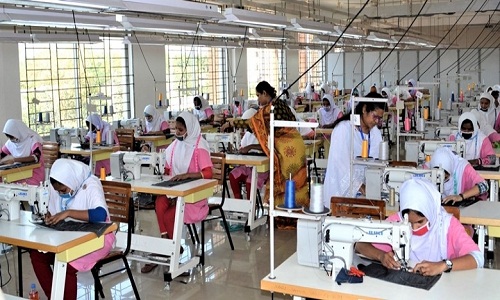 career development. Around 91 per cent of managers see training as important for the professional development of their employees, while 88 per cent viewed it as important for maintaining job satisfaction.
Only 16 per cent managers surveyed revealed their companies have undertaken skill assessments of their whole workforce. These companies have done skill assessments of their whole workforce employees. Around 49 per cent managers, and 50 per cent of others had taken some sort of company sponsored training over the past 12 months, while only one-third work for companies that use a Learning Management System,
Budget constraints impair employee training
Although there is an awareness of the need for more training, budgets aren’t matching this. Less than 30 per cent of those surveyed have seen their budgets increase in the last two years, and over 70 per cent think that more investment is required. Additionally, only 38 per cent see a planned increase in investment in training over the next two years. Many businesses hold back due to the lack of a clear method for measuring the effectiveness of training. This suggests that there is no consistent way of measuring the success of training, and thus no way to justify further investment.
Restoring old skills
Some functional areas require more ongoing training, with technical design and product development ranking the highest. This is followed by technical apparel making, quality control, production and process management, retail operations and visual merchandising ranked the lowest.
Brands are planning to increase on-shoring as they face new challenges around trade rules, currency fluctuations and speed to market. Additionally technology advances are lessening the number of workers. There is a pressing need to train new talent into local industry in order to restore what many view as dying skills. This is a particularly urgent challenge for specialised skills like bra-making, hosiery and pattern making.