FW
Implementation of new wage structure to shut down many RMG units
The Bangladesh Garment Manufacturers and Exporters Association (BGMEA) believes the implementation of new wage structure for apparel workers may lead to the closure of a number ofreadymade garment (RMG) units. On September 13, the Bangladesh government set Tk8,000 as the minimum monthly wage, with Tk4,100 as basic salary, for the country’s apparel workers. The new wage structure is set to become effective from December.
Without an increase in prices to go with the higher wages, this new wage structure could lead to the closure of a number of RMG businesses. From 2014-2018, about 1,200 RMG factories had to shut down their operations. The prices of Bangladeshi apparel goods had seen an 11.72 per cent fall in the US market, which is the single largest export destination for Bangladeshi goods. The BGMEA president also urged the trade unions and other stake holders not cause conflict regarding the new wage structure by spreading incomplete information.
IAF to host next convention in Pakistan
The annual convention of the International Apparel Forum (IAF) will be held in Pakistan next year. IAF is the only global federation representing apparel associations from 60 countries representing over 1,50,000 companies. The convention will gather apparel industry leaders from across the world and will be a unique opportunity for Pakistan’s apparel industry to learn new techniques.
IAF has been developed to deliver a unique forum for credit professionals from the international apparel sectors. The aim is to equip members with the practical strategies they need to meet the challenges of a changing business environment and add value to their roles. It provides a community for members to meet, network and learn.
It enables members to exchange experiences and views on issues of common interest, share practical ideas that members can implement in their own organizations, develop and promote best practices in the credit and risk management community. It facilitates improvement of knowledge and skills and keeping up to date with industry developments and connecting credit leaders and practitioners with each other and with industry experts. This is for the first time that a convention of the International Apparel Forum will be held in Pakistan. It will be held in the fourth quarter of 2019.
Albini creates traceable Supima cotton
Italian company Albini in partnership with Oritain has created the first 100 per cent traceable Supima organic cotton. Using forensic science, Oritain analyses the naturally-occurring chemical properties of the actual fiber itself, creating a unique chemical fingerprint for the product that links it back to the field in which it was grown – which cannot be altered, copied or adulterated.
Oritain can test the product at every stage of the supply chain to verify that the fabric is consistent with the original fingerprint and has not been substituted, blended or tampered with. Only an exact match shows that the product is authentic. Thanks to this procedure, each step is traceable and it is therefore possible to go back, from the finished fabric, precisely to the field in which the cotton was grown. The cotton will be used by French luxury brand Kering and is aimed at helping consumers understand the origins of the clothing they wear. The project will be using only organically grown Supima cotton that is woven and dyed by Albini.
Kering is focused on sustainable raw material sourcing. This innovative technology for its organic cotton supply chain will enable the company’s Materials Innovation Lab greater visibility to verify farming best practices and fiber quality and ensure integrity within the supply chain.
22nd Taipei, Innovative Textile Application Show showcases textile related technologies & services
"Federation of Indian Chambers of Commerce & Industry (FICCI) in partnership with the Department of Commerce, Ministry of Commerce & Industry, Government of India is organising the India Pavilion at the 22nd Taipei, Innovative Textile Application Show, that is being held from October 16-18, 2018. The pavilion is showcasing the best in textile accessories, textile related technologies & services. The pavilion is being headed by Vrittant Sharma, Research Associate & Trade Fair and FICCI."
 Federation of Indian Chambers of Commerce & Industry (FICCI) in partnership with the Department of Commerce, Ministry of Commerce & Industry, Government of India is organising the India Pavilion at the 22nd Taipei, Innovative Textile Application Show, that is being held from October 16-18, 2018.
The pavilion is showcasing the best in textile accessories, textile related technologies & services. The pavilion is being headed by Vrittant Sharma, Research Associate & Trade Fair and FICCI.
Key Indian exhibitors
The India pavilion hosts a meaningful exhibitor presence includes companies like Indorama industries, J.Korin Spinning, Dodha Synthetics, Paras Fashions, Kireet Apparels, etc.
One of the largest sources of employment generation
The Indian textiles industry, currently estimated at around US$ 120 billion, is expected to reach US$ 230 billion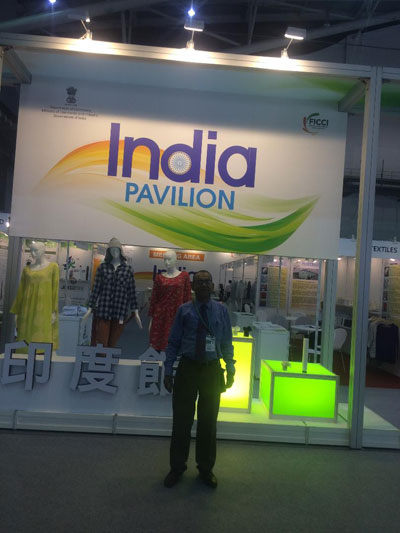 by 2020. The industry contributes approximately 4 per cent to India’s Gross Domestic Product (GDP), and 14 per cent to overall Index of Industrial Production (IIP).
With 45 million people employed directly, the textile sector is one of the largest sources of employment generation in the country. With 3,400 textile mills having installed capacity of more than 50 million spindles and 842,000 rotors, it is the second largest sector in the world
One of the largest contributors to exports
The textiles sector is also one of the largest contributors to India’s exports with approximately 15 per cent of total exports. The Indian textiles industry is extremely varied, with the hand-spun and hand-woven textiles sectors at one end of the spectrum, while the capital intensive sophisticated mills sector at the other end of the spectrum.
New styles, sustainability initiatives to boost global denim sales by 2023
"After going through a distressed period, the denim industry is now on an upswing. As a recent study by P&S Market Research indicates, global jeans sales reached $40 billion in 2016, and are expected to exceed $87 billion by 2023. Data from Edited suggests retailers have started to refocus on their denim assortments by planning new releases. They have so far stocked 42 per cent more denim products than the last year. As a result, both manufacturers and designers are betting on denims revival."
 After going through a distressed period, the denim industry is now on an upswing. As a recent study by P&S Market Research indicates, global jeans sales reached $40 billion in 2016, and are expected to exceed $87 billion by 2023. Data from Edited suggests retailers have started to refocus on their denim assortments by planning new releases. They have so far stocked 42 per cent more denim products than the last year. As a result, both manufacturers and designers are betting on denims revival.
Levi Strauss & Co in 2017 posted an 8 per cent growth owing to a significant revamp of its women’s jeans. This is the jeans maker’s strongest annual growth since 2011. Similarly, streetwear brands Off-White and Vetements garnered a lot of attention for the washes on their reworked denim and patchwork styles respectively, while mass-market labels such as American Eagle Outfitters set a record for volume last Fall, in an effort to lure teens into stores by providing a range of different silhouettes and washes, from ripped high-waisted ‘jeggings’ to indigo mom jeans.
Asia-pacific witnesses fastest growth
Driven by factors such as surge in digitisation within the apparel industry, advancement in new denim knitting technologies, growth in investment in clothing and increasing adoption of luxurious and casual garments from all segments of the society, has led to Asia-Pacific witnessing the fastest growth in denim sales.
Over dominance of comfort clothing over the past decade led to stagnancy in growth of the classic jeans. The segment did not witness any major innovations during this period. Short-lived trends such as cropped and frayed hemlines, flared bottoms and ’80s throwbacks did uplift the gloom for a brief period but could not bring back the reign enjoyed by the skinny jean style.
Meanwhile, for a brief period from 2015 to 2016, athleisure and comfort stretch street clothing overtook the denim industry but post this luxury and mass markets witnessed a huge upswing. To lower the cost of mass market, various denim manufacturers are experimenting with new materials, replacing cotton with nylon, polyester, aramid, and other spun thermoplastic variations.
Emergence of new denim styles
Driven by new trends and eager shoppers, the denim market soared through the early months of 2018. Skinny jeans represented 58 per cent of women’s jeans with other styles such as wide leg and flare bottom, frayed details, silhouettes such as cropped hems, culottes, mom jeans, and wide styles also gaining momentum
In addition to this, silhouettes such as cropped hems, culottes, wide leg and flare bottom styles, frayed details and black and white colors are the most in-demand denim styles today with brands like Madewell and Everlane refocusing their attention on them. Madewell, witnessed record sales both in stores and online last quarter, and continues to report double-digit increase in comparative store sales, thanks to its jeans category.
Sustainability initiatives in denim
With sustainability being the centre of conversation in fashion and apparel industry, Levi’s launched its F.L.X. technology– a laser-powered process that allows consumers to customise a unique distressed finish on their jeans. By giving consumers the opportunity to personalise their designs, laser distressing could be used as a means to create thousands of finishes currently being achieved through laborious traditional methods like sanding.
LA-based US garment sweatshops fined for non compliance
Garment contractors in the US have been fined for labor law violations. A worksite operating under the name of Pure Cotton had 57 employees. Most worked up to 65 hours a week for less than the minimum wage and without overtime. Few were covered by workers’ compensation insurance. Two workers, ages 15 and 16, were operating industrial sewing machines in violation of California’s child labor laws.
Four other garment manufacturing contractors were operating in the same building without licenses. Wage theft is endemic in the garment industry. In 2016, the US Department of Labor investigated 77 Los Angeles garment factories and found that workers were paid as little as four dollars and an average of seven dollars an hour for ten-hour days spent sewing clothes for retailers including Forever 21, Ross Dress for Less and TJ Maxx.
Up to 85 per cent of Los Angeles garment manufacturers violate California wage and hour laws. Although the contractors who make garments can be caught and fined, the brand-name retailers whose pricing structure incentivizes wage theft may escape legal liability. Further, enforcement priorities seem to focus on punishing wage theft rather than rehabilitating garment workers.
Garment workers who are not paid as required by law may file claims against the contractor who hired them, the manufacturers whose garments they produce, and sometimes the retailer.
Tough times for Egyptian cotton
Durable, fine and luxuriously soft, cotton sourced from Egypt has long been seen as the best on the market. But recent years have been far from smooth for the North African country's farmers.
Cotton was once Egypt’s main source of wealth in the 19th century, as the Nile Delta provided fertile grounds for the crop used to make the towels, sheets and robes coveted by Europe's bourgeoisie. But decades of fierce international competition have diminished returns. Profits are meager.
Short fiber cotton -- while lower quality than the long fiber variety -- looks good and has increasingly been used by textile giants, dealing a heavy blow to Egyptian players. The United States and Brazil are now the world’s top cotton exporters, followed by India and Australia, leaving Egypt trailing behind. The popular uprising in 2011 dealt a fresh blow to the cotton sector, as political and economic chaos hit production and export chains.
Last year brought producers some respite, thanks to rising prices and higher export volumes. But a trade spat between the US and China has seen benchmark global cotton prices fall afresh. The major challenge however is boosting productivity. A rise in productivity rather than prices would ensure better incomes for workers.
Centre sanctions Rs 43 crore to Meghalaya for textiles project
The centre has sanctioned Rs 43 crore to Meghalaya under the Integrated Sericulture Developement Project and Intensive Bivoltine Sericulture Development Project. It gave new seeds and taught people about new technologies to breed silkworm. As a result the production of mulberry, eri and muga in the state has increased to 1,000 metric tonne from 500 MT before 2014. Those who were producing one crop earlier are now producing three crops in a year.
Meghalaya will also get Rs 7.8 crore from the Centre for setting up a textile tourism complex in Nongpoh. The Ministry of State for Textiles will provide all infrastructure and machines to the centre to enable it to export local garments worldwide. The apparel centre will be linked with all fashion designers.
Sixth ITMA ASIA + CITME opens in Shanghai
The sixth ITMA ASIA + CITME 2018 exhibition opened in Shanghai with industry players focusing on technology’s impact on taking China’s textile industry forward into the future. The combined show is spread over 180,000 sq. mt exhibition space and has attracted a total of 1,733 exhibitors from 28 countries and economies to showcase a wide array of latest technology solutions that will help textile makers to become more competitive.
ITMA ASIA + CITME 2018 is owned by Cematex and its Chinese partners – the Sub-Council of Textile Industry, CCPIT (CCPIT-Tex), China Textile Machinery Association (CTMA) and China Exhibition Centre Group Corporation (CIEC). It is organised by Beijing Textile Machinery International Exhibition and co-organised by ITMA Services. The Japan Textile Machinery Association (JTMA) is a special partner of the show. China occupies over 68,000 sq. mt. net space at the exhibition. In Asia, Japan takes up over 3,500 sq. mt. net space while Taiwan occupies nearly 2,500 sq. mt. net.Among European participants, Germany takes the largest space of nearly 6,400 sq. mt. This is followed closely by Italy and Switzerland.
In product categories, spinning has the largest space, occupying 22 per cent of the total exhibit space. Finishing machinery forms the next biggest group at 20 per cent, followed by knitting (19 per cent) and weaving (17 per cent).
Karl Mayer launches a digital brand KM.ON
Karl Mayer has launched a brand for delivering digital solutions called KM.ON. KM.ON stands for digital driven innovation. This brand brings together the digital solutions portfolio of the Karl Mayer Digital Factory and the entire Karl Mayer Group. KM.ON’s digital portfolio of services will support customers in selected areas and is made up of eight solution categories. The platform of hardware and software can be installed easily and links the machines securely to the protected cloud.
Karl Mayer Digital Factory is a new digital start-up. This is a pioneering company operating alongside this innovative market leader. It employs a team of software specialists and technology experts in a new, creative environment away from the main company headquarters. With this corporate start-up, Karl Mayer has a software company at its disposal that can act quickly and be customer-oriented on the market.
Karl Mayer is systematically driving the topic of digitisation forward in order to seize the opportunities offered by the upheavals of today’s time. Another integral part of Karl Mayer’s digitisation strategy is its participation in Adamos, a strategic alliance of German global market leaders in machine construction.
Karl Mayer is expanding the offers of KM.ON. Other solutions and the expansion phases for existing products are already being planned e.g. in the areas of data analysis, condition monitoring and the digital machine logbook.