FW
Denim manifests in all forms at Texworld Denim and Texworld Paris
"With over 80 per cent of the visitors coming from outside France, Messe Frankfurt France’s trade shows remain the all- important event for the global fashion industries. These shows witness around 5 per cent visitors from Italy, 7 per cent from Russia and Canada, 16 per cent from Switzerland, 17 per cent from India, 15 per cent from South Korea, 14 per cent from Lebanon, 8 per cent from Argentina and Mauritius, 5 per cent from Colombia, 11 per cent from Tunisia."
 With over 80 per cent of the visitors coming from outside France, Messe Frankfurt France’s trade shows remain the all- important event for the global fashion industries. These shows witness around 5 per cent visitors from Italy, 7 per cent from Russia and Canada, 16 per cent from Switzerland, 17 per cent from India, 15 per cent from South Korea, 14 per cent from Lebanon, 8 per cent from Argentina and Mauritius, 5 per cent from Colombia, 11 per cent from Tunisia.
Gathering of world weavers, manufacturers
Texworld Denim and Texworld Paris featured over 1,058 exhibitors, the show dedicated to denim benefited from a steady stream of enthusiastic and attentive visitors. The show brought together weavers and denim manufacturers, from major countries such as China, Bangladesh, Pakistan, Turkey and India, as well as from Canada.
Never out of fashion, denim manifested in all its forms, with some suppliers making appreciable efforts in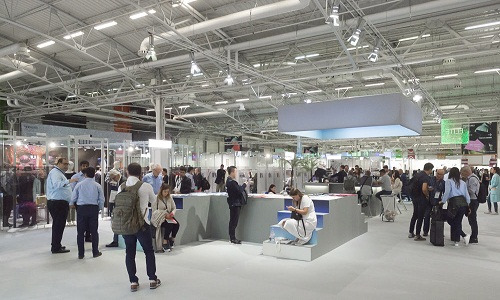 material, green manufacturing processes, while observing sustainable social standards. Pakistan exhibitor Master Textile Mills, for instance, prided itself on the environmental friendliness of its entire production chain, from the yarn to the trousers and jackets.
Texworld Denim remains firmly connected to its subject and the collections of fabrics or finished products on display were taken up by buyers, either as is, for replenishments or capsule collections, or as an excellent addition for the fashion collections that are in making.
Some major American denim labels were also spotted at the stands. Top Chinese operator Foison Apparel describes the attendance as ‘the best’, as did weavers Zhejiang Sansen Textile and their commercial director, Xiaodan Wu, who also added that the show was excellent with serious, specialist.
Benefits to professional buyers
Located at the intersection between Texworld and Apparel Sourcing, Texworld Denim Paris attracted a professional audience and thus benefited from visits by fabric buyers. The trends forum and corresponding catwalk show completed this sense of general satisfaction by presenting the best in skills and manufacturing capabilities from exhibitors. Texworld Denim Paris is in the process of introducing a different way of looking at denim. Next Texworld Denim Paris is scheduled for February 11-14, 2019, Paris Le Bourget
Modest fashion forges ahead with growing global demand
"Being publicly associated with Muslims, whether as designers, models, consumers or influencers was considered as a big taboo for the fashion industry; especially after 9/11 attacks on the United States. But now, a connection to Muslims is seen as an asset with global fashion brands, from luxury to high street, running promotions for Ramadan and Eid. In London especially, luxury retailers gear up for the "Harrods Hajj," a seasonal pre-Ramadan influx of affluent Gulf shoppers. Fashion brands even create a capsule collection from their existing ranges. A specialist infrastructure for the fashion-industry is growing globally with Muslim designers showcasing their work at the proliferating number of modest fashion weeks and fairs around the world."
 Being publicly associated with Muslims, whether as designers, models, consumers or influencers was considered as a big taboo for the fashion industry; especially after 9/11 attacks on the United States. But now, a connection to Muslims is seen as an asset with global fashion brands, from luxury to high street, running promotions for Ramadan and Eid. In London especially, luxury retailers gear up for the "Harrods Hajj," a seasonal pre-Ramadan influx of affluent Gulf shoppers. Fashion brands even create a capsule collection from their existing ranges. A specialist infrastructure for the fashion-industry is growing globally with Muslim designers showcasing their work at the proliferating number of modest fashion weeks and fairs around the world.
In mainstream luxury sector, online portal Net-a-Porter forged ahead with an Eid edition in 2015. Last year, new Dubai-based modest e-retailer The Modist persuaded high-end designers including London-based Mary Katrantzou, to produce exclusive modest designs. Use of fashion imagery has also changed. A decade ago, modest clothing brands and magazines avoided showing faces -- or the human form at all -- in deference to some interpretations of Islamic teaching. Today , Muslim models wearing the headscarf, or hijab, are regular features in star in ad campaigns and on the catwalk.
A religious touch to fashion
Visible religious diversity is a part of the industry's belated wake-up to its lack of ethnic and racial diversity, as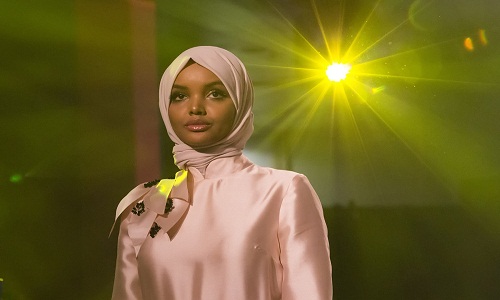 well as to body size and to gender and sexual identities. Now, religion is being added into the mix. For instance, cosmetics company CoverGirl, which once paved the way on racial and sexual diversity with brand ambassadors like Queen Latifah and Ellen DeGeneres, in January 2017, appointed American hijabi beauty blogger Nura Afia. Sephora, too, has showcased hijabis in cosmetics marketing for its Fall 2017 campaign. The diversity of the Muslim population offers a double win for brands seeking to make visible their commitment to all forms of social diversity.
This rising affinity towards the muslim community has led to not only more people belonging to the religion entering the fashion industry, but also established names being more out about their Muslim heritage. Supermodel sisters Gigi and Bella Hadid have associated themselves publicly with Islamic causes. Bella has openly identified herself as Muslim and spoken of their Palestinian father's encouragement that they should be proud of their dual heritage. Gigi has shared on social media her cultural participation in Muslim festivals such as Eid with her then-boyfriend, Zayn Malik.
Emergence of the global Muslim consumer
With "home-grown" designers from within the Muslim community now entering the mainstream market; competition from global brands – be it Dolce & Gabbana's abayas or Nike's Pro Hijab – has become more marked as stakes have become higher. A global modest fashion infrastructure of competing modest fashion weeks, fairs, and expos has grown out of what were once low-key, community-run gatherings. This transition from avoiding Muslim consumers to wooing them has been fostered by professional marketers who have identified Muslims as a global consumer segment.
In early 2018, British retailer Marks & Spencer (M&S) decided to include "modest outfits" as an online search category and received quite a few negative responses. When M&S started to sell burkinis two years before, the controversy was about the garment. This time, the garments -- selected from existing lines -- were not the problem: it was the terminology.
Driven by search engine optimisation, rather than religious ideology lots of women commenters welcomed longer sleeves or higher necklines as suitable for occupation or age. M&S also confirmed that "'modest fashion' is an increasingly popular search term." As mainstream fashion brands continue to chase Muslim consumers, the market mature brands will need to listen to marketing experts who advise them to think internationally but act locally.
India sees huge potential to increase textile exports to Mexico
Mexico is a major market for apparel, man-made and cotton textiles. However, India’s share in is only 3 per cent. Owing to availability of raw material and infrastructure, Indian firms have a potential to increase their market share in all the categories. Over the last five years, Mexico’s total textile and apparel exports declined at a CAGR of -2 per cent to touch $6.43 billion in 2017, while imports increased at a CAGR of 1 per cent to reach $10.2 billion. It remained the 18th largest importer of textile and apparel products globally, and its textile and apparel trade deficit was $3.79 billion in 2017.
Man-made textile is the largest imported category in Mexico, representing 38 per cent of its total textile and apparel imports (2017). This is followed by apparel and cotton textiles with a share of 33 per cent and 12 per cent respectively. India was the third largest supplier of textile and apparel products to Mexico in 2017. Its exports of T&A to Mexico stood at $0.32 billion in 2017. In fact, India’s exports witnessed an increase of 2 per cent over the last five years.
Pakistan: APTMA to reopen 100 mills in Punjab
All Pakistan Textile Mills Association (APTMA) plans to reopen a hundred former mills in Punjab. The decision was borne out of the promised Rs 44 billion subsidy for exporters assured by Finance Minister Asad Umar in his supplementary budget speech.
The subsidy will be derived from a massive regulatory hike in gas prices which has raised the price by 40 per cent from Rs.600 per million British thermal unit (mmBtu) to Rs 780 mmBtu for commercial consumers. The plan to create a new category for those industrial consumers who are registered manufacturers or exporters of one of five zero-rated sectors is to charge them the unchanged rate of Rs.600 per unit.
These five export sectors would be textiles including jute, leather goods, carpets, surgical tools, and sports goods business which the government of Pakistan intends to capitalise on by offering them internationally competitive gas rates.
India: Seed companies asked to pay up in Maharashtra
Maharashtra has sent notices to nearly 60 cotton seed companies seeking a compensation of Rs 1,050 crores for losses incurred by farmers owing to sub-standard seeds that were prone to pest attack. A total of 14 lakh farmers applied to the state seeking compensation from the companies, of which hearing in nearly 10 lakh cases have been completed.
Last year, farmers across Maharashtra reported large areas under cotton affected by pink bollworm, a major cotton pest. Following the pest attack, the government adopted three ways to provide compensation to farmers: through crop insurance, by seeking compensation under the national disaster relief fund and also by making seed companies a part of the process.
Cotton farmers in the state are facing a crisis. Large-scale use of genetically modified or Bt cotton seeds that are failing to keep pests at bay is one of the main reasons for the crisis. This issue gains further significance as in Maharashtra nearly 96 per cent of the cotton crop cultivated in the state is by using Bt seeds. The use of an illegal variety of Bt seeds, herbicide tolerant seeds, has some part to play in the crisis. Seed companies have a month to reply to the notice. However they can move court against the order.
Three international organisations to invest in Myanmar’s textile industry
Three international organisations will invest over $750,000 in Myanmar’s textile industry over the next two years. These include: Myanmar Artisans, a social enterprise, Turquoise Mountain, a non-government international organisation and DaNa Facility, which is under the UK Department for International Development.
The Myanmar Artisans Project will initially be carried out in Kachin, Chin and Shan states and later expanded to the other states and regions. The aim of the project is to improve and preserve the local textile market and improve the global market share of Myanmar-made products. The project will include training and better market connections for local weavers so they are able to reach value-added markets and increase their family incomes.
Turquoise Mountain has worked in Myanmar from the end of 2014 with an aim to preserve Yangon’s landmark urban heritages and re-create the traditional craft industry. It expects to make a huge socioeconomic impact in Myanmar by supporting vocational schools and preserving historic heritage.
PT Superbtex installs flaw detector to contain contamination in polyester
The raw material for spinning synthetic fibers originates from well-controlled processes in chemical plants. This is why contamination with foreign matter occurs very rarely. However, synthetic yarns like polyester can have different fiber qualities with different glossiness. Mixed-up yarns can lead to defects in the following processes along the production chain. The visual inspection of these costly errors is still very time- and labor-intensive.
Indonesia-based textile company PT Superbtex has a simple and efficient solution to overcome this issue. It has installed the yarn clearer YarnMaster ZENIT+ with the OffColor feature. The new functionality has been developed for the detection and elimination of very small color and shade variations in mélange yarns..
Founded in 1974, PT operates four facilities and produces polyester yarns. The company is trying to improve processes along the value chain and in order to reach a better profitability the focus is on optimal quality and higher efficiency. The major portion of the production is delivered to the local market for both weaving and knitting applications, while some 15 per cent of the production is exported.
It uses different polyester fibers in its spinning mill. Dull, semi-dull, bright, and super-bright are the typical fiber qualities used and all of these have a different glossiness.
Philippines, US to announce free trade negotiations in November
The US and the Philippines plan to announce the start of a free trade negotiations by next month as the two allies look to bolster their economic relationship amid uncertainty over security ties. Once completed, the free trade agreement will be the US' second in Southeast Asia after the one with Singapore.
The move towards starting talks comes after both resolved issues around a Trade and Investment Framework Agreement, including those related to e-commerce. The talks, which could last one to three years, are part of President Donald Trump's strategy to pursue bilateral rather than multilateral trade agreements to let Washington secure the best possible deal.
The US ranks among the Philippines' major trading partners. In 2017, bilateral trade totaled around $20 billion, with the US registering a $3.2 billion trade deficit, according to the Census Bureau. The Trump administration has been tough in trade negotiations, but Lopez is upbeat on a win-win deal. For the Philippines, a free trade agreement with the US would upgrade the current Generalised System of Preferences scheme wherein the U.S. reviews zero-tariff privileges given to more than 3,000 Philippine products every three years.
Pakistan to implement environmental laws in knitwear, garment units
Pakistan textile industry has received technical support from the Punjab Environment Protection Department to implement environmental laws in the factories set up by knitwear and garment manufacturers and exporters. The entrepreneurs have chalked out a detailed plan of action to ensure total compliance with national and international standards. The time frame to bring about total compliance has been set at one year.
The move to complete compliance process was confirmed by the Environment Secretary Zafar Nasrullah. He said the department is actively giving technical support and mentoring to industry members to adopt technically sound and cost effective solutions facilitating green entrepreneurial processes.
The compliance initiative will also receive adequate support in terms of soft loans from banks and financial institutions. The department is also prepared to create linkage with financial institutions and banks to provide soft loans to the industry.
India’s Nitin Spinners revenue up 22 per cent
Nitin Spinners’ revenue has grown 22.70 per cent over the previous year. With an installed capacity of 2,23,056 spindles and 2,936 rotors it produces 50,000 tons of yarn in a year. To move up the value chain, the company has also established a knit fabric division with 63 knitting machines, with an installed production capacity of 9,000 tons of fabric a year.
Nitin exports around 64 per cent of its production to over 50 countries globally. Based in Rajasthan, Nitin a leading player in the textile industry, manufactures 100 per cent cotton yarn and knitted fabrics by using the latest ultra-modern technology. As a part of strategic initiatives, the company plans to foray into the finished fabric segment to meet the rising demand in the apparel industry.
The plan is to invest in a greenfield integrated textile complex with cotton/blended spinning facilities. This complex will have facilities for weaving, dyeing, finishing and printing of woven and knitted fabrics.
Nitin Spinners makes cotton yarn in single, multifold slub, compact, core spun and Elitwist yarns. The products are widely used in manufacturing apparel and garments, inner wear, terry towels, woven fabrics, home furnishings, carpets, denim, industrial textiles, medical textiles, mattress ticking and socks, among others.