FW
Cotton Connect works toward increasing organic cotton use
Volcom is working with Cotton Connect on a program to increase the supply of organic cotton. The program forecasts by improving wages and living standards of farmers growing organic cotton, it will increase organic cotton harvests and safeguard the world’s environment. Action-sports brand Volcom, based in the US, is a part of Kering, a France-based luxury conglomerate. Kering is also the parent company of Gucci, Yves Saint Laurent and Alexander McQueen.
Cotton Connect, based in the UK, works on building sustainable supply chains, teaching sustainable agriculture practices and developing skills of women in countries where organic supply chains start. The program will also guarantee that yarn labeled and sold as organic cotton is indeed organic cotton. Certifying cotton as organic can occasionally be a murky process. This project makes it possible for a company to seek traceability in a supply chain, which was said to be impossible.
The program also offers a year long organic-farming-skills program for farmers that includes working to develop natural pest controls and organic fertilizers. The program also offers sessions on women’s rights and life skills. It embodies both environmental and social benefits. The program opened in 2017 in Madhya Pradesh and produced nearly 27 metric tons of organic cotton.
Arvind to adopt sustainable dyeing technologies in its units across India
Textile major Arvind is keen on introducing DyeCoo’s CO2-dyeing technology at its manufacturing plants across India. This eliminates the need for water and chemical dyes and is environmental free. DyeCoo, a Dutch company, is looking to partner leading textile firms in India.
If all goes well, Arvind will be the first company in India to introduce sustainable technology in the manufacturing of textiles in India. Arvind is in the process of ramping up textile production across its manufacturing units as it plans to double its textile business in the next five years. The company has earmarked an investment of Rs 500 crores every year for the next five years to expand its textile business.
Arvind has an annual production capacity of more than 100 million meters in denim, 132 million meters in woven fabric, 10,000 tons of knit fabric and 48,000 meters of voile. The group has built a strong portfolio of brands that straddles consumer segments across the income pyramid.
The company is also looking at developing garment clusters in Jharkhand, Andhra Pradesh and Gujarat. Each of these clusters will employ 4000 to 8000 workers. These clusters will be like a global supply chain. Arvind already has a cluster operational in Ethiopia.
Over 13,000 buyers flock Hong Kong Fashion Week Fall/Winter
"Among the markets outside Hong Kong, this edition of the Fashion Week saw the highest buyer attendance from Mainland China, Indonesia and the US, showing that the sourcing sentiment in both mature and emerging markets has remained unaffected. Among emerging markets, buyer attendance from Russia recorded an increase. The results also highlight that despite economic uncertainties, global buyers still value Hong Kong's position as an unrivalled sourcing hub for global fashion traders and retailers."
 Organised by the Hong Kong Trade Development Council (HKTDC), the 50th edition of HKTDC Hong Kong Fashion Week for Fall/Winter wrapped up at the Hong Kong Convention and Exhibition Centre (HKCEC). The four-day fair was held from January 14 to 17, 2019 and attracted nearly 13,000 buyers from 78 countries and regions.
Among the markets outside Hong Kong, this edition of the Fashion Week saw the highest buyer attendance from Mainland China, Indonesia and the US, showing that the sourcing sentiment in both mature and emerging markets has remained unaffected. Among emerging markets, buyer attendance from Russia recorded an increase. The results also highlight that despite economic uncertainties, global buyers still value Hong Kong's position as an unrivalled sourcing hub for global fashion traders and retailers.
Informative seminars and presentations attract new, old buyers
Information-sharing events during the Fashion Week included: "The Visionary Fashion Trends for Spring/Summer 2020" presentation by leading international fashion forecaster Fashion Snoops, as well as seminars exploring issues such as sustainable development in the fashion industry, the cotton market outlook and the latest cotton textile technologies.
Industry players from emerging markets showed enthusiasm for Fashion Week, including Urszula Tomaszewska-Kislo from Poland who visited the event for the first times. She operates 30 shops in Poland together with an online store selling clothing under her own brand. The show deepened the Polish buyer’s understanding of current fashion trends and provided it a good platform for sourcing high-quality goods. The brand not only found four potential clothing suppliers and garments but also placed an onsite order for $10,000 worth of women's sweaters offered by a supplier from Mainland China.
Cloud-based Job Order System to deal with costs, stock issues
The fashion industry needs to deal with challenges arising from rising costs and smaller orders. iGarment (Hong Kong)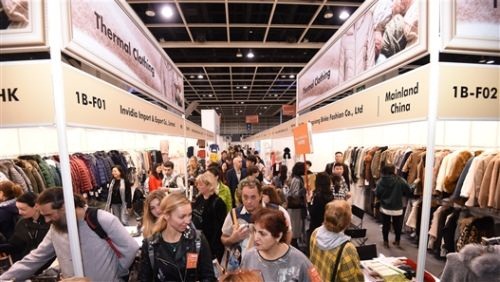 addresses these issues through the development of an innovative cloud-based garment production coordination system. Participating in the Fashion Week for Fall/Winter for the first time this year, the brand showcased its iGarment cloud-based Job Order System that covers everything from sample development to production progress and shipping.
Factory visit for practical experience
During the first two days of the fair, iGarment met more than 100 buyers, exhibitors and designers from Hong Kong, Mainland China and Southeast Asia. To understand their needs, the company arranged visits to those factories that have adopted its system. Due to the overwhelming response from buyers, iGarment has already decided to return to the fair next year.
Contest for local designers invites applications
Since 1977, The HKTDC has been organising the Hong Kong Young Fashion Designers' Contest (YDC) to unearth talented local designers. This year's competition will be held during CENTRESTAGE in September, and is now open for application.
Egypt emerges a major sourcing hub, Ethiopia to follow
"Rising labor costs in East Asia and tax-free access to the US market is encouraging Asian textile and garment manufacturers and Western buyers to turn to Egypt. China is planning to move 20 per cent of its production to Egypt either by setting up shop, through mergers or full acquisitions of local companies. The US-China trade war is also pushing Chinese manufacturers to look for new hubs to avoid potential tariffs of 25 percent into the US."
 Rising labor costs in East Asia and tax-free access to the US market is encouraging Asian textile and garment manufacturers and Western buyers to turn to Egypt. China is planning to move 20 per cent of its production to Egypt either by setting up shop, through mergers or full acquisitions of local companies. The US-China trade war is also pushing Chinese manufacturers to look for new hubs to avoid potential tariffs of 25 percent into the US.
QIZ enables duty-free export of garments to Egypt
The Qualifying Industrial Zones (QIZ) program allows Egyptian manufacturers to export garments to the US duty-free, if at least 10.5 percent of raw materials used in the garment are Israeli. As the Readymade Garment Export Council of Egypt notes, these zones, established by the US Congress in 1996, have generated over $8.6bn in exports since 2004.
The scheme has also raised concerns among Egyptians who reject normalisation of relations with Israel and specifically 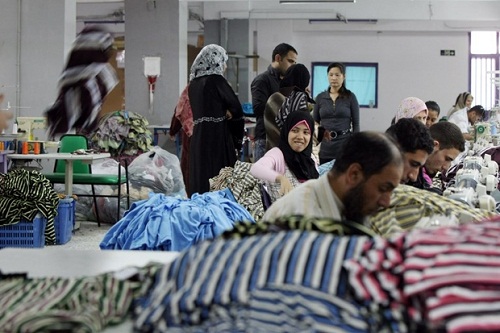 protested against QIZs during the 2011 uprisings. Last year, exports from the QIZs were worth $752.7 million while in the first half of 2018, exports to the US grew by 25 per cent, according to QIZ Egypt figures. QIZ exports account for 46.7 percent of Egypt’s total exports to the US.
Egypt wants to bolster the current garment and textile exports, roughly split between the EU and US, to $10 billion by 2025. If this figure is achieved, around $5 billion or more would be destined for the US, significantly increasing the amount Israel will net through the QIZ agreement. Chinese firms will also benefit from the QIZ agreement, and directly bolster Israeli exports. Such an uptick in exports is considered probable given the historical trajectory of other garment manufacturers to reach over $5bn in annual exports.
A major sourcing hub for Chinese companies
China has invested around $6 billion in Egypt over the past four years, while $18 billion in deals were signed with Chinese companies during President Abdel Fattah al-Sisi’s visit to Beijing in September, including railway, real estate and energy projects. Chinese businessmen see Egypt as a major sourcing hub for Chinese companies as they expect up to 50 per cent of Chinese production to relocate.
On its part, to attract foreign investment, Egypt has established a new industrial city in New Suez, slated to open at the end of the year, and allocated 1.2 million sq. mt. of land in the industrial zone of El Minya in Upper Egypt. Foreign companies can employ up to 25 per cent non-Egyptian workers.
Egyptian companies may feel the squeeze by Ethiopia
A particular growth driver of Egypt’s garment exports is the expansion of Hong Kong-based Li & Fung, the world's leading supply chain solutions partner which connects buyers, retailers and suppliers for consumer brands and retailers, in the country.
Currently, out of the $16 billion in volume and five billion pieces of clothing that Li & Fung sourced globally last year, just $30 million – or 1.62 million pieces - were from Egypt. By 2019, Li & Fung wants to double that figure, and by 2022 aims to source $90m from Egypt.
Yet while Egypt offers favorable investment terms to foreign companies - Turkish and South Korean firms are already established at QIZs– Egyptian companies may feel the squeeze in future as Ethiopia offers free land and low wages and electricity. Besides, the country also has an FTA with the USA.
US hopes for a steady trade agreement with EU
The US wants its trade agreement with the EU to develop rules of origin that ensure that preferential benefits go to products genuinely made in the United States and the EU. Apart from wanting a comprehensive duty free treatment for textiles and apparel products, the US wants rules of origin to incentivize production in the US and EU and establish origin procedures that streamline the certification and verification of rules of origin and that promote strong enforcement, including with respect to textiles.
In customs and trade facilitation, the US aims at building mechanisms to ensure shipments are released quickly after determining compliance with applicable laws and regulations. In addition, objectives in this area include providing for streamlined and expedited customs treatment for express delivery shipments, simplified customs procedures for low-value goods and a more reciprocal de minimis shipment value–the minimum value for goods that can enter the country duty-free–all generally aimed at promoting cross-border e-commerce.
The US also wants to create a mechanism to take appropriate action if the EU negotiates a free trade agreement with a non-market country, such as China. Additionally, the US wants to strengthen existing procedures and create new ones to address antidumping and countervailing duty evasion.
Pure Origin London to launch own catwalk
Fashion festival Pure London, Pure Origin will launch its own forward trends catwalk showcasing key looks, innovations and materials for AW21/SS22. Pure Origin will be held from February 10 to 12, 2019. This is a manufacturing and supply chain expo. Major players in the industry will showcase new technologies and emerging trends that will shape the future of fashion and help businesses to stay ahead of the curve in today’s fast-changing retail landscape. Offering a visual platform, the catwalk will showcase the latest trends for sourcing, sustainability and manufacturing including fabric, raw materials, apparel, footwear and accessories.
As a convenient and cost-effective way for buyers to meet with UK and international manufacturers, Pure Origin brings together over 200 exhibitors from 13 countries to create a wide range of business and networking opportunities, new thinking and innovation. Garment and fabric suppliers, denim and textile designers and technology brands attract buyers, sourcing, and technical personnel. With its own seminar stage, Pure Origin features speakers and leading change-makers debating the future and how to make it sustainable and circular. The biggest challenges in garment sourcing, from the integration between sustainability and speed-to-market, supply chain transparency, fabric and technological innovation, will be addressed.
Pakistan’s textiles sector fails to meet targets for 2014-19
Pakistan’s textile policy for 2014-19 has failed to achieve its targets. The main reasons are: a financial crunch for different schemes under the policy and non-availability of energy at competitive prices.
Exports of textile products were expected to increase beyond 10 per cent. Instead exports further declined during this period. One main export impediment is the levy of customs duty on import of cotton. During the policy implementation period, the energy cost was made almost double and resultantly several mills were closed, rendering thousands of people jobless.
The textile policy aimed at doubling value addition in five years, doubling textile exports in five years, facilitating additional investment in machinery and technology, improving the fiber mix in favor of non-cotton, improving the product mix especially in the garment sector, strengthening existing textile firms and establishing new ones, making the textile sector domestically and internationally compliant, especially with respect to labor and environment rules and conventions, encouraging textile units to use modern management practices for improving efficiency and reducing waste.
The policy aimed at systematically developing and strengthening clusters, training workers for capacity building, offering internships and programs for enhancement of skills and adopting measures to increase the ease of doing business and reduce the cost of doing business.
Pakistan’s textile exports grew 0.06 per cent from July to Dec
Pakistan’s overall exports grew 2.19 per cent during July to December. Imports fell by 2.29 per cent. Textile exports grew 0.06 per cent from July to December.
Exports of knitwear grew 10.51 per cent during July to December. Exports of bed wear increased by 3.27 per cent and exports of made-up articles rose by 1.57 per cent. Meanwhile, exports of readymade garments surged by 0.89 per cent in first six months of the current financial year.
Exports of cotton cloth fell 100 per cent. Similarly, exports of raw cotton tumbled by 73.62 per cent. Exports of cotton yarn witnessed an increase of 17.14 per cent. Exports of towels declined 2.03 per cent. Exports of cotton cloth, tents, canvas and tarpaulin and others also registered a decline during the first six months of the ongoing fiscal year.
IFDC dedicates fund to boost modest fashion brands
The Islamic Fashion and Design Council (IFDC) has dedicated a fund to help emerging modest brands find success in the business of modest fashion and lifestyle. Participants have the potential to become a strong part of the global modest fashion narrative. The first event where the fund will be applied is the upcoming Pret-A-Cover Buyers Lane. This is a first in the global modest fashion space.
The Pret-A-Cover Buyers Lane is an invitation-only platform where well selected modest fashion and design brands will be showcased to global attendees; an opportunity that can very well catapult their journey to the next level.
One challenge for designers is rising event production costs. A designer’s career can be made or broken by their ability to showcase work and gain critical exposure at key events like Pret A Cover Buyers Lane. Until now. IFDC will be working together with brands, helping them to remove roadblocks thereby increasing their pathways to development and success. By covering fees and certain costs, IFDC’s aim is to significantly bolster the momentum of the growing modest lifestyle industry.
Designers will get direct access to prominent global retailers, VIPs, industry leaders, and more looking to discover opportunities within the lucrative Muslim fashion and lifestyle markets and also within the wider secondary market of modest lifestyle consumers.
New barcode from Digimarc to help apparel retail
Digimarc has developed a barcode for apparel application. With this barcode, shoppers can scan hangtags or apparel labels using their phones to complete a purchase in the aisle or to find sizes, styles and colors not available on the retail floor. Easy and reliable scanning helps retailers capitalize on in-the-moment buying intent, and links store associates with retail inventory management systems. Even if the correct size or color is not available in the retail showroom, the barcode can link the physical store with the retailer’s e-commerce site for more options and recommendations, enabling shoppers to immediately buy online.
Adding the Digimarc barcode to all apparel media including hangtags, labels and displays is aimed at elevating the entire purchase journey by ensuring seamless shopper engagement, product discovery, as well as making it easy for shoppers to buy at the point of display without the need for traditional checkout.
The barcode can also be added to hangtags on garments and to retail displays, allowing retailers and brands to maintain aesthetic integrity and provide an engaging customer experience. Since Digimarc Barcode is generally imperceptible to shoppers, there is no need for unsightly QR codes on the tags.
Easier scanning translates into an improved shopping experience with less snags at the front-end and shorter lines.