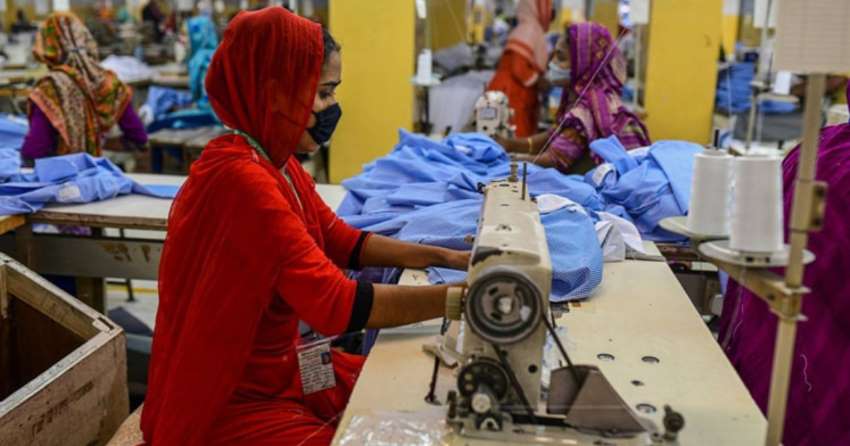
Bangladesh's apparel industry, long regarded as the world's manufacturing hub for affordable, high-volume garments, is facing one of its most significant commercial challenges in recent years. Fresh trade data from Eurostat reveals that the country's traditional low-cost sourcing model is failing to protect export earnings as global buyers prioritize value, speed, flexibility and product differentiation over price alone.
The first quarter of 2026 shows the severity of the shift. While total European Union apparel imports declined by 11.62 per cent year-on-year to €21.09 billion, Bangladesh's exports to the bloc contracted by an even steeper 19.26 percent to €4.59 billion, representing the sharpest decline among the world's leading apparel suppliers. More concerning is that export volumes fell by only 8.32 per cent, while average unit prices fell 11.93 per cent to just €13.84 per kg, indicating that manufacturers are sacrificing profits simply to retain production orders.
Table:
|
Supplier |
Value growth |
Volume growth |
Unit price growth |
|
World |
-11.62% |
-5.53% |
-6.44% |
|
China |
-7.90% |
-1.02% |
-6.95% |
|
Bangladesh |
-19.26% |
-8.32% |
-11.93% |
|
Turkey |
-18.92% |
-20.14% |
+1.52% |
|
India |
-10.15% |
-4.13% |
-6.28% |
|
Vietnam |
-2.12% |
-7.16% |
+5.43% |
Source: Eurostat; compiled by Mohiuddin Rubel (Former Director, BGMEA).
Pricing power matters
The comparison with competing sourcing destinations highlights the weakness in Bangladesh's export model. Although Turkey experienced a significant reduction in shipment volumes, it increased its average selling price by 1.52 per cent to €27.93 per kg. Vietnam performed even better, raising unit prices by 5.43 per cent to €29.35 per kg while largely preserving export revenues.
These figures show that buyers remain willing to pay higher prices for suppliers capable of delivering technical products, design complexity, faster replenishment and stronger compliance credentials. Bangladesh, by contrast, continues to compete primarily on price, leaving manufacturers trapped in an increasingly unsustainable race to the bottom.
The US denim puzzle
The same pattern is evident in the US, where Bangladesh appears to be gaining market share but losing commercial value. By April 2026, Bangladesh accounted for 30.4 per cent of all men's denim pants imported by volume, up from 25.2 per cent a year earlier. However, this achievement came alongside an 8.33 per cent decline in average FOB prices, which dropped from $7.93 to $7.27 per garment. Among major suppliers, only Tanzania exported jeans at a lower average price.
Meanwhile, competing exporters moved in the opposite direction. Pakistan raised denim prices by 9.45 per cent, Mexico increased prices by 7.56 per cent, while suppliers from the EU27 recorded a remarkable 28.05 per cent increase, reflecting their focus on higher-value products rather than discount-led competition.
|
Supplier |
Unit share |
FOB price |
2026 Price change |
|
Mexico |
27.80% |
$11.60 |
+7.56% |
|
Bangladesh |
30.40% |
$7.27 |
-8.33% |
|
Pakistan |
16.30% |
$8.02 |
+9.45% |
|
Egypt |
5.70% |
$9.02 |
+2.74% |
|
Vietnam |
4.50% |
$11.39 |
+4.36% |
Source: US Office of Textiles and Apparel (OTEXA).
Although Bangladesh increased its share in commodity denim, its overall value share of US apparel imports slipped from 11.1 per cent to 10.5 per cent through March 2026. Vietnam, meanwhile, increased its value share from 19.3 per cent to 22.5 per cent, underscoring the growing importance of premium product positioning.
Beyond basic manufacturing
Stakeholders argue that the downturn reflects deeper operational shortcomings rather than temporary market weakness. Many domestic manufacturers continue to define competitiveness through production efficiency for standardized basics, while international retailers increasingly demand technical capabilities, rapid product development, sustainable manufacturing and complex garment construction.
Traditional quality control systems often prioritize consistency in basic products, whereas higher-value apparel requires flexible manufacturing capable of accommodating sophisticated designs and evolving fashion trends. Similarly, factories frequently simplify product specifications to match existing production capabilities instead of investing in technology, skills and processes that enable more complex manufacturing.
Lessons from foreign investors
Foreign-owned manufacturers operating in Bangladesh demonstrate that an alternative model is already viable. South Korean manufacturer Youngone has built its business around specialized outdoor apparel, technical sportswear and performance garments rather than commodity basics. These operations invest heavily in workforce training, advanced production technologies and sustainability standards while paying wages substantially above industry averages. Their success suggests that Bangladesh possesses the labour force needed to produce high-value apparel. The primary constraint lies not with workers but with investment strategies and factory management models that continue to prioritize volume over value creation.
Preparing for post-LDC era
Bangladesh's upcoming graduation from Least Developed Country status has accelerated the need for structural reforms. Under the government's 2026-2029 RMG strategy, policymakers are shifting emphasis from traditional subsidies towards measures designed to strengthen long-term competitiveness.
The proposed framework includes negotiating new Free Trade Agreements to preserve preferential market access, expanding Export Credit Insurance to support deferred payment arrangements, strengthening independent compliance audits, improving product testing infrastructure and establishing transparent mechanisms for handling worker and buyer complaints.
These initiatives reflect changing buyer expectations. Global brands increasingly evaluate suppliers on governance, traceability, sustainability and financial reliability alongside production costs. Compliance has evolved from a competitive advantage into a prerequisite for participation in international sourcing networks.
For an industry that generates over 80 per cent of Bangladesh's export earnings, the challenge extends beyond weathering a cyclical slowdown. The current trade data suggests that the era of winning business primarily through the world's lowest prices is drawing to a close. Sustained growth will depend less on producing larger volumes of basic garments and more on building the technological capabilities, product sophistication and commercial resilience required by an increasingly value-driven global apparel market.