For decades, India’s garment manufacturing sector has been bound to its traditional strongholds; Bangalore, Delhi-NCR, and Tirupur. Yet, inside the high-stakes strategy sessions of the Bharat Tex Roundtable, industry leaders and policymakers confronted a stark, operational reality: the urban model that built India's apparel export engine has hit a structural wall.
To capture the global supply chain realignment and achieve the country's ambitious $100 billion export target, Indian apparel is embarking on a decisive geographical shift. The future of garmenting is migrating into the labor-surplus interiors of Madhya Pradesh, Uttar Pradesh, Odisha, and Jharkhand.
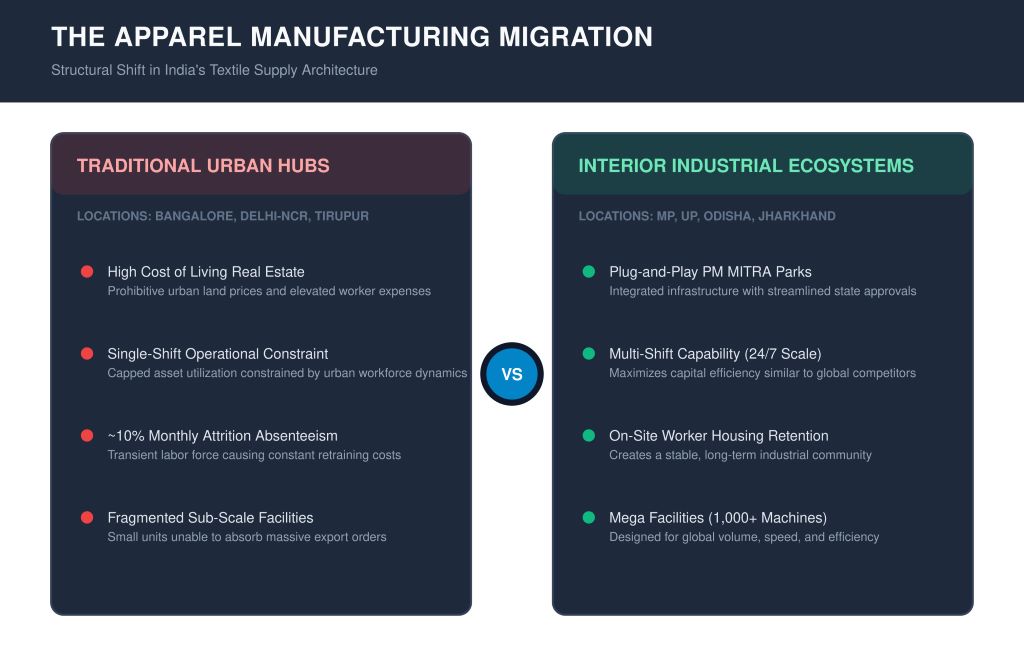
The Urban Cost Wall: Why Tier-1 garmenting has hit its limit
During the roundtable's primary deliberations, industry captains highlighted that historical production setups,defined by small, sub-scale factories operating single shifts in soaring metro areas, are no longer economically viable. High urban land values, elevated living expenses for workers, and localized infrastructure bottlenecks make expanding existing capacity in cities like Bangalore or Gurgaon prohibitively expensive.
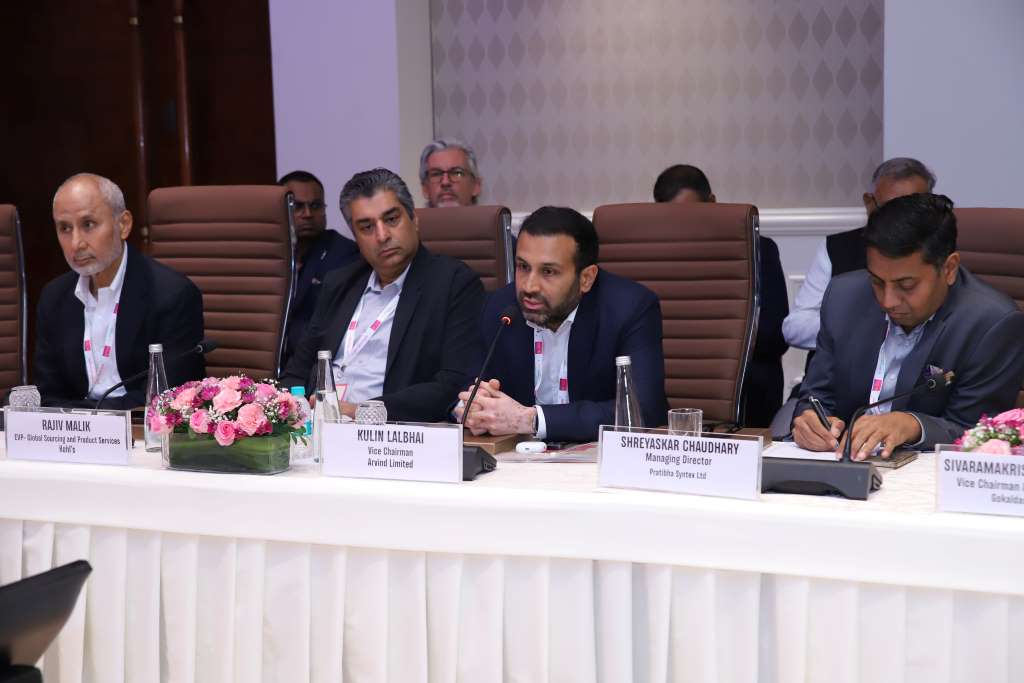
Kulin Lalbhai, Vice Chairman, Arvind Limited feels, "Historically, garmenting in India was small subscale factories set up in large cities where cost of living is very, very high and with single shift operations. To fix supply, we have to mobilize these new futuristic zones for garmenting. We need Madhya Pradesh, Uttar Pradesh, Jharkhand, Odisha. This is where the garment industry needs to thrive."
Operating single shifts in urban centers severely caps asset utilization. While competing apparel hubs in Sri Lanka, Vietnam, and Bangladesh run multi-shift operations to maximize capital efficiency, Indian urban manufacturers remain constrained by city-centric workforce dynamics and high overheads.
The Labor Retention Solution: Building integrated ecosystems
The core driver of this interior migration is labor stability. In Tier-1 apparel clusters, factories struggle with an unsustainable monthly attrition rate hovering around 10%, coupled with equivalent monthly absenteeism. This rapid churn severely damages factory efficiency, inflates retraining costs, and prevents suppliers from taking on large-scale, time-sensitive export orders.
Setting up manufacturing hubs in interior, labor-surplus states offers a structural fix. By anchoring facilities closer to worker hometowns and embedding dedicated worker housing into park designs, manufacturers can transform a transient workforce into a stable, long-term industrial community.
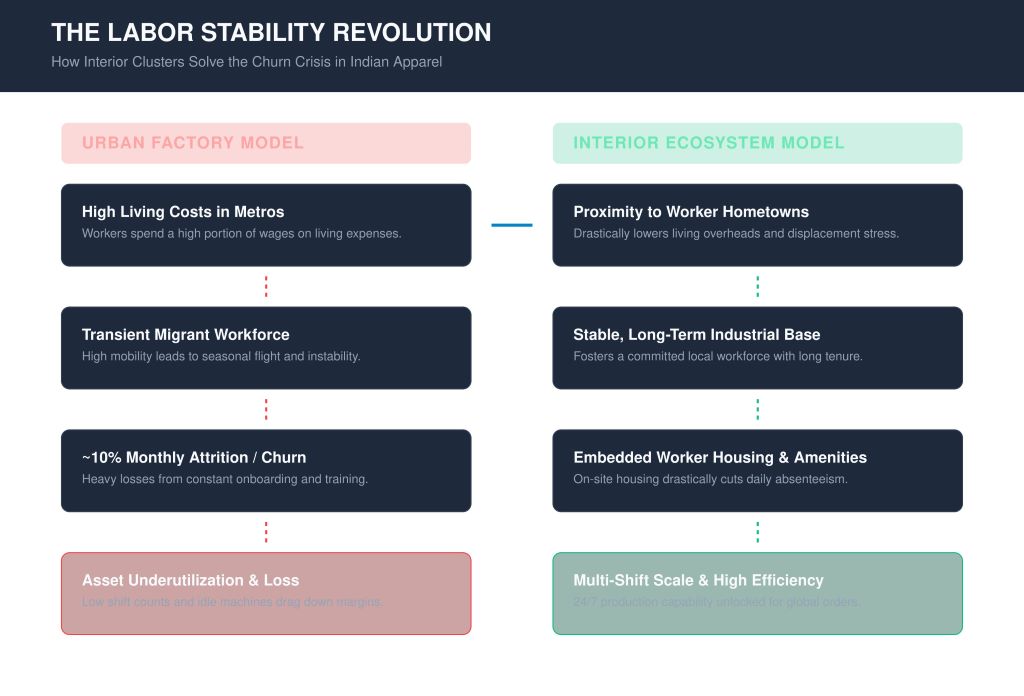
This model is being codified through mega-infrastructure projects like the PM MITRA (Mega Integrated Textile Region and Apparel) parks. Parks like the 2,158-acre PM MITRA hub in Dhar, Madhya Pradesh, integrate spinning, weaving, processing, and garmenting alongside dedicated worker housing and plug-and-play factory floors.
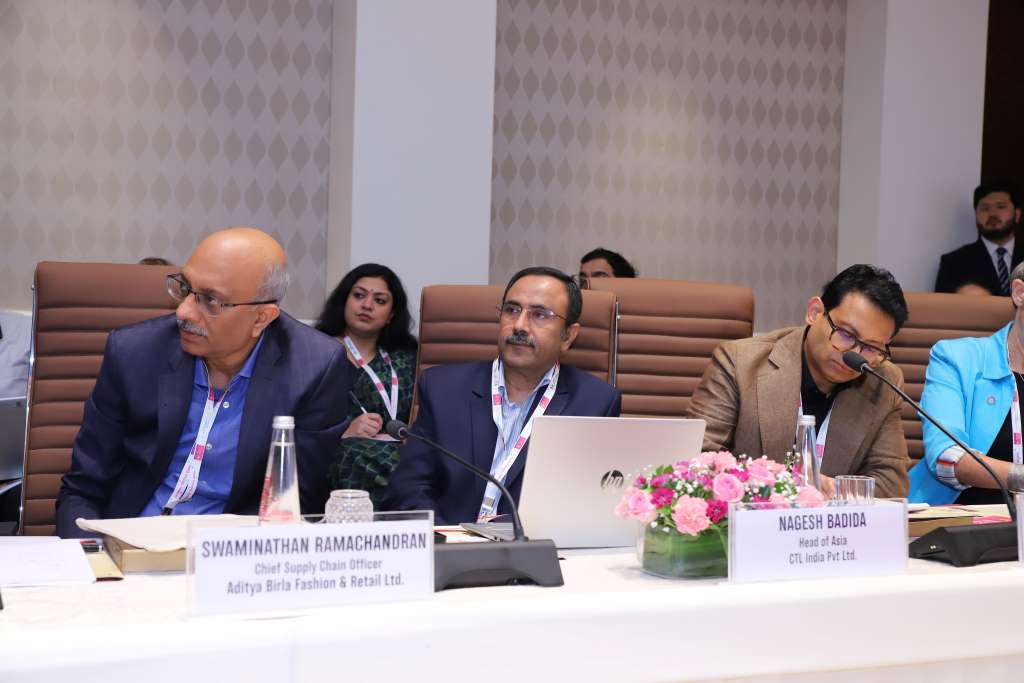
"No industry can survive with 10% monthly attrition and 10% monthly absentee. We have to have a model where labor stays with us. We reward labor well. Labor housing is solved for... when factories come up, it has to come up in sizes of 1,000 and 2,000 machines.", opines Swaminathan Ramachandran, Chief Supply Chain Officer, Aditya Birla Fashion & Retail Ltd.
Last-Mile Implementation: De-risking the greenfield leap
Despite the clear economic rationale, relocating the center of gravity of India's textile industry is not without friction. Panelists acknowledged a persistent managerial hesitation: mid-to-senior management teams and executive leadership naturally gravitate toward established hubs like Bangalore or Delhi, where talent pools, vendor networks, and social infrastructure already exist.
Building an industrial base in regions without prior garmenting heritage requires heavy upfront lifting. A new greenfield apparel unit carries a typical gestation period of roughly three years before achieving optimal worker productivity and financial breakeven. To bridge this gap and convince manufacturers to take the leap, industry leaders called on state governments to deliver on three key enablers:
● Single-window execution: Replacing multi-departmental bureaucracy with true single-window clearances to accelerate land allotment, power connections, and environmental permits.
● Gestation risk-sharing: Introducing targeted policies—such as accelerated depreciation and direct, labor-oriented production incentives—to offset operational losses during the initial three-year training phase.
● Dedicated Middle-Management training: Establishing regional supervisory training institutes in states like UP and MP to cultivate local quality managers, line supervisors, and floor leaders.
The Road Ahead: Scaling for the global stage
The interior migration is no longer just a cost-containment strategy; it is a fundamental requirement for global competitiveness. As FTAs open duty-free access to major Western markets, global brands seeking scale are looking for reliable suppliers capable of delivering massive volume with full social and environmental compliance.
By pairing state-level incentives with mega-infrastructure parks, interior states are positioning themselves to absorb India's next manufacturing boom. For Indian apparel, the path to $100 billion in exports runs directly through the industrial heartland.