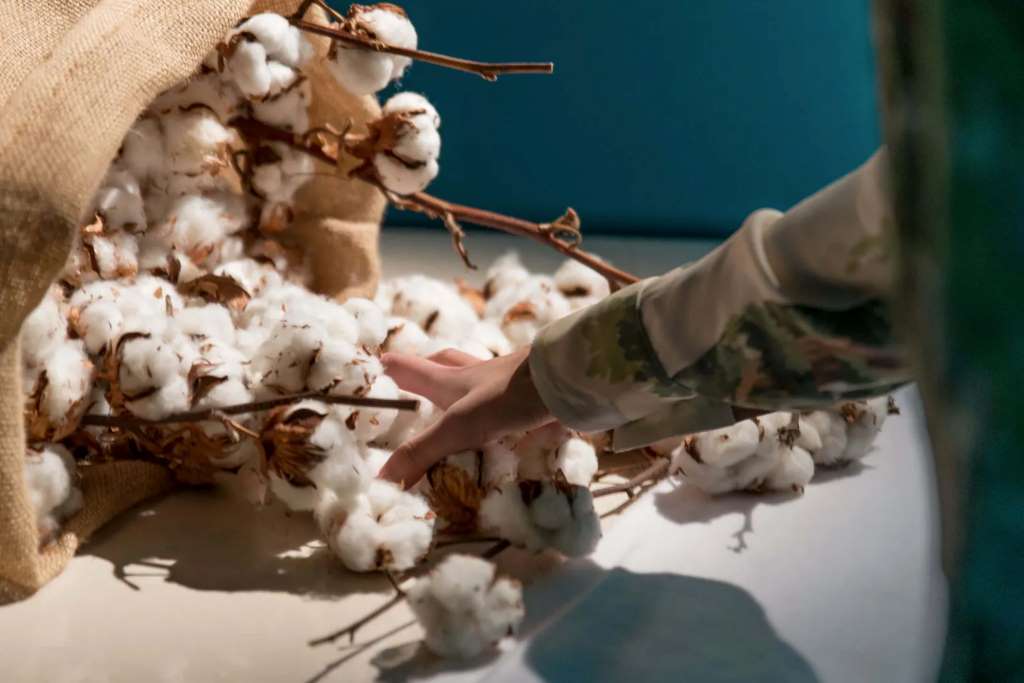
The surplus yield of cotton in states like Maharashtra, Madhya Pradesh, Andhra Pradesh and Gujarat has already led to a huge pile up in many godowns across the country. The price of freshly harvested cotton in Tamil Nadu hovered around Rs 3,500 to Rs 4,000 because of the arrival of poor quality fibers moistened by the rain.
India is one of the largest cotton producing countries in the world. In fact there is a fast accumulating buffer stock of cotton globally. Other cotton producing countries like China and the United States are seeing a growing buffer stock of cotton produced in their own countries. The global accumulation of cotton stock is 21.82 million tons during 2014-15.
Last year, India’s cotton export had fallen to 0.89 million tons compared to 2.02 million tons the country exported in 2013-14. This was because of sluggish markets and a fall in buyers. Last year the country produced 6.4 million tons from 12.4 million hectares.
Recently harvested cotton is currently being sold below the minimum support price fixed for the commodity by the cabinet committee on economic affairs. The committee had fixed prices of Rs 3,800 for medium staple cotton and Rs 4,100 for long staple cotton. In many parts of Maharashtra and Odisha, however, traders are buying medium staple cotton for Rs 3,500 and lesser and long staple cotton for Rs 3,800 to Rs 4,000.
- 1
- 2
- 3
- 4
- 5
- 6
- 7
- 8
- 9
- 10
Redefining what responsible production looks like
India's textile and apparel sector has set the global benchmark for sustainability at scale, and two clusters are leading the... Read more
China’s duty-free revival meets a reality check as Hainan shifts from VICs to va…
Hainan’s retail recovery is beginning to look less like a cyclical rebound and more like a rewiring of China’s domestic... Read more
Zombie inventory and shrinking margins inside China’s fashion returns meltdown
China’s digital fashion market, long celebrated as the world’s most sophisticated test bed for e-commerce innovation, is facing a destabilising... Read more
Circularity by Design: How EU rules are turning data into fashion’s new currency
The European fashion sector has entered a compressed transition window. Two regulatory confirmations: the revised EU Textile Labelling Regulation (effective... Read more
The Lyst Reset: Chanel and Dior rewrite luxury’s power index
The global luxury hierarchy has been quietly rewritten, and not by sales alone. In Q1 2026, Chanel rose to the... Read more
Inventory, not expansion, defines winners in global apparel
The 2025 fiscal year has crystallised that revenue growth and operational health are no longer moving in tandem. In an... Read more
From growth-at-all-costs to cash discipline, the new economics of DTC fashion
The global direct-to-consumer apparel market is entering a correction phase, as fashion brands across the US, Europe and the UK... Read more
Britain’s Forgotten Growth Engine: Why policy gaps are undermining fashion and t…
Britain’s fashion and textile industry, often framed through the lens of creativity and design, is emerging as a case study... Read more
Beyond price rallies structural reform can strengthen India’s cotton economy
India’s cotton economy is entering a decisive phase, where firmer prices and tighter arrivals in the 2026-27 season have given... Read more
Polyester volatility redraws India’s textile industry competitive map across Asi…
India’s synthetic textile industry has entered a phase of cost instability as polyester staple fibre (PSF) prices rise across domestic... Read more