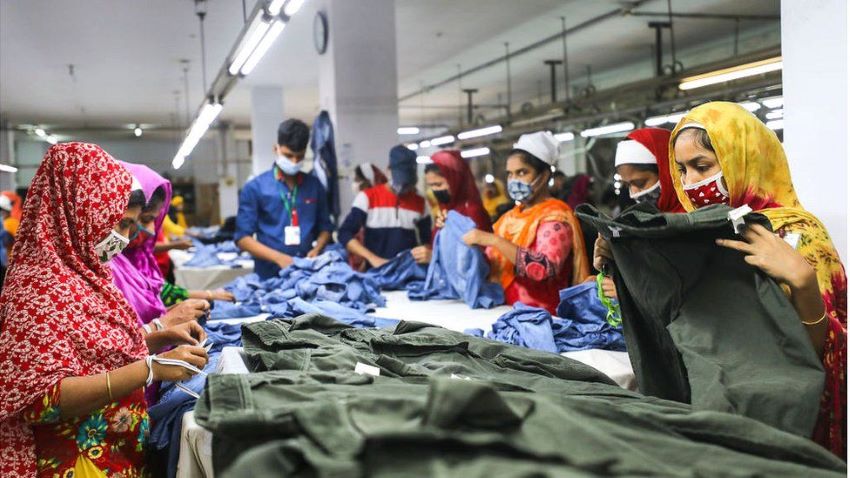
Egypt plans to develop its textile industry with the objective of becoming the next textile factory of the planet. More factories will be opened. Machinery will be renovated and workers will be trained. The vision is to quadruple exports of textiles and garments by 2025, have a million employees in the industry and attract investment worth 17.5 billion dollars.
Egypt is upgrading its upstream textile industry. The aim is to support the country’s private upstream manufacturers’ competitiveness in world markets. The restructuring program aims at restoring Egypt’s prominent position in the world market and capitalising on the globally renowned fine Egyptian cotton fiber. The program includes the modernisation of spinning, weaving, knitting, dyeing, finishing, printing and confection, based on a product line definition which brings forth added value to Egyptian cotton, from cotton farming to readymade goods with world class levels in terms of quality and efficiency. The total value of the program includes around 7,80,000 new spindles and 1,250 new looms, dyeing, printing and finishing machinery and state-of-the-art cutting and sewing equipment.
The investments will stimulate the dynamism for upgrading technology in the entire industry and ensure a continual increase in productivity as well as technical and management skills, to maximise value creation within the Egyptian textile value chain. It will affect Egypt’s vertical integration and competitiveness.
- 1
- 2
- 3
- 4
- 5
- 6
- 7
- 8
- 9
- 10
Global cotton enters a deficit year in 2026 as supply drop meets logistics risk
The global cotton economy has entered a fragile and sensitive phase. Early projections for the 2026-27 season suggest that world... Read more
India’s textile trade gets a Pacific push as New Zealand FTA removes tariff barr…
India and New Zealand have inked a ‘once-in-a-generation’ Free Trade Agreement (FTA), one that will have a profound impact on... Read more
Lululemon’s world-first nylon circularity push signals a new apparel arms race
The global apparel industry’s circularity narrative is entering a more technically demanding phase. Polyester recycling once the flagship of sustainable... Read more
Beyond the DTC Rush: Levi’s hybrid channel strategy sets a new retail benchmark
The global apparel sector is entering a phase where channel strategy is no longer a tactical lever but a core... Read more
The New Rules of Resale: EPR turning secondhand into fashion’s strategic growth …
The global fashion industry is facing a decisive regulatory and commercial reset. What began as a sustainability narrative around reuse... Read more
The 2027 Mandate: Why denim’s future hinges on verifiable data
For decades, the global denim industry has relied on a narrative of durability, heritage, and authenticity. That narrative is now... Read more
Europe’s textile core unravels as costs, imports and policy pressure bite
Europe’s textile and apparel sector, long seen as a benchmark for craftsmanship and industrial depth, is slipping into a prolonged... Read more
Automation, innovation, regulation are the forces shaping textiles in 2026
The global textile sector has entered a new era. Early 2026 saw the industry breach a $1.06 trillion valuation, reflecting... Read more
The new Brussels rulebook, every EU apparel order is now a balance-sheet risk
The humble export order sheet is undergoing a transformation. What was once a straightforward commercial instrument: SKU, volume, FOB price,... Read more
Why 2026-27 could be a defining cotton year for India’s farm-to-fashion economy
The global cotton economy is entering a more constrained phase, and for India, the implications run far beyond the farm... Read more