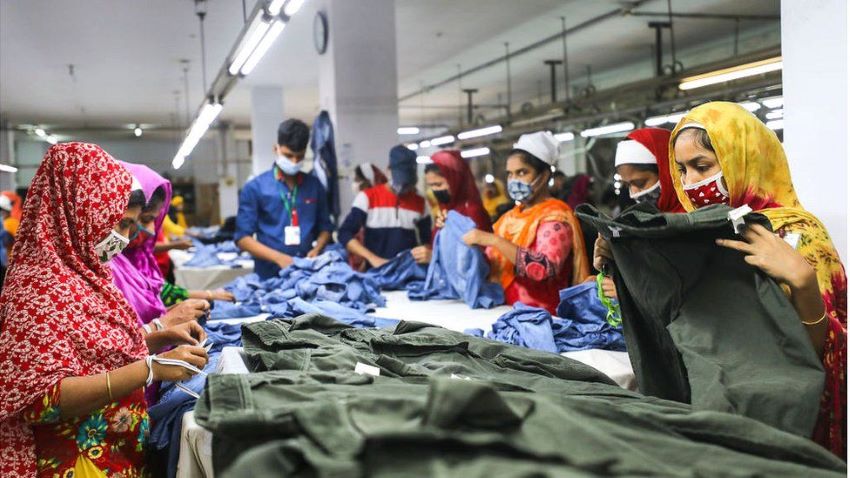
Ethiopia’s exports of textiles and apparel grew 32 per cent from 2012 to 2016. The share of textile and garment exports in the country’s total exports grew from 2.46 per cent to 5.46 per cent during the same period.
Ethiopia is transitioning from an agriculture-based economy. The textile-apparel industry is a significant element of the economy, in both financial and social terms, as it is a major source of employment and foreign exchange. Cotton consumption in Ethiopia is expected to increase in the coming years as a result of expansion in the textile industry due to foreign investment from countries such as China, India, and Turkey, among others. The Ethiopian cotton sector currently meets 70 per cent of the domestic industry’s raw material requirements. Several foreign companies have committed to investing in industrial parks to accelerate textile production and garment manufacturing. There are at least a dozen spinning mills in the pipeline to address some of the expected demand for yarn. These planned facilities, plus the 15 existing spinning mills currently operating, will bring the country’s installed annual processing capacity of lint cotton to 2,00,000 metric tons.
In sub-Saharan Africa, cotton-producing countries export about 90 per cent of their fiber.
- 1
- 2
- 3
- 4
- 5
- 6
- 7
- 8
- 9
- 10
India’s textile market nears Rs 15 lakh cr as domestic demand rewrites growth
India’s textile and apparel economy is no longer being driven merely by population growth or festive consumption cycles. It is... Read more
China Discounts, Bangladesh Bleeds: Inside Europe’s new apparel sourcing crisis
Europe’s fashion imports opened 2026 with a hard jolt. Fresh Eurostat-linked trade data for January shows the European Union’s apparel... Read more
Geopolitical volatility triggers sharp decline in global textile confidence: Sur…
The global textile industry is grappling with a sudden and severe downturn in sentiment as regional conflicts disrupt essential trade... Read more
India’s legacy buying houses confront existential challenge as FTAs reshape supp…
The Indian apparel sourcing is being reshaped with a a series of new Free Trade Agreements (FTAs). It is changing... Read more
ICRA sees apparel export recovery in FY27 as margin pressure eases, FTAs gain tr…
India’s apparel export sector is moving out of a year defined by tariff-led disruption and into one shaped by market... Read more
From Price to Purpose: India’s textile leaders chart a sustainable future at CMA…
The Indian textile industry is standing at a historic crossroads. For decades, the sector has been fueled by its reputation... Read more
Industrial automation and AI take center stage at Garment Technology Expo (GTE) …
The conclusion of the 39th Garment Technology Expo (GTE 2026) in Greater Noida has signalled a decisive shift in South... Read more
The End of Geographic Masking: Shein and peers reclaim Made in China as a strate…
The era of the corporate ghost is ending. For years, the world’s most aggressive retail disruptors operated under ambiguity, relocating... Read more
$120 Crude, Zero Margin: How India’s textile hubs are paying the price
For India’s textile clusters, the current West Asia crisis is no longer a distant geopolitical headline. In Surat’s polyester corridors... Read more
Luxury under pressure as stagflation and geopolitics redefine the winners’ circl…
The 2025 earnings for Europe’s listed luxury majors have delivered a verdict that has far more implications than the prevailing... Read more