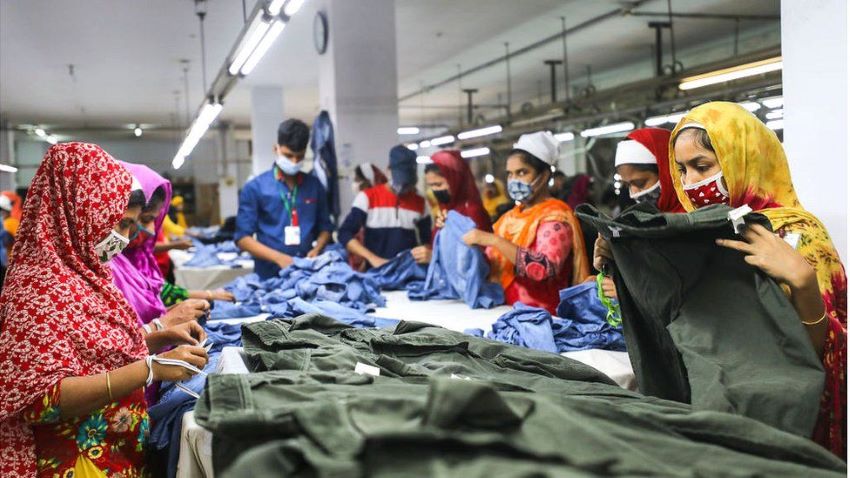
A scheme has been devised for Indian power loom units. Energy Efficiency Services (EESL) will procure energy efficient power looms, motors and rapier kits and give them to small and medium power loom units at no upfront cost.
The use of these efficient equipments would result in energy saving and cost saving to the unit owner and he would repay in installments to EESL over a period of four to five years. The aggregation of demand and bulk procurement will also lead to a reduction in capital cost, the benefits of which will be passed on to power loom units so that their repayment amount and period would reduce.
The initiative will be implemented on a pan-India basis. Plain power looms are being upgraded. They are being attached with process control equipment. This leads to higher productivity, better quality and more than 50 per cent additional value realisation. So far, 1.70 lakh plain power looms have been upgraded.
The power loom sector in India is predominantly an unorganised on and has a large number of micro and small units which produce 57 per cent of the total cloth in the country. There are 24.86 lakh power loom units in this country, most of whom use obsolete technology.
- 1
- 2
- 3
- 4
- 5
- 6
- 7
- 8
- 9
- 10
New Australian Wardrobe Economy: Where AI, sustainability, e-commerce converge
Australia’s fashion and apparel industry is no longer defined by post-pandemic recovery; it has entered a transformative phase. According to... Read more
Intertextile Shenzhen 2026- Pioneering the AI-driven future of fashion technolog…
The global textile industry is descending upon the Shenzhen Convention & Exhibition Center from June 9–11, 2026, for the highly... Read more
Yarn Expo Shenzhen 2026: GBA connectivity and AI innovation drive mid-year sourc…
The global textile industry is preparing for a strategic return to the South China manufacturing heartland as Yarn Expo Shenzhen... Read more
Indo-Dutch alliance targets textile circularity as global green jobs hit 142 mn
Netherlands and India formalized a roadmap to scale circular design and textile recycling. At the FICCI RECEIC Global Symposium 2026... Read more
Redefining what responsible production looks like
India's textile and apparel sector has set the global benchmark for sustainability at scale, and two clusters are leading the... Read more
China’s duty-free revival meets a reality check as Hainan shifts from VICs to va…
Hainan’s retail recovery is beginning to look less like a cyclical rebound and more like a rewiring of China’s domestic... Read more
Zombie inventory and shrinking margins inside China’s fashion returns meltdown
China’s digital fashion market, long celebrated as the world’s most sophisticated test bed for e-commerce innovation, is facing a destabilising... Read more
Circularity by Design: How EU rules are turning data into fashion’s new currency
The European fashion sector has entered a compressed transition window. Two regulatory confirmations: the revised EU Textile Labelling Regulation (effective... Read more
The Lyst Reset: Chanel and Dior rewrite luxury’s power index
The global luxury hierarchy has been quietly rewritten, and not by sales alone. In Q1 2026, Chanel rose to the... Read more
Inventory, not expansion, defines winners in global apparel
The 2025 fiscal year has crystallised that revenue growth and operational health are no longer moving in tandem. In an... Read more