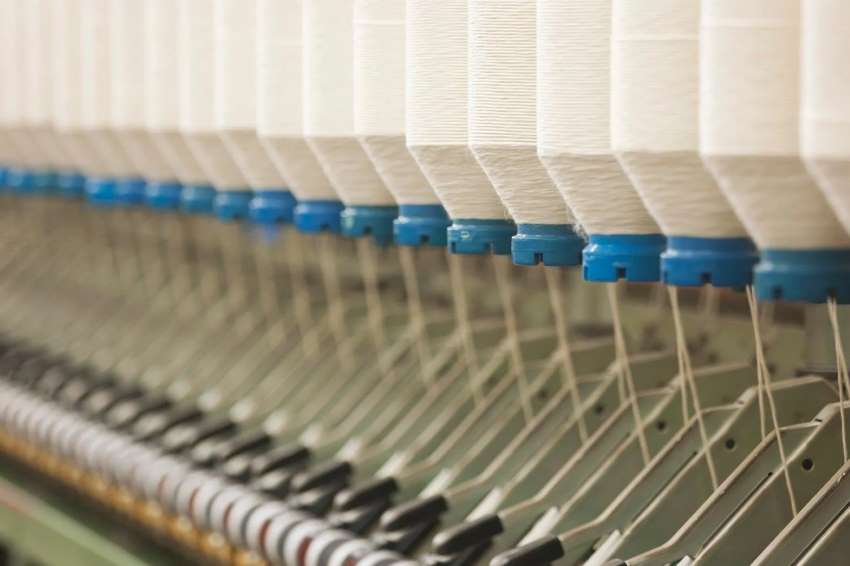
The Japanese market is facing a shortage of jacquard fabric for summer 2014 and also possibly for winter 2014. Japanese companies wanting to use jacquard fabric to produce garments have to start production planning as soon as possible.
Most Japanese apparel companies have taken to the jacquard fabric in a big way as it has a strong fashion element. Patterns range from dobby to the more complex variety. The design is superior to the ordinary woven or knitted fabrics. Large flower-shaped jacquard fabrics, Matt Lacey embossed fabrics are received well by the market. In terms of design, patterns with a three-dimensional effect have also become popular. Wool blends have come into jacquard.
Jacquard production is time consuming. The preparation process involves various types of materials. The overall production capacity of major jacquard producers has declined substantially. Jacquard fabrics have a high requirement of yarn dyeing and yarn dyed process. Only certain machines can produce printed jacquard fabric. Since the spring series of clothing uses more cotton, linen, silk and synthetic fibers and thin high-density material, fabrics of the specified concavity, luster and elasticity is also required.
- 1
- 2
- 3
- 4
- 5
- 6
- 7
- 8
- 9
- 10
The Invisible Bleed: How a single chemical is slowing India’s apparel machine
The global fashion industry has spent the better part of the past two years obsessing over visible disruptions viz. volatile... Read more
The Closet Paradox: How ‘nothing to wear’ is driving global overconsumption
In an era of overflowing wardrobes and instant fashion gratification, a striking paradox has emerged: the more clothes we own,... Read more
US trade rulings and labor slowdown reshape 2026 cotton supply chains
The global cotton industry is entering a period of adjustment, shaped by legal rulings, trade policy recalibrations, and a softening... Read more
Zero-tariff paradigm drives strategic re-sourcing at Global Sourcing Expo 2026
Projected to reach a valuation of $30.3 billion this year, the Australian textile and apparel market is entering a period... Read more
Strategic manufacturing takes center stage at Gartex Texprocess Mumbai 2026
A $179 billion industrial cornerstone contributing 2 per cent to the national GDP, the Indian textile and apparel sector is... Read more
The Hidden Tax on Fashion: 2026’s EPR rules squeeze margins and shake supply cha…
As the 2026 enforcement deadlines for California’s SB 707 and the European Union’s harmonized Waste Framework Directive loom, the global... Read more
Guess? Inc. retreats from China as American cool hits a cultural wall
For more than two decades, Guess? Inc., the emblem of ‘accessible American cool’, maintained an ambitious footprint in China. At... Read more
The Hormuz Effect: Why a distant war is shaking Bangladesh’s garment exports
The immediate impact of the Iran- Isarel-US conflict is being felt in the logistics arteries that connect Bangladesh’s factories with... Read more
The rise of localized luxury, MEA, North America, and India lead growth
The global luxury industry is no longer defined by relentless expansion. The ‘2025 Global Luxury Brandwatch Report’ highlights a sector... Read more
Hormuz blockade sends shockwaves through India’s textile chain as polyester cost…
What began as a geopolitical escalation in the Gulf has rapidly metastasized into a full-scale industrial disruption for India’s textile... Read more