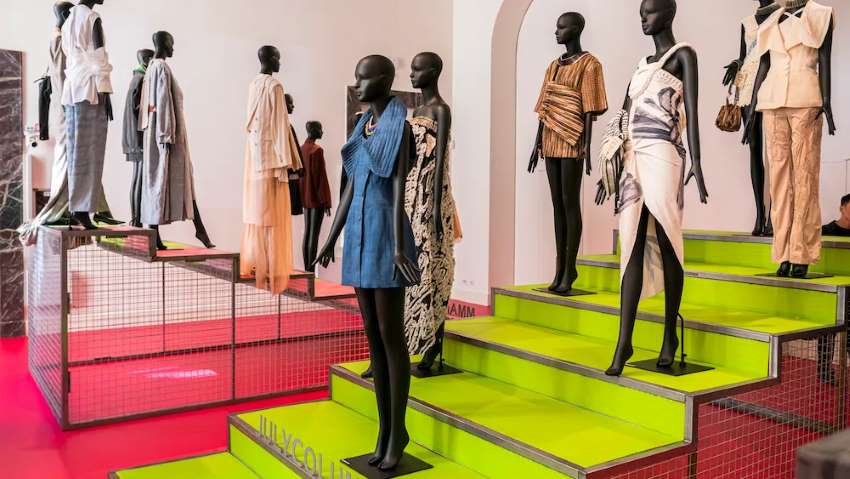
As more customers are shopping online, Australian retailers are focusing on smaller stores with more localised ranges. A smaller offline apparel market means brands will need to rethink the way they reach their customers. Brands are becoming less reliant on being stocked in bricks-and-mortar stores and focus more on direct-to-consumer sales. It’s about a collection of 18 pieces that change every month and about not having stock in-store. There are possibilities and opportunities for small brands to be more nimble and respond to the market than with more stock. Emerging designers may be best placed to thrive in this changing bricks-and-mortar landscape because many of them are already questioning traditional ways of selling. Several Australian designers have returned to making products to order, which not only suits a smaller bricks-and-mortar footprint, but is also more sustainable.
Questions remain whether one-off factors have driven retail sales higher over the past two months, but recent economic data, particularly around the labor market, new car sales and tourism, has been strong. And Australia’s population is currently growing far quicker than what many previously thought. These are all factors that would generally support retail sales growth, and with consumer confidence also edging higher, it suggests that perhaps the outlook for retailers is not as bad as expected.
- 1
- 2
- 3
- 4
- 5
- 6
- 7
- 8
- 9
- 10
The Death of the "Stockpile" Model: Inside the Digital Textile disrupt…
For decades, the global textile industry has been a game of high-stakes gambling: manufacture thousands of identical garments, ship them... Read more
Fuel crisis, rising costs the geopolitical shockwave hitting Indian textiles
The hum of textile machinery in Panipat has gone dead. Over 400 dyeing units have put their shutters, not because... Read more
Price wars, fast fashion, diamond money leads to Surat’s industrial shake-up
The sound of Surat’s diamond polishing wheels, once the city’s heartbeat, is fading. In its place, the relentless pulse of... Read more
India’s textile market nears Rs 15 lakh cr as domestic demand rewrites growth
India’s textile and apparel economy is no longer being driven merely by population growth or festive consumption cycles. It is... Read more
China Discounts, Bangladesh Bleeds: Inside Europe’s new apparel sourcing crisis
Europe’s fashion imports opened 2026 with a hard jolt. Fresh Eurostat-linked trade data for January shows the European Union’s apparel... Read more
Geopolitical volatility triggers sharp decline in global textile confidence: Sur…
The global textile industry is grappling with a sudden and severe downturn in sentiment as regional conflicts disrupt essential trade... Read more
India’s legacy buying houses confront existential challenge as FTAs reshape supp…
The Indian apparel sourcing is being reshaped with a a series of new Free Trade Agreements (FTAs). It is changing... Read more
ICRA sees apparel export recovery in FY27 as margin pressure eases, FTAs gain tr…
India’s apparel export sector is moving out of a year defined by tariff-led disruption and into one shaped by market... Read more
From Price to Purpose: India’s textile leaders chart a sustainable future at CMA…
The Indian textile industry is standing at a historic crossroads. For decades, the sector has been fueled by its reputation... Read more
Industrial automation and AI take center stage at Garment Technology Expo (GTE) …
The conclusion of the 39th Garment Technology Expo (GTE 2026) in Greater Noida has signalled a decisive shift in South... Read more