FW
Adidas, H&M to halt rent payments, spark outrage
Global retailers, including Adidas and H&M, sparked outrage in Germany recently after announcing they planned to stop paying rent on stores that have been forced to close over the virus crisis. German sportswear maker Adidas, which made a net profit of nearly €2 billion ($3.16 billion) last year, has been hit hard by a slump in China sales and massive store closures. The company, one of Germany's best-known brands, told DPA news agency that it was temporarily suspending rental payments, just like many other companies.
Similarly, Swedish clothing giant H&M would not be paying rent on its roughly 460 closed stores in Germany, telling DPA that it had informed landlords and hoped to find a mutually acceptable solution soon. German shoe store chain Deichmann intends to suspend rent and service charges from next month for the duration of the government-ordered closures. The company expected those with political responsibility to compensate for the lost rental income of the affected parties.
Electronics retailers Saturn and MediaMarkt, as well as Adidas rival Puma, also planned to halt their rent payments for now.
Moda to co-host SS21 edition alongside Autumn Fair in September
 Amid challenging times, Moda, the heart of UK fashion, has decided to push back the date for the show to September. The SS21 edition for the show, which was originally planned for August, will now take place from September 06-08, 2020 at The NEC Birmingham.
This move reflects organiser Hyve Group’s commitment to creating a unified portfolio of UK trade shows, as Moda will now take place alongside leading retail trade show Autumn Fair.
Moda Event Director, Adam Gough says; “After carefully monitoring the situation, and listening to our customers, we have decided to move the SS21 edition of Moda back to September. This decision reflects our commitment to continuing the growth of one of the UK’s longest-standing and best-loved fashion trade shows and it is our hope that both exhibitors and visitors will support this decision.”
He continues; “Like many of you, the Moda team are working from spaces that look a little different – from home offices to shared dining tables. However,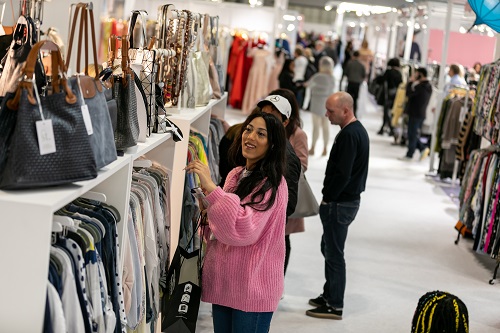 we want you to know that our inboxes remain open, and our phones are switched on as we continue to work remotely.”
As part of Hyve Group’s UK-wide initiative, Moda will also be running the #InspiredByKindness campaign. The project, which encourages people to share positive stories and acts of kindness, is designed to keep Moda’s community-feel alive during this difficult time. Moda will be offering their platforms to both brands and retailers, in a bid to support their businesses and share the inspirational work and acts of kindness that have emerged from the current situation.
The heart of UK fashion, Moda is the key meeting place for mainstream fashion, delivering a high quality and cost-effective platform for mid-market brands and ensuring a commercially viable and convenient buying environment for retailers across the UK and Ireland. Bringing together over 1,200 collections under one roof at the NEC Birmingham, to deliver the complete season's overview to over 8,000 visitors annually. The show also brings fashion to life on 16 catwalk shows throughout the three days to inspire buyers and sell brands, alongside a comprehensive retail-focused seminar program, interactive workshops and networking events.
APTMA appreciates government’s efforts to combat Convid-19
APTMA has appreciated all the positive steps taken by the Government to combat the extremely negative impact COVID-19 is having on Pakistan’s economy. Given that the great majority of export orders have either been deferred or cancelled the entire textile sector is in crisis. Europe and the USA are closed for business. The crisis is further compounded by the fact that industry had entered into contracts for importing cotton, the values of which has fallen from around 80 cents/lb to 50 cents/lb as of today.
Given this grave situation, the government’s steps of deferring loan repayments and speeding up of refunds will fall far short of keeping the industry afloat. This will result in a lot of concerns/companies going bankrupt. The impact on unemployment can only be shielded by the industry for a month or two beyond which will there will be no capacity to retain workers.
Further immediate actions to keep the industry afloat and retain jobs, the government needs to
1. Extend the Debt repayment moratorium to cover interest as well as working capital lines of credit.
2. Reduce the rate of interest for industry to 5 per cent
3. Suspend implementation of 1.5 per cent turnover tax. This is a presumptive tax on profits and as there are no profits possible under the current circumstance it should be suspended/held in abeyance.
4. Zero rating for the sector must be restored. Given the record of FBR and the design of the Sales tax system at least 3 months sales tax gets stuck in the pipeline before it is refunded. As the refund is only reclaimable after exports and exports are not happening, collection of sales tax will only hasten bankruptcies, and usher in a very serious depression. We strongly urge the government to suspend the sales tax regime till normalcy returns.
5. Renegotiate the LNG contracts on favorable terms to reduce the cost of gas in times to come.
6. Get NEPRA to re-determine the tariffs of IPP’s to reflect the actual rates of return thereby reducing circular debt and power tariffs for all the country.
Xinjiang bounces back with planning of 0.5 mn ton PET project
Amid global pandemic outbreak, there comes an encouraging news, for laying down foundation stone on March 29, 2020, for a breakthrough investment Polyester fibre (PET) production with the capacity of 500,000 tons per year in Bayingol Mongolian Autonomous region of Xinjiang.
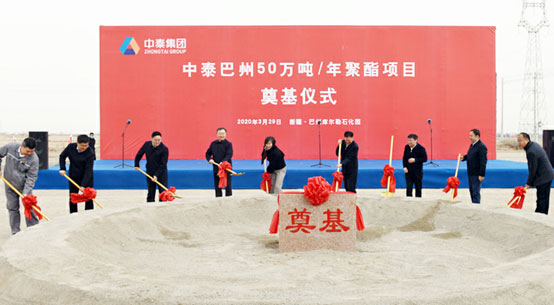 |
| Local leaders and investors are laying down the cornerstone for 500,000 tons/year PET project |
The project would be set up inside Korla Petroleum and Petrochemical Industrial Park in the Korla city under Bayingol Mongolian Autonomous Prefecture (region) in Xinjiang Uygur Autonomous Region.
Xinjiang, a far west region of China is the cotton-richest area, with more than four-fifths of cotton production in the country. As per National Bureau of Statistics report, cotton output of 5.002 million tons in 2019 to represent 84.9 percent of total cotton production in China. The new project is of great significance as, except for a very little amount of viscose fiber production the region doesn’t have manmade fiber manufacturing base here. The pioneer PET polyester project will facilitate Xinjiang’s strategy for largely promoting textile and garment development to provide 1 million jobs. Xinjiang government had initiated an ambitious scheme several years ago to take full advantage of its cotton resources to boost local economy and employment on this far-west land.
Mr. Wang Hongxin, Chairman of Xinjiang Zhongtai Group, said at the ceremony that Zhongtai Group invested heavily in Bayingol Monglian Autonomous Prefecture with aggregate 10 billion Yuan for caustic soda and its value-chain business in the past years and will invest in another four new projects in 2020, and three of which are to be planted right here for 7.5 billion Yuan in total, as one of the four new investment schedules from the Zhongtai Group, including the pioneer PET polyester project.
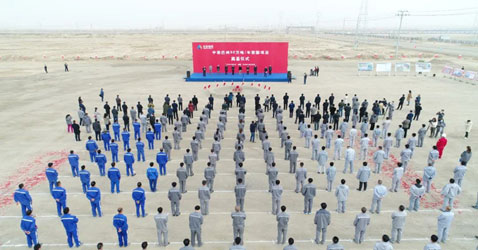
Mr. Lu Zhengping, Chairman of Zhongtai Petrochemical Company in Korla city, told reporters at the ceremony that this polyester project is the first PET project in terms of its size and capacity in Xinjiang, we all know that PET is made from purified terephthalate acid (PTA) and ethylene glycol (EG), and Zhongtai Group has its own PTA production for 1.2 million tons per year, and to line up with it, this new project will start with its overall field construction in April and is expected to finish at the end of 2021, with approx. 3.4 billion Yuan in budget. PET project will have 250,000 tons of filament and 250,000 tons of staple. In an estimation of the social and economic effects, the PET project, when completed, will lead to a sale income for 3.76 billion Yuan, VAT contribution for 57 million Yuan every year and provide 600 direct jobs and boost the conjoint downstream sectors, like spinning, weaving, dyeing and printing, for an employment of over 50,000 people.
It is understood that the PET project is a pivot that connects petrochemical industry with textile and apparel industry and its filament and staple will reshape present composition of raw materials that previously relied predominantly on cotton, making it possible for cotton spinning to update to manufacturing variety of fabrics in cotton-cotton/chemical fiber blends and filament weaving diversity, a milestone for transforming textile industry into a refinery-petrochemical-textile integration not only in Korla city in Bayingol Mongolian Autonomous Prefecture, but also in Xinjiang as a whole.
Contributed by Mr. ZHAO Hong
He is working for CHINA TEXTILE magazine as Editor-in-Chief in addition to being involved in a plethora of activities for the textile industry. He has worked for the Engineering Institute of Ministry of Textile Industry, and for China National Textile Council and continues to serve the industry in the capacity of Deputy Director of China Textile International Exchange Centre, V. President of China Knitting Industry Association, V. President of China Textile Magazine and its Editor-in-Chief for the English Version, Deputy Director of News Centre of China National Textile and Apparel Council (CNTAC), Deputy Director of International Trade Office, CNTAC, Deputy Director of China Textile Economic Research Centre. He was also elected once ACT Chair of Private Sector Consulting Committee of International Textile and Clothing Bureau (ITCB)
COVID-19 makes fashion industry more flexible and swift
 Covid-19 is having a tremendous impact on the global textile and apparel industry. As Andreas Kelsch, Sales Director of Turkey-based Be Ma, reveals, be it at trade fairs, which are witnessing fewer visitors or production and delivery delays, the pandemic is impacting all aspects of business.
Impact on the entire value-chain
The retail industry is witnessing a slowdown, impacting the entire value chain–from garment making to sales of chemical auxiliaries. Brands are postponing delivery of their completed garments. Buyers are also telling manufacturers not to cut fabrics and process other raw materials which they have already imported or stored for the current orders placed by them, notes Mostafiz Uddin, Managing Director of Bangladesh-based Denim Expert.
Factories face production delays
Most factories are trying to cope with the situation. However, they are facing production shortfalls and run the risk of having to suspend production lines.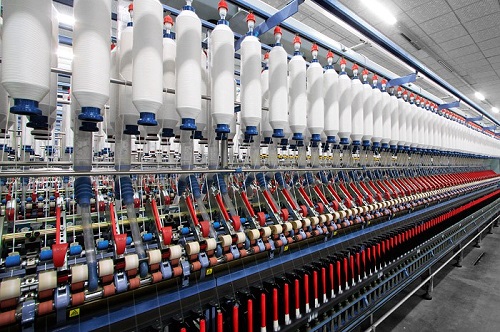 In order to reduce their immediate costs, these manufacturers also plan to either cut down on the number of workers they employ or reduce their shift hours. However, both of these possibilities are likely to result in a loss of income for around four million workers, feels Uddin.
Digital channels gaining popularity
With most stores shut, retailers are moving to new digital channels. However, the outbreak has also had certain upswings. As Alberto De Conti from the brand Hub 1922 of the Rudolf Group that operates in both Italy and Germany observes, there is an adoption of new, regular and exciting B2B digital and communication channels that would beneficial for the environment as well.
Also going digital is US-based The Lycra Company who is fulfilling all orders and shipments without any interruptions. Most of the company’s interactions are being conducted virtually. It further plans to ramp up its digital resources to facilitate such connections besides investing in digital media to drive awareness and promotion of our innovations and technologies, reveals Denise Sakuma, director of the company’s global RTW and denim.
The outbreak is forcing companies to look at their roles differently. Not only are they planning to look at other supply chains but also develop contingency plans. As Alice Tonello Marketing and R&D Head of Italy-based Tonello points out it is likely to lead to reorganisation in production, towards flexibility and swiftness, which in turn could lead to more near shoring.
Welspun to make disinfectant wipes, masks
Amid the Covid-19 outbreak in the country, the Welspun Group is switching capacities at its textiles plant in Anjar, Gujarat to manufacture disinfectant wipes and masks to meet the demand-supply gap for personal protection. The company plans to build a pipeline of a few hundred thousand masks and wipes in the coming weeks that could be made available to all on-ground workers and their families attending to essential services.
The plant that makes home textile products for largely exports along with domestic market also has technical textiles capabilities for products like disposable wipes, wound care, diaper, drapes and gowns apart from technical textile durables for automotives, protectives and home textiles, among others. Now, as a natural extension, the group is looking to manufacture disinfectant wipes and masks to bridge the demand-supply gap in the country.
With this, the company aims to bridge the unhealthy gap between demand and supply for personal protection and wipes in the country even for non-specialised application need. While it is working on using technology and skill set that are not optimized for such finished products, the group feels it can build a pipeline of a "few hundred thousand masks and hand wipes" in the coming weeks.
With its prime focus currently on speedy production of such essential supplies, Welspun is focused on making these masks and disinfectant wipes available for all on-ground workers and their families who are at great risks by attending to essential services amidst the pandemic.
Among the top global makers of bed and bath linen, the company has been manufacturing cotton terry towels, beach towels, bath rugs and mats, bath robes, cotton sheets, pillows and comforters among other things at its Vapi and Anjar facilities.
US, EU buyers to stop buying Vietnamese goods
Many US and European Union (EU) partners have sent notices to Vietnamese garment and textile businesses informing they will temporarily stop receiving goods for three to four weeks. Ph?m Xuan Hong, Chairman of the HCM City Association of Garment Textile Embroidery and Knitting says, nearly two-thirds of the garment-textiles market narrowed with this. Half of all textile exports from HCM City go to the United States, while the EU accounts for 15-18 per cent of annual exports.
According to chairman of Viet Thang Jean Ph?m Van Viet, the Chinese experience shows it will take at least two months in the United States and EU to control the pandemic. The United States accounts for 30-35 per cent and the EU 20 per cent of the company's total export turnover. About 40 per cent of existing fabrics will be abandoned or sold at low prices, he said. Suddenly stopping imports forced enterprises to store many containers of products that were on the way to US and EU ports, he said, which will increase expenses, according to a Vietnamese media report.
The most urgent problem for textile enterprises is not delivery of orders but how to protect workers. Textile enterprises in the country have suggested the government to quickly disburse approved economic stimulus packages and consider partial use of the unemployment insurance fund and social insurance fund to help businesses continue paying their workers.
They also hope the ministry of finance and the banking system will lower interest rates or give interest-free loans, which could be used to pay workers until production activities and trade return to normal.
India’s textile industry seeks $108 billion bailout package
India’s $108-billion textiles industry, which helps the likes of Gap and Macy’s stock their store shelves, is seeking a bailout package on their foreign exchange liabilities after the lockdown prompted cancellation of orders that were to fetch payments in dollars.
Losses in forex contracts could run into crores of rupees for the exporters that had used anticipated dollar receivables to enter into contracts with banks. To cover the hedging liabilities, the industry is seeking benefits similar to the moratorium extended to borrowers, who now have a three-month grace period on repayments.
Textile exporters book forward contracts against overseas receivables to protect their cost or to earn premiums. On shipment, they provide documents to banks booking the contracts. Due to cancellation and delays, they are unable to provide the bill of lading and other documents.
If exporters are not able to ship, they do not receive the money from overseas buyers. In such cases, they have to unwind those forwards deals booked up to six months in advance at a loss of 2-4 rupees/unit of dollar, dealers said.
Abhishek Goenka, CEO of IFA Global points out textile exporters should be given some flexibility to manage their dollar delivery in the form of some extensions so they do not have immediate cash flow problems considering (that the lockdown is) no fault of theirs.
Sri Lanka apparel firms divert production to masks and protective equipment
Sri Lanka’s apparel sector has turned factories to make mask and protective equipment for frontline workers who are fighting against COVID-19, though tight controls are making it difficult to keep factories running. At the moment the industry is making one million pieces of safety suites through JAAF for people who are working frontline of COVID-19 treatment. However, production halted after police asked some factories to close and workers were not allowed to report to work at others.
The fabric for mask production had been donated by Teejay Lanka, a local knitted fabric manufacture, while the HDPE polythene to produce coverall protective suites were donated by PolyPack, a Sri Lankan plastic products maker. In addition, a number of factories are working with the government to supply in a number of protective cover all garments made out of HDPE polythene, again being provided free of charge to the Government for use in state hospitals. The raw material for this project has been donated Polypack.
However, the industry is not looking at exporting at the moment due to workforce shortages meanwhile the government tightens its Island wide curfew.
AAFA welcomes Senate’s $2 trillion war chest
The American Apparel and Footwear Association (AAFA) has welcomed US Senate approval of a S$2 trillion war chest which will ease the hardship felt by businesses across the country since the outbreak of the COVID-19 which is now rampant in the states.
An estimated 3.3 million people filed for unemployment in the USA last week alone as it reels from a surge in virus cases and a huge hit to its economy. Senators have now agreed to the terms of a new bill which will provide direct payments of $1,200 to millions of individuals who earn $75,000 or less, and an additional $500 per child. Whilst $500bn is set aside to help companies via a loan system and $350bn has been designated to support small businesses.
AAFA has urged the US President to swiftly approve the bill – an action Trump has already affirmed that he will – to alleviate the strains felt on business owners and employees across the country.
This legislation will inject liquidity into the system allowing companies to sustain operations, and keep employees on the payroll so they start up quickly once health authorities give us the all clear.
Broken down, the bill – passed following a brief hiccup as Democratic and Republican Senators squabbled over unemployment benefits – will alleviate some of the financial burden left on the doorsteps of individuals paid under US$75,000, which will now be afforded a monthly pay packet of US$1,200 until they’re able to resume work.