FW
Individuals, stakeholders find new ways to clean up Asian clothing industry
As per United Nations Climate Change, the fashion industry, which accounts for 10 per cent of the world’s carbon footprint and 20 per cent of waste water, is likely to consume a quarter of its global resources by 2050. This pollution is more prevalent in Asia, the largest manufacturer and exporter of clothing and textiles. A majority of production takes place in China with the country’s clothing production accounting for an estimated third of the industry’s global carbon footprint, primarily on account of its reliance on coal-powered plants.
 As per United Nations Climate Change, the fashion industry, which accounts for 10 per cent of the world’s carbon footprint and 20 per cent of waste water, is likely to consume a quarter of its global resources by 2050. This pollution is more prevalent in Asia, the largest manufacturer and exporter of clothing and textiles. A majority of production takes place in China with the country’s clothing production accounting for an estimated third of the industry’s global carbon footprint, primarily on account of its reliance on coal-powered plants. Asian eco-minded entrepreneurs are viewing all aspects from education to supply-chain solutions and elegant “trashion” collections made from waste to tackle these issues.
Circular principles
More than 75 per cent of the world’s top-polluting cities are located in China. To deal with this issue, Christina Dean, a Hong Kong based journalist, founded Redress, a Hong Kong-based NGO, in 2007. The NGO works with global brands and organisations to reduce textile waste and introduce circular principles such as producing and using renewable resources, recycling waste, and increasing products’ longevity. It produces Frontline Fashion, an online docu-series, and the annual Redress Design Awards. Today, Redress is conventionally referred to as the largest sustainable-design competition in the world.
Dean also pioneered upcycled-fashion brand and social-impact business called The R Collective. Launched in February, the label turns trash to treasure. Its inaugural “Start From Zero” collection is made entirely from rescued waste from textile mills in Italy and Japan upcycled into pieces like artistic, architectural dresses and sharply tailored blazers.
Turning discarded textiles into new fabrics
As per McKinsey & Co and Business of Fashion’s joint report, 2019 State of Fashion, China is expected to become the world’s largest apparel market this year. However, it also produces 26 million tons of textile waste a year, compared to the 16 million ton produced by the US, 1 million ton by India, and roughly 500,000 ton by Bangladesh.
According to Sissi Chao, a member at Shanghai’s WeWork 819 West Nanjing Rd, every textile that is thrown away could be turned into a new yarn or woven into a new fabric. She founded RemakeHub, a business-to-business social enterprise platform that provides waste-management solutions to fashion and lifestyle clients in 2018. The platform cultivated roughly 50 new sustainable materials, all recycled from trash.
The company, in 2018, also teamed up with Futian Environment Charity to recycle roughly 2,500 donated T-shirts into backpacks for underprivileged children in China’s western Qinghai Province.
Recycling fabric scraps into accessories
India’s garment industry also pollutes land and water besides generating enormous amounts of waste. Being the world’s largest producer of cotton, India also faces serious problems such as health issues among farmers exposed to insecticides, and devastating droughts. Launched by Mahima Gujral, Sui collection is a sustainable spinoff of her family’s business. It pays homage to nature with a closed-loop production process in which the brand’s waste is recycled into new products. Sui recycles its packaging and upcycled fabric scraps (or “deadstock”) into accessories like mobile phone holders and headbands.
Instead of using conventional cotton, Gujral sources pesticide-free hemp and organic cotton that’s been certified by international verification organisation Global Organic Textile Standard.
One of Sui’s most effective decisions was to implement a “slow fashion” model, in which brands craft made-to-order garments one-by-one to avoid overstock. Instead of low-cost, mass-produced clothing, Sui does not make a clothing item until she receives an order for it, thus minimising waste and enhancing the durability of its clothes.
Denim manufacturers invest in supply chain to meet market needs
 Denim manufacturing firms are making major investments in factories from the US to China to meet market demands and improve their environmental footprint.
Curbing excess use of water
A new textile maker, Vidalia Denim recently opened in a 900,000 sq. ft. facility in Vidalia, La., in the Mississippi Delta region. To employ over 300 full-time workers to make denim, this mill will be fully commercially operational in the first quarter of 2019. Its indigo dye technology will curb total water usage by more than 60 per cent compared to a legacy mill. The brand will also use e3 sustainable cotton exclusively in its operations, sourcing its cotton from across the U.S. farm belt.
Promoting eco-friendly cotton
Bayer CropScience has launched a new e3 cotton program that enables farmers to grow cotton in a less impactful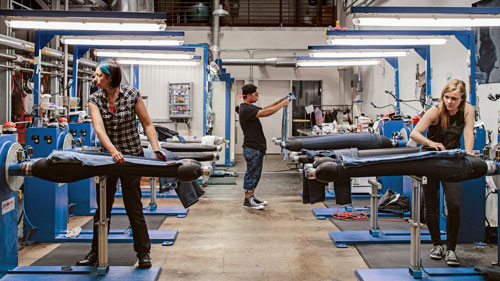 way. Independent auditors will certify a farmer’s commitment to grow e3 cotton in an environmentally responsible, economically viable and socially equitable manner in the U.S.
Chinese denim mill Seazon plans to increase the number looms to 630. In line with this, Seazon will also introduce a new intelligent wastewater recycling system to its dyeing and finishing process, which will reuse more than 80 per cent of its wastewater.
Denim fiber firms expand capacity, global reach
Driven largely by shifts in sourcing patterns and increasing demand for sustainability, major denim fiber firms are building up their capacities and global reach. Invista’s Cordura brand has launched TrueLock, a next generation of durable colors. This fiber is made from Invista’s nylon 6.6 multi-filament fiber that is solution dyed, locking the color in at the molten polymer extrusion level to create deep, durable color throughout the fiber. The company further plans to expand the Cordura TrueLock filament product line to introduce additional standard colors and deniers.
The Lenzing Group, a major producer of wood-based cellulosic fibers, is in the midst of growing its capacity and upgrading its facilities. The company is investing more than €100 million ($116.5 million) in sustainable manufacturing technologies and production facilities through 2022. The company’s Refibra technology transforms cotton scraps from apparel production and wood pulp from responsibly managed forests into virgin Tencel lyocell fibers. The fibers are manufactured in a closed-loop production process using bioenergy.
Lenzing has also formed a joint venture with Duratex, to build the largest—a 450,000 ton capacity—single line dissolving wood pulp (DWP) plant in the state of Minas Gerais, close to São Paulo, Brazil. The estimated investment for the construction of this DWP mill is expected to be over $1 billion, and the joint venture will supply the entire volume of dissolving wood pulp to the Lenzing Group.
Increasing share of Spandex market
Korean company Hyosung Corp is making a $100 million investment in its first spandex plant in Maharashtra, India, which is expected to be operational by 2019. Hyosung aims to increase its share of the Indian spandex market to 70 per cent from the current 60 per cent. This would bring the company’s total number of plants to nine globally, with additional investment planned for total capacity of 390,000 tonnes globally by 2020. To make Vietnam a global production base for all of its core products, Hyosung established Hyosung Vietnam in the Nhon Trach industrial complex with an investment of approximately $1.5 billion.
Textile makers focus on sustainability with new materials, production processes
Leading textile producers are seeking new ways to ensure sustainability by not only introducing eco-friendly fabrics but also revamping their production processes. For instance, textile and thread manufacturer A&E, which makes sustainable threads in four variations, has launched a premium thread for apparel, Perma Core which provides strong colorfastness and sewability. The company’s newest addition to the range, Anefil Poly, is used for making footwear.
Similarly, industrial thread firm, Coats uses recycled materials for its range of bobbins. The new Ecobobs Y2 bobbin is performance-focused, promising to improve productivity by 10 percent due to precision winding and increased capacity. Developed specifically for footwear and accessory production, the bobbin also reduces thread waste by 20 percent.
Alongwith materials, brands are also updating their production practices. Fabric manufacturer Faytex has recently introduced an innovative process for waterless dyeing across several products. Faytex has expanded this process across its Dri-Lex Eco Line to promote water conservation.
Coats also aims to reduce its water usage by 40 percent by 2022. Meanwhile, A&E, in its 2017-’18 Sustainability Report, noted that it has reduced its carbon footprint per kilogram of thread by 11 percent since 2006.
Technical textile conclave in Coimbatore on April 24
Indian Technical Textiles Association, SIMA and Indian Texprenuers Federation are partnering to hold ‘National Investors Conclave on Technical Textiles’ in Coimbatore on April 24, 2019. The conclave will give the necessary inputs to plan for value addition or diversification. Eminent speakers from abroad, leading consultants, experts from DRDO, centers of excellence and TRAs and technical textile machinery manufacturers will make presentations and interact with the delegates during the event.
Technical textiles have been identified as the thrust area for exponential growth considering its potential for value addition, exports, domestic demand etc. India launched a technology mission on technical textiles in August 2011 and created eight centers of excellence across the country, out of which two are in Coimbatore. Tamil Nadu, Andhra Pradesh, Telangana and Karnataka have offered special incentives for investments in technical textiles.
The technical textile industry in India is growing at a CAGR of 20 per cent. The diverse range of technical textiles in India can be broadly grouped into categories such as agrotech, meditech, packtech, clothtech, indutech, hometech, geotech, Oekotech, protech, sportstech, buildtech and mobitech. All these sectors are expected to see double digit growth. Demand for this sector is rising due to many factors including rapid urbanisation, advances in medical technology, expansion in construction sectors, awareness on safety and environmentalism and increased spending on healthcare.
Shima Seiki offers enhanced capabilities with new flat knitting machines
Shima Seiki’s new SVR123SP flat knitting machine has an extra loop presser bed, capable of inlay technique used to produce hybrid knit¬weave patterns suited to technical textile production. Even materials that could not be knit before such as metallic and monofilament yarns can now be knit.
The SDS¬ONE Apex3 3D design system has an ultra¬realistic simulation capability that realizes virtual sampling. When countless variations must be evaluated before arriving at a final design, virtual product samples can be used to streamline the decision making process by minimizing the enormous amount of time, cost and material normally associated with producing actual samples for each variation. When approved, the same data can be used to program machines for immediate knitting, significantly reduc¬ing lead times.
Shima Seiki, based in Japan, is a computerized knitting machine manufacturer. Its fast, efficient and reliable P¬CAM series computerized cutting machines are known for their innovative functions. A knife sharpening system produces a sharp, strong blade every time. Strong, robust components permit quicker response times for knife movement and more accurate cutting composites and other industrial materials. PCAM machines are ideally suited to global production in a wide range of industrial applications in addition to apparel and textiles.
Sustainable cotton in focus at Kingpins Amsterdam
Denim trends come and go, but cotton is the constant common denominator for most jeans. At a panel discussion at Kingpins Amsterdam, experts from cotton-growing regions discussed the current state of affairs in the global cotton business. From the debate on what’s sustainable, to cotton-growing initiatives that are finally taking shape, denim experts shared their perspectives on the current cotton market.
Brands and retailers are reacting to sustainability, but in different ways. Some companies are in it to do the actual right thing, whereas others are doing the minimum required to give consumers a feel-good feeling. Swedish furniture company Ikea decided to switch to 100 per cent sustainable cotton in 2015. Now Ikea only uses cotton that’s either recycled or grown with less water, chemical fertilizer and pesticides. Pakistan’s Artistic Milliners takes a 360-degree approach to sustainability. From cotton, water recycling, energy conservation and the company’s CSR activities, the goal is to always take the sustainable path.
However, an organic cotton farm works 10 times harder than a conventional cotton farm using the latest technology for growing cotton. Organic requires more inputs and is harder on the environment. Even if denim wants more organic cotton, there are larger players in the field. The cotton market is moved by the home textile industry. The reality is that the market will dictate what the results will be.
More than that, brands need to hit suppliers where it hurts the most. It pays, it seems, to give suppliers ultimatums. They should tell suppliers to be 100 per cent sustainable, because if not brands are not going to buy anything from them.
Cotton plantation in the US decreases by 2 per cent in 2019
A recently released report by USDA indicates, cotton plantation in the United States is likely to decrease by 2 per cent in 2019 with only around 13.78 million acres being planted. This is far below the previous market expectations of 15.2 million acres. Of the total plantation, Texas cotton planting area is only 7.314 million acres, a decrease of 454,000 acres compared with the same period last year.
Industry insiders note that American cotton farmers have been waiting for the Sino-US trade negotiations to end as the progress of negotiations have affected farmers' planting intentions. According to foreign analysts, the output of American cotton in 2019 is estimated to be about 22.19 million bales, an increase of 20.5 per cent over the same period of last year, which is the highest level since 2005/2006.
Prym Fashion to expand services in India, open unit in Chennai
Prym-Fashion plans to expand its services in the Indian apparel segment. The company will soon open a new fastener finishing facility, known as Prym Fashion India in Chennai. This new facility, which will begin operations in April, will enabel the company’s popular Gripfix fasteners for the children’s and baby wear markets. By stamping the fasteners in Germany and providing made-to-order enamel finishing at Prym Fashion India, the company will reduce lead times to India-based producers of children’s and baby wear by more than 50 percent.
Gripfix is the company’s bestseller in its baby wear range and has a secure five-prong system that neither tears nor comes off. The flat design of Gripfix fasteners maximises comfort, and the company’s commitment to product quality and reliability make them both durable and safe for use with clothing designed for infants and children.
Prym Fashion India will be located within the Chennai Free Trade Zone, allowing the company to export enameled fasteners to apparel manufacturers in South Asia, including Sri Lanka and Bangladesh.
Modest fashion has had to fight biases
The global modest fashion market has had to fight misconceptions. One is that modest fashion is long boring dresses. Also consumers have become accustomed to purchasing low-quality modest clothing and assume that all modest-fashion brands work at this level. Many designers tend to receive more support further away from where the majority of modest-fashion shoppers are. Though modest fashion is more prominent in the Islamic market, the Islamic market and media are the least supportive of up-and-coming Muslim designers. Instead such designers are doing well in the US, Canada and the UK. In the US market, they receive a lot of support from retail buyers and media outside of the modest-fashion industry, as they see the versatility in their designs to extend beyond modest fashion and into the mainstream.
Designers want the chance to sell beyond their website. Their dream is to see a modest rack in every department store and retail setup. By simply stocking modest-appropriate offerings, they feel retailers can increase their customer base and make modest women across the globe feel their real value in the fashion world.
But change is happening. People are looking at modest fashion as stylish. Big brands like Nike are adding hijabi collections.
Levi’s to open 100 stores in 2019
Levi Strauss & Co., plans to open 100 stores in fiscal 2019. The company already has 70 more stores than during the same time last year. It also plans to roll out an online shop later this year, and a pickup-in-store feature to help boost sales. The company reported a 7 per cent increase in its first-quarter revenues to $1.435 billion for 2019 over the same period last year. Its net income, for the first quarter was $147 million compared to the $19 million net loss reported during the first quarter of the last year.
This was the sixth consecutive quarter of double-digit constant-currency revenue growth. This growth was driven mostly by Levi’s women’s business, which grew by 18 percent. However men’s bottoms, whose sales increased by 6 percent, made up for the largest percentage of revenues. The wholesale business of the company also increased by 8 percent despite continued door closures.
The region that performed the most for the company included the Americas, which encompasses the United States, Canada and Latin America. Revenues in those geographic areas were up 9 percent to $717 million while in Asia revenues inched up 8 percent to $253 million, but revenues rose only 3 percent in Europe, to $465 million.