FW
Nordstorm confident of sales recovery in H2: Refinitiv
IBES data from Refinitiv indicates, Nordstrom is confident of improving sales in the second half of the year and beyond. The retailer reported a bigger-than-expected loss and a 53 per cent fall in sales in its second quarter ended August 1 as stores were shut for about half of the reported quarter due to the COVID-19 pandemic. The company is currently focusing on amplifying relevant categories, brands and trends to meet customers' changing preferences.
Like many of its peers, Nordstrom suffered tremendously from a pandemic-induced months-long closure of its stores across the United States, bringing foot traffic to a standstill. The company’s bottom line took a hit after the retailer moved its popular Anniversary Sale from the second to the third quarter. The move impacted its online sales which declined by 5 per cent.
The Seattle-based company posted net sales of $1.78 billion for the second quarter compared with $3.78 billion, a year earlier. It reported a net loss of $255 million, or $1.62 per share, compared with a profit of $141 million, or 90 cents per share, a year earlier. Its total revenue fell by 52 per cent to $1.86 billion, missing Wall Street estimates of $2.38 billion.
Kasa Trade adapts business to include social media and e-commerce
The Kassa Trade Organization or Kassa Trade has adapted its business to accommodate social media and ecommerce industry. The company works directly with South American factories to minimize costs and provide lower prices to retailers and designers who need inventory. It offers the ‘Influencer Program’ to social media influencers who wish to capitalize off their audience. Through the program, social media influencers are able to create their own clothing line to sell directly to their audience. The process is all handled by Kassa Trade, with no upfront cost to the client.
The Kassa Trade Organization was founded by childhood friends, Bowei Oki and Phil Dawit. Oki and Dawit are members of the African diaspora who have settled in the Washington Metropolitan Region. Oki is a Nigerian immigrant who moved to the United States via Canada. He is an industrial engineer who holds experience working in the supply chain industry. Dawit is the son of Ethiopian immigrants and the first American born member of his family. He holds experience working in the commercial real estate industry.
Court approves J Crew’s bankruptcy exit plan
J Crew Group has won court approval for its plan to shed debt and handle control of the business to lenders. J Crew’s plan conforms to Federal bankruptcy rules. The retailer expects to officially exit bankruptcy in September. To do so, it will swap more than $1.6 billion of old secured debt for ownership in the company. The plan also provides for a new $400 million credit facility and will turn J. Crew’s bankruptcy loan into $400 million of term loans.
J Crew’s new owners will include Anchorage Capital Group LLC, Davidson Kempner Capital Management LLC and GSO Capital Partners LP. J Crew filed for bankruptcy in Virginia in early May The bankruptcy plan will wipe out equity stakes of TPG Capital LP and Leonard Green & Partners LP, which bought J. Crew in a 2011 leveraged buyout.
The company operates 170 J. Crew stores along 141 Madewell stores. Before furloughing most of its employees in April, the company employed about 13,000 around the world. The “vast majority” of its store associates had returned to work as of August 9, 2020.
Counter negative propaganda about child labor in textile sector, urges EEP
At a seminar organized jointly by the Faisalabad Chamber of Commerce and Industry (FCCI), International Labor Organization (ILO) and Employers Federation of Pakistan (EFP), Ismail Suttar, President, EEP urged the industry to counter the negative propaganda about employing child labor in its textile sector. He informed that a campaign had been launched against Pakistan accusing it of employing child laborers in Sialkot’s football industry. He urged industry leaders to become part of the strategy to eliminate child labor from the textile sector by the year 2030.
Sattar pointed out Pakistan was facing new challenges on the continuity of GSP Plus facility as UK is no longer a member of EU. He also elaborated on the Multinational Enterprises Program and informed that with better training and skills more job opportunities could be created for competent workers. Rana Muhammad Sikandar Azam, President, FCCI said there was no child labor in the organized textile sector. However, in the unorganized sector there may be child labor and the industry must make concerted efforts to eliminate it.
Sindh was already implementing a proposal to give 40 per cent representation to employers, 40 per cent to employees and 20 per cent to the government in the board of social security, but it was still being headed by the minister concerned, Azam said.
Brands, organizations publish open letter on sector’s need for revival
As global operations slowly resume, 15 major companies, brands and organizations have published an open letter stressing on the need for the sector to build back better and more sustainably from this crisis. Launched during 2020’s virtual World Water Week, the letter’s signatories include multinationals such as H&M, Tchibo, Burberry, PVH, Tommy Hilfiger, Calvin Klein and Primark as well as the Sustainable Apparel Coalition, ZDHC, Alliance for Water Stewardship, CDP and WWF. Other companies, brands and organizations can also sign up to the Open Letter to add their voices to the call for a more sustainable future for the industry
It calls on companies, brands and organizations in the fashion, apparel and textile sector to support and encourage governments to deploy green economic recovery plans; maintain and strengthen corporate sustainability commitments; recognize the importance of WASH and pledge action; recognize the importance of nature, particularly freshwater ecosystems, in maintaining human wellbeing; increase brand-led sustainability efforts and ensure a role for circularity; enhance and strengthen supplier relationships; and enhance traceability and transparency
Simco Spinning & Textile nominated spinner of ‘Aware Integrity Solution’
Simco Spinning & Textile, manufacturers of Cyclo recycled fibers, has collaborated with The Movement to become nominated spinner of the Aware Integrity Solution in Bangladesh. Aware’s Integrity Solution combines tracer and blockchain technology to help move the industry forward. By adding Aware tracer particles to the certified recycled Cyclo Fiber, Simco can scan the final garment to verify that genuine Cycloe yarn has been used for the final product. Cyclo recycled fibers of Simco Spinning & Textile has pioneered the production of fibers using recycling technology from cutting waste.
Netherlands-based The Movement company offers innovative branded sustainable fiber and yarn solutions for the textile industry. Its Polylana Fiber and Aware can be embedded in various kinds of sustainable materials. Genuine sustainable materials are verified by unique tracer particles and validated by secure blockchain. These yarns are available directly at nominated spinners in several locations across the world.
DGFT amends export policy for surgical masks and medical coveralls
The Directorate General of Foreign Trade (DGFT) has amended the export policy for 2/3 ply surgical masks, medical coveralls of all classes and categories from ‘restricted’ to ‘free’ category, and stated that from now, all these items can be freely exported.
The Centre removed the prohibition on export of medical coveralls for C-19 last month, allowing a quota of up to 50 lakh units to be exported every month against licenses issued by the government. However, India’s PPE manufacturers and the Apparel Export Promotion Council (AEPC) had urged the Centre to lift restrictions on exports on PPE coveralls since they were losing a significant amount of the export business to neighboring countries.
The Council had claimed that manufacturers of PPE coveralls, who invested crores in PPE manufacturing equipment, were facing difficulties since prices were crashing due to oversupply. A Sakthivel, chairman of AEPC welcomed the move. However, the council also wants curbs on N95 masks export removed.
To counter Chinese silk yarns, India needs to evaluate textile trade
 With COVID-19 causing significant cracks in its blooming economy, India needs to reexamine its approach to trade, especially its import of textiles and relics from China, wrote acclaimed fashion designer Ritu Kumar who owns a bespoke label in a recent article ‘How Chinese imports are destroying our traditional textiles’ published in Hindustan Times. According to Kunar, this will help the country to preserve both its livelihood and local traditions.
One of the reasons the pandemic affected European countries like Italy, Spain and France most was due to the persistent growth of fashion industry in these countries. The billion-dollar licensing arrangements made by companies made European fashion very powerful and empowered them to dictate terms of the luxury goods trade through effective marketing, and new products. Their pursuit of better profit margins led them to Chinese tailors who began manufacturing cheaper copies of these garments. These tailors could easily sell their copies in the local market with a ‘Made in France’ label, adds Kumar.
Displacing traditional Italian and Uzbek textiles
Chinese manufacturers also displaced traditional Italian family enterprises before making inroads into Uzbekistan. They traded with Ubzek textile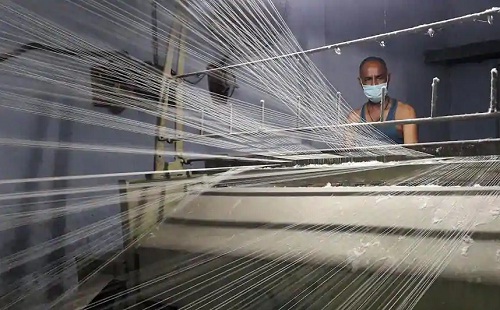 companies on the famous Silk Road route for textile ikats and embroideries. They lost genius of textiles in the Fergana valley of Babar with women in the region switching to velvet and synthetic kaftans manufactured and printed in China, using copies of patterns from traditional ikats
India too faces the risk of losing its textile crafts to China, warns Kumar. China is already making inroads in the Benaras sari market by selling cheaper, stiffer and totally unwearable versions of these saris in the Indian market. These saris are made with duplicate Chinese yarns which change their structure totally, making them unattractive to wear.
Original yarns to counter Chinese competition
To sustain itself, the Benaras silk industry needs to revert to original yarns, she says. India has abundant stock of indigenous mulberry silks that are softer, finer, lighter and allow more pliability when woven and have a wonderful texture. It also has traditional fibers like organic ahimsa silks, tussars and mogas, which are an intrinsic part of its heritage. These can easily replace Chinese yarns in Indian garments; especially Benaras saris and help the industry to engage millions of weavers in the country.
By dumping their silk yarns at a fraction of cost initially, Chinese manufacturers set up a lucrative business in India. This business is run by middlemen, who are unaware of the risks involved in producing unwearable garments from Chinese silk yarns. Therefore, the Indian textile industry needs to not just seek a ban on these imports but also adapt its textile techniques to find alternative yarns and fibers, opines Kumar.
COVID-19 to change fashion dynamics as demand to revive by 2023
 With one disaster after another, the fashion industry seems to be facing some of its darkest days ever. In April, revenues of the apparel and footwear sector contracted between 27 and 30 per cent year on year with luxury contracting almost 39 per cent, said McKinsey & Company. Analysts say, these estimates failed to account for three months of shuttered stores and a big shakeout of the industry is still to come.
Squeezing creativity out of fashion
Phyllis Shapiro, Founder and President, Innovative Consulting Solutions and Assistant Professor, believes, chasing cheap and measuring margins by brands over the last 10 years had already squeezed creativity out of fashion and made it uninteresting. The pandemic has made matters worse with the count for shuttered stores stretching beyond 13,000 in 2020. Shpairo believes, store closures will continue as companies are crippled by lack of cash and expects consolidation further upstream.
Walter Loeb, Consultant and former Retail Executive too expects more companies to go out of business. Already, COVID-19 has led to a long list of bankruptcies filed by companies such as: Brooks Brothers, JC Penney, J Crew, Stein Mart, Stage Stores, Debenhams, etc, Retailers are ploughing through the scum by bailing on staff, suppliers and stores. They are reviewing the current situation to determine future profitability. Lack of demand coupled with an oversupply of unsold stock has made matters untenable for them, says Loeb.
Regaining growth levels
Achim Berg, Senior Partner, McKinsey & Company points out, the light at the end of the tunnel may stretch to 2023. The industry may reach 2019 growth levels in 2023. Brands with a strong balance sheet will emerge stronger, online retail will perform better while luxury players may have a tougher time.
Though China, where a large portion of luxury purchasing happens, may recover sales, the European and North American markets will suffer, he adds. While China’s recovery may be V-shaped, Europe’s may have ‘Nike swoosh’ recovery, with the middle tier, falling apart, says Shapiro. Fashion, may be amongst the last categories to recover as consumers focus on basic requirements. In fashion, men’s wear may be the last to bounce back, views Loeb.
Evolve with changing times
Though present realities are bleak, there is hope for those that can stomach the blows. Brands with strong fundamentals will emerge stronger from the pandemic on account of close proximity with consumers, social media channels and stronger inventory management. However, these brands should reorganize their operations according to changing scenario and consumer behavior. Once their financial conditions stabilize, consumers may begin to buy fashion again, though the dynamics of their purchases may change, adds Berg.
Vietnam textile and garment exports to decline by 14%: Vinatex
The Vietnam Textile and Garment Group (Vinatex) forecasts Vietnam's textile and garment exports will continue to decline by 14-18 per cent each month for the rest of 2020 over the same period last year.
The group also said the total textile and garment export value for this whole year is estimated to hit about $32.75 billion, a year-on-year decrease of 16 per cent. Le Tien Trưong, General Director, Vinatex said the textile and garment will face greater difficulties in the final half of the year than the first half. Vietnam Textile and Apparel Association (VITAS) said the second quarter was the most difficult quarter for the textile and garment industry as customers in major export markets such as the US and EU cancelled 30-70 per cent of orders because the markets were closed due to the Covid-19 pandemic.
The Ministry of Industry and Trade also said as of July, many textile and garment enterprises had few orders for the last two quarters of this year, especially high-value products. Meanwhile, face masks and personal protective equipment, which are considered major products for many garment enterprises, have sharply decreased due to global oversupply.
According to the ministry, Vietnam's export value of textiles and garments in July was estimated at $3.43 billion, up 14.4 per cent compared to June but down 11.8 per cent year-on-year.
In the first seven months of this year, the textile and garment export value was at $19.21 billion, down 13.8 per cent year-on-year. The ministry forecasts Vietnam's textile and garment export value this year would reduce by 10-15 per cent to $33.6-36 billion compared to last year.