FW
Digital textile printing market continues to grow
The textile industry has taken an immense leap in the digital printing sector. One of the utmost promising developments in the textile industry is digital fabric printing. It has unlocked the doors for numerous prospects to enhance the quality and sustain the growing demands of textile printing. Worldwide market value for digital textile printing expanded to CAGR (Compound annual growth rate) of $1.88 billion in 2018.
 Specialists have forecast that global digital textile printing production will be around 1.6 billion square meters annually by 2019. Digital systems are set to continue this fascinating prospect as the products of the fashion, signage and home-made industries add new business models and value to the industry. This will upsurge the total value of the market by $3.75 billion in 2023 and will grow to consume over 2.70 billion m².
Dye-sublimation printing, in particular, has seen dramatic growth in the past several years, and direct-to-fabric printing is poised to displace some of the “traditional” transfer-based dye-sublimation printing. Improved print head design and higher-quality substrates are also strong drivers of growth of digital textile printing. Complement on top of that the phenomenal growth of “soft signage,” and it is hard to find a pessimistic forecast.
Digital Textile Printers are seeking more precise ways to determine the type of equipment and determine the length of time for printing. It has been revealed that print service providers are focusing on their printing technology for digital textile printing automatically. Worldwide, 22.2% of the Digital Textile Printing Market of the Polyester segmented to register the CAGR. The most frequently used digital textile printing are Direct to Fabric (DTF) and Direct to Garment (DTG) segment by printing process accounting more than 80% of the market portion of digital textile printing market.
Electronics for Imaging, Inc. is a leading international company based in Silicon Valley that specializes in digital printing technology, believes that digitally printed textiles will grow at 10-15% in the next several years.
“Mimaki” is another foremost manufacturer equipped with a wide range of solutions for textile printing. Yuji Ikeda, General Manager of global marketing at Mimaki Engineering, recently said to Textile Today that the market is growing and believes it will continue to do so at an extraordinary pace.
Eco-friendly mechanisms, high design flexibility, low-cost ornaments are the main motives for the growth of digital printing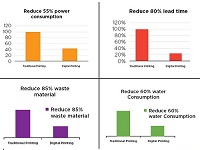 technology. The traditional textile printing process takes approximately 6-8 weeks to take 3-10 days through digital printing technology.
Difference between traditional digital printing
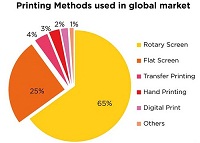
China produces nearly one-third of all printed textile in the world. Likewise, currently, the market segment of digital textile printing is only one to two percent. Compare to that 65% of the rotary screen printing is made, 25% by flat screen printing and made by handprint. Contrary to expectations, digital printing has scarcely any impact on the traditional printing process.
Printing Methods global market
 Bangladesh’s 86% of exports emanate from textile and textile products. In the field of digital printing, Bangladesh factories are doing significantly well. According to the data of BTMA (Bangladesh Textile Mills Association), Bangladesh has 240 dyeing-printing-finishing mills.
Picanol To Participate In Techtextil 2019 In Raleigh, N.C.
YPRES, Belgium — January 29, 2019 — Techtextil 2019 will take place February 26-28, 2019, in Raleigh, N.C., and Picanol will be present with an information booth — Booth 1636.
The history of Picanol is clearly intertwined with that of the American textile industry. Picanol set up its own organization — Picanol of America — on February 1, 1966. Since then, America has always proven to be a market of great strategic importance as Picanol has installed tens of thousands of weaving machines at American weaving mills. Over the years, the technical fabrics segment has become a very dominant area, which makes Techtextil an important fair for Picanol.
Picanol will not only promote its rapier and airjet weaving machines at Techtextil 2019, but also the extensive range of services and support that it provides to its many customers from its 18,000 square foot facility: training, electronic repairs, new machines installation & start-up, textile technical support, spare parts, and weave-up upgrades are among the most critical services that the Picanol team will discuss with visitors.
Rieter 2018 sales climb 11% to CHF 1,075 million
During fiscal 2018, total sales of Rieter, a textile machinery company, were CHF 1,075.2 million, 11 per cent higher than CHF 965.6 million in the last fiscal. The company's net liquidity also increased to CHF 150.3 million over CHF 130.5 million in fiscal 2017. However, the order intake was down 17 per cent year-on-year to CHF 868.8 million.
In the Asian countries excluding China, India and Turkey, Rieter increased sales in the reporting year by 36 per  cent to CHF 433.9 million, of which Uzbekistan contributed CHF 144.1 million. In 2018, sales in China fell by 19 per cent to CHF 148.6 million. With the phasing out of the subsidy programme in the western province of Xinjiang, the demand for machinery declined. Sales in India fell by 16 per cent to CHF 146.2 million. In Turkey, Rieter has achieved sales of CHF 154.8 million in a difficult market environment, due to the introduction of the new ring and compact spinning machines. Sales in North and South America amounted to CHF 108.6 million
In the Europe region, Rieter increased sales 3 per cent to CHF 47.3 million. Sales in the Africa region amounted to CHF 35.8 million.
The Machines & Systems business group has posted an order intake of CHF 468.3 million, a reduction of 30 per cent compared to the previous year. Demand in the new machinery business was characterised by uncertainties in Asia and Turkey as well as the tense financing situation for emerging market customers. Both factors had a negative impact on the investment sentiment in the spinning industry. This was especially evident in the fourth quarter of 2018, which with an order intake of CHF 34.9 million was very weak in all regions.
In the Components segment, order intake was CHF 260.1 million, around 14 per cent above the previous year. Due to weaker macroeconomic conditions, order intake in the fourth quarter of 2018 amounted to CHF 55.0 million which was lower than in the previous quarters. This decline can be attributed to a low propensity for investments by customers.
With an order intake of CHF 140.4 million, the After Sales segment has recorded a year-on-year decline of 9 per cent. Order intake of CHF 29.1 million in the fourth quarter of 2018 was lower than in the previous quarters. This is due in particular to the lower order intake for installation services for new Rieter machines.
Rieter completes acquisition of 25% stake in Electro-Jet S.L.
The Rieter Group completed the acquisition of a 25% stake in Electro-Jet S.L. on December 14, upon approval by the Spanish antitrust authority.
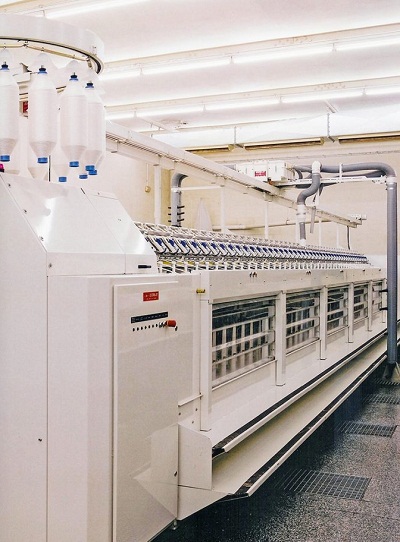 On July 18 last, Rieter signed a contract to acquire 25% of Electro-Jet S.L., thus strengthening the ring spinning system. The company, based in Gurb (Spain), generated annual sales of around EUR 25 million in 2017 and employs around 135 persons. The joint development of innovative products is also planned as part of the strategic partnership.
The Spanish company Electro-Jet, founded in the 1960s, is dedicated to the manufacture of machinery for the textile industry. The company has been exporting almost 95% of total production, India being one of its three top export markets. Within their range of products there are several models of overhead travelling cleaners for ring spinning frames, looms, winders, etc., which have been adapted to the requirements of the most modern machines. Electro-Jet also has its manufacturing facility in Madurai.
At the beginning of this century, the company also started production of a new automatic roving frame that has revolutionised the market.
It is specially in the automation field that Electro-Jet has been working vigorously for the past few decades and has installed worldwide many automatic transport systems for bobbins, cones and cans, having two main lines: the TAB transport system that allows a total automation in mills where having a great flexibility is a key factor.
The company also offers to its spinning customers several systems to process spinning tubes such as silos (stock) and complete automatic sets in order to sort out, clean and lay on trays this kind of tubes.
In the area of transport, logistics, palletising and packing, Electro-Jet executes made-to-measure projects, submitting this way global solutions for total automation of mills. It also offers fabric batchers and inspection machines, one of the main auxiliary machines in weaving mills, as they allow accumulation of fabric at the loom exit, in order to check it before passing to the next productive phase. They are designed to work both with natural and synthetic fibers, and they can be equipped with different options to be perfectly adapted to the needs of each mill
Indian textile and clothing exports decline in Q2 FY 18-19
"India’s textile and clothing (T&C) exports in the second quarter of FY 18-19, dropped 5.82 per cent to $8,935.55 million over its previous quarter. The US still remains top export market for India’s T&C goods, with goods worth of $2,059.37 million exported the US. Export of knitted apparels surpassed those of woven apparels. Knitwear exports totaled to $1941.34 million with a growth of 4.56 per cent"
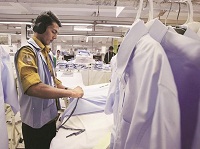 India’s textile and clothing (T&C) exports in the second quarter of FY 18-19, dropped 5.82 per cent to $8,935.55 million over its previous quarter. The US still remains top export market for India’s T&C goods, with goods worth of $2,059.37 million exported the US. Export of knitted apparels surpassed those of woven apparels. Knitwear exports totaled to $1941.34 million with a growth of 4.56 per cent
Cotton T-shirts lead growth
In the knitted apparel segment, cotton T-shirts ruled with export value worth $414.54 million. Exports of knitted cotton nightdresses and pyjamas grew at a robust 58.76 per cent to $83.71 million while those of cotton knitted babies garments declined by 3.34 per cent. Export of woven apparel was $1,731.83 million, registering a decline of 21.06 per cent. This was led by the export of men’s cotton shirt which was worth $204.24 million but its growth dropped marginally by 1.05 per cent. Exports of dresses made from cotton and artificial fibres dropped significantly by 43.38 per cent and 42.13 per cent totaling $75.20 million and $42.71 million respectively.
Indian exports rule the USA market
Country-wise, the US remained largest export market for India’s textile and clothing goods. In the second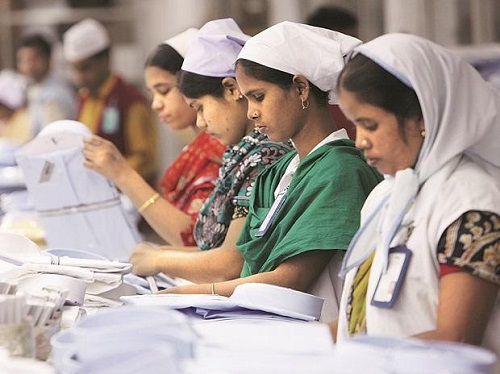 quarter of FY 18-19, exports to US was $2059.37 million, a growth of 2.89 per cent. In the US, India’s apparel exports rule with a stake of 47 per cent from the total T&C exports to the country. India’s apparel exports to the US during the quarter was $969.72 million.
Bangladesh, second largest export market
India’s T&C exports to Bangladesh increased by 1.97 per cent over the previous quarter with exports totaling to $580.12 million. India’s cotton exports to Bangladesh totaled to $475.21 million with a growth of 8.04 per cent. Export to UAE was worth $567.14 million with negative growth of 13.21 per cent. Currently UAE is the third largest export market for India’s T&C goods. Knitted apparel is the biggest commodity exported to the UAE with an export value of $252.12 million. But growth of knitted apparel dropped 7.48 per cent. Exports to UK was $517.22 million in Q2 but perceived a negative growth of 9.40 per cent over the previous quarter. Exports of knitted apparel totaled to $213.99 million with a growth of 10.07 per cent. Woven apparel exports dropped by 35.68 per cent while those of carpets and other textile floor coverings declined by 2.53 per cent.
Cotton lead T&C exports to China
India’s T&C exports to China fell 22.49 per cent to $464.84 million. Cotton was the major commodity exported worth $369.91 million. But the commodity perceived a negative growth of 24.72 per cent over the previous quarter.
Growth in other European markets also declined. India’s exports to Germany totaled $417.62 million a negative growth of 2.77 per cent. Export to Spain was $225.42 million declining 25.43 per cent. Exports to Italy dropped 4.20 per cent with an export value of $197.67 million while to France dropped 26.60 per cent to $190.61 million. Exports to Netherlands totaled $173.45 million with a growth of 4.07 per cent.
Pure London will go plastic-free
Pure London will replace speakers’ plastic water bottles with sustainable glass ones, getting rid of plastic cutlery in all catering areas and installing easy-to-use recycling points conveniently around the site. The aim is not the rather difficult one of banning plastics altogether, but cutting down on the amount used.
Last year, Pure London launched the hallmark Power of One campaign, designed to unite the fashion industry to take steps toward a sustainable future. By creating a forward-thinking supply chain and taking positive action towards change, the show offers a platform for greener and healthier fashion and retail industries. There is also a key focus to further educate retailers on why they should be investing in and stocking sustainable brands, how to move forward with best practices and implement sustainability policies as part of their business structure.
The next Pure London will be February 10 to 12, 2019.
Pure London is the UK's leading trade fashion buying event, representing conscious fashion, women’s wear, men’s wear, footwear, accessories, young fashion and kids’ wear. The show offers buyers from UK and international independents, multiples, department stores, e-tailers and mail order the opportunity to discover collections launching for the season ahead, attend catwalk shows and hear from their peers and other industry experts.
Pure Origin announces list of expert speakers
Manufacturing and supply chain expo, Pure Origin announced a line-up of leading experts who will take to the stage from February 10 to 12, 2019 discussing Brexit, sustainability, personalisation, the Amazon impact, digitalisation of the textile and apparel industry, innovations in athleisure, and garment costing interspersed with the newly launched Pure Origin AW21/SS22 Trend Catwalk shows.
Jovit Balseviciene, Solution Consultant from Lectra UK and Northern Europe, and Jean-Patrice Gros, UK & NE Managing Director, Lectra SA will highlight the growing consumer demand for personalisation. Christopher Stopes, Representative of GOTS in the UK, Global Organic Textile Standard, will discuss why organic fibre production on farm and organic processing in factories is good for people and planet; how to get started.
On Day two, experts from World Textile Information Network’s leading publications Industry Digitalisation and Technical Textiles will speak. Tansy Fall will provide an insight into the changing shape of the textile and apparel manufacturing supply chain and the impact on sourcing decisions. She will be followed by Maddi Cornforth, who will look at Amazon’s investments and patents in the textile, apparel and fashion sector. Anna Borkowicz, market intelligence analyst on Technical Textiles will given an insight into industry and challenges associated with development and commercialisation of smart clothing sport and fitness.
On day three, Fiona Haran, Editor of WTiN’s Future Textile, will dwell on the innovations in athleisure, and type of functionalities adopted in the products with commercial examples. Mark Powell, Senior Consultant, at EFI Optitex will end the show with a talk on using 3D digital transformation to support sustainability.
India and Bangladesh governments support Apparel Sourcing Week 2019
Scheduled for March 15 and 16, 2019 at the ITC Gardenia in Bengaluru, the Apparel Sourcing Week is being supported by the governments of both India and Bangladesh. Minister for Commerce and Industry, Suresh Prabhu has consented to be the chief guest at the inaugural session of Apparel Sourcing Week. India and Bangladesh are also working on a Comprehensive Economic Partnership Agreement (CEPA) which would set an example for giving a boost to regional trade in South Asia.
Acknowledging this prolific opportunity and supporting the need for greater synergy in the garment industry, the newly appointed commerce minister of Bangladesh Tipu Munshi has agreed to be the guest of honor at the Apparel Sourcing Week. Munshi not only understands the significance of ASW ’19 platform from a business perspective, but also sees India as an important market of the future.
The exhibition will be supplemented by a series of six retail-focused seminars by industry experts, 2-trend forecast workshops by Fashion Snoops and one gala networking dinner on the first night that will bring together the who’s who of the Indian Retail industry.
Sustainability is a way of life among Mauritius apparel units
In Mauritius, sustainability is commonplace among manufacturers, both because companies adopt more eco-friendly policies and because resources aren’t easy to come by. Mauritius’ main markets for its textiles and apparel are the US, UK, France and South Africa. Denim is the third major apparel product after T-shirts and shirts. Other products for which the country is known are knitwear, casual shirts, formal wear, swimwear and sweaters.
Mauritius boasts of having one of the best infrastructures in Africa. It has quite a few vertically integrated units. The country is developing the capability and capacity to cater to the needs of global buyers especially US buyers. The tiny isle off the coast of Africa enjoys the benefits of African Growth and Opportunity Act, a trade privilege program that means it can ship products to the US duty free. And Mauritius enjoys a similar perk with Europe.
These trade agreements position Mauritius to serve global brands that can ship to key customers in both regions without tariffs straining margins that are already tight. In terms of communication, credibility in terms of delivery, Mauritius is faster than Asian countries. The country may not yet be making headlines as a supplier of denim, but that’s due to a lack of open-mindedness about new sourcing locales.
Bucharest hosts seminar on creating organised workforce
Romanian textile unions met in Bucharest to debate the road towards an organised workforce with living wages and collective agreements, together with global brands H&M and Inditex, their key suppliers, employer associations and the government. The seminar, held in Bucharest on January 22-23, 2019 was a part of an EU-funded project.
Christina Hajagos-Clausen, Textile Director, IndustriALL showcased how unions work with global brands, the Bangladesh Accord, how GFAs can be used in organising; and the Action – Collaboration – Transformation (ACT) initiative to achieve living wages. Representatives from GFA partners H&M and Inditex, also members of ACT, explained how they in cooperation with unions solve problems when they occur and promote functioning labour-management relations and collective bargaining.