FW
South Africa to launch black industrialist textile firm
Bulelani Magwanishe, the Deputy Minister of Trade and Industry and Sihle Zikalala, KwaZulu-Natal MEC for Economic Development, Tourism and Environmental Affairs will launch Africa Bespoke Apparel (ABA), an R81 million black Industrialist textile firm in Verulam, KwaZulu-Natal, South Africa on January 22, 2019. ABA is one of the first black industrialists beneficiaries to have created around 450 job opportunities within four months of its operations. The company received a grant of R35.5 million from the Department of Trade and Industry and also Black Industrial Scheme (BIS). The project is co-funded by KwaZulu-Natal government’s Growth Fund.
The latest technology installed through BIS will help ABA increase its production by three times. Besides BIS will extend its support to ABA to expand into the sub-Saharan African markets.
Mumbai hosts GTTES showcasing latest innovations in textile tech
Global Textile Technology and Engineering Show (GTTES) is being held in Mumbai, from January 18 to 20, 2019. The fair offers new optimism, opportunities and prospects for the textile industry with 400 exhibitors, 49 countries and 65 international business delegations.
Among the participants are: Sri Lanka, Slovenia, Belgium, China, France, Germany, Italy, Japan, Spain, Turkey, UK, USA, Taiwan, Morocco, Algeria. The event has achieved its place as a reliable international business platform for both domestic and overseas companies. GTTES facilitates interaction with all export promotion councils which will help industry to know more about export opportunities, various government subsidies, market initiative schemes available for Indian manufacturers and help to gain information and develop new opportunities for exports from India.
The event is a platform to connect exhibitors with new markets which have never looked at India as a sourcing opportunity. Both for Indian manufacturers and foreign exhibitors these new and developing markets can bring future opportunity for business and expand their customer networking in an unprecedented way.
GTTES is a must to visit event for every company in textiles and textile engineering. A highlight of the event was the launch of the Colorix digital printing solution by the Orange Group.
Myanmar garment exporters to EU increase from 22 to 180 in five years
According to Aung Naing Oo, Director-General of Department of Investment and Companies Administration (DICA), the numbers of garment factories whose products are being exported to the European Union have increased by 180 within five years. In 2013, only 22 garment factories exported to EU but at present, the number has increased to 202, an increase by 180, primarily due to benefits brought about by the EU's Generalized Scheme of Preferences (GSP).
There were 24 factories: 22 garment factories exporting garment to the EU, one factory (non-CMP industry) and one factory (CMP industry) before the EU’s reinstatement of GSP rights to Myanmar in 2013. At the time, these factories created more than 23,000 jobs.
After Myanmar earned GSP rights beyond 2013, the number of factories of all kinds has increased to 305—202 garment factories, 26 factories (non-CMP) and 77 factories (non-CMP garment). These factories have job creating capacity of more than 300,000 jobs.
Malaysia to increase textile exports to the US
Amidst ongoing trade war between the US and China, Malaysia is seeing a huge potential of enhancing textile exports to the US. One of the buyers, at the recently concluded Heimtextil Trade Show, said if US firms decide to quit China, Malaysia could be ideal replacement mainly owing to latter’s superior textile quality. He added that many US buyers are now becoming aware of this unbalanced dependence on China, besides a lot of overseas importers have often faced quality concerns with Chinese products.
Another participant, Nature World Manufacturing Sdn Bhd, too received good enquiries. The company manufactures home textile products. The event witnessed good participation from Asean countries, including eight from Indonesia, three from Malaysia and eight from Vietnam.
Olaf Schmidt, Vice President, Textiles and Textile Technologies, Messe Frankfurt expressed delight at ASEAN region’s potential and said that soon countries like Vietnam, Malaysia and Bangladesh would become key players in the global textile supply chain.
Kering publishes ‘Planetary Boundaries’ paper in conjunction with CISL
French luxury and lifestyle business Kering, which owns brands like Gucci, Yves Saint Laurent and Alexander McQueen, has published the first in a series of white papers on the concept of Planetary Boundaries in conjunction with the Cambridge Institute for Sustainability Leadership (CISL).
The Planetary Boundaries (PB) framework was first introduced in 2009 as a science-based guidance system for human development on earth. The concept was developed by a group of environmental scientists led by Johan Rockström from the Stockholm Resilience Centre and Will Steffen from the Australian National University. The group wanted to define a ‘safe operating space for humanity‘ for the international community, including governments at all levels, international organisations, civil society, the scientific community and the private sector, as a precondition for sustainable development.
The PB framework is a fundamental element to include when designing the agenda for managing and mitigating our global environmental challenges. As businesses we need to go far beyond our single, individual issues and contribute to meaningful change at a global level.
The fundamental principle on which the PB framework rests is that Kerin’s actions undermine the relatively stable conditions of the past 12,000 years. This unique period of stability of the climate, and of the earth system as a whole, known as the Holocene epoch, has allowed humanity to develop agriculture, settlements and the complex societies prevalent today.
Indian cotton exports to Pakistan unlikely to increase despite duty cuts
India's cotton exports to Pakistan are unlikely to increase, despite the neighbouring country scraping import duty, as high domestic prices have made exports uncompetitive. Indian cotton is currently available around Rs 43,000 a candy, while prices in Pakistan are at sub Rs 43,500 making it (exports) unviable so far.
Recently, Pakistan scrapped duties on import of cotton for February 1-June 30 to tide over shortage of the crop. Indian traders, usually large exporters to Pakistan, would have benefited, but for their high procurement cost. In 2015-16, India had exported over 2.5 million bales of cotton to Pakistan when crop there fell over 30 per cent. In the current year, Pakistan has harvested 10.8 mln bales of cotton, down 25 per cent from initial target of 14.4 million bales. But the situation is different this time. Indian prices are not competitive. If rupee depreciates or prices in Pakistan rise exports will pick up
Indian cotton can reach Pakistan in just one day through roads from Punjab or even via sea route it can reach in three-four days, as against 20-45 days from other regions such as Africa, the US or Australia.
Selvedge Run ends in Berlin, sees a rise in number of visitors
Selvedge Run was held in Germany from January 15 to 17, 2019. Selvedge is a trade show for quality garments and crafted goods with a focus on denim and heritage brands. It featured more than 70 brands and a strong increase in visitors.
This was the first edition of Selvedge Run as a part of the Panorama Berlin family. With this acquisition, Panorama hopes to reach out to new target groups and create connecting synergies. After several successful editions Selvedge Run felt it was time to reach out to a new level and with the wide range and the logistic power of Panorama, Selvedge saw a good opportunity to unfold the full potential of its exhibitors and their brands and to open it to a wider audience.
Selvedge Run is a trade show for quality garments, shoes, accessories and lifestyle goods. It is a home for brands with character. The name is taken from the technical term for the narrow, tightly woven, self-finished edges most commonly associated with high-quality denim.
Longevity and transparency rather than a fast fashion approach is what Selvedge Run is looking for: a preference for not outsourcing to low wage countries and a closer geographic and cultural link between design and manufacturing with, wherever possible, a commitment to fair and sustainable production conditions. Brands that have a close connection to a specific region and its cultural and economic heritage are preferred.
Crude oil volatility affects Indian synthetics sector
Volatility in crude oil prices has hit Indian synthetic textile manufacturers. When crude prices hit their highest levels in 2018, raw material buyers placed massive orders steadily to build their pipeline inventory before any further rise. The sudden spurt in prices prompted producers of manmade fiber and synthetic yarn manufacturers to start placing orders again. However, the entire sentiment saw a reversal in two months.
Raw material buyers in the synthetic textile industry have disappeared from the market amid expectations of a further fall in prices. Raw material purchasers have deferred their purchase orders on expectations of a further decline in crude oil prices and, subsequently, prices of synthetic fiber and yarn. Manmade fibers and yarns are made from petrochemicals, which are derivatives of crude oil. Their prices follow the movement in crude oil prices.
The industry believes the October-December quarter may not be good in terms of the top line and bottom line but hopes for stabiliity from the March quarter. Also the impact of volatility in crude oil prices has been nullified by the rising demand for synthetic textile products in India. Polyester is slowly replacing cotton, thereby increasing the production of manmade fibers. Demand for synthetic textiles is rising with rapid urbanisation and low-cost options available in the clothing segment.
Levi’s denim customisation offers creative freedom to customers
"To whet consumers’ appetites for perfectly damaged jeans, Levi’s has been selling denim customised by Aldridge, rapper Snoop Dogg, actress Sasha Lane, surfer Kelly Slater, tattoo artist Dr. Woo, basketball star Blake Griffin and others. Model Lily Aldridge, Vice President of technical innovation for Levi's, designs a pair of jeans on an iPad alongside Bart Sights. So does her husband, Kings of Leon singer Caleb Followill, A pair of Levi's designed by Lily Aldridge go through the laser process."
 To whet consumers’ appetites for perfectly damaged jeans, Levi’s has been selling denim customised by Aldridge, rapper Snoop Dogg, actress Sasha Lane, surfer Kelly Slater, tattoo artist Dr. Woo, basketball star Blake Griffin and others.
Model Lily Aldridge, Vice President of technical innovation for Levi's, designs a pair of jeans on an iPad alongside Bart Sights. So does her husband, Kings of Leon singer Caleb Followill, A pair of Levi's designed by Lily Aldridge go through the laser process.
Technology to create personalized experiences
Levi’s plans to expand its customisation program next year where consumers can follow Aldridge’s lead and get their denims customised. The brand will install a laser machine, developed by Spanish company Jeanologia, in one of its stores in the U.S. Online and in stores, consumers will use a similar app to personalise their jeans. Levi’s is yet to finalise the cost for customisation of their jeans.
Lily Aldridge places a tear on a pair of jeans she personalises at Levi's temporary downtown L.A. studio. She has customised so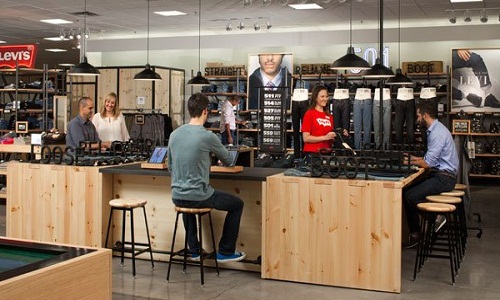 far two pairs of jeans and drew cheetah spots on a back pocket with the laser machine. These jeans are displayed by Bart Sights, Vice President-Technical Innovation for Levi's.
Besides beating fast fashion at their own game, customisation delivers what people need when they want it, and giving them the freedom to express their creativity.
Yoga wear dominates active wear in the US
The active wear market in the US has changed over the last three years. About $48 billion is being spent on active wear in the US every year. As more consumers in the US are exercising and prioritizing their health, this is fuelling the active wear market for on-trend performance items.
Traditional sports brands have grown their assortment. The number of yoga products in stock in 2018 has increased by 35.8 per cent compared to 2016. Yoga leggings skyrocketed by 87 per cent compared to 2017. What was once a simple stretchy legging has become a wardrobe phenomenon.
Pricing in the traditional sports market, despite some fluctuations, has generally maintained a consistent level. Traditional active wear retailers are having to compete to maintain their valuable relationship with customers. Non-traditional sports retailers are getting in on the game and launching their own active wear collections at a more accessible price point for consumers.
So retailers need to harness the power of data and understand when to buy-in or buy-out of trends. Grey and white are the most favored color for new active wear products, holding almost 23 per cent of the color palette. High rise leggings are the most popular style for replenishments – not surprising seeing they are a flattering design that suits all body types.