FW
The Resale Revolution: Vinted’s marketplace model reshapes European retail

The French fashion market has reached a turning point. In a development that highlights the growing influence of circular commerce, Vinted has emerged as the leading fashion retailer in France in terms of volume of items sold, overtaking a roster of established apparel giants that have long dominated the market. Data compiled by the Institut Français de la Mode (IFM) places the Lithuania-founded peer-to-peer marketplace ahead of traditional retailers, confirming that secondhand commerce has evolved from a niche sustainability trend into a mainstream retail force.
The achievement marks more than a change in market rankings. It reflects a broader transformation in consumer purchasing behavior across Europe, where inflationary pressures, constrained household budgets, and rising environmental awareness are boosting demand for pre-owned fashion. Unlike conventional retailers, Vinted has built its position without manufacturing products, holding inventory, or operating stores. Instead, it has leveraged digital infrastructure, logistics integration, and network effects to become one of Europe’s most influential fashion platforms.
France’s new fashion leader
The latest IFM rankings reveal the scale of the disruption. Vinted now sits above value-fashion chains, global e-commerce platforms, and fast-fashion leaders in terms of items sold within the French market.
Table: Leading fashion retailers in France by items sold
|
Rank |
Market position |
Business model/subsSector |
|
#1 |
Vinted |
Peer-to-Peer Digital Marketplace |
|
#2 |
Kiabi |
Value-Driven Brick-and-Mortar / Digital |
|
#3 |
Amazon |
Multi-Category E-Commerce Platform |
|
#4 |
Decathlon |
Mass-Market Sports & Performance Apparel |
|
#5 |
Shein |
Direct-to-Consumer Ultra-Fast Fashion |
|
#6 |
H&M |
Global High-Street Fast Fashion |
|
#7 |
Intersport |
Multi-Brand Sporting Goods Retailer |
The ranking is particularly notable because it places a resale marketplace ahead of businesses built on large-scale production and inventory ownership. This shift suggests that consumers are prioritizing value, affordability, and access over ownership of newly manufactured apparel.
Growth through infrastructure
Vinted’s ascent has been driven by an operational model that differs sharply from conventional e-commerce. While most online marketplaces charge sellers listing or transaction fees, Vinted removed selling fees altogether. Instead, the platform derives revenue primarily from buyer protection charges and premium visibility services. This structure lowers barriers for participation and encourages a constant influx of inventory. The result is a marketplace with exceptional product depth and liquidity, where buyers can access millions of listings across price points.
Equally important has been the company’s investment in logistics and payments infrastructure. Through Vinted Go, the company has established a network of over 500,000 pick-up and drop-off points across Europe. Combined with the introduction of Vinted Pay and dedicated sorting facilities, these investments reduce dependency on third-party providers while lowering transaction costs.
The strategy enables profit trading even for low-value items, an area where many traditional retailers struggle due to shipping and handling expenses. By minimizing friction at every stage of the transaction, Vinted has transformed operational efficiency into a competitive advantage.
Financial momentum
The company’s financial performance shows how effectively this model is scaling. Recent figures show strong growth across merchandise volume, revenue, and cash generation, even as management continues investing heavily in expansion.
Table: Financial performance and core trading metrics
|
Category |
Performance indicator |
Baseline |
|
Gross Merchandise Value (GMV) |
€10.8 bn |
47% year-on-year growth |
|
Group Revenue |
€1.1 bn |
38% year-on-year growth |
|
Net Profit |
€62 mn |
Reduced by 19% due to reinvestment |
|
Free Cash Flow |
€137 mn |
Increased 36% year-on-year |
|
Average Transaction Value |
€13.81 |
Supported by 83% repeat-customer engagement |
These figures illustrate a business achieving scale while maintaining healthy liquidity. The combination of strong free cash flow and high customer retention indicates that Vinted’s growth is being driven not only by new users but also by increasing engagement among existing members. Chief Executive Officer Thomas Plantenga has repeatedly emphasized that the company’s objective is to make secondhand the default choice for consumers. The strategy hinges on reducing operational costs while increasing convenience, thereby reinforcing network effects that become stronger as participation grows.
Exporting the model
Having established France as its strongest market, Vinted is now attempting to replicate its success internationally. France alone has evolved into a multibillion-euro GMV engine, providing a blueprint for expansion into other European territories. The company has already strengthened its presence in Germany, broadened its category offerings beyond apparel into electronics and collectibles, and entered additional European markets including Latvia, Estonia, and Slovenia.
The most significant move, however, has been its entry into the US. The American market presents a vastly different operating environment. Europe’s dense geography allows efficient use of collection points and consolidated shipping networks. In contrast, the US faces higher logistics costs, greater geographic dispersion, and intense competition from established resale players such as Poshmark, ThredUp, and eBay. Whether Vinted can successfully adapt its low-cost European logistics model to North America may determine the company’s next phase of growth and future valuation.
The trust challenge
Despite its momentum, secondhand commerce still faces limitations. Unlike traditional retail, peer-to-peer marketplaces must overcome concerns around product quality, sizing accuracy, authenticity, and counterfeiting. These trust barriers remain one of the strongest defences available to premium fashion brands and established retailers. Many consumers continue to place a value on guaranteed quality, standardized returns, and the certainty associated with purchasing new products.
Recognizing this challenge, resale platforms are investing in authentication services, artificial intelligence-driven recommendations, and enhanced customer support. The goal is to narrow the trust gap between new and secondhand purchases. If platforms such as Vinted succeed in creating a resale experience that matches the reliability of traditional retail, the implications for the apparel industry could be profound. What began as an alternative channel for budget-conscious shoppers may evolve into a dominant distribution model capable of reshaping the economics of fashion retail across global markets.
For now, Vinted’s rise to the top of France’s fashion rankings offers a clear signal: the future growth battle in apparel may no longer be fought primarily through manufacturing scale or store networks, but through the ability to build efficient, trusted marketplaces that keep products circulating long after their first sale.
France declares war on ultra-fast fashion with new green law, will reshape global supply chains

France has become the first major economy to legislate specifically against the ultra-fast fashion business model, a watershed moment for the global apparel industry. By approving landmark legislation aimed at curbing the environmental impact of high-volume, low-cost fashion imports, the French Parliament has created a regulatory template that could reshape apparel sourcing, pricing and retail strategies across Europe.
More than an environmental measure, the legislation is a structural intervention into one of the world's fastest-growing retail models. Companies that built their success on thousands of daily product launches, ultra-low prices and cross-border direct shipping now face financial penalties, advertising restrictions and tighter operational scrutiny. If replicated elsewhere in Europe, the French model could alter the economics of ultra-fast fashion.
Targeting the volume model
Unlike conventional sustainability regulations that apply broadly across the apparel sector, France's legislation introduces a distinct category for ‘ultra-fast fashion’. Companies will be assessed primarily on two characteristics: the sheer volume of new products introduced daily and the pricing structure that encourages rapid consumption over repair.
The framework is widely seen as targeting Asian digital marketplaces including Shein, Temu and AliExpress, whose business models depend on constant product refreshes and direct-to-consumer cross-border shipments. Traditional European retailers such as Zara and Kiabi are largely insulated under the current framework, reflecting the government's intention to curb the most aggressive volume-driven retail models rather than the broader fashion industry. The move also signals an effort to protect domestic retailers from low-cost imports while aligning with France's wider environmental objectives.
Cost of compliance
The legislation introduces a phased environmental surcharge on qualifying garments that will increase significantly over the next four years.
Table: Rising financial toll of ultra-fast surcharges
|
Year of implementation |
Environmental penalty per garment |
Maximum penalty (% of pre-tax price) |
|
2026 |
€0.25 to €6.00 |
50% |
|
2028 |
€10.00 |
50% |
|
2030 |
€20.00 |
50% |
For retailers operating on razor-thin margins, the implications are substantial. A €5 garment could immediately incur a surcharge equal to half its pre-tax value under the penalty cap. By 2030, a €20 item could attract an additional €10 levy, severely eroding the price advantage that has fuelled ultra-fast fashion's growth. Beyond product levies, the legislation also prohibits advertising by designated ultra-fast fashion companies across traditional media and influencer marketing channels. E-commerce platforms will also be required to display messages encouraging garment repair, reuse and reduced consumption, reinforcing behavioural change alongside financial disincentives.
Supply chains under pressure
The law is expected to reverberate well beyond France's borders. Ultra-fast fashion retailers have relied on direct air shipments of millions of small parcels from manufacturing centres in China to European consumers. The new framework, combined with additional packaging taxes on lightweight imports, threatens to increase logistics costs while undermining the efficiency of cross-border fulfilment networks. As a result, companies may increase efforts to regionalize distribution, diversify sourcing and establish European warehousing operations.
For apparel-producing economies such as Bangladesh, the implications are equally significant. Manufacturers heavily dependent on high-volume, low-cost production could face order consolidation unless they move toward higher-quality, longer-lasting products that better align with Europe's evolving sustainability requirements.
Conversely, European value retailers, local apparel brands and circular fashion platforms such as second-hand marketplaces stand to benefit as consumers shift spending away from ultra-low-cost imports.
Industry divided
Despite broad political support, the legislation has exposed sharp divisions within the retail industry. French apparel organizations welcomed the bill as a necessary step toward addressing environmental costs that have long gone unpriced. However, several major trade bodies, including Alliance du Commerce, Fevad and the Federation of Commerce and Distribution have questioned whether the law will achieve its intended objective.
Industry groups argue that large global platforms possess the technological sophistication to restructure logistics networks, split shipments or adapt product listings to remain below regulatory thresholds, while smaller domestic retailers could face disproportionate compliance burdens.
Environmental organizations have expressed different concerns. Campaign groups argue that exempting established international retailers weakens the legislation's environmental credibility, pointing out that global brands including Zara, H&M, Primark and Uniqlo also depend on high-volume production models.
European legal test
Before the legislation reaches full implementation, it must also face European regulatory scrutiny. The European Commission has previously questioned whether certain provisions including advertising restrictions and targeted import penalties are compatible with EU rules governing digital commerce and the single market.
French authorities maintain that the measures are comparable to existing public-health restrictions applied to products such as tobacco and alcohol. However, the legislation's practical impact will ultimately depend on implementing decrees that define precisely how companies will be classified and how environmental performance will be measured. Much will hinge on France's environmental labelling methodology, which incorporates both production volumes and product durability into sustainability assessments.
Strategic pivot for global retailers
The timing is particularly significant for Shein, which has been actively expanding its European footprint. The company has invested in regional logistics hubs, local sourcing partnerships and temporary physical stores across France as it attempts to reduce dependence on cross-border fulfilment. Those investments may help cushion some operational disruptions, but they are unlikely to eliminate the financial impact of escalating environmental surcharges. Whether localized operations can preserve the company's ultra-low-price proposition will become clearer as implementation rules take shape.
Europe's green retail agenda
France's initiative also aligns with broader European reforms reshaping the textile industry. From July 2026, the EU's Ecodesign for Sustainable Products Regulation prohibits large companies from destroying unsold clothing, footwear and accessories. At the same time, Extended Producer Responsibility (EPR) schemes will require apparel companies to finance textile collection, recycling and waste management based on product durability and recyclability.
Together, these measures create a powerful regulatory framework that transforms textile waste from an environmental concern into a direct commercial cost. For the global apparel industry, France's legislation marks more than a national policy experiment. It signals that governments are willing to regulate fashion not only through sustainability targets but also by directly challenging the commercial logic of ultra-fast consumption. As other European markets weigh similar measures, the industry may be entering a new era where speed and low prices are no longer sufficient competitive advantages.
France declares war on ultra-fast fashion with new green law, will reshape global supply chains
France has become the first major economy to legislate specifically against the ultra-fast fashion business model, a watershed moment for the global apparel industry. By approving landmark legislation aimed at curbing the environmental impact of high-volume, low-cost fashion imports, the French Parliament has created a regulatory template that could reshape apparel sourcing, pricing and retail strategies across Europe.
More than an environmental measure, the legislation is a structural intervention into one of the world's fastest-growing retail models. Companies that built their success on thousands of daily product launches, ultra-low prices and cross-border direct shipping now face financial penalties, advertising restrictions and tighter operational scrutiny. If replicated elsewhere in Europe, the French model could alter the economics of ultra-fast fashion.
Targeting the volume model
Unlike conventional sustainability regulations that apply broadly across the apparel sector, France's legislation introduces a distinct category for ‘ultra-fast fashion’. Companies will be assessed primarily on two characteristics: the sheer volume of new products introduced daily and the pricing structure that encourages rapid consumption over repair.
The framework is widely seen as targeting Asian digital marketplaces including Shein, Temu and AliExpress, whose business models depend on constant product refreshes and direct-to-consumer cross-border shipments. Traditional European retailers such as Zara and Kiabi are largely insulated under the current framework, reflecting the government's intention to curb the most aggressive volume-driven retail models rather than the broader fashion industry. The move also signals an effort to protect domestic retailers from low-cost imports while aligning with France's wider environmental objectives.
Cost of compliance
The legislation introduces a phased environmental surcharge on qualifying garments that will increase significantly over the next four years.
Table: Rising financial toll of ultra-fast surcharges
|
Year of implementation |
Environmental penalty per garment |
Maximum penalty (% of pre-tax price) |
|
2026 |
€0.25 to €6.00 |
50% |
|
2028 |
€10.00 |
50% |
|
2030 |
€20.00 |
50% |
For retailers operating on razor-thin margins, the implications are substantial. A €5 garment could immediately incur a surcharge equal to half its pre-tax value under the penalty cap. By 2030, a €20 item could attract an additional €10 levy, severely eroding the price advantage that has fuelled ultra-fast fashion's growth. Beyond product levies, the legislation also prohibits advertising by designated ultra-fast fashion companies across traditional media and influencer marketing channels. E-commerce platforms will also be required to display messages encouraging garment repair, reuse and reduced consumption, reinforcing behavioural change alongside financial disincentives.
Supply chains under pressure
The law is expected to reverberate well beyond France's borders. Ultra-fast fashion retailers have relied on direct air shipments of millions of small parcels from manufacturing centres in China to European consumers. The new framework, combined with additional packaging taxes on lightweight imports, threatens to increase logistics costs while undermining the efficiency of cross-border fulfilment networks. As a result, companies may increase efforts to regionalize distribution, diversify sourcing and establish European warehousing operations.
For apparel-producing economies such as Bangladesh, the implications are equally significant. Manufacturers heavily dependent on high-volume, low-cost production could face order consolidation unless they move toward higher-quality, longer-lasting products that better align with Europe's evolving sustainability requirements.
Conversely, European value retailers, local apparel brands and circular fashion platforms such as second-hand marketplaces stand to benefit as consumers shift spending away from ultra-low-cost imports.
Industry divided
Despite broad political support, the legislation has exposed sharp divisions within the retail industry. French apparel organizations welcomed the bill as a necessary step toward addressing environmental costs that have long gone unpriced. However, several major trade bodies, including Alliance du Commerce, Fevad and the Federation of Commerce and Distribution have questioned whether the law will achieve its intended objective.
Industry groups argue that large global platforms possess the technological sophistication to restructure logistics networks, split shipments or adapt product listings to remain below regulatory thresholds, while smaller domestic retailers could face disproportionate compliance burdens.
Environmental organizations have expressed different concerns. Campaign groups argue that exempting established international retailers weakens the legislation's environmental credibility, pointing out that global brands including Zara, H&M, Primark and Uniqlo also depend on high-volume production models.
European legal test
Before the legislation reaches full implementation, it must also face European regulatory scrutiny. The European Commission has previously questioned whether certain provisions including advertising restrictions and targeted import penalties are compatible with EU rules governing digital commerce and the single market.
French authorities maintain that the measures are comparable to existing public-health restrictions applied to products such as tobacco and alcohol. However, the legislation's practical impact will ultimately depend on implementing decrees that define precisely how companies will be classified and how environmental performance will be measured. Much will hinge on France's environmental labelling methodology, which incorporates both production volumes and product durability into sustainability assessments.
Strategic pivot for global retailers
The timing is particularly significant for Shein, which has been actively expanding its European footprint. The company has invested in regional logistics hubs, local sourcing partnerships and temporary physical stores across France as it attempts to reduce dependence on cross-border fulfilment. Those investments may help cushion some operational disruptions, but they are unlikely to eliminate the financial impact of escalating environmental surcharges. Whether localized operations can preserve the company's ultra-low-price proposition will become clearer as implementation rules take shape.
Europe's green retail agenda
France's initiative also aligns with broader European reforms reshaping the textile industry. From July 2026, the EU's Ecodesign for Sustainable Products Regulation prohibits large companies from destroying unsold clothing, footwear and accessories. At the same time, Extended Producer Responsibility (EPR) schemes will require apparel companies to finance textile collection, recycling and waste management based on product durability and recyclability.
Together, these measures create a powerful regulatory framework that transforms textile waste from an environmental concern into a direct commercial cost. For the global apparel industry, France's legislation marks more than a national policy experiment. It signals that governments are willing to regulate fashion not only through sustainability targets but also by directly challenging the commercial logic of ultra-fast consumption. As other European markets weigh similar measures, the industry may be entering a new era where speed and low prices are no longer sufficient competitive advantages.
Primark expands US footprint with dual mid-year openings
Primark is accelerating its American growth trajectory, announcing the opening of two additional locations this July. The retailer will debut its seventh Texas storefront at Houston’s Willowbrook Mall on July 16, followed by its inaugural entry into the Indiana market at Indianapolis’s Castleton Square Mall on July 23. These upcoming launches, each spanning nearly 30,000 sq ft of retail space, bring the company’s total US store count to 44. This rapid roll-out follows the retailer's recent high-profile launch of a 54,000-sq-ft flagship in New York City’s Herald Square, signaling a move toward both high-density urban flagships and strategic regional expansion.
Value-driven retail in a competitive landscape
The retailer's US expansion is built on a ‘store-led’ model that prioritizes physical experiences to drive brand awareness in a highly competitive market. By maintaining price-sensitive offerings - such as denim starting at $12 and T-shirts at $5 - Primark is positioning itself as a primary destination for inflation-conscious consumers seeking fashion without compromise. Primark’s offering of quality fashion at exceptional value is more important than ever to today’s consumers, noted Kevin Tulip, President, Primark US. While the company utilizes digital platforms to build engagement and provide product visibility, it intentionally keeps its US sites non-transactional, compelling shoppers to visit physical locations to finalize purchases. This disciplined approach to bricks-and-mortar retail has been instrumental in growing the brand's presence across 13 states since its US debut in 2015.
Primark is an international value-fashion retailer founded in Ireland in 1969. It operates over 480 stores across 19 countries, offering apparel, beauty, and homeware. The company is currently scaling its U.S. presence, aiming for 60 stores by the end of 2026, supported by strong global profitability and sustained brand momentum.
Taiwan textile sector integrates circularity through material engineering
Taiwan’s textile manufacturers are aggressively shifting from basic recycled content toward sophisticated, circular material systems to address tightening global sustainability regulations. By emphasizing mono-material designs and textile-to-textile recycling, the nation’s mills are attempting to solve the industry’s long-standing challenge of complex, multi-fiber garment disposal. This technical evolution is best exemplified by Everest Textile’s latest breakthrough: a fully polyester-based, three-layer material that integrates 100 per cent Global Recycled Standard (GRS) polyester with an eco-friendly rTPEE membrane. Having recently secured the Outstanding Innovation Technology Award at the 2026 Taiwan Circular Economy Awards, this innovation demonstrates how manufacturers are reducing greenhouse gas emissions by up to 70 per cent compared to traditional petroleum-based synthetic alternatives.
Industrial cross-pollination and resource efficiency
The industry’s strategy extends beyond mere fabric production, favoring interdisciplinary material migration to maximize resource efficiency. Leading firms are now upcycling textile waste into high-performance resins for the electronics sector, while simultaneously importing precision optical film expertise to create solvent-free, functional membranes for activewear. We are moving beyond simple performance-led innovation toward responsible functionality, explains a lead researcher at the Taiwan Textile Federation. By converting agricultural byproducts - such as oyster shells and fish scales - into functional yarns, suppliers are curbing dependence on virgin synthetics. These developments align with the European Union’s upcoming Digital Product Passport (DPP) requirements, positioning Taiwanese suppliers as essential partners for global brands struggling to meet mandatory traceability and carbon-accountability standards.
Taiwan’s textile sector is a highly specialized ecosystem focused on high-performance functional textiles, polymer engineering, and sustainable manufacturing. Key markets include high-end sportswear, outdoor apparel, and industrial safety sectors. Growth plans prioritize circularity, mono-material engineering, and digital supply chain integration, supported by a long-standing foundation of advanced technical R&D.
Thailand T&A exports remain resilient amid shifting regional demand
Thailand's textile and apparel (T&A) sector is navigating a period of structural recalibration, with recent data revealing a nuanced divergence between upstream production and finished apparel. While aggregate export values for the sector reached US$1.84 billion in Q1, FY26 – a marginal 1.1 per cent Y-o-Y increase.
Internal performance metrics highlight contrasting fortunes.
Textile exports, specifically fiber and fabric shipments,recorded a growth of 6.37 per cent to US$1.139 billion, underscoring Thailand's enduring strength as a reliable supplier of high-quality intermediary inputs. Conversely, the finished garment segment experienced a contraction of 6.43 per cent, falling to US$701 million as global apparel demand remained suppressed by persistent inflationary pressures in key Western markets.
Strategic integration into regional manufacturing
The industry's current trajectory reflects a deliberate transition toward high-value, processed textile inputs rather than reliance on basic raw material volume. Thai manufacturers are increasingly optimizing their role as a critical downstream hub for regional supply chains, a shift validated by the rising share of imported fabrics intended for value-added conversion. Their ability to provide consistent craftsmanship and compliance-ready manufacturing helps keep them competitive despite the global slowdown in mass-market fashion, notes a regional industry analyst. This stability is boosted by Thailand's mature infrastructure and its ability to offer smaller, flexible development cycles that larger, low-cost manufacturing hubs struggle to accommodate. As the country looks toward H2, FY26, the focus remains on leveraging regional trade corridors and nearshoring advantages to offset softening external demand.
Eyeing long-term export stability with value-added production
The Thai textile and apparel sector is a mature, export-oriented manufacturing hub specializing in high-quality fabrics, technical textiles, and precision garment finishing. It serves major markets including the US, EU, and Japan. The industry currently prioritizes value-added production, sustainability, and regional supply chain integration to achieve long-term export stability.
H&M prioritizes margin expansion over physical scale in 2026 restructuring
Swedish retail giant H&M is signaling a definitive departure from aggressive physical expansion, opting instead for a disciplined portfolio optimization strategy that favors long-term profitability over total store count.
According to the company’s six-month report for FY26, the group operated roughly 3 per cent fewer stores in the Q2, FY26 compared to the previous year, with a net reduction of 128 locations over the past twelve months. This contraction is not indicative of corporate decline but represents a calculated effort to enhance productivity per square foot. By shuttering underperforming assets and reallocating capital toward high-potential markets and digital infrastructure, the retailer has successfully improved its operating margin to 12 per cent - a notable 160 basis point increase from the prior year.
Inventory management and digital integration
The retailer's financial performance in mid-2026 highlights the success of its ‘leaner’ operational model. Despite a 1 per cent decline in net sales in local currencies, H&M achieved significant margin gains by reducing inventory levels and curbing markdown activity. Daniel Ervér, CEO notes, while tighter inventory control occasionally hampered demand fulfillment, the long-term objective remains a more responsive, data-driven supply chain. The brand is reducing organizational complexity to move decision-making closer to the customer, states Ervér, emphasizing the integration of digital tools and AI-driven forecasting. This shift enables the company to maintain high-quality product availability while avoiding the excess stock that previously eroded retail margins. Looking toward H2 FY26, the group is intensifying investments in its digital ecosystem, ensuring that its physical and online channels function as a unified, high-efficiency network.
Accessible fashion with sustainable profitability
H&M Group is a multinational fashion retailer operating a diverse portfolio of brands, including H&M, COS, and ARKET. With a global network of over 4,000 stores, the group focuses on providing accessible fashion while transitioning toward omnichannel growth and sustainable profitability, supported by a 35-year legacy of retail innovation.
ELG emerges from bankruptcy with a narrowed focus
Formerly known as Saks Global, Exemplar Luxury Group (ELG) officially exited Chapter 11 bankruptcy, marking a significant transition for the American retail conglomerate. Formed in 2024 through the high-profile merger of Saks Fifth Avenue, Neiman Marcus, and Bergdorf Goodman, the company entered bankruptcy protection this past January under the weight of substantial debt incurred during its acquisition phase. The finalized reorganization plan has successfully reduced the company’s funded debt by approximately 75 per cent, from $3.4 billion down to roughly $1.2 billion, providing a more stable foundation for its future operations under the ownership of its senior lenders.
Streamlining footprint and inventory
As a part of its operational overhaul, the group has drastically reduced its physical footprint, shutting down a large portion of its off-price Saks Off 5th and Last Call locations to concentrate capital on its most profitable premium storefronts. ELG now operates 49 flagship locations - 15 Saks Fifth Avenue stores, 33 Neiman Marcus stores, and one Bergdorf Goodman flagship. This ‘right-sizing’ strategy is designed to prioritize full-price selling and personalized luxury experiences, aiming to mitigate the commodity-level price fatigue that previously eroded margins. The company aims to unite coveted brands with unrivaled customer experiences to drive growth for the broader luxury ecosystem, states Geoffroy van Raemdonck, CEO following the court’s approval.
Navigating a competitive retail landscape
The company now faces the critical challenge of winning back high-end consumers who migrated to competitors like Nordstrom or direct-to-consumer boutiques during its financial instability. With a growth target of 7 per cent in annual revenue through 2030, ELG intends to leverage its extensive customer data to curate personalized product assortments. However, analysts warn, success depends on more than just balance-sheet repair. Industry experts note, the organization must effectively prove its value proposition in a market where top luxury houses increasingly prioritize their own proprietary retail channels, potentially limiting the availability of exclusive inventory for traditional department store networks.
Targeting turnaround with operational efficiency
Exemplar Luxury Group (formerly Saks Global) is a multi-brand luxury retail entity managing iconic banners including Saks Fifth Avenue, Neiman Marcus, and Bergdorf Goodman. Focused on full-price, experiential retail for the affluent US market, the firm is currently executing a turnaround strategy centered on operational efficiency and sustainable growth.
Virudhunagar PM MITRA Park attracts Rs 2,192 crore investments
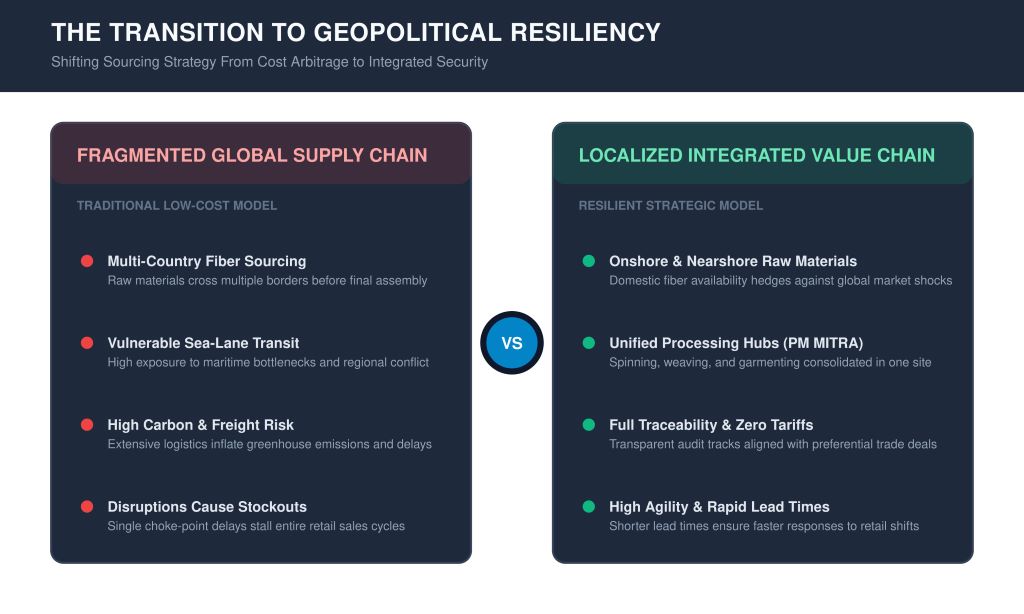
The PM MITRA Mega Textile Park in Virudhunagar, Tamil Nadu, has reached a significant operational milestone, securing committed investments of Rs 2,192 crore from 23 anchor investors ahead of its projected 2027 completion. Finalized through the Special Purpose Vehicle (SPV) board, this early capital influx signals a robust institutional confidence in the park's ‘plug-and-play’ infrastructure model. By consolidating the entire textile value chain - from spinning and weaving to high-end processing and garment manufacturing - the facility is engineered to mitigate the logistical inefficiencies that have traditionally hampered domestic export competitiveness.
Infrastructure as a competitive lever
Beyond land allotment, the project is rapidly advancing its utility framework to meet international sustainability standards. With nearly Rs 550 crore in infrastructure works currently under execution, the site is being equipped with a 15 MLD Zero Liquid Discharge (ZLD) common effluent treatment plant and a 20 MW solar power facility. This focus on sustainable processing is a strategic move to attract global brands that demand verified environmental compliance. The park’s design creates a frictionless environment for both MSMEs and large-scale integrated units to scale operations, notes a senior ministry official, highlighting how the proximity to the Tuticorin port will further reduce lead times for export-oriented apparel shipments.
Driving regional exports
The Virudhunagar PM MITRA Park is a flagship 1,052-acre integrated facility in Tamil Nadu designed to centralize spinning, weaving, processing, and garment production. It aims to drive regional exports, attract large-scale textile FDI, and generate 15,000 jobs. Currently under construction, it represents a key pillar of India’s 2030 textile manufacturing roadmap.
Tiruppur to boost performance with $11.5 billion knitwear exports by 2030
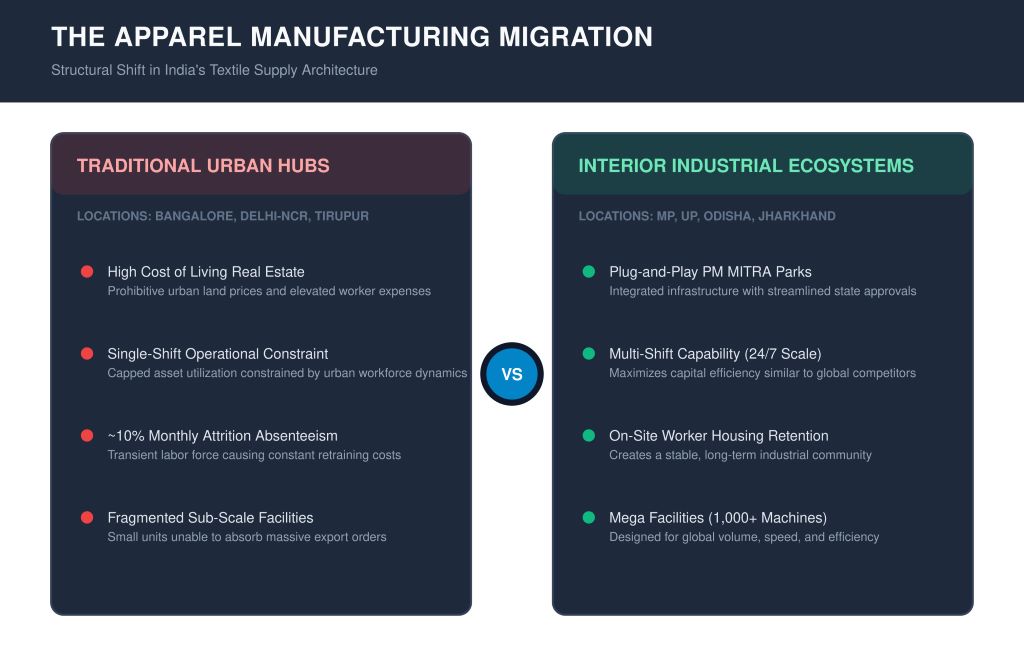
India’s preeminent knitwear manufacturing cluster, Tiruppur, has raised its performance trajectory by establishing an ambitious export baseline, targeting an expansion to $11.5 billion by 2030. To mitigate the historical vulnerability associated with cotton price volatility and shifting global buyer preferences, the cluster is executing a structural transition toward a balanced manufacturing mix. The updated strategy mandates that man-made fibers (MMF) and blended fabrics comprise 50 per cent of total regional garment production. This material diversification allows local manufacturers to capture higher-margin segments in the technical textile and global athleisure markets, which currently dominate international consumer demand.
Policy synchronization and supply chain interventions
The realization of this multi-billion-dollar export mandate is heavily contingent upon large-scale infrastructure deployment and central policy support. During recent bilateral stakeholder consultations, the Union Ministry of Textiles committed to accelerating the development of the 1,052-acre PM MITRA Mega Textile Park at Virudhunagar, which serves as a vital processing hub for the regional supply chain. The integration of integrated spinning, green processing, and advanced machinery modernization schemes will fundamentally enhance our cost competitiveness, noted KM Subramanian, President, Tiruppur Exporters’ Association. Key challenges, such as logistics costs and tariff uncertainties in Western markets, are being offset by the imminent implementation of new Free Trade Agreements (FTAs) alongside a dedicated state allocation of Rs 1,250 crore for industrial worker housing.
Prioritizing technical textile innovation
The Tiruppur industrial cluster is India's premier knitwear manufacturing hub, commanding nearly 60 per cent of the nation’s total knitwear export volume. Operating for over five decades, the cluster generates direct employment for more than one million personnel. Its modern operational roadmap prioritizes large-scale sustainable processing and technical textile innovation to achieve its long-term financial targets.