FW
IndustriALL reach $2.3 m Bangladesh Accord settlement with MNC brand
IndustriALL Global Union and UNI Global Union have reached a $2.3 million settlement with a multinational apparel brand to resolve life-threatening workplace hazards. The settlement, reached through an arbitration process under the legally-binding Bangladesh Accord for Fire and Building Safety, represents one of the largest payments made by a brand to remedy workplace dangers in its supply chain.
The brand, under the terms of the settlement, has agreed to pay $2 million towards remediation of more than 150 garment factories in Bangladesh. The apparel maker will contribute a further $3,00,000 in IndustriALL and UNIs joint Supply Chain Worker Support Fund that was established to support the work of the global unions to improve pay and conditions for workers in global supply chains.
The global unions brought the case to the Permanent Court of Arbitration arguing that the brand did not require its factories to remedy timely hazards leaving thousands of workers in dangerous conditions. The unions also charged that the brand did not ensure that it was financially feasible for its factories to fix on-going safety issues, as required by the Accord. At the time of the case’s filing in October 2016, none of the brand’s known supplier factories had completed the required remediation and all of them had at least one high risk safety hazard which had not been fixed. These included factories lacking fire alarm and sprinkler systems, lacking fire doors and not separating flammable materials from the factories’ boilers.
The unions’ claim for arbitration urged several of the brand’s contracted factories towards better progress—one went from a remediation rate of around 50 per cent in October 2016 to over 90 per cent in October 2017. However, many other factories supplying the brand continue to stagger far behind, with remediation rates hovering near 50 per cent and serious structural and fire safety issues left unresolved. All necessary safety improvements need to be completed by the Accord’s expiration in May 2018.
Cotton spinners pin hope on demand uptick to expand margins
With margins squeezed in the past couple of quarters owing to dwindling yarn exports and excess spinning capacity the cotton yarn industry is pinning its hopes on a fall in raw material (cotton) prices. Cotton spinners pin hopes on demand uptick to improve margins. According to CRISIL, among other issues, disruptions stemming from the roll-out of the GST took a toll on margins.
Yarn spinners say, margins were hit when the price of cotton went up, leading to lower demand from fabric and garment manufacturers, as well as dwindling yarn exports. They are hoping margins will improve in the last quarter of the current fiscal year on the back of an uptick in demand and improved yarn exports. However, in the interim, the industry is also expected to see a bumper crop, which could bring down cotton prices to some extent.
According to CRISIL, margins fell to a 20-quarter low in the second quarter of 2017-18.It further stated that the second quarter of fiscal 2018 was the least profitable in five years for spinners, or cotton yarn mills. Spinning units such as Chiripal Group and Balkrishna Textiles are hoping increased arrivals might bring down cotton prices.
Crisil has pointed towards a sharp increase in cotton production, expected at 37.5 million bales, in cotton season (CS) 2017-18 which would be a shot in the arm for spinners in the last two quarters of this fiscal year. It could frustrate further drop in margins. Also, demand normalisation after demonetisation and goods and services tax- or GST-led disruptions would improve utilisation.
However, the research firm is of the view that the Ebitda margin profile is different for large organised players owing to efficient procurement practices as well as benefits accruing from economies of scale.
Brunello Cuchinelli sells 6 per cent stake to invest in ‘humanist capitalism’
Brunello Cucinelli, the Italian fashion businessman owner of the high-end label he founded 40 years ago, has sold 6 per cent stake in the fashion company and raised about €100 million for his family’s charitable foundation. Through his company Fedone Srl, Brunello Cucinelli sold over four million shares of the luxury group at €26 a share, for a total of around €100million.
Cucinelli reportedly said he and his family will continue to remain majority shareholders of the company but he wanted to raise funds from the share sale to finance his “life-long project of restoration” in his local community. To put it in a nutshell, he will invest further in what the family calls “humanist capitalism.” After the share sale, Brunello Cuccinelli, his wife, and two daughters will remain majority shareholder, with 51 per cent of the company’s equity. Fidelity with a 10 per cent stake, and OppenheimerFunds — one of the world's most reputable investment firms — with a 5 per cent stake, are the other largest shareholders. Through the share placement, he wanted to separate the family’s philanthropic activities from the business for the long term. The family had reached the decision as part of a wider discussion over strategy “for the next 15, 30, 40 years”, he added.
Egyptian textile, spinning exports sees 6 per cent hike in 2017
The Egyptian Textile Export Council says the country’s textile and spinning exports increased 6 per cent in 2017, to touch $832 million as against $783 million in 2016. As per Minister of Trade and Industry Tarek Kabil Egypt will establish the largest textile and garment city in Egypt on an area of 3.1m sq m in that city. The city will incorporate 568 factories with a paid-up capital of $2 billion —infused over seven years — 87 per cent of which will come from foreign investments and 13 per cent from local investments.
Kabil announced the textile and garment city will provide up to 1,60,000 direct job opportunities, with a total production value of $9bn per year. Kabil said, “This new city will include schools for training with the latest technology in the spinning and textile industry.” The General Authority for Investment and Free Zones earlier announced, “Egypt is home to the only fully integrated textiles industry in the Middle East, where the entire production process is carried out in Egypt, starting from the cultivation of cotton and ending with the production of yarns, fabrics and ready-made garments, carried out domestically.”
Garment technology fiesta GTE 2018 concludes on a bright note in Delhi

The Garment Technology Expo (GTE) 2018, held from January 19 to 22 at NSIC Complex, New Delhi, concluded on a positive note for both visitors and technology suppliers who displayed latest innovations.
On Day 4, despite being the start of the week, people came in huge numbers to make the 26th edition of the GTE a huge success. Industry leaders including G S Madan, M D, Madan Trading Company, Delhi; domestic brand and manufacturer Harjot Takkar, Director, Sahib Textiles (Tacfab), Sonepat; Consultant Pooja Makhija, Director, Fashion Futures, Delhi; and pattern services provider Shri Niwas Sharma, Director, Apparel Solutions, Delhi were present.

G S Madan explored automation in all segments from cutting to stitching and finishing, “As the industry is still on oxygen, the only way to survive is to adopt automation as much as possible so that we can reduce workforce and minimise cost,” he observed.
Technical and PD teams of various companies also shared upcoming developments. Nikita Gupta, Merchandise Manager, Sreepriya Exports, Kolkata opined her company is installing CAD systems and has recently started working on the lean project to boost efficiency. The key attraction at the fair was technology, the display of machine-to-machine communication systems powered by several tech companies like Juki, Jack, Hikari, Duerkopp Adler and Brother.
The display of Pick and Place heat seal machine by Cheran was much appreciated. The machine reduces the time of tag attachment in the garment by replacing conventional stitching with automatic sticker attachment. ‘Shirt Automation’ by Italian pioneer MAICA drew crowds at its stall. MAICA displayed ‘UAM 04’, an automatic placket attachment machine.
Digital printing was showcased by India-based ColorJet, which presented digital printer TXF at the fair. The printer offers speed of up to 24 sq. mt. per hour and can achieve print resolutions of up to 1,440 DPI. The company has ambitious plans in place to expand in apparel manufacturing hubs like Bangladesh and Vietnam. And as Smarth Bansal, Brand Manager, Colorjet points explained, “India is already our stronghold and now we are looking to capitalise on the lucrative opportunities in other emerging countries. We are looking to collaborate with local partners, especially in Vietnam.”
‘Apparel 4.0’ conference at GTE 2018 puts the limelight on smart factories
Aimed at increasing productivity, efficiency and creating an ecosystem of smart factories in India, the 26th Garment Technology Expo 2018, attracted about 350 companies and more than 21,000 visitors. The annual Garment Technology Expo’s is the flagship event of GTE New Delhi and is held in spring. This is Indian subcontinent’s largest show for apparel technology.
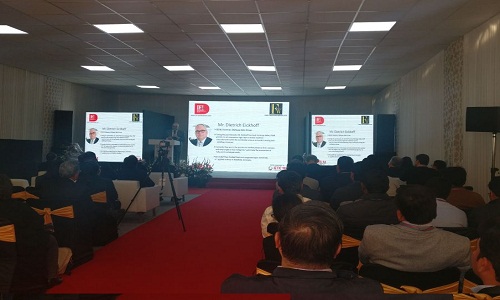
But what was really a star attraction in this edition was the ‘Apparel 4.0’ conference held on the second day of GTE. ‘Apparel 4.0’ is an interpretation and application of Industrial Revolution 4.0 in the apparel technology and apparel manufacturing sectors across the supply chain. The day-long conference was jointly organised by DFU Publications was aimed at educating the industry on how Apparel 4.0 is shaping and transforming the global fashion and apparel business. The discussions got a tremendous response and appreciation from industry stakeholders.
The conference was attended by distinguished stakeholders and experts from the industry who discussed major challenges the industry is facing in today's digital marketplace and how to identify them and what practical steps companies can take to digitize their value chain. H KL Magu, Chairman, AEPC, was the chief guest and inaugurated the conference in the presence of Zhang Min, Chairman, ShangGong Group, who also was the guest of honour. The opening remarks were offered by Sanjay Chawla, Founder, DFU Publications & FashionatingWorld. Speaking on the occasion, HKL Magu, spoke about the possibilities of adapting Apparel 4.0 in India especially with focus on export and what steps the Indian garmenting sector can take to be competitive in the global space.
Other well known experts who spoke on the occasion were: Mike Fralix, President and CEO, TC2, USA, Dietrich Eichoff, CEO & Chairman, Duerkopp Adler, Germany, Samath Fernando, CIO, Hirdaramani Group ,Sri Lanka , Darlie Koshy, Director General , ATDC, Prabir Jana, Head Research, NIFT Delhi and Ricky Sahni , Organiser GTE, among others.
Mike Fralix spoke on how millennials are disrupting the fashion supply chain, and technology is leading the Apparel 4,0; the introduction of sewbots and the resurgence of robotic systems in apparel making. Fralix also talked about the big shift taking place in the global garmenting market and how India being a resourceful country can take advantage of rising demand in the domestic and international market. Prabir Jana spoke on how the global apparel industry is moving fast towards adapting Apparel 4.0 and how China is emerging among the frontrunners. China over the years has become one of the fastest adapters of technology and the factory ecosystem is changing fast in the country.
Samath Fernando, stressed on the need of using cutting edge technology and how being technological sound can bring a big transformation in the entire sector. He also spoke on the efforts made by him towards technological improvement in his group and across Sri Lanka.
A panel discussion on Opportunities and Challenges for implementation of Apparel 4.0 in India was also a part of the conference. Rajesh Bheda of RBC, was the moderator with Darlie Koshy, DG, ATDC as session chairman, Raja N Shanmugam, TEA President, J D Giri, Shahi Exports, Sudhir Sekhri, GEA, R C Kesar, OGTC, Gunish Jain, Royal Datamatic, Vinod Aiyer, Fortuna Colours among the panellists. The discussions revolved around digitalization of apparel manufacturing processes, from design to production, creating a new organization and factory ecosystems, increasing flexible with optimized resources and smart factories.
Silvio Albini, Albini Group head and ex-president Milano Unica dies
Italian entrepreneur Silvio Albini, 61, was found dead unexpectedly in his house in Bergamo. His death was probably due to a stroke. Albini managed Cotonoficio Albini — the fine quality shirting manufacturing company that employs over 1,400 people and registers over €147 million in annual sales.
His company, founded in 1876, celebrated its 140thanniversary in 2016 and is led today by the fifth generation of his family.
The entrepreneur,who had been president of the Italian textile show Milano Unica and vice president of the Bergamo association of entrepreneurs, strongly believed in the importance of promoting and supporting Made in Italy products.
He had recently started a series of initiatives targeted at expanding his group’s presence in the smart casual segment through its own Albiate 1830 company and a collaboration project started with Candiani Denim designed by Matias Sandoval.
Robotic ‘Sword of Damocles’ hangs over low cost sourcing countries
World Bank President Jim Yong Kim said recently that automation could render about two thirds of jobs in the developing world redundant. An ILO report on Textile and Clothing Sector in ASEAN states the textile, clothing and footwear (TCF) sector is at the highest risk of losing jobs to automation. Reports suggest Raymond will be firing 10,000 workers across its 16 manufacturing units in India. These workers will be replaced by robots in around three years
Adidas, in 2016, successfully tested an automated shoe factory, ‘Speedfactory’, using 3D technology and robotics. Under consideration is another automated plant in the US as well as its newest factory in 2018 in Arkansas which will house autonomous robots — and their human supervisors— will be able to daily manufacture 8,00,000 sports shirts.
Texprocess, a major trade fair for the international garment-manufacturing and textile processing industry, put on display a Digital Textile Micro Factory at its May 2017 show in Frankfurt, Germany. It was a live demonstration of an integrated production chain for apparel right from the design stage to digital printing to automated cutting to sewing.
The threat from automation is real and developing countries such as Bangladesh cannot escape this threat as “we service the same brands that will demand higher productivity, lower cost, lower carbon footprint, better working condition, quicker turnaround time, and flexibility” said an industry expert.
In Bangladesh, over four million workers in the garment industry are earning over 82 per cent of the nation's overall export income. The main ‘product’ of Bangladesh is the labour of the millions who take raw textiles and turn them into finished garments, however, much of this labour is concentrated in the final phase of production before shipping known as ‘Cut and Sew — the same process that Western innovation is working to automate. The question now is for how long Bangladesh can sustain production on the ‘low labour cost” advantage? A fiscal rethink may soon be necessary if the wave of automation causes large numbers of job losses. Then making the robot pay tax and using the money to retrain humans may be a solution to a problem.
Vancouver's Eco Fashion Week comes to end after eight-year run
Eco Fashion Week, a Vancouver-founded, not-for-profit event that highlights environmentally friendly designers and garments, has canceled its 13th edition for 2018 and will not move forward with additional shows. Following eight years and 12 editions, the fashion event dedicated to showcasing and promoting sustainable practices in the fashion industry, has canceled its 13th edition indefinitely.
Organizers of the Vancouver and Seattle-based non-profit event noted a lack of support, which made it increasingly hard to produce a sustainable event that its volunteers could properly organize. Founded in 2010, EFW offered a platform for 160-plus environmentally minded designers and labels from over 15 countries, including Vancouver’s own Mishel Bouillet, Obakki, and Bianca Bellatoni. It brought together 100 speakers and 80 vendors as part of its panel discussions, which saw figures like Esther Speck, vice president of global sustainability at Lululemon; local designers John Fluevog and Nicole Bridger; and Tony Shumpert, vice president of reuse and recycling at Value Village, converging in Vancouver to address how we can more sustainably produce, reuse, and dispose of clothing.
Although EFW is bowing out of Vancouver’s fashion circuit, Laroche hopes that designers, retailers, and consumers alike will continue to re-evaluate their own manufacturing and consumption habits.
Trident unveils four new sheet technologies at Heimtextil
Comfort, performance and luxury are key elements for Trident’s new sheet launches at Heimtextil this week. Trident’s new generation wrinkle-free finishing, creating a super soft sheet combined with comfort features such as moisture management and breathability. Air Rich yarn makes the sheeting soft and smooth. The collection was developed using a special technology that adds to the strength and the luxurious look also provide a smooth drape that lasts through multiple washings.
The Tetra Fine ultimate performance sheet provides an all-in-one offering of four key attributes: Moisture management, quick dry comfort, anti-pilling and wrinkle resistance.
NectarSoft is finished with a unique yarn and fabric treatment that helps remove weak cotton tendrils. The result is a lustrous, internally smooth and ultra-soft sheet with a graceful drape.
Hyde Park is a pure luxury collection made of 100 per cent Egyptian cotton. High 500-count construction provides strength and lustrous sateen weave. The brand is introducing products that enhance one’s bath experience with premium blends and innovation in yarn construction in their towel range.
The company in a statement said, “Today, the definition of luxury is focused more on our personal quality of life. Luxury, in its new context, is the enjoyment of the best in life.” Durasoft employs a unique innovation in spinning to create a luxuriously soft, absorbent towel with high resilience and minimal linting. Plush and thick from the start, the towels get softer and better with time. Their Tender Touch collection is crafted from a plush blend of luxury cotton, silk and Lenzing Tencel. The towels are breathable and more absorbent than a typical luxury towel as well as lustrous and silky soft. Using the mill’s Twist Management technology, the Feather Touch collection offers an extremely subtle feel as well as its eco-friendly attributes. This super thick and thirsty three-ply construction “takes our technology to the next level of luxury and sophistication,” the company said.
For the Stellar collection, Cashmere is intimately blended with cotton to produce a yarn that's naturally strong and traps moisture with a uniquely soft hand and luxurious appearance.
The North American market remains Trident’s largest trade area and it is expanding in Canada and Latin America. In addition, the company is putting a major focus on warehousing and drop ship this year as well as enhancing its design, product development and sales team in the US.