FW
Pakistani leather garment exporters ask for financial incentives
The Pakistan Leather Garments Manufacturers and Exporters Association (PLGMEA) has demanded preferential rates for exporters of finished leather goods. The demand has come in the wake of difficulties in counterbalancing export and import transactions. In a meeting with the Governor of the State Bank of Pakistan (SBP), the association said exporters of finished leather goods should be given loans on lower rates. They said the reduced mark-up rates on ERF Loans for exporters of finished goods should be at 3 per cent, whereas exporters of raw material and semi-finished products should be made to pay 6 per cent.
Chairman of PLGMEA, Fawad Ijaz Khan, said the export business provides employment opportunities to a good number of people in the country. He raised concerns, about financial transactions with one of the country’s major trading partners, Iran. Pakistan is carrying out transactions with Iran in Dirhams, owing to the ban imposed on Iran by international fraternity. Iran makes a large part of finished leather import to Pakistan. The SBP has said that the normal trade with Iran will continue once international sanctions are lifted after February 2016. The association has also asked for four per cent incremental rebate for the leather garments and exporters of leather goods.
US delegation to visit Bangladesh soon on GSP
Bangladesh may again be on US’ GSP list if it satisfies the US delegation, given with the task to monitor the execution of the action plan on RMG sector. The delegation is visiting the country soon. This was stated by commerce minister Tofayel Ahmed after he held a meeting with diplomats from various countries including the US.
Ahmed says, the country has done well in implementing the action plan on RMG. Everything that was asked and needed in the given situation has been maintained. The country deserves GSP facilities and was in the fray before the Rana Plaza collapse in 2013. The facility was postponed but not cancelled. Now there is no reason for not having it. He stated that everybody from Bangladesh wishes the products from their country are under GSP facility.
The US ambassador, Marcia Bloom Bernicat, said that Bangladesh can acquire GSP benefits only if they see more improvement in the working environment and labour laws. A delegation from Bangladesh will also visit the US on the same issue.
Techtextil India to display a host of technical textile innovations
Techtextil India, the premier business event for the technical textile and nonwovens industry players in India will return to Mumbai from September 24 to 26, with a host of new innovations and latest market insight of the technical textiles and nonwovens.
The event, from its launch edition has been drawing attention to the entire technical textile and nonwoven industry value chain with its 10 product groups and 12 application areas of agrotech, buildtech, clothtech, geotech, hometech, indutech, medtech, mobiltech, oekotech, packtech, protech and sporttech, facilitating exposure of domestic players to the global market. Expectations for the fourth edition are high as the exhibition promises a pure business and learning environment with networking opportunities.
Amid reports of the Textile Ministry rolling out schemes of around Rs 427 crores to promote geotextiles textiles, Coir Board of India has voiced its intention to showcase eco-friendly coir geotextiles at this industry event. Coir Geotextiles are permeable fabrics used to prevent soil erosion and for other bio-engineering applications. It protects land surface and promotes quick vegetation. Totally biodegradable and better tensile strength, coir geotextiles help soil stabilisation in varying slopes.
An all-encompassing range of technical textiles and nonwoven products along with a seminal symposium with numerous product-focused and market-relevant topics makes it the most anticipated event of the year for sector professionals. Around 150 technology-leading companies are expected to showcase their latest technical textile solutions at the fair. These include 50 Indian companies and foreign contingents from Austria, Belgium, England etc.
Alongside the exhibition, Techtextil India Symposium will bring subject experts on topics like machinery, raw material, nonwoven and technical textile for an annual forum September 25, 2015 at the fairgrounds. The event is being organised by Messe Frankfurt Trade Fairs India and is part of the company’s international portfolio of 45 fairs.
Techtextil-india.in.messefrankfurt.com
H&M launches €1 m eco-innovations in fashion award
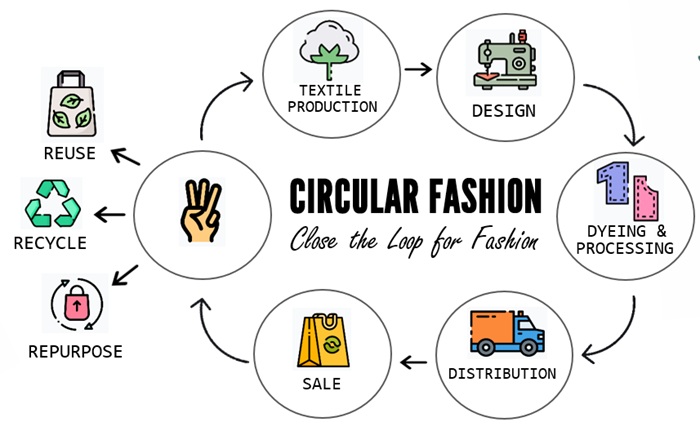
H&M has launched a new €1 million prize has under the H&M Conscious Foundation for eco-innovations working to ‘close the loop’ in the fashion industry. Chosen by a jury, five winners of the first Global Change Award will share the prize money and get access to industry support to develop their ideas further. According to Karl-Johan Persson, H&M CEO, and H&M Conscious Foundation board member, the challenge is open to everyone as he believes that ground breaking, game-changing ideas can come from anywhere. Explaining the aim of the award, Person said that each year, the Global Change Award tries to find truly brave and bold ideas that make change.
In collaboration with Accenture and KTH Royal Institute of Technology in Stockholm, the innovation accelerator, will include an innovation boot camp in Stockholm, that would be provided by KTH Innovation, and guidance from Accenture Strategy on how to develop the winning ideas further, Person added.
The closing date for application is end of October and the jury will announce the five winners on February 1, 2016. Each winner gets €100,000 and the public is invited to distribute the other half of the grant through an online vote. The votes’ result will be declared at an award ceremony in Stockholm on February 10, 2016.
Funded by the Stefan Persson family, the H&M Conscious Foundation is a non-profit global foundation. The Persson family is also the founder and main owner of fashion company, H&M. Neither H&M, nor the foundation will take any equity or intellectual property rights in the innovations.
Turkey rises to number six in global textile exports
A note released by the Turkish Statistics Institute (TÜİK) reveals, Turkey has emerged the sixth largest textile and confection exporter of the world. It accounted for around 4 per cent of global exports last year. China topped the list with 41 per cent, India followed with 5.4 per cent, Italy 5.3 per cent, and Germany accounted for 5 per cent. As per the note, Turkey’s share of the sector in total exports was 18.7 per cent last year, in value with around $29.5 billion. This rate was around 40 per cent in 1995, but dipped to 26 per cent in 2005 and 19.3 per cent in 2010. Today, the leading exporting sector of Turkey is the automotive sector.
The figures released by the Turkish Exporters’ Assembly (TİM), last year, Turkey’s exports rose by about four per cent to reach $157.6 billion—a record in the history of the modern republic. Along with textiles and chemicals, car sales have been a major driving force, netting $22.3 billion.
There has also been a dip in the share of textiles trade in the world. In 1995, the share of the sector in world trade was seven per cent, this rate dipped to 4.6 per cent last year. Turkey was one of the three countries, which gave a trade surplus in the sector, according to the report.
Yuan's devaluation may benefit RMG manufacturers
The devaluation of Chinese Yuan has had the world market in a tizzy and raised concerns about further economic meltdown in the country. For some retailers, though, the lower-valued currency will change things it won’t affect companies, even those in the same sector. The Wall Street Journal, in an article comparing the currency slide’s likely impact on Spain’s Inditex and Sweden’s H&M stated that though both companies had similar sales exposure to China and their presence had grown there in recent years, the impact to each would vary significantly.
Also, according WSJ, so far, the decline in Yuan need not give rise to panic however, if this continues, it could be alarming. Retailers’ products will suddenly be more expensive in the local currency and the lower value will mean more expensive travel, which may mean sales to Chinese tourists, if the retailers don’t cut down the prices. H&M sources nearly 40 per cent of its products from China according to the Swiss global financial services firm UBS. While that number is a lower 20 per cent for Zara owner, Inditex.
In recent years, as the Yuan was allowed to rise against the dollar, H&M’s cost of goods went up at a faster pace compared to its rival. Its gross margin has been steadily falling in the past five years, while that of Inditex has remained steady, helping to boost the latter’s stock, the Journal mentioned. Inditex’s stocks are up 26 per cent this year, compared to just a 6 per cent rise for H&M, but the Journal said that this could reverse.
21st Intertextile Shanghai Home Textiles takes off on a high note
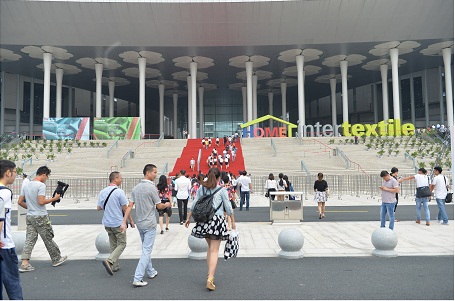
In recent years, the fair has expanded to include the full product XBH 2013spectrum of upholstery fabrics, bedding and towelling, carpets and rugs, wallcoverings, design artwork, digital printing, sun protection systems, non-textile curtain accessories and more. In her inaugural speech, Wendy Wen, Senior General Manager, Messe Frankfurt (HK) said, “Domestic suppliers are out in force again this year, with more than 1,000 taking part, while 14 Chinese regional pavilions feature, as do a number of trend forums and product zones. And this year’s International Hall features country and region pavilions from Belgium, India, Italy, Korea, Morocco, Pakistan, Taiwan and Turkey.
Exquisite Europe zone in focus
Intertextile Shanghai Home Textiles is regarded Asia’s leading trade fair, particularly for its offerings of premium products from overseas, in addition to the wide range of price and quality options provided by Chinese suppliers. The premium offerings are evident in ‘Exquisite Europe’ zone, which features exhibitors from 12 countries. This include: Casadeco, Designers Guild, JAB, Jean Paul Gaultier and Prestigious, bedding and towelling exhibitors including Curt Bauer, Mundotextil and Traumina, and upholstery fabrics suppliers Fiorete and Trevira. Exquisite Europe will also include pavilions from Belgium and Italy, while other pavilions from India, Korea, Morocco, Pakistan, Taiwan and Turkey will also feature in the International Hall.
“We also have two new product areas this year: a digital printing zone which is a fast-emerging sector of the industry, and a Whole-Home Style zone featuring exhibitors with multiple products displayed in a real-home setting,” said Wen, elaborating on the fair layout.
Buyers on the lookout for original service designs and artwork for fabric and product development will have a wide selection to choose from in the Intertextile Design Boutique. Design studios participating include Antoinette et Freddy, Diane Harrison, Elka Studio and Simon Ashby Studios. A carpet & rug zone also returns to the fair again as suppliers from Asia and the Middle East will visit to take advantage of the increasing interest in these products from Chinese consumers.
InterDesign – Revamped fringe programme
To meet the needs of the industry, this year’s fringe program has been revamped, with a new name for the design and trend section called InterDesign. The InterDesign programme has been developed in response to increasing interest of Chinese consumers in design and trends, with some of the industry’s biggest players participating this year. The InterDesign Programme includes three special areas in the International Hall: a Trend Area, Trend Concept Show and Forum Space.
The International Lifestyle Trend Area, which is designed by the NellyRod Agency, has featured the 2016 lifestyle trend concepts, while the Trend Concept Show brings these trends to life in a practical home setting. The show is coordinated this year by leading Chinese designer Shen Lei, who is also a member of the 2015 Trend Committee which developed the 2016 trends. He has recruited some of China’s best interior designers, who have been paired with the industry’s leading brands – to create displays which help buyers visualise the latest trends.
Leading design, trend experts show the way
A comprehensive seminar program with sessions conducted by industry’s top experts is also on offer. In the Design & Trends category, the highlights include a talk on day two by Vincent Grégoire of the NellyRodi Agency, who will explain in detail the 2016 trends found in the International Lifestyle Trend Area. On day one, a forum talk was led by Shen Lei with an open discussion with the designers about their featured work in the Trend Concept Show.
Seminars, tours of the International Lifestyle Trend Area are being conducted by members of the Trend Committee. This year, they are led on first and second day by Grégoire as well as Dan Namura from Dan Project of Japan. Namura has also worked with Heimtextil Frankfurt, the parent fair of Intertextile Shanghai Home Textiles, for a number of years. Seminars covering market information and testing & certifications are organised during the fair.
A strong feature of this year’s fair is the wide range of Chinese exhibitors taking part, which are grouped by region and product category to ensure sourcing efficiency for buyers. This include the Emerging Players Hall featuring new companies, the Glamorous Brands Hall showcasing branded decorative fabrics and the Home Experience Hall, which highlighted Chinese fabric trends, and also include regional pavilions from Binzhou, Gaoyang, Guangzhou, Huzhou, Nantong including Haimen and Tongzhou, Pujiang, Zhenze and Zhouquan. In total, 13 regional pavilions will feature, with the biggest ones being the Colourful Haining Hall, the Fashionable Yuhang Hall and the Premium Two-City Hall, featuring the Tongxiang and Shaoxing Pavilions.
www.intertextilehome.com
Iran's fashion industry on growth track
The fashion industry in Tehran, Iran hopes to do well after the thawing of diplomatic relations. Young Iranians are taking to fashion seriously after 30 years of political resistance and struggle. Brands and stores are being set up to meet demand, which has a rich history, culture and highly skilled artisans. Many hope that fashion, which is big business, will grow further.
People who enjoyed fashion, had a limited number of brands to choose from, until recently. This was because there were sanctions against Iran. Pouneh Moradi, a showroom director said that if one is looking for a brand in Iran, they are available only sparsely and shopkeepers try to use these brands as much as they can. She added that Iranian brands use foreign brand names to sell products, as there’s lack of advertising.
However, in recent years, there have been some major changes. There are designers that have emerged from the country with original ideas. Thus, there are scores of local brands, registered or unregistered, in the country. Besides, models too are in demand as fashion weeks are held across the country and there are several modelling agencies coming up that are within an Islamic framework and ethos. Modelling is being approved now; fashion is also making inroads in other parts of the country apart from the capital.
Argentina's sweatshops a bane for industry
Clandestine sweatshops staffed mainly by foreign workers who have no basic labor rights are common in the textile sector of Argentina. About 2.7 million Bolivians have migrated to Argentina lured by promises of a decent job. However, they are employed in precarious working conditions with no health insurance. They work long hours and are often injured at work because of the lack of safety measures. There are thousands of such sweatshops involved in sewing and cutting clothes.
There are campaigns to promote better legislation, campaigns to promote union membership and collective bargaining. In Argentina, a country of 41 million people, including 1.8 million foreign nationals, the law on immigration guarantees the right to work, education and health care for South American immigrants. But many of these modern-day slaves are undocumented. And 90 per cent of them work in agriculture or in the textile industry.
So people are forced to work making clothes for big and small brand names, street fairs, famous designers, fashion boutiques, counterfeit clothing markets, and even government departments. The textile and apparel industry of Argentina is heavily subsidised and there are protectionist measures in place against imports. Additionally, special loans with low interest are available for investments. Anti-dumping measures are mostly directed against Chinese imports which have a share of 44 per cent of all apparel imports. The annual rate of growth for the apparel and textile sector is earmarked at 7.5 per cent up to 2020.
US: West Coast Trend Show show a sell-out
The West Coast Trend Show was held in the US on August 8, 9 and 10. It catered to the Spring ’16 menswear fashion market. This season there was a 20 per cent increase in retailers over last year. The sold-out show featured more than 200 brands. There were several retailers from Las Vegas.
WCTS draws buyers from mid-tier to upper-end specialty stores in California such as Patrick James in Fresno and Gary’s in Newport Beach as well as retailers from Alaska, Arizona, Colorado, Idaho, Montana, Nevada, New Mexico and Washington state.
With going getting tough for brick-and-mortar retailers they have to standout. If they don’t have a relationship with their customers, they’re at a great disadvantage. It’s key for retailers to find unique ways to deliver value to the customer and differentiate with regards to service and product mix.
Overall, business is rebounding. Brands are taking more risks. From soft coats and lightweight knits to linen tops and bottoms, buyers at WCTS were looking for products to inspire their business. Garment pigment-dyed linen and twill jackets are extremely popular. This was possibly West Coast Trend Show’s most successful spring show to date with the highest number of retailers and representatives in attendance.