FW
Vietnam textile and garment exports to decline by 14%: Vinatex
The Vietnam Textile and Garment Group (Vinatex) forecasts Vietnam's textile and garment exports will continue to decline by 14-18 per cent each month for the rest of 2020 over the same period last year.
The group also said the total textile and garment export value for this whole year is estimated to hit about $32.75 billion, a year-on-year decrease of 16 per cent. Le Tien Trưong, General Director, Vinatex said the textile and garment will face greater difficulties in the final half of the year than the first half. Vietnam Textile and Apparel Association (VITAS) said the second quarter was the most difficult quarter for the textile and garment industry as customers in major export markets such as the US and EU cancelled 30-70 per cent of orders because the markets were closed due to the Covid-19 pandemic.
The Ministry of Industry and Trade also said as of July, many textile and garment enterprises had few orders for the last two quarters of this year, especially high-value products. Meanwhile, face masks and personal protective equipment, which are considered major products for many garment enterprises, have sharply decreased due to global oversupply.
According to the ministry, Vietnam's export value of textiles and garments in July was estimated at $3.43 billion, up 14.4 per cent compared to June but down 11.8 per cent year-on-year.
In the first seven months of this year, the textile and garment export value was at $19.21 billion, down 13.8 per cent year-on-year. The ministry forecasts Vietnam's textile and garment export value this year would reduce by 10-15 per cent to $33.6-36 billion compared to last year.
Trevira withdraws participation from Heimtextil
Trevira has decided not to participate in the 2021 edition of Heimtextil, the international trade fair for home and contract textiles that will be held in Frankfurt/Main. This decision has been made in agreement with parent company Indorama Ventures PCL (Thailand), which has put stringent measures in place to keep its staff and customers safe. As a result, the concern and its subsidiaries are not currently participating in any trade fairs.
At the 2020 Heimtextil, Trevira exhibited together with around 30 of its major Trevira CS customers with a joint booth whose total floor area measured over 2000 square metres. The number of partners exhibiting alongside Trevira has increased steadily over the past three years, and the Trevira display, along with many of the newest flame retardant Trevira CS collections from its customers, has always been hugely popular at the fair, especially in Hall 4.2, where it has continually attracted a very high number of visitors. As a joint booth, it has benefited especially from the vibrant and positive discussions among visitors and exhibitors, together with the various events that accompany the display. Usually, these included a press conference and a party held at the new stand. Trevira’s Heimtextil presence in the past three years has strengthened and expanded the position of Trevira CS as the leading brand for flame retardant home textiles.
Intertextile Shanghai Home Textile launches special features
The Intertextile Shanghai Home Textiles expo has launched an assortment of special features. To accommodate buyers who cannot come to Shanghai due to travel restrictions, Intertextile launched an innovative cloud platform that enables participants to virtually walk through the trade fair under the guidance of the Home Textile Association’s experts.
Intertextile also launched a new online business matching platform, which is dedicated to connecting suppliers and buyers across the world. The free service helps participants identify and connect with potential business partners based on their preferences and interests. Interested buyers can register at http://hk.mikecrm.com/cLBHUB0.
On the expo floor, the 2021 Intertextile Trend Forum is led by Shen Lei, the Chinese representative of the Intertextile International Lifestyle Trend Committee. This year, Intertextile teamed again with the NellyRodi Agency from France to present the design theme ‘Bound’ with three trends: Cozy Warmth, Past Future and Bold Clash. Each trend is designed to reflect on current environmental, economic, societal and identity changes.
In addition to this, the fair is launching the Designer x Brands Virtual Showroom at hall 4.1C39 and hall 5.1C32, which is specially curated by Shen Lei. In the virtual showroom, six top Chinese designers collaborated with selected exhibitors including Huatex International, JAB, Morphrow, Novatex, YADA and Zhejiang Maya Fabric to present collections that reflect the 2021 Intertextile Trends. Intertextile Shanghai Home Textiles – Autumn Edition is organized by Messe Frankfurt (HK) Ltd; the Sub-Council of Textile Industry, CCPIT; and the China Home Textile Association (CHTA).
China’s sewing machine exports decline 21.90 per cent in H1
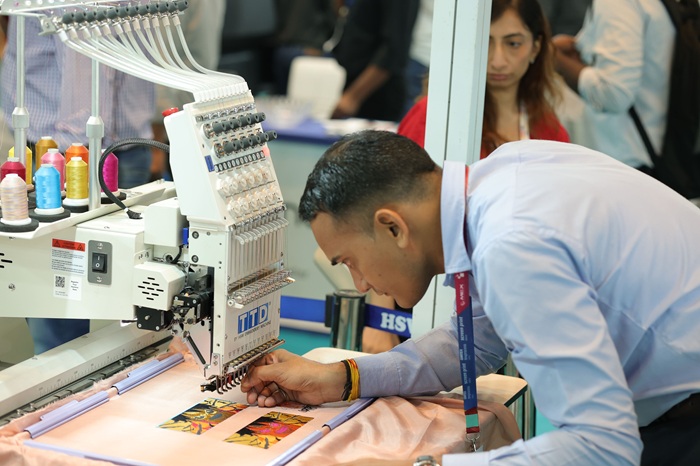
National Bureau of Statistics of China stats show, the country’s sewing machine exports declined by 21.90 per cent on Y-o-Y basis in January-June ’20 period. The total revenues clocked by the country in sewing machine exports during the first half of 2020 were $934 million. Of total export values, industrial sewing machines contributed $ 446 million and declined significantly by 26.03 per cent on Y-o-Y basis. As far as export volume is concerned, Chinese industrial sewing machines fell by 26.41 per cent to 1.42 million sets. The average export cost per sewing machine valued $371.66 during H1 ’20.
In June ’20, China exported sewing machines worth $169 million, marking a 20.93 per cent yearly decline. However, the country’s exports increased by 23.14 per cent from May ’20.
The export volume of industrial sewing machines, in particular, in June ’20 fell by 31.96 per cent on Y-o-Y basis to 221,700 sets but, as compared with May ’20, the volume-wise shipment surged by 16.91 per cent. The export value of industrial sewing machines also declined 43.96 per cent to $59.67 million on a yearly basis. However, on M-o-M basis, the value increased by 4.17 per cent.
Vietnam cotton imports decline by 9.1 per cent in July
In July 2020, Vietnam’s cotton imports declined 9.1 per cent year-on-year to 121,100 while it declined by 2.6 per cent month-on-month. From January to July 2020, Vietnam’s cotton imports declined 4.5 per cent year-on-year to 899,900 tonne.
In July, US remained the major import origin for Vietnam with 68 per cent of its cotton coming from the US. The volume and proportion of Indian cotton import also increased in July to reach second place. While Vietnam imported 82,000 tonne of cotton from the US, it imported 11,100 tonne from India.
Operating rate of spinning mills in Vietnam continued to recover, to above 50 per cent. Besides, the shipmenst date of Vietnamese cotton yarn began to rise in early July, but was slightly lower than the corresponding period of last year. In July, the overall demand for the Vietnamese cotton textile market was not much different from that in Jun.
However, under the background of higher ICE cotton futures (higher costs), most Vietnamese mills chose to sell at lower prices. Therefore, both carded and open-end cotton yarn sales are seen, but most of them are mainly purchased by regular customers.
LVMH, Tiffany to finalize tie-up in three months
French luxury goods giant LVMH and US jewelry chain Tiffany plan to finalize their $16.2 billion tie-up over the next three months. Louis Vuitton owner LVMH agreed to buy Tiffany last year in its biggest acquisition yet, betting it could restore the luster of the US jeweler by investing in spruced-up stores and new collections.
Under the deal terms, Tiffany and LVMH set August 24 as the first deadline to complete, but with the provision that one of the parties could push back that deadline as far as November 24, according to a Tiffany filing to the US Securities and Exchange Commission submitted earlier this year.
Tiffany is exercising the option to apply November 24 as the ultimate deadline, according to the source. Since the acquisition was agreed, LVMH deliberated about whether to renegotiate the deal, in part on the grounds of the impact of the COVID-19 epidemic on Tiffany’s business. But in the end LVMH decided not to seek a re-negotiation.
Prada, Valentino to stop use of animal materials in collections
By the end of 2021, fashion giants Prada and Valentino will stop the use of certain animal materials in their products. Prada will stop using kangaroo leather and Valentino will stop use of alpaca wool. The Prada Group, with brands such as Prada, Miu Miu, Church’s, and Car Shoe confirmed to Italian animal rights group Lega Antivivsezione Italiana (LAV) it will cease the purchase of any new kangaroo leather.
According to Peta.org.uk, around 2.3 million kangaroos are reportedly killed every year for their skin. To produce leather, the animals are first shot. Then, the injured kangaroos – as well as orphaned joeys – are decapitated or hit sharply on the head to “destroy the brain” before their skin is torn off so it can be exported and made into accessories often labelled as k-leather.” Graphic photos of charred kangaroos and reports of their habitats having been destroyed by bushfires in Australia have led people to demand an end to this government-sanctioned slaughter.
The exotic skins industry is also responsible for the inhuman slaughter of crocodiles, snakes and ostriches, all of whom have died for fashion. Alpaca wool, famous for its soft and lustrous fibres, is used in some Valentino creations. These are harvested from live Alpacas from the world’s largest privately owned alpaca farm, Mallkini, located in Peru.
PETA recently revealed rough treatment of these animals at the hands of the shearers, which caused social media backlash. Valentino has said that it would hence severe all ties with Mallkini.
Australia’s luxury brand Rebecca Vallance launches athleisure collection
Sydney-based luxury fashion brand Rebecca Vallance has launched a five-piece athleisure collection called Sportif. The collection has been in the works for 18 months and was set to launch in February, but that proved impossible due to pandemic-related obstacles in her supply chain.
Ahead of the launch, the brand’s website featured a Sportif signup page to be the first to secure a piece from this limited collection, which collected 5,800 email addresses in the first 24 hours. The brand had more customers sign up than pieces available to sell. Vallance declined to share the number of units made. The page was promoted through Instagram and email, and the company opted to stick to digital promotions throughout the limited collection’s launch.
A second release, with 40 styles, will launch later this year — they will be available in the four Rebecca Vallance stores, all in Australia, as well as on the brand’s e-commerce site. The brand plans to incorporate unpaid influencers into its marketing for the line at that time.
In addition to its site and stores, Rebecca Vallance sells through retailers including Net-a-Porter, Saks and MyTheresa.com. Its top markets are traditionally the US, Australia, the U.K. and the Middle Eastr. Currently, sales in the US and Australia are head-to-head, and sales via RebeccaVallance.com are up well over 100 per cent year-over-year.
India: Revenue department notifies Rules of Origin norms for FTA imports
The Department of Revenue under the Indian Ministry of Finance has notified norms to enforce provisions for Rules of Origin to allow preferential rate of customs duties on products imported under free trade agreements (FTAs). The norms have been framed to check inbound shipments of low-quality products and dumping of goods by a third country routed through an FTA partner country.
‘Customs (Administration of Rules of Origin under Trade Agreements) Rules, 2020' would come into force on September 21. These rules shall apply to import of goods into India where the importer makes a claim of preferential rate of duty in terms of a trade agreement.
The ‘rules of origin’ provision prescribes for the minimal processing that should happen in the FTA country so that the final manufactured product may be called originating goods in that country. Under this provision, a country having an FTA with India cannot dump goods from some third country in the Indian market by just putting a label on it. It has to undertake a prescribed value addition in that product to export to India.
According to the notification, to claim preferential rate of duty under a trade agreement, the importer or his agent, at the time of filing bill of entry, has to make a declaration in the bill that the imported products qualify as originating goods for preferential rate of duty under that agreement; and produce certificate of origin.
The importer also has to possess all relevant information related to country of origin criteria, including the regional value content and submit the same to the proper officer on request.
Salaried jobs in Indian textiles sector drop by 29 per cent: CMIE
Salaried jobs in the Indian textile sector declined by 29 per cent in July, says the Centre for Monitoring Indian Economy (CMIE). The drop fall textile wage bill implies a sharp fall in employment in the industry, CMIE noted. The leather industry too recorded a 22.5 per cent fall in its wage bill in the June 2020 quarter.
In fiscal 2019-20, India had 86.1 million salaried jobs, which declined to 67.2 million in July this year. Salaried jobs are preferred forms of employment for most people. These jobs offer better terms of employment and also better wages. Households with salaried jobs are better placed to build savings and plan a sustained improvement in their standard of living. Such households are also better placed to borrow and service their borrowing because of the steady nature of their earnings, CMIE said.
In India, salaried jobs have stagnated in recent times. In 2017-18 they grew by 1.6 per cent then in 2018-19 they grew by a meagre 0.1 per cent before contracting by 1.8 per cent in 2019-20. As a result, salaried jobs in 2019-20, at 86.1 million were lower than their level of 86.3 million in 2016-17. This is before the lockdown hit salaried jobs.