FW
Coimbatore mask makers expect new orders as government allows exports
Coimbatore mask and coverall manufacturers hope to tap export orders as the government has permitted export of surgical masks. Raja Shanmugham, President, Tiruppur Exporters’ Association, said the government’s decision to allow masks exports will benefit manufacturers who had invested in machines to make coveralls and masks. Though the government had earlier permitted export of non-surgical masks and coveralls, manufacturers were unable to do so as there was no clarity and exporters were unable to get quotas.
According to A Sakthivel, Chairman, AEPC, garment manufacturers who have taken to manufacture of masks will benefit from the government’s decision to permit export of surgical masks.
KS Sundararaman, Chairman, Indian Technical Textile Association says, the government’s decision to permit export of two-ply and three-ply masks with quota restrictions will benefit export, However, the government should permit export of N 95 masks too gradually. There are international standards to be met for export of surgical masks but the manufacturers will be able to meet the standards, he said.
Virtual Denimandjeans exhibits A/W 21 collections
Attended by over 44 global denim companies, the first virtual edition of Denimsandjeans, exhibited A/W21 collections from exhibitors of over 10 countries. The show allotted a virtual booth to exhibitors where buyers and suppliers could interact individually. Other activities like denim talks, seminars, and trend presentations also happened with users attending talks or networking with exhibitors. Exhibitors decorated their booths well inside their own offices and these were visible to visiting customers.
The Trend Zone was divided into five different categories and collections were displayed in those categories. Denimsandjeans team created separate trend zones and they were running throughout the show .The trend zone categories included Super Sustainable, On Demand , Super Technology/Washing/Chemical, Super Comforts, and Super others.
The platform got a very good response from all the stakeholder of Denim Community and most of them found this a helpful tool to connect with their buyers
Repackaged digital assets could help brands improve online engagement
 In a major setback to online fashion shows, none of the luxury brands that launched their collections at the Men’s Fashion Week in Milan or Paris last year, could elicit a similar response on Instagram. Tracking firm Tribe Dynamics observes, digital shows, videos and presentations generated less than one-third of online engagement. The all-digital London Fashion Week saw a 55 per cent drop in social media engagement than in January, says Launchmetrics, another tracker of online activity.
Online engagement by brands was relatively subdued compared to the same period the year prior. For instance, Hermes earned only 28 per cent of its media value during the weeks surrounding its latest menswear show compared to a year earlier, reveals Tribe Dyanamics. According to EMV, Valentino’s couture collection could reach roughly 57 per cent of its online engagement to EMV in July this year compared to its Autumn/Winter 2019 Couture collection. Critically acclaimed collections also failed to make an impression. Prada, who organized a digital fashion show on July 14, recorded a 60 per cent decline in earned media value from July 6 to July 19.
Low attendance by influencer marketers
A reason for this decline was the low attendance of influencer marketing agencies to live shows, possibly due to budgetary constraints or an easy front row 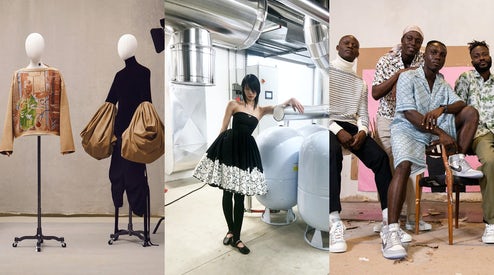 access to a digital collection. Influencers, who partnered brands during digital fashion week, met with relative success. For example, Caroline Daur, an Instagrammer with 2.4 million followers, who partnered Dior, earned a 2.28 per cent engagement rate, compared to her average 1 per cent engagement rate and Dior’s 0.2 percent average engagement rate, notes Obviously data.
Brands that held in-person, intimate runway shows with influencers too earned only a fraction of their earned media value compared to last year, though this was above average compared to other brands that opted for strictly digital events. Etro’s, live runway show earned the brand just over 40 percent of what the same show last year earned.
Creating impactful moments
For the upcoming Spring/Summer 2021 ready-to-wear shows, brands need to reconsider their approach to online format. They need to focus on merging the two concepts to create impactful, share-worthy moments both on and offline, says Micheal Jais, Chief Executive Officer, Launchmetrics. He advises brands to repackage and redistribute their digital assets, to provide consumers the right content at the right moment.
Nearshoring by US, Europe threatens Asian garment industry
 A McKinsey study states, Bangladesh, Vietnam, Cambodia may soon lose their competitive edge in the global garment industry as manufacturing and marketing advances may make it easier for US and European garment importers to produce garments closer to home. The study says that by 2025, around 25 per cent of global sourcing executives would source 50 per cent of their imported ready-made garments near Europe and the US. Forty-two per cent of the respondents believe that over 30 per cent of these imported garments would come from sources near Europe and America by 2025.
However, this may also cause a significant loss of business and employment for many Asian countries.
Shift in fashion influencers and trends
Earlier, when designers created new designs, brands would wait for 30-60 days before launching the final product. This would help them to evolve their consumers’ demands. Now, this demand is influenced by celebrities and social media personalities. The fast-paced fashion trends launched by these celebrities benefit small-sized, and internet-based fashion brands who are able to quickly transform a concept to a finished final product.
Earlier, cost-consciousness amongst fashion leaders helped Asian garment manufacturers to win many new orders. However, since the last two decades labor costs in Asia too have been increasing. It is already higher in China than in Mexico. Hence, it makes sense for manufacturers to bring manufacturing closer to destination markets.
Reduction in production costs
In future, automation, robotics, and artificial intelligence will dramatically reduce manufacturing costs and time lead times. New sewing technologies will help brands automate sewing for complicated clothing items like a collared shirt or a pair of fancy-dress pants. Automation of warehousing, fabric handling during sewing, shipping, and storing of readymade garments will also reduce their production costs.
Near-shoring will benefit countries like Turkey, Mexico, Morocco, and several South American nations and islands. However, it may harm labor intensive Asian garments powerhouses like China, Bangladesh, and Vietnam. The concept can be beneficial only if it reduces the cost of garments sourcing by 70 per cent. However, this scenario is around 10 to 15 years away, view experts.
Garment automation does not indicate an export collapse for Asian manufacturers like Bangladesh or Vietnam. These countries can start exporting their clothes within the Asian markets of Bangladesh and Vietnam. However, automation may create major challenges for the employment sector of countries like Bangladesh. Hence, these countries would have to find alternative modes of employment for the displaced laborers; else they may lead to huge geopolitical and economic consequences.
ACIMIT reports decline in orders in Q1
The Italian textile machinery association ACIMIT has reported a decline in orders in the first quarter of 2020 for the sector.
The index of orders intake for textile machines drawn up by ACIMIT for the period from January to March 2020 fell by 31 per cent compared to the same period of 2019. The index value stood at 72.2 basis points (2015 = 100).
Orders intake was negative both on foreign markets and in Italy. In the foreign markets orders declined by 26 per cent, while in the domestic market they declined by 57 per cent compared to the first quarter of 2019.”
ACIMIT represents an industrial sector that comprises roughly 300 manufacturers (employing around 12,000 people), which produce machinery for an overall worth of around 2.3 billion euros, of which 82% are exported. Creativity, sustainable technology, reliability and quality are the hallmarks that have made Italian textile machinery worldwide leaders.
Archroma collaborates with Soorty for a denim collection
As part of its active engagement in the fight against COVID-19, Archroma, a leader in color and specialty chemicals, has announced a collaboration with Soorty for a new collection combining eco-advanced colors with hygiene and protection technologies.
The denim collection will be introduced by Soorty under the brand SmartCare+ and will include denim fabric, garments and, coming soon, masks. The products will be introduced shortly to major denim brands and retailers, to be made available to consumers around the globe in the coming weeks.
Such technologies were developed and selected by Archroma for their compliance with The Archroma Way: safe, efficient, enhanced, it’s our nature. The approach finds its origin in Archroma’s deep belief that it is possible to make the textile industry sustainable.
Myntra launches Work-From-Home Collections in Middle East market
Flipkart-owned fashion marketplace Myntra said it is launching trending Work-From-Home wear from its private brands in the Middle-East market capitalizing on the consistent need of shoppers amid the COVID-19 pandemic. The fashion etailer has entered into a strategic partnership with UAE’s ecommerce platforms, Noon and Namshi, to sell athleisure and casual wear to shoppers in the region which is said to have high internet penetration and growing popularity of online shopping due to the coronavirus outbreak.
Both Noon and Namshi are part of the Emaar group, a conglomerate located in the UAE. Noon is a horizontal ecommerce platform with products across categories, and Namshi is a vertical platform, focussing primarily on fashion in the premium segment.
On Noon, Myntra has listed brands Dressberry, Mast & Harbour, Moda Rapido, Here & Now, Sztori and HRX. Namshi will list Wrogn alongside Dressberry, Mast & Harbour and HRX over the next few weeks. Myntra will be putting up 500 styles on each platform. Both the companies will work closely to track new consumer needs in order to tweak styles and collections for the market.
This move comes a year after Myntra conducted a short-term pilot with Walmart Canada to test the international waters. As part of the pilot, consumer research data highlighted the Middle East and South East Asia as top markets with high internet penetration, densely populated shoppers of Indian origin and matching fashion choice.
COVID-19 hits Puma’s Q2 sales
German sportswear brand Puma said that coronavirus pandemic has hit its second quarter sales and profitability.
The brand’s second-quarter sales fell a currency-adjusted 30.7 per cent to €831 million and earnings before interest and taxes slumped to a loss of €114.8 million from €80.3 million a year earlier in what Gulden called "the most difficult quarter I have ever experienced.
Sales lagged an average analyst forecast for €815 million and the EBIT loss was steeper than the analyst forecast of -€113 million.
The company focused on ensuring financing and liquidity to survive the crisis and banked on more e-commerce although that was not sufficient to compensate for losses elsewhere.
In May, it secured a revolving credit facility of €900 million, including €625 million from state-owned German bank KfW.
The second quarter started with a 55 per cent decline in sales in April and 38 per cent in May. By the end of June, there was a relative improvement, with sales only down 6 per cent and with 85 per cent of Puma's owned and operated stores open again.
L Brands cuts 850 jobs
L Brands Inc. is eliminating 850 corporate staff as it works to stabilize its business. The 15 percent headcount reduction is part of the Ohio company’s efforts to drive $400 million in annual cost savings by retooling its management structure and labor model.
L Brands will also collaborate with suppliers to find areas to rein in costs and maximize margins for Victoria’s Secret, which it’s still planning to spin out into a separate, standalone business.
The company said Victoria’s Secret’s spring inventory receipts were down 45 percent versus a year ago, while fall receipts are projected to tumble 50 percent from last year.
Meanwhile, L Brands is continuing the process of closing 250 Victoria’s Secret stores this year, while also negotiating with landlords for rent breaks. And overseas, L Brands is working to reduce operating losses in the company-owned businesses in the UK and China.
Ten apparel brands file for bankruptcy
Over 10 leading apparel brands sourcing from India have either filed for Chapter 11 bankruptcy recently or are planning to do so soon.
JCPenney, LOFT, Ann Taylor, True Religion, J Crew, Lucky Brand, G-Star, Muji (in the US), Men’s Wearhouse and few more apparel giants have either filed for Chapter 11 bankruptcy recently or are in the process for the same.
The major concern for Indian companies is top players like Ascena Retail Group and JCPenney, used to place huge orders and shared long-term business relations with India. Though the sourcing of JCPenney had already been reducing from India in recent years, the company still used to source apparel and home furnishing (combined) worth Rs. 1,600 crore. On the other hand, Ascena Retail Group’s (Ann Taylor, LOFT) annual sourcing from India was around Rs. 2,000 crore till last year and it used to source from at least 67 Indian factories, while at the global level, it was associated with around 600 facilities.
Chapter 11 has also become a tool for a few companies to utilise their money and turn their accounts healthier. While some existing suppliers strongly believe that these brands and retailers still have good potential and can revive in future, others feel that it is too early to comment on the same. A lot of things depend on the support from the US Government, which is yet to be announced.