FW
Knitting industry major Shenzhou International bounces back as a role model
There is a well-known saying in China’s textile industry to commend Shenzhou International Group quoted as “Shenzhou is to the knitting industry what Foxconn is to the electronics industry”, speaking highly of the knitting giant that has grown up synchronically with the rapid development of the whole textile industry in China over the years.
As a role model in the industry, Shenzhou is the largest employer with approximately 100,000 employees working diligently in different factories both at home and abroad where there has been an overwhelming job growth of its operations both in Cambodia and Vietnam.
The COVID-19 has an across-the-board impact, which aroused media and government concerns over the business and employment especially in the big companies because their ups and downs have a penetrating influence on the whole textile industry. According to its latest corporate report, as of Feb.28, the actual production capacity was running at 95% since its facilities were rebooted on Feb.10 in the homeland operations, and the pause before the production got restarted would soon be made up for and the finished goods delivery would be realized on time without delay.
 |
| Mr. Ma Jianrong, Chairman of the Group being interviewed by media |
In fact, on the very date of Feb.10, the first lot of workers coming back to work amounted to 14,000 in number in different localities, 39% of Shenzhou’s 40,000 homestay jobs inside the country. In an on-site interview, Mr. Ma said “The workers who have come back to this production base today actually spent their holidays for Spring Festival here in Beilun District of Ningbo city without going to the other places. The employees now in Wenzhou city, Taizhou city inside our Zhejiang province or workers in Hubei province, where the novel coronavirus situation is a bit severe, are requested to stay at home temporarily. If some people from those regions are already here, we get all of them tested in a professional medical check procedure. If anyone is tested to have a body temperature rise, we send him or her to the local Center of Disease Control and Prevention, and it anyone from these places is tested to result in a normal body temperature, we persuade him or her to go back home and stay there until the situation gets better on a favorable term that it is a leave of absence (LOA )with salary and annual full-time premiums.”
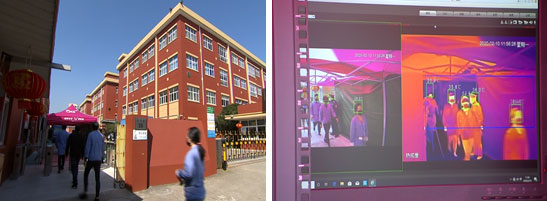 |
| Shenzhou’s workers come back to workplace in Beilun District, with infrared temperature measurer working on each passer-by |
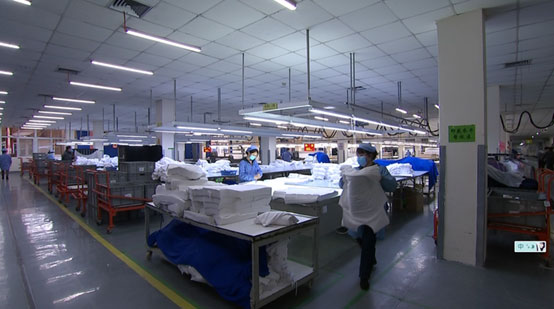
Mr. Ma went on saying that every person is asked to wear face mask with operating desk a bit away from each other and to wash hands at least three or four times a day while body temperature is measured three times during working hours in addition to the entry test. Moreover, for the sake of safety, a QR code is designed and set up for each operator with quick access to the personal updated information.
At 16:oo on the afternoon ,Feb.14, a bus with over 20 workers from other provinces pulled up in front of the dormitory building, an initial step that led to a series of chartered-bus plan to carry over 17,000 workers from 14 provinces , such as Sichuan, Gansu, Yunnan, Shanxi and Shandong , on more than 700 buses to the workplaces across the country on a proximity principle where workers in different provinces are taken to the operations nearby, said Mrs. Li Saizhen, Chairwoman of Workers Union in the company.
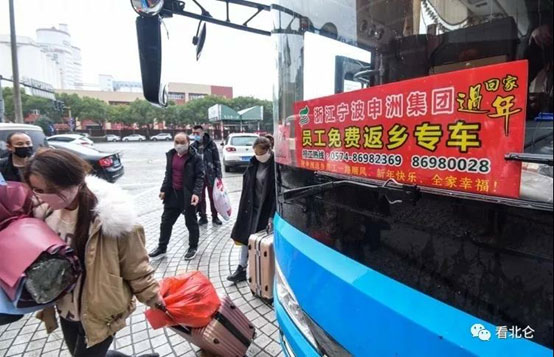 |
| A chartered bus stops inside Shenzhou’s compound with workers returning to work |
Shenzhou International got publically listed in Hong Kong Stock Exchange in 2005 and turned out to gain market capitals amounting to HK$117.32 billion and dividend yield by 2.31%, and P/E by 22.12% on March 16,2020 according report by HKEX. The company’s business income is largely from the international sportswear and knit apparel brands, like Adidas, Nike, Uniqlo, Puma as well as Decathlon, Russell and Mizuno etc. and its advanced productions in vertically-integrated system on basis of knit fabric-dyeing, printing & finishing-garment package services make it the choicest one for the long-term supply chain partnership with those big names. The two production bases in Vietnam (fabric knitting and garment sewing) and one garment operation in Cambodia are playing important role in taking more orders to compensate for what is short of in China on merits and demerits conditions.
When the number of new infections is shrinking in China, the COVID-19 has swollen to be an international pandemic, dragging a lot of countries into an intractable chaos. The role model company is making itself an exemplary one in addressing the challenging issues that cropped up at the time when a new issue appears significantly spiny.
Contributed by Mr. ZHAO Hong
He is working for CHINA TEXTILE magazine as Editor-in-Chief in addition to being involved in a plethora of activities for the textile industry. He has worked for the Engineering Institute of Ministry of Textile Industry, and for China National Textile Council and continues to serve the industry in the capacity of Deputy Director of China Textile International Exchange Centre, V. President of China Knitting Industry Association, V. President of China Textile Magazine and its Editor-in-Chief for the English Version, Deputy Director of News Centre of China National Textile and Apparel Council (CNTAC), Deputy Director of International Trade Office, CNTAC, Deputy Director of China Textile Economic Research Centre. He was also elected once ACT Chair of Private Sector Consulting Committee of International Textile and Clothing Bureau (ITCB)
Vietnam garment, textile export down three per cent
Vietnam’s export turnover of garment and textile products in the first two months of 2020 was down 3.5 per cent year-on-year. Shipment of clothes was down 2.3 per cent. Shipment of yarn was down 16 per cent. At present, the supply of raw materials basically meets production demand in March and April. However, the sector is facing a lot of difficulties, as the world economy is affected seriously by the coronavirus disease, resulting in a decrease in global demand.
In the first nine months of 2019, Vietnam’s exports to the US jumped by 34.8 per cent year on year. The United States is Vietnam’s largest export market. Overall, Vietnam-US trade will likely to continue to increase. However, Vietnam will need to be more careful particularly for industries such as steel, footwear and agricultural products exports to the US that have been growing. If it does not, the United States is likely to impose countervailing duties on products that it deems to harm its domestic industries. Vietnam however, will have to be even more careful to deal with origin fraud and transshipment as this has been the source of US tariffs on Vietnam in the past. The tariffs were imposed to prevent steel products that originated from China attempting to bypass anti-dumping rules.
Victoria’s Secret adds shapewear to its offerings
Victoria’s Secret, owned by L Brands, has witnessed a significant decline in sales since 2017 as consumers switched to other intimates brands promoting inclusivity and comfort. The company has employed many new strategies to get their customers back including re-entering the swimwear category, hiring its first transgender and plus size model and working with outside brands in collaborations. Nevertheless, Victoria’s Secret is still a market share leader in the intimates industry in the US and worldwide. If everything goes right, Victoria’s Secret’s shapewear might be a win-win situation for the brand’s image and the shapewear industry.
US-based Victoria’s Secret is an intimate apparel brand selling bras, pajamas, perfumes and other accessories. The retailer has for years faced criticisms for an out-of-date focus on sexy styles while competitors prioritized comfort. It canceled its once-annual fashion show as viewership increasingly shunned the provocative show. L Brands has been focused on diversification of its supply chain over the past five years. The company has been in negotiations with Chinese suppliers to take costs out of the production chain to offset the increase.
Brands renew sustainability commitments through new initiatives
A new report by The Gaurdian states, the fashion market is belatedly responding to the growing problem of overconsumption as brands such as H&M and Zara have renewed their commitments to sustainability. John Lewis has introduced labelling to encourage a culture of handing down children’s clothes. Nudie Jeans has become a success, with organic products and stores that promote repair services and resale.
Fashion has also increased its accessibility to people. There is a discernible shift from discarding clothes to repairing, reusing or even renting them. Britain. Messages from public figures, such as the environmentalist Greta Thunberg, about not buying clothes is helping persuade people to turn their backs on fast fashion. As a new research reveals, 51 per cent of Britons are opting to purchase expensive but longer-lasting clothes rather than cheaper throwaway items, up from 33 per cent a year ago.
Taiwan’s textile and apparel exports decline by 9 per cent
Taiwan Textile Federation, Taiwan’s textiles and apparel exports declined 9.0 per cent in 2019 compared to the previous year to reach $9.1 billion. It was the first decrease in exports in three years since 2016.
As a result of US-China trade friction and political turmoil in Hong Kong, exports sharply decreased to Mainland China and Hong Kong. The fact that Taiwanese companies in the upstream and middle-stream sectors have relocated their production to Vietnam and Indonesia is also a factor for the decrease.
Exports of fabrics decreased 6.0 per cent to $6.2 billion, while those of spun yarns decreased by 14.0 per cent to $1.4 billion. Textile fibers exports declined 25.0 per cent to $640 million.
In regard to the top five destinations, exports to Vietnam decreased by 2.0 per cent to $2.2 billion. Fabrics exports to the country decreased 1.0 per cent to $1.7 billion, while spun yarns grew 2.0 per cent to $241.0 million.
UK shoppers turn down fast fashion
The number of sustainable shoppers in the UK has increased by a third in the last 12 months. Customers are increasingly mindful of fashion waste and the supply chain. Though women are more for it than men, over two-thirds of UK shoppers are ready to ditch the wasteful nature of fast-fashion. They are choosing a more quality conscious approach to shopping and buying secondhand clothing and opting to recycle their cast-offs as well. Shoppers are moving away from fast fashion and there are new waves of consumers who are willing to invest in higher quality items, acknowledging that more expensive price tags might mean more mileage from certain items of clothing. In the past year, the number of people who favor clothes that will last has risen from just one-third to 51.4 per cent. On the other hand, in the same time period, the number of people in favor of fast fashion has lessened by 46.2 per cent. The fight against fast fashion and in particular against labels that peddle cheap, throwaway, trend-led clothing has gathered momentum.
Besides shopping at high streets, most fashion consumers are making more sustainable choices with their old clothes – with 71.3 per cent opting for clothing recycling rather than tossing them in the bin.
US retailers to shut stores to limit coronavirus spread
Major retailers plan to shut stores in the United States to limit the spread of COVID-19, including Nike, Under Armour , and Lululemon Athletica, a day after similar moves by several other US retailers. Coronavirus, which has already caused schools to close and put an end to sports events in the United States, is likely to hit retailers' sales as virus-wary shoppers in Europe and the U.S. stay home.
Nike stores in Canada, Western Europe, Australia and New Zealand will be closed from March 16 to 27, 2020. Its stores in South Korea, Japan, most of China and in many other countries, however, would continue their normal operations. Under Armour would shutter all of its stores in North America for about two weeks, while Lululemon’s stores would be closed in North America and Europe for a similar period.
Nike and Lululemon operate more than 650 stores in the US, while Under Armour has nearly 190 stores in North America, according to the companies' latest annual reports. Their online stores would continue to be available to shoppers.
Japan’s textile and apparel exports decline 1 per cent in 2019
Japan Textiles Exporters Association trade figures reveal the nation’s exports of textiles and apparel in 2019 decreased 1 per cent year-on-year to $7,742.66 million. Exports to Vietnam increased by 5 per cent to $1,053.32 million.
Exports of textile fibers decreased by 1 per cent to $827.34 million, while those of rayon staple fiber grew by 16 per cent to $73.23 million. Similarly, exports of polyester staple fiber declined by 3 per cent to $38.82 million, along with those of acrylic staple fiber also by the same 3 per cent to $534.29 million.
Yarn exports decreased by 8 per cent to $956.06 million with exports decreasing for rayon filament yarns, nylon filament yarns and polyester filament yarns. Exports of nylon filament yarns dropped 25 per cent to $178.96 million. Exports of woven and knitted fabrics remained about the same as the previous year at $2,811.27 million, and those of coated fabric decreased by 4 per cent to $458.54 million. Fabric exports increased for nylon filament fabrics, polyester filament fabrics and spun synthetic wovens, but decreased for cotton fabrics. Exports of nonwoven fabrics remained firm, while exports of apparel grew by 9 per cent to $536.97 million.
Indonesia eases import restrictions
Indonesia plans to relax restrictions on importing goods as one of its fiscal measures to combat the harmful economic effects of the COVID-19. The number of restricted import goods will be reduced by up to 50 per cent to spur business activities. As many as 749 harmonized system codes will be scrapped. Stimulus packages are being prepared, including one that will expedite the import process for 500 importers with good reputations and another to reduce logistics costs in ports across the country. Items included in the list of restricted import goods include ceramics, soybeans, corn, textiles and textile products, vaccines, health equipment, telecommunication tools and equipment, footwear and food supplements, among many others. Manufacturing industries have complained of disruptions to their supplies of raw materials that have crippled factories across Indonesia. Twenty per cent to 50 per cent of raw materials for the country’s industries are usually sourced from China.
Indonesia might not be affected severely by the global health emergency, thanks to its minimal exposure to global trade and its wide room to maneuver in monetary policy. It isn't deeply integrated in the global supply chain. Indonesia is heavily dependent on domestic demand. Household consumption grew 4.97 per cent in the fourth quarter of 2019 and accounts for more than 50 per cent of gross domestic product.
India’s yarn exports down 30 per cent
India’s yarn exports fell 30 per cent in value terms in January to February 2020 compared to last year. Reason: COVID-19. There was a sharp fall in cotton yarn exports to China, Iran, Korea and Vietnam. China accounts for nearly one-third of Indian yarn exports. As for the performance of the cotton spinning industry, it has already been severely constrained in the current fiscal year amid multiple headwinds, including a demand slowdown in the domestic as well as export markets and unfavorable raw material prices. While the industry was pinning hopes on a gradual recovery in yarn exports from the fourth quarter onwards, aided by the softening of domestic cotton prices, recent developments could prolong tough times for Indian spinners.
Around 11 countries buy 41 per cent of India’s cotton yarn exports. India’s garment exporters depend heavily on China for their import requirements. They are exploring other sources like Japan for woven fabric made out of artificial filament yarn, slide fasteners and parts, sewing machines, furniture, bases and covers, and sewing machine needles.
Another opportunity for Indian exporters is that buyers in the US and Israel are interested in sourcing from India. They had been buying these products from China so far.