FW
M&B Hangers President bags TRSA Maglin/Biggie Lifetime Achievement Award
Milton M. Magnus III, President, M&B Hangers, Leeds, AL, was recently named the winner of TRSA’s Maglin/Biggie Lifetime Achievement Award, which honors exceptional lifetime contributions by an associate member to improve the association and industry. Magnus III will receive his award during the Annual Awards Dinner on Sept. 19, in conjunction with the TRSA 106th Annual Conference in Boston, MA.
Magnus is a longtime, active member of TRSA. He promotes TRSA’s value to the industry, supporting the association through personal involvement and enabling his company’s management to give their time to TRSA activities. He’s been an active supporter of TRSA’s advocacy efforts and is one of TRSAPAC’s strongest supporters, donating annually to ensure the linen, uniform and facility services industry is well represented in front of policymakers. Magnus has served on a variety of committees and currently chairs the associate committee. He is also a current member of the TRSA Board of Directors.
Magnus joined M&B Hangers 45 years ago. Under his leadership, the company has grown and diversified to a full-line hanger manufacturer in the United States. M&B Hangers operates manufacturing plants in Leeds, AL, and in PiedrasNegras, Mexico.
NRF urges USTR to avoid additional tariffs
A recently released study by the National Retail Federation urged the Office of the U.S. Trade Representative to avoid 25 percent tariffs on $300 billion in Chinese goods. The report prepared by the Trade Partnership Worldwide projected that American consumers will have to pay $4.4 billion more each year for apparel, $2.5 billion more for footwear, $3.7 billion more for toys, and $1.6 billion more for household appliances if the administration proceeds with the additional tariffs.
David French, Senior Vice President-Government Relationa, NRF has urged the Office of US Trade Representative to reevaluate a strategy based solely on tariffs and work with its allies to put international pressure on China.
According to him, it would be impossible for all market participants in the industry to simultaneously move sourcing to other countries if the tariffs are levied. The retailers would be forced to continue to use Chinese suppliers and pass on higher costs to their customers – just in time for the holiday shopping season.
As part of monthly consumer surveys conducted by Prosper Insights & Analytics, NRF has been tracking the public’s growing concern over the trade war. The June survey found 81 percent of consumers are “concerned the ongoing trade war will cause prices to increase,” a 12 percent increase since November 2018.
In addition to French’s oral testimony, NRF submitted comments to USTR detailing the negative economic impact of the proposed tariffs on American businesses, workers and consumers.
Fashion SVP Summer Edition to be held in London
UK sourcing and manufacturing expo Fashion SVP will hold its summer edition from June 25-26at the Olympia exhibition center in London. The show’s resident denim section, formerly known as Source Denim, will feature Orta Anadolu as a first-time exhibitor, while Pioneer Denim will return to the show as an exhibitor. Both of these companies will present their latest innovations, with focus on sustainable solutions. Other denim manufacturers due to participate include Denim Club from India, Turkish suppliers Kilim Group and Tusa, and Marjomotex from Portugal.
Fashion SVP has again partnered with Fashion Enter – the social enterprise striving be a center of excellence for sampling, grading, and production as well as learning and the development of skills within the fashion and textiles industry. This collaboration will provide visitors with practical, interactive 'drop-in' workshops relevant for start-ups and established fashion players alike.
LVMH Group Co to launch menswear
LVMH group’s luxury multibrand e-tail site 24S will launch a menswear collectionin January 2020. The collection will feature labels like Balenciaga, Fendi, Gucci, Off-White and Acne Studios, as well as exclusive items by Dior and Celine, two labels also owned by Bernard Arnault's luxury goods giant.
Introducing menswear was a part of the group’s strategic plan ever since it launched its operations. The brand will offer an unrivalled product range and service, by showcasing the best in fashion to its customers from all over the world. 24S, which changed name last May, dropping 24 Sèvres, the name it started with, isn’t the only luxury multi brand e-tailer to introduce menswear. Last March, My theres a hired Australian manager Chris Kyvetos, making him its first purchasing director for menswear
H&M opts for cleaner transport
H&M is backing greener commercial transport initiatives in a bid to become more environment-friendly.
The Swedish fashion conglomerate has a collaboration with the transport giant Maersk to champion its new, carbon-neutral ocean product -- a biofuel-blend that incorporates fuels such as wasted cooking oil that has been tested to propel vessels, showing promising results in reducing the emissions from ocean shipping.
H&M aims at achieving a fossil-free commercial heavy transportation system by 2050. Its ambition to become climate positive by 2040 requires cooperation and engagement from all parties in the supply chain. The group wants to use its size to be a force for good and enable scaling innovative solutions, such as the carbon neutral ocean product, for a greener commercial transport.
Luxury fashion brand Ralph Lauren plans to set science-based greenhouse gas reduction targets by 2020 and 100 per cent renewable energy targets by the end of this year. In May PVH, the parent company behind Calvin Klein and Tommy Hilfiger, unveil Forward Fashion, the evolution of its corporate responsibility strategy that aims at reducing its negative impacts to zero, focusing on eliminating carbon emissions by using more renewable energy sources and cutting waste to zero by avoiding landfill solutions.
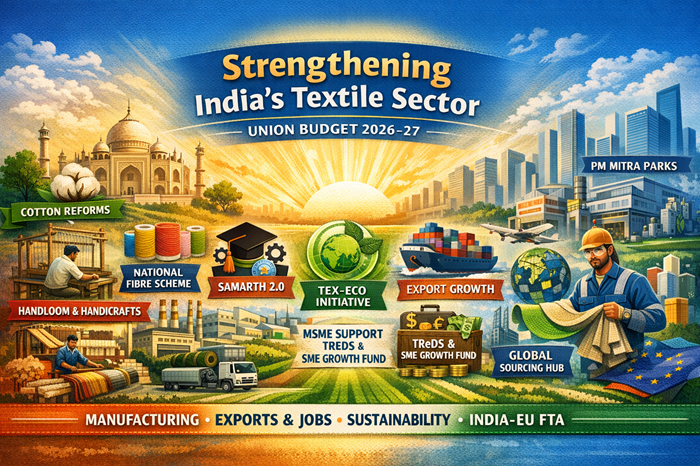
Indian industry looks for solutions
The Indian textile industry has hit roadblocks on exports. The most likely reason for this may be the industry’s focus on select markets/zones — where it has been unable to compete on the price front with FTA countries — rising manufacturing cost, inability to compete with low-cost destinations, or limited exposure to blended apparels.
This pressure on the price front has pushed the apparel sector to concentrate on retaining business rather than on growth or exploring new markets. The country’s textile and apparel sector has found it difficult to compete with Vietnam and China, as manmade fiber is expensive in India and the industry is ill-equipped to shift to blends and still relies on cotton.
Growth in the apparel sector’s exports will solve India’s twin challenges of job creation and greater participation of women in the textile industry. A fiber-neutral policy, single lower GST rate for all textile products, a scheme to promote large-scale apparel manufacture, providing more support to small and medium exporters, and speeding up India’s foreign trade agreements would go a long way in boosting apparel exports. Also highlighting the concept of the green process (zero-liquid discharge in processing) and green factories across the country would help in branding. A Cotton Technology Mission would help curb the volatility of cotton prices, which are currently at the highest level.
India unveils textile package
India has unveiled a special package for the domestic apparel sector. The aim is to encourage the domestic apparel sector to compete with multinational brands. Additional incentives will be provided under the Amended Technology Upgradation Fund. Section 80JJAA of the Income Tax Act will be relaxed. Fixed term employment will be introduced for the apparel sector. State and central taxes/levies embedded in manufacturing will be rebated.
India’s traditional textile and synthetic materials cater to different domestic market segments. Traditional textiles and fabrics are primarily cotton-focused and cater to niche markets. In India, import of synthetic fabric is approximately 30 per cent of domestic production of traditional textiles. The share of imported apparel with respect to the domestic apparel market in India is nearly 1.4 per cent.
There have been challenges for the export sector over a period of time and one big challenge is credit. There has been a sharp decline in credit to the export sector. To reduce transaction costs for exporters, there may be multi-modal transport, which will help enhance efficiency in the logistics sector. Each logistics company will be rated by a regulatory organisation, which will be created by the industry. A e-wallet mechanism may be introduced to effectively address the woes of exporters who have been complaining of delays in refund of taxes under the GST regime.
Lakshmi upgrades Kenyan factory
Rivatex East Africa was a sick textile factory. The Indian company was awarded the contract for supply, installation, testing and commissioning of plant, machinery and equipment. In less than three years of signing the line of credit agreement, Rivatex has been upgraded to post an almost tenfold increase in its capacity.
Once fully operational, the factory is expected to revive Kenya''s textile industry -- by generating direct employment as well as helping increase incomes of cotton growers in 22 counties, along with strengthening of forward and backward linkages.
India and Kenya have bilateral cooperation in multiple sectors such as education, health, industrial and infrastructural development, culture and others. Lakshmi Machine Works provides spinning technology to Indian textile mills. The company is a leading textile machinery manufacturer and has brought out various innovative products during the year and worked towards its three pillars – automation, digitisation and sustainability – with a greater focus on after sales and service. The after sales and parts and components business have grown significantly during the year. Exports to markets like Bangladesh, Kenya and Vietnam have doubled. Currently exports sales contribute to more than 40 per cent of the total revenue.
Brother offers bolder designs with GTX
Brother’s GTX direct-to-garment printer can print bigger and bolder designsthan previous models on a multitude of fabric types.
It has unmatched vibrant print quality and impressively fast printing speed that guarantees more output which leads to better business. It’s low maintenance, thanks to its automatic wet capping station and white ink circulation system that minimizes clogged nozzles. It’s also environment-friendly as its new formulated inks are water-based, Okeo-Tex Eco-Passport certified, and CPSIA compliant, which make it safe to print on children’s clothing. The GTX’s innovative replaceable ink pouches make use of less plastic, allowing users to reduce their carbon footprint and environmental impact.
Brother’s Luminaire Innov-ís XP1 is the company's flagship sewing, embroidery and quilting machine with exclusive features. Features include Stitch Vision Technology for virtually perfect stitch positioning and more precise previews via an intelligent projection of light – preview, audition and edit designs and stitches directly on the fabric. It also has 65 square inches of workspace, a large embroidery frame with a new spring lever release, powerful surround LED lighting, large touch screen display with capacitive technology, camera detecting buttonhole feature and Enhanced My Design Centre, including a new echo quilting feature. The PE-DESIGN 11 is the latest personal embroidery and sewing digitising software from Brother.
Marzoli offers intelligent spinning systems at ITMA 2019
"Marzoli, a Camozzi Group company is offering intelligent spinning systems at ITMA.2019. The company has developed MRM (Marzoli Remote Maintenance In collaboration with Camozzi Digital. This is the first patented software platform in the world that analyses the big data of machinery processes detected as mission critical, to continuously monitor operations. It reduces machine downtime, increase the lifespan of parts and enables effective and prompter maintenance."
 Marzoli, a Camozzi Group company is offering intelligent spinning systems at ITMA.2019. The company has developed MRM (Marzoli Remote Maintenance In collaboration with Camozzi Digital. This is the first patented software platform in the world that analyses the big data of machinery processes detected as mission critical, to continuously monitor operations. It reduces machine downtime, increase the lifespan of parts and enables effective and prompter maintenance. Remote control, on the other hand, is made possible by YarNet: a highly innovative software, thanks to which users can easily manage the entire Marzoli spinning process directly from their PC, quickly querying each single machine with ease, a real value-added technology for customers aiming to maximise productivity and profitability.
Other innovative products on show include Brain Box: the new patented Marzoli software with an integrated 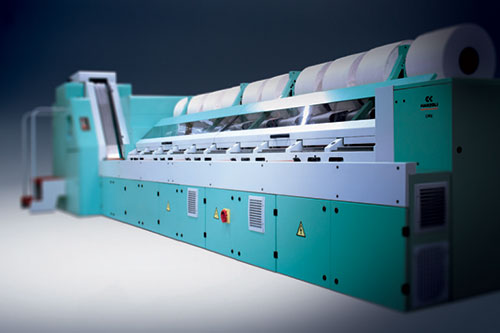 APP, developed entirely in-house, which significantly improves plant performance. In fact, the data emerging from the tests conducted shows a 5.5 per cent increase in productivity, an 8 per cent increase in efficiency, and 1.5 per cent energy savings. Installation is fast and simple, with just four steps: apply the sensors to the individual machines, connect the sensors to Brain Box, download the APP, and activate the monitoring function for the detection of any issues.
Another main attraction at ITMA is the innovative 24,000 spinning module by Marzoli, whichenables customers to achieve a significant reduction in TCO (Total Cost of Ownership) thanks to a 4 per cent cost savings for conditioning, a 10 per cent reduction in investments in the square footage of production sites and a 9 per cent cost savings for internal logistics.