FW
Crude oil volatility affects Indian synthetics sector
Volatility in crude oil prices has hit Indian synthetic textile manufacturers. When crude prices hit their highest levels in 2018, raw material buyers placed massive orders steadily to build their pipeline inventory before any further rise. The sudden spurt in prices prompted producers of manmade fiber and synthetic yarn manufacturers to start placing orders again. However, the entire sentiment saw a reversal in two months.
Raw material buyers in the synthetic textile industry have disappeared from the market amid expectations of a further fall in prices. Raw material purchasers have deferred their purchase orders on expectations of a further decline in crude oil prices and, subsequently, prices of synthetic fiber and yarn. Manmade fibers and yarns are made from petrochemicals, which are derivatives of crude oil. Their prices follow the movement in crude oil prices.
The industry believes the October-December quarter may not be good in terms of the top line and bottom line but hopes for stabiliity from the March quarter. Also the impact of volatility in crude oil prices has been nullified by the rising demand for synthetic textile products in India. Polyester is slowly replacing cotton, thereby increasing the production of manmade fibers. Demand for synthetic textiles is rising with rapid urbanisation and low-cost options available in the clothing segment.
Levi’s denim customisation offers creative freedom to customers
"To whet consumers’ appetites for perfectly damaged jeans, Levi’s has been selling denim customised by Aldridge, rapper Snoop Dogg, actress Sasha Lane, surfer Kelly Slater, tattoo artist Dr. Woo, basketball star Blake Griffin and others. Model Lily Aldridge, Vice President of technical innovation for Levi's, designs a pair of jeans on an iPad alongside Bart Sights. So does her husband, Kings of Leon singer Caleb Followill, A pair of Levi's designed by Lily Aldridge go through the laser process."
 To whet consumers’ appetites for perfectly damaged jeans, Levi’s has been selling denim customised by Aldridge, rapper Snoop Dogg, actress Sasha Lane, surfer Kelly Slater, tattoo artist Dr. Woo, basketball star Blake Griffin and others.
Model Lily Aldridge, Vice President of technical innovation for Levi's, designs a pair of jeans on an iPad alongside Bart Sights. So does her husband, Kings of Leon singer Caleb Followill, A pair of Levi's designed by Lily Aldridge go through the laser process.
Technology to create personalized experiences
Levi’s plans to expand its customisation program next year where consumers can follow Aldridge’s lead and get their denims customised. The brand will install a laser machine, developed by Spanish company Jeanologia, in one of its stores in the U.S. Online and in stores, consumers will use a similar app to personalise their jeans. Levi’s is yet to finalise the cost for customisation of their jeans.
Lily Aldridge places a tear on a pair of jeans she personalises at Levi's temporary downtown L.A. studio. She has customised so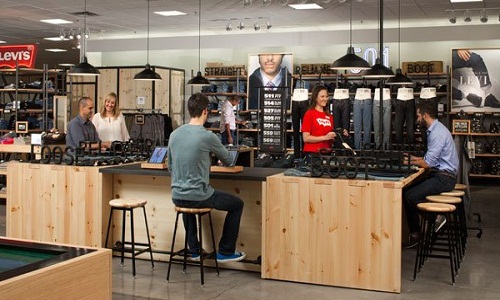 far two pairs of jeans and drew cheetah spots on a back pocket with the laser machine. These jeans are displayed by Bart Sights, Vice President-Technical Innovation for Levi's.
Besides beating fast fashion at their own game, customisation delivers what people need when they want it, and giving them the freedom to express their creativity.
Yoga wear dominates active wear in the US
The active wear market in the US has changed over the last three years. About $48 billion is being spent on active wear in the US every year. As more consumers in the US are exercising and prioritizing their health, this is fuelling the active wear market for on-trend performance items.
Traditional sports brands have grown their assortment. The number of yoga products in stock in 2018 has increased by 35.8 per cent compared to 2016. Yoga leggings skyrocketed by 87 per cent compared to 2017. What was once a simple stretchy legging has become a wardrobe phenomenon.
Pricing in the traditional sports market, despite some fluctuations, has generally maintained a consistent level. Traditional active wear retailers are having to compete to maintain their valuable relationship with customers. Non-traditional sports retailers are getting in on the game and launching their own active wear collections at a more accessible price point for consumers.
So retailers need to harness the power of data and understand when to buy-in or buy-out of trends. Grey and white are the most favored color for new active wear products, holding almost 23 per cent of the color palette. High rise leggings are the most popular style for replenishments – not surprising seeing they are a flattering design that suits all body types.
Poll reveals Americans’ distrust for fashion brands
A new poll by Changing Markets, an organisation dedicated to reducing the environmental footprint of corporations and the Clean Clothes Campaign, indicates Americans seek more supply chain transparency from clothing brands. The poll, which comprised of over 7,000 interviews across seven countries (more than 1,000 in each), including the US, asked participants to share their public perceptions on environmental and labor issues within the fashion industry.
It found four in five Americans (79 per cent) think clothing brands should provide customers with more information on their commitments to protecting the planet, and what measures they're taking to minimise pollution within their supply chain. Additionally, 73 per cent percent of American respondents think clothing brands should be held responsible for what occurs in their manufacturing processes — meaning it's up to them to produce their clothes sustainably and ethically. Another 81 per cent of Americans are concerned about the working conditions of employees, with 63 per cent believing fashion industry should pay its garment workers higher wages.
The polls also revealed that less than a third of Americans polled think that industry self-regulation is the most effective way to minimise the fashion industry's impact on the planet, and nearly half of them didn't know which brands actually have sustainable supply chains, as Nike, H&M, and the Gap do. And 61 per cent of Americans said they find it difficult to know which ones do and which ones don't.
Textile show Colombiatex in Brazil this week
Colombiatex will be held in Brazil from January 22 to 24, 2019. This is Latin America’s most important textile show. In addition to offering apparel fabrics and inputs, companies introduce technological developments in machinery for faster productive processes in cutting and apparel-making, automation, design and energy efficient equipment.
Nearly 40 companies in the Brazilian textile industry will launch innovations. Colombiatex will showcase advances and technologies in Brazilan in textile and apparel production. One of the main attractions will be a virtual expo on Brazil’s Industry 4.0 and a virtual reality experience of a model Industry 4.0 plant, highlighting the country and the importance of its industry. During this visit, which will be led by Brazilian specialists, visitors can also access a virtual mirror. The device uses a camera to take body measurements, with the person then choosing the model and the print.
Visitors will be shown trends for 2019 and new developments, using fashion shows. The collection brings together inputs from Brazilian companies, filled with color and design, representing the charm and evolution of Brazilian fashion. Brazil is a reference point in the machinery and equipment sector for the textile industry in Latin America in terms of quality, technology and competitiveness.
Technical textiles hold a great future for India
The technical textile industry in India is growing at a CAGR of 20 per cent. The diverse range of technical textiles in India can be broadly grouped into categories such as agrotech, meditech, packtech, clothtech, indutech, hometech, geotech, Oekotech, protech, sportstech, buildtech and mobitech. All these sectors are expected to see double digit growth.
Demand for this sector is rising due to many factors including rapid urbanisation, advances in medical technology, expansion in construction sectors, awareness on safety and environmentalism and increased spending on healthcare. Technical textiles are significant for the growth of the entire textile industry as they are value added products manufactured primarily for technical performance and multi-functional properties with less intent on aesthetics and design.
This sector is considered as a sunrise sector and it provides new opportunities to the Indian industry to have a long term sustainable future. However, the absence of a clear classification for technical textiles is creating confusion and many genuine manufacturers do not get the incentives and subsidies allowed to this sector. This is impacting investment in this segment.
India still has a long way to go as it currently lacks the ability to domestically fulfill the rising demand and to be globally competitive in this sector. There is untapped potential both in the export and domestic market of technical textiles.
Menswear Tradeshow Project NY to focus on streetwear’s future
Menswear trade show Project NY, to be held from July 20-22, 2019 in New York has revealed a program showcasing the hottest trends for Fall/Winter 2019-20. The trade show will address one of the biggest questions in contemporary men’s fashion: Where next for streetwear?
The three-day show will feature five neighborhoods, each dedicated to a different aspect of menswear. The Tents, for example, will play host to high-end contemporary luxury brands such as Troubadour, Eden Park and Ace & Everett, while The Foundry will offer visitors a curated selection of men’s apparel, home goods and male grooming products, among other “purposeful objects”, with confirmed exhibitors including Raw Shaving, Beltology and The Frenchie Group.
Elsewhere, Project Sole will focus on footwear and Blue will present buyers with a range of premium denim brands. The last day of the show will be dedicated to streetwear. It will include talks entitled “Streetwear Starter Pack: FW19 Edition”, led by Brian Trunzo, senior consultant at WGSN, and “The Future of Streetwear”, led by WGSN associate editor Quentin Humphrey.
Project NY will also discuss other growing tendencies in menswear. Moderated by Trunzo, the “Take (Back) Ivy & The Great Prep Revival” panel, featuring Jack Carlson of Rowing Blazers, GQ’s Sam Hine, Jeremy Kirkland of Blamo! and vintage collector Josh Matthews, will explore the resurgence of the prep style in men’s fashion.
Orders start coming for Vietnam post US-China tariff war
The ongoing US-China trade war threatens to dent exports from the world's two largest economies but other countries may see Chinese and American demand diverted their way. Vietnam is one of the places most expected to benefit from the trade war-inspired buying. The Southeast Asian nation has been touted as a possible winner in the US-China trade war because of its low cost of manufacturing. Some companies have already begun shifting production out of China to avoid tariffs imposed by America.
Vietnam will likely benefit from those adjusted supply chains for a long time. It is now set to be kind of a China 2.0 for various reasons. While firms have been limited by the logistical constraints of relocating and building new facilities in Vietnam, the country has begun to see new orders flooding into its existing industries that have some capacity for increased production.
Big export orders are flowing into the seafood, and the furniture and the garment industry. People have started to divert business away from China. Vietnam’s companies have good earnings growth and are trading at a price-to-earnings ratio of around 12 times, which is lower than in neighboring countries. Vietnam unseated Singapore as Southeast Asia's top grossing market for initial public offerings in 2018.
Pakistan enhances synthetic filament capacity
Pakistan is upgrading its filament production capacity. The aim is to ensure availability of the raw material for the industry as well as fair protection to the domestic industry to attract further investment. Internationally cotton is 30 per cent of total fiber consumption and manmade fiber and filament is at 70 per cent while the situation in Pakistan is the opposite. The filament manufacturing group of the textile division of Pakistan has committed to invest $125 million to upgrade its existing production capacit
Vietnam, Bangladesh, and Cambodia are leading exporters of synthetic textiles following China. So far domestic policies in Pakistan and market conditions have hindered the country’s foray into this emerging market.
In India higher GST rates have had the effect of raising cost of production and restricting supply as the business environment became tougher to manage. Polyester filament yarn production increased five per cent in 2017 up to July, relative to the same period the year before. Polyester filament yarn makes up the vast majority of total filament yarn production in India this market year as 92 per cent of total yarn production consists of polyester filament yarn.
Nylon filament yarn production makes up just three per cent of total filament yarn production in India. The increase in polyester filament yarn production has offset the drop in polypropylene filament yarn and viscose filament yarn production.
Pakistan withdraws duties on cotton imports
Gas and electricity tariffs have been rationalised for the export-focused industry in an attempt to cut cost of production and boost competitiveness. These incentives have brought down the cost of production for the textile value chain.
Pakistan has been a net importer of cotton for nearly two decades. Its cotton production hit the highest in the last ten years in 2014-15 and that year too the country imported about a million bales.
In 2018-19 season, Pakistan is expected to face a shortfall of three to four million bales. High duties and taxes of up to ten per cent, including three per cent customs duty, two per cent additional duty and five per cent sales tax, were imposed on cotton imports in July 2018, leading to a sharp decline in imports. Now the plan is to rationalise subsidies for agricultural crops in order to encourage the cultivation of cotton. The cotton ginning industry os being encouraged to reduce contamination, improve productivity and upgrade the machinery.
Owing to trade tensions between the US and China, Pakistan’s textile industry is receiving a large number of import queries from the US. Simultaneously Pakistan is working on expanding its market share in China, Japan, the European Union and the US.