


FW
Startup to build sleepwear, loungewear and casual wear units in Africa
An ambitious startup - the Walls of Benin - led by 30-year-old Chi Atanga, a man from Cameroonian born in Manchester, England, plans to build factories in Africa for making stylish and sophisticated sleepwear, loungewear and casualwear that is suitable for all occasions
Atanga, who researched and designed the business plan for Walls of Benin, is now setting up operations in a Special Economic Zone outside the coastal city of Mombasa, Kenya's second-largest city. He will take the spirit of African print textiles and swap wax and heavy cloth for more luxurious and ecological fabrics. Kente, Ghana's famous silk-and-cotton blend is an example of an African fabric, while silk and Tencel are natural fibres with extra softness and moisture-wicking properties.
Currently, Walls of Benin operates from Kenya and Rwanda, and imports silk and Tencel from Portugal. In April 2018, the company partnered with Wildlife Works, a wildlife conservation group based in Kenya, to launch an African production. It hopes to export luxury loungewear made of extra-soft silk and Tencel to Europe and elsewhere.
Upcoming denim show Bluezone to highlight change
Bluezone will be held on September 4 to 5. This will reinforce denim’s sense of community and discovery. This edition will be the largest yet with more than 100 international brands in the denim and sportswear categories showcasing their latest fabric developments.
The show’s overriding theme for the season, Perpetuum Blue, reflects how the denim industry is in a state of constant motion. Through trend displays, workshops and presentations, Bluezone will bring to life how parallel universes like high fashion and non-fashion are developing in the denim sector.
New exhibitors at the already sold-out show include: Desert Studio, Pizarro Wiser, Hyosung Creora and Imatex. Fashion label Atelier & Repair will also present a collection in partnership with Candiani and Lenzing. Italian denim mill Berto will present its Pianeta fabric development made with upcycled production scraps.
Pakistan-based mills will showcase sustainable inroads they’re making. Rantex will introduce an eco-color concept, while Soorty will bring its Zero Waste Water collection. Meanwhile, Naveena will present its flexible performance technology, Wraptech.
For the first time, the outdoor area around Bluezone will be used as additional exhibition space. The street festival-inspired space, called the Blue Yard, will offer a blend of old and new, showcasing a mix of vintage showrooms and exhibits that revolve around new technologies.
GTE ’18 Bengaluru to showcase latest technologies and innovations
"Garment Technology Expo (GTE), is one of the biggest and most comprehensive B2B expos for apparel machinery. The next edition of GTE ’18 will take place in Bengaluru from August 18 to 20, 2018 at Dr Prabhakar Kore Convetion Centre. This is the 8th edition of GTE to be held in South India. The three-day expo will showcase technologies related to making fine garments under one roof. The exhibits encompass technology dedicated to apparels, embroidery, laundry and steam finishing, knitting, digital printing and accessories. The first GTE Bengaluru was held in 2006 and since 2008, the expo is being held every alternate year."
 Garment Technology Expo (GTE), is one of the biggest and most comprehensive B2B expos for apparel machinery. The next edition of GTE ’18 will take place in Bengaluru from August 18 to 20, 2018 at Dr Prabhakar Kore Convetion Centre. This is the 8th edition of GTE to be held in South India. The three-day expo will showcase technologies related to making fine garments under one roof. The exhibits encompass technology dedicated to apparels, embroidery, laundry and steam finishing, knitting, digital printing and accessories. The first GTE Bengaluru was held in 2006 and since 2008, the expo is being held every alternate year.
Many firsts
Many first time exhibitors will showcase their latest products and technologies at GTE ’18 to help the industry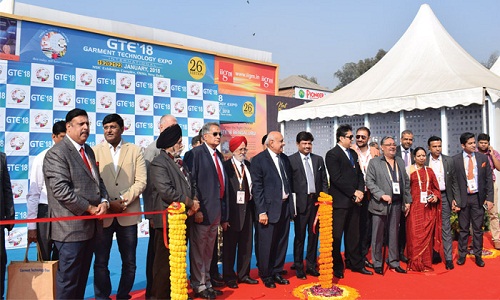 gear up for the future. These include exhibitors showcasing embroidery machinery, lazer cutting machines etc. They will launch innovative machines to cater to the domestic and export market. The three-day expo will host customers and international participants from over 22 countries.
The nerve centre of the garment industry, home furnishing fabricators in South India, Bengaluru, is also the region’s biggest readymade garment production and export hub with over 1,500 factories employing 500,000 workers. The metro is conveniently connected with neighbouring states in the South. All major garment brands have set up production bases in the city while many big Indian garment exporters operate from the city.
Wide array of products on display
GTE ’18 will showcase a wide range of products including sewing machines, knitting, embroidery and digital textile printing machines, laundry & steam finishing equipment, quilting, spreading & cutting and leather garment machines, CAD/CAM, finishing & testing, fusing and dyeing machines, dyes & chemicals, spares & attachments, accessories & trims, fancy yarns, fabrics, IT enabled services, software solutions.
The biggest industry show in the subcontinent, GTE is patronised by trade professionals including manufacturers, exporters, institutions and other volume consumers. Numerous brand owners, CEOs, MDs, production heads and the like visit the expo to negotiate deals for new machinery while designers, technical supervisors, shop floor managers, etc, update themselves on new technologies, materials etc. The expo attracts visitors from all over Karnataka, Tamil Nadu, Madhya Pradesh, Andhra Pradesh, Kerala, Maharashtra, Goa, Gujarat and more. Designers, manufacturers, dealers, traders, distributors and agents are the target visitors.
Ensuring a good footfall
A promoter of value addition shows, GTE ’18 will ensure record footfall of genuine visitors. The expo is being publicised through all industry related trade magazines, media, emails, SMS messages etc to stakeholders in the garment industry. Prior to the expo, the organiser ensure extensive branding on autos, advertisements in all leading newspapers in India and hoardings in vantage locations.
Global home textiles market registers robust growth
"As per latest US customs data, the country’s imports of home textiles and made-ups grew at a robust 7.7 per cent to reach 8,740 million sq. mt. during the January-May 2018 period. Import of made-ups and home textiles of man-made fibres grew 10 per cent to reach 6,093.6 million sq. mt. In contrast, cotton made-ups and home textile imports grew by 1.6 per cent to reach 2,375.5 million sq. mt."
 As per latest US customs data, the country’s imports of home textiles and made-ups grew at a robust 7.7 per cent to reach 8,740 million sq. mt. during the January-May 2018 period. Import of made-ups and home textiles of man-made fibres grew 10 per cent to reach 6,093.6 million sq. mt. In contrast, cotton made-ups and home textile imports grew by 1.6 per cent to reach 2,375.5 million sq. mt.
Home textiles and growing business
In value terms however, US imports of cotton made-ups and home textiles during January-May 2018, were $3034.7 million, 1.41 per cent lower than during January-May 2017. China, which enjoys a share of 36 per cent in total US cotton home textile imports, witnessed a fall of 0.57 per cent in exports to the US, at $1,091.6 million. Close on the heels is India at $990.99 million, witnessed a drop of 6 per cent.
In MMF made-ups and home textiles, India's share is a meager 4.43 per cent, while China enjoys majority share of 61 per cent. In dollar terms, India's exports of MMF home textiles to the US grew 6.66 per cent to $100 million during January-May 2018. China's exports during the period were to the tune of $1390.92 million, growing 7.52 per cent
The global home textile market is estimated to reach $130 billion by 2021. Bed linen accounts for the largest share of 45 per cent in this segment, while bath linen constitutes 20 per cent. Other segments such as floor coverings, furnishings, table and kitchen linen make up 35per cent of home textile market. Bed linen and bedspreads segment is expected to grow at a CAGR of 4.4 per cent to reach $60 billion by 2020. The US is the world's single largest home textiles market accounting for 21 per cent market share. The US market is projected to grow at CAGR of 3 per cent to reach $27 billion by FY2020. Europe is the second largest home textiles market, accounting for 26.8 per cent. Bed and bath linen market in Europe is expected to grow at CAGR of 1.7 per cent to $17 billion by 2020.
Meanwhile, Asia Pacific, accounting for 44 per cent of the market, remains the most dominant producer and consumer of home textiles. Here, China is the largest manufacturer and consumer of home textiles. The market size is estimated at $30 billion.
India is the third largest home textiles market in the Asia Pacific region, projected to grow at a CAGR of 7.2 per cent to reach $5.6 billion by 2020. India's bed linen consumption is expected to reach Rs 19,350 crore ( $US 2.81 billion) by 2021, growing at a CAGR of 8 per cent from 2011-2021. Towels consumption in the country is estimated to reach Rs 7,060 crore ( $US 1.02 billion) by 2021, curtains Rs 4,790 crore ( $US 0.70 billion) , blankets Rs 2,850 crore ( $US 0.41 billion), upholstery Rs 3,080 crore( $US 0.45 billion), kitchen linen Rs 2,400 crore( $US 0.35 billion), and rugs and carpets ( $US 0.18 billion) crore by 2021. The strong growth expected in the market over the next three years has pushed up investments in the sector.
Used clothes add to sustainability woes
Overconsumption and the inevitable disposal of unwanted clothing has become a worrying global problem. In many cases, these clothing are unnecessarily thrown away. Instead, it could be repaired or recycled. One truck of textiles is thrown away every second globally.
Materialistic values and a widespread desire for having new styles have reduced the functional value of clothing, making it easily disposable. A staggering 100 billion items of clothing are being produced annually, and 50 per cent of fast fashion pieces are disposed of within a year.
While consumers have grown increasingly concerned about where and how garments are made, there are still serious concerns over its environmental impact and contribution to climate change. Fashion is deemed to be one of the world’s most polluting industries – from toxic chemical use to water pollution and waste. Some 35 per cent of the global total of microfibers in the oceans comes from clothes and textiles.
By 2050, it is anticipated, the fashion industry will use up 25 per cent of the world’s carbon budget. Recycling is problematic environmentally. Recycling is energy intensive and may require use of further virgin materials. While it resolves some of fashion’s sustainability issues, it does not adequately address the problem that consumers buy too much and that the average number of times a garment is worn has fallen by 36 per cent since 2000.
US home textile suppliers expect good season
Home textile suppliers in the US have a busy season ahead. Back-to-College season is a significant event for vendors, who have created bedding, bath and accessories collections specific to dorm rooms and college apartments. This year, most back-to-school shoppers plan to start shopping at least three weeks before school begins.
College and graduate students spending on dorm or apartment furnishings make the category the third largest behind electronics and clothing/accessories. For the harvest season, running from late September through Thanksgiving, home textile suppliers of decorative pillows and bath accessories have created novelty capsule collections. This is when table linens and kitchen textiles imbued with autumnal hues take the spotlight.
The holiday shopping season is prime time for blankets, throws, flannel sheets, holiday-themed table linens and whimsical bathroom décor. When it comes to Christmas trimmings, home textile suppliers are also in the mix with stockings and tree skirts whose motifs range from tongue-in-cheek to formally elegant.
Total holiday sales at retail across all categories last year rose 5.5 per cent. That marked the largest increase since the 5.2 per cent year-over-year gain seen in 2010. Holiday sales at furniture and home furnishings stores climbed 7.5 per cent unadjusted year-over-year, a strong showing.
Sachin Tendulkar’s brand True Blue extends categories
Men’s wear brand True Blue may extend into accessories or women’s wear. The brand was launched in 2016 by Arvind and Sachin Tendulkar. True Blue is a lifestyle brand and does shirts, T-shirts, blazers, bundies, suits, denims, chinos, polos. Most of the silhouettes are western. Fabric details and the stories are Indian. Every season the brand takes inspiration from India—places, arts—and represents that in apparel.
True Blue, which blends Indian authentic cloth making and dyeing techniques into western wear, is currently sold through nearly 75 outlets including eight standalone stores in the country. Now, the plan is take True Blue, to global markets including the US and UK. The creative team travels extensively from Kashi to Kashmir and Rajasthan, spending days trying to absorb the energy to create the collection.
True Blue stands for authentic or original. Blue stands for India. Blue stands for Sachin Tendulkar. He has worn blue most of his life. So he was okay with the color as the name. The core of the brand is modern India. It wanted to depict India as larger than life in apparel. True Blue has a new take on India, the modern India.
Arvind, the country’s largest textile company, runs stores of nearly two dozen brands, including Gap, US Polo, Arrow, Sephora and Children’s Place as a licensee or JVs. True Blue will be its first owned brand to venture outside India and stretch into a wide range of adjacent categories.
Top retailers present at denimandjeans show in Bangalore
Denimsandjeans show is on in Bangalore from August 1 to 2. The annual event enables supply chain companies including top mills, garment manufacturers, accessory and chemical suppliers to come together.
More than 18 companies from across the globe, Italy, Turkey, Korea, Singapore, Bangladesh, China and Switzerland, with different product profiles for the denim industry are participating.
Apart from latest denim fabrics, yarn, dyes, chemicals, washing technology, software and trims manufacturers are also participating in the event. Leading Indian denim mills like Arvind, Raymond, Oswal Denim, L&J, Mafatlal, and companies like Reliance Industries are also displaying their latest offerings at the show.
The first day of the show witnessed visits from top retailers like M&S, VF Sourcing India, Levi’s, Landmark Group, Monte Carlo, Being Human and export houses like Gokaldas Images and many more. Most of them were happy to see sustainable fabrics as sustainability is the prime focus for them.
India is currently a hot favorite for international retailers who are seeking to strengthen their foothold in the booming apparel retail market. The country is now looking forward to sustained growth in apparel retail and with the increase in organized retail, the value of the market is expected to grow substantially and this is expected to impact the denim industry very positively.
Repo rate hike will hit knitwear sector: Exporters
The Federation of Indian Export Organisation, Southern region has stated that the RBI's recent repo rate hike was expected given the inflation outlook. Knitwear exporters in Tirupur, on the other hand, have expressed concern that the increase in cost of credit would impact the sector. The RBI recently raised its interest rate by 25 basis points on inflationary concerns for the second time in two months.
The FIEO's southern region Chairman A Sakthivel, however, pointed out to the tight liquidity conditions faced by the export sector especially, by MSME, and requested the RBI governor to bring export credit under priority lending category immediately. The Tirupur Exporters’ Association however stated that the increase in cost of credit would make exports uncompetitive and impact knitwear garment exports.
Orta makes a mark with its sustainable cotton and denim dyeing process
Demand is growing around the world for Orta Anadolu’s sustainable cotton fabrics. The company has been increasing its use of Better Cotton, which now accounts for five per cent of its total cotton consumption. Orta Anadolu is a Turkish denim fabric manufacturer.
If a fabric from Orta Anadolu is labeled as Better Cotton, this means that 100 per cent of the fiber composition is Better Cotton. The company also uses organic cotton, which accounts for three per cent of its overall cotton use.
Demand is growing around the world for Orta’s sustainable cotton fabrics. Its main markets are the US and Europe and now Chinese brands are also interested in recycled fabrics and Better Cotton.
Another key focus for Orta is the dyeing of its denim fabric. Its Indigo Flow process reduces water use by up to 70 per cent compared with standard dyeing processes, resulting in cleaner, better dye penetration and less oxygen-stress in the wastewater. Indigo Flow is unique to Orta and is a more sustainable method of indigo dyeing, resulting in cleaner waste water, no salt formation and less chemical use. The process has 60 per cent less biological oxygen demand and chemical oxygen demand than other processes.











