FW
SGCCI to set up office in Dhaka to promote Surat textiles
In its endeavour to promote polyester fabrics, saris and dress materials manufactured in Surat, the Southern Gujarat Chamber of Commerce and Industry (SGCCI) plans to set up an extension office at Dhaka with the assistance of Federation of Bangladesh Chamber of Commerce and Industry (FBCCI). Recently, a SGCCI delegation led by its president B S Agarwal visited Bangladesh and held a series of meetings with the Bangladesh Garment Manufacturers and Exporters Association (BGMEA), FBCCI, Chittagong Chamber of Commerce and Industry at Dhaka to promote synthetic fabrics of Surat.
Agarwal says Bangladesh is the top manufacturer of readymade garments and its garment industry uses around 90 per cent cotton. There is huge potential for Surat fabrics, including saris and dress materials. The FBCCI office-bearers have invited Surti weavers and textile processors to set up their units in Dhaka and Chhitgong.
He further said fabric samples will be sent to the SGCCI office at Dhaka and circulated to all garmenting units there. The SGCCI also needs to register its fabric with the buyers of top world-renowned readymade garment brands. Once Surat's fabric is registered, orders will start flowing. He said the annual export of readymade garments to Europe and the US from Bangladesh is pegged at $28 billion. Most cotton fabric is sourced by garment manufacturers in Bangladesh from India and China. Bangladesh has free trade agreements (FTA) with all leading countries including those of Europe and the US.
Myth-busting research defining benefits of Merino wool
For wool growers hoping to supply to important therapeutic market sector, myth-busting research is defining the skin health and comfort benefits of superfine Merino wool and the fibre parameters. According to Australian Wool Innovation (AWI), clinical studies are showing the therapeutic benefits of wearing superfine Merino wool that is useful for those suffering from skin diseases such as eczema, also known as atopic dermatitis (AD).
Eczema typically results in itchy, red, cracked and painful skin. It often starts in childhood with an estimated 12-28 per cent of children born in western countries affected. Separate clinical trials conducted by the Murdoch Childrens Research Institute and by the Queensland Institute of Dermatology are challenging and breaking the significant myths that wool is not good to wear for those with AD and wool is a possible source of allergy, AWI said.
Program Manager of Fibre Advocacy and Eco Credentials with AWI, Angus Ireland said that AWI was keen to develop a specification for wool that is suitable for sensitive skin. It is likely that that will evolve into a swing tag that brands would then put next to the Woolmark logo on their products. Trials were conducted using light weight, 150 gram per square metre superfine Merino wool garments with a micron range finer than 18.6 microns, but there are a number of fibre, fabric and garment characteristics that affect the overall level of comfort of a wool garment.
Facing roadblocks in India, Monsanto seeks support of US lawmakers
Facing a tough time in India over sale of its genetically modified seeds, Monsanto has started talking to US lawmakers to seek their support for its interest in the growing Indian market. The company's registered lobbyist Akin Gump Strauss Hauer & Feld has disclosed Monsanto has paid more than Rs 1 crore since the last quarter of 2015 for lobbying on issues related to the regulation of biotechnology products in India along with a couple of other specific issues.
As per disclosures made by the lobbying firm, it worked for Monsanto on India-specific issues in the US Senate, the US House of Representatives, the Department of State, the Department of Commerce and the US Trade Representative (USTR) during the second quarter of 2016.
In its latest disclosure report, Monsanto has said that it had paid as much as $50,000 for lobbying activities till the quarter ended June 30. Similar amounts were disclosed for each of the two previous quarters, taking the total amount to $150,000.
Besides issues relating to regulations in India, Monsanto's lobbyists have also disclosed having lobbied on a few other issues in these quarters. These include: US regulatory approval of agricultural products and those relating to biotech approvals in China and also the Defend Trade Secrets Act of the US.
India's first textile city likely to come up in AP
India’s first textiles city is likely to come up in Andhra Pradesh. The central government has already initiated the process of identifying land, technology and expertise for the purpose. The buzz is textiles minister Smiriti Irani has spoken to Andhra Pradesh chief minister N Chandra Babu Naidu for providing land and other facilities. With Naidu’s Telugu Desam Party being an ally of the ruling National Democratic Alliance at the Centre, the proposal, mooted by the Niti Aayog, is likely to be accepted. Irani, along with Naidu and top officials from Niti Niti Aayog are likely to visit China to get a first hand information on the working and structure of the proposed mega textile city.
It may be recalled the Ministry had announced a special package for the textile sector in June aimed at improving India’s competitiveness which would lead to greater production. The package is estimated to cost Rs 6,000 crores, which includes funds for additional five per cent duty drawback for the garments sub-sector. The government will also bear the cost of employers’ contribution under the Employees’ Provident Fund scheme for new employees of the garment sector earning less than Rs 15,000 a month for the first three years. The textiles sector is the largest employer in the country, employing 32 million people and is critical to Prime Minister Narendra Modi’s plans of creating jobs in the country.
Guess Q2 earnings up 76 per cent
Guess is an American clothing brand reports its Q2 earnings for FY17 which saw an increase of 76.4 per cent as against the second quarter of fiscal 2016. Diluted earnings per share too soared 81 per cent for the second quarter compared to the earlier fiscal’s second quarter. During the quarter, Guess saw gains from sale of a minority interest investment of around $22.3 million. Excluding the gain from the sale of the minority interest investment, adjusted net earnings were $12 million and adjusted diluted earnings per share were $0.14 dollars during the second quarter of fiscal 2017.
In the quarter under review, net revenues however, fell marginally to $545 million vis-a-vis $546.3 million in the fiscal ago quarter, while they rose 0.5 per cent in constant currency terms. Operating margin in the second quarter of fiscal 2017 also declined 190 basis points to 2.9 per cent versus 4.8 per cent in the corresponding period of the previous fiscal.“Operating margin fell mainly due to higher expenses, driven by retail expansion and the negative impact from currency exchange rate fluctuations, partially offset by lower charges related to legal matters.
GST may arrive in April
GST may be in place by April 2017. The proposed levy will be a single tax that will cover all levies at the Centre and state levels, including entry tax. It is a value-added tax, which means a levy at each stage of production, sale or consumption will be set off against taxes paid in the previous stage. It is expected to benefit consumers and help government revenues and add to overall economic growth.
States want the GST rate to be upward of 20 per cent to protect their revenue. The one nation, one tax regime is expected to help Karnataka’s growth and also help draw investments. West Bengal which had strongly supported passage of the bill seems to have adopted a wait-and-watch policy as it has deferred the date for the debate on the issue. Karnataka is also taking its own time to approve the legislation.
Once GST comes into effect, all central- and state-level taxes and levies on all goods and services will be subsumed within an integrated tax having two components: a central GST and a state GST. This will ensure a complete, comprehensive and continuous mechanism of tax credits. Under it, there will be tax only on value addition at each stage, with the producer/seller at every stage able to set off his taxes against the central/state GST paid on his purchases. The end-consumer will bear only the GST charged by the last dealer in the supply chain, with set-off benefits at all the previous stages.
Government mulls capping price of Bt cotton seeds
The Union government is rethinking capping the price of Bt cotton. This move comes three months after it issued a controversial gazette notification that armed the government with powers to intervene in the seed market to fix the prices of Bt cotton seeds, the genetically engineered cotton crop cultivated all over the country. Facing sharp criticism, the Union agriculture ministry withdrew the notification but later put out the same as a draft proposal and sought public comments. The ministry is now evaluating public opinion and will consult all stakeholders before finalising the guidelines, sources said.
With the ministry set to debate the prices of Bt cotton seeds, as many as 10 Indian firms have teamed up to put up an unified front to take on the government. These companies are: Bayer, Dow Agro, Dupont Pioneer, Mahyco, Metahelix, Monsanto, Namdhari, Rasi Seeds, Shriram Bioseeds and Syngenta. They joined hands earlier this week to form the Federation of Seed Industry of India. Together these companies constitute more than 30% of India's GM seed market.
Several companies are of the feel the government’s plan to control cotton seed prices was a retrograde step that would destroy the industry.
Bangladesh denim exports on the rise
Bangladesh is the second largest producer of denim products after China. The country ships around 180 million pieces of denim jeans around the world annually. In last seven months, the country’s garment makers exported nearly 200 million pairs of men’s and boys’ jeans.
Bangladesh’s denim producers are helped by the fact that orders are shifting to them from their rivals. To cope with the increasing demand, the country's denim industry is poised to go for expansion and upgradation. A good price range and quality are the two factors helping Bangladesh to increase its denim exports. In last seven month of 2016, exports of denim products to the US and EU rose by roughly 25 per cent.
Brands like Charles Voegele, G-Star, Jack and Jones, s.Oliver, River Island, H&M, C&A, PVH and Gap have turned to Bangladesh in the last couple of years for denim product imports. Many companies in Bangladesh are doubling their capacity. New export orders for denim goods have surged by nearly 20 per cent when fresh orders for knitwear and other woven products are on the wane.
Bangladesh produces 30 million yards of denim a month against a monthly demand of nearly 60 million yards. Around 25 domestic denim makers supply 50 per cent of the demand.
Haryana cotton ginners not to start ops unless VAT issues sorted
Cotton ginners in Haryana have said they will not to start operations this season unless the Haryana government addresses their grievances regarding refund of VAT and reduction of the market fees. The ginners also want the exclusion of ‘Kutcha arhtiyas’, commission agents in grain markets from purchasing raw cotton from farmers. The ginners, want the market fee plus the Haryana Rural Development Fund (HRDF) on cotton reduced from 4 per cent to 1.6 per cent as was being done since 2011-12 and refund the extra VAT they will have to pay on raw cotton in the wake of the government’s waiver on cottonseed and oilcakes. The government issues a notification for this purpose every year. However, no notification has been issued this year so far, members of the Haryana Cotton Ginners Association rue.
It may be remembered that the National Agriculture Marketing (NAM) initiated by Prime Minister Narendra Modi has a provision for farmers selling their produce directly to millers without the involvement of commission agents.
HKTDC unveils ‘Centrestage’, a platform for brand launches and promotions
"In an attempt to solidify Hong Kong’s position as a hotspot for global fashion and style, Hong Kong Trade Development Council (HKTDC) is all set to launch CENTRESTAGE, a brand new fashion promotion and launch platform, to be held from September 7 to 10, 2016 at the Hong Kong Convention and Exhibition Centre (HKCEC)."

In an attempt to solidify Hong Kong’s position as a hotspot for global fashion and style, Hong Kong Trade Development Council (HKTDC) is all set to launch CENTRESTAGE, a brand new fashion promotion and launch platform, to be held from September 7 to 10, 2016 at the Hong Kong Convention and Exhibition Centre (HKCEC).
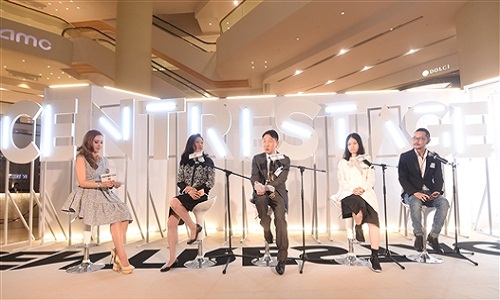
Organised by the Hong Kong Trade Development Council (HKTDC), the trade show will feature some 200 fashion brands from 20 countries and regions, as well as more than 50 spectacular events, including the large-scale opening gala fashion show ; CENTRESTAGE Elites’ and around 30 other fashion shows. There will also be designer sharing sessions, industry seminars, networking events and more. The trade show is supported by local and overseas industry players, and is expected to attract buyers, particularly select shops, department stores and e-tailers, as well as fashion media and fashion enthusiasts in the region. Designers and guests at the press conference include local designer Mim Mak as well as Simon Choi, Project Director of Fashion Mirage, Hong Kong Fashion Designers Association and Elina Lee, Director of Partnership, Marketing, Communications, Events & Special Projects, Hong Kong Design Centre (HKDC).
Fashion shows interspersed with informative seminars
Spread over four thematic zones: Glam, Allure, Metro and Forward, CENTRESTAGE will see participation from Chinese mainland, Taiwan, Japan, Korea, Malaysia, Thailand, India, Australia, the United States and Europe. The show will also be attended by various trade organisations like Hong Kong Fashion Designers Association, the California State Trade and Export Promotion & Center for International Trade Development from the US, the Taiwan Textile Federation and the Thailand Textile Institute. The event will showcase almost 30 fashion shows featuring brands like 45R, anagram, ANTEPRIMA, Aquascutum, ARTHUR LAM, ATSURO TAYAMA, Charmante, Galtiscopio and more.
Forecasting trends in fashion and retail
Apart from the fashion shows the event will have in depth seminars, analytical discussion with experts from WGSN and Fashion Snoops to forecast fashion and retail trends for the coming year. The seminar CENTRESTAGE Elites will focus on Asia’s design influence on international styles and trends. There will also be seminars to grasp the latest developments in global market. The event has been designed to become a signature fashion event for the region showcasing the best of fashion and styling in Asia. To promote CENTRESTAGE the first of its kind fashion event, HKTDC is launching a citywide campaign ‘Hong Kong in Fashion’, an aggressive promotional series.
HKTDC is the international marketing arm for Hong Kong-based traders, manufacturers and services providers. With more than 40 offices globally, including 13 on the Chinese mainland, the HKTDC promotes Hong Kong as a platform for doing business with China and throughout Asia.