FW
Brandix partners Accenture to overhaul operatoins
Sri Lankan apparel maker Brandix is overhauling its operations with the help of Accenture. This includes productivity enhancement, a shift to data-based analytics and the integration of internet of things. These changes will come in addition to an overhaul of Brandix’s end-to-end processes and operations. Accenture is expected to deliver innovative enhancements to Brandix’s manufacturing, supply chain, finance and human resources operations.
Brandix operates manufacturing units that stretch across India and Bangladesh as well. The company is more than four decades old, and has developed a substantial customer base across the global apparel market, through its specialisation in innovative apparel distribution. Consistent with trends across the globe, Brandix is looking to transform its organisation to align it better with demands in the contemporary market. Accenture is a management consultant. The firm has been rapidly developing its own capabilities in the digital sphere, with the objective of supporting an increasing share of clients across the Indian market with digital transformations.
The retail industry is being redefined globally by consumer expectations, digital technologies and transformative business models. To create value in this highly competitive environment, apparel manufacturers need to embed technology-led innovation not only at the edges of systems but also within their core processes.
Brands look for ways to tackle ocean waste
Plastic waste is a big problem. By 2050, the oceans could contain more waste than fish. Consumer demand for recycled fashion is on the rise, and more and more sports and fashion companies work with it - in different ways.
Econyl yarn from Aquafil is a 100 per cent regenerated nylon yarn derived from pre and post industrial waste such as discarded fishing nets and carpet fluff. Such materials, once they have reached the end of their useful life, instead of being disposed of in the landfill, are recovered and regenerated by means of a complex chemical-physical process. Aquafil works closely with fishing communities to enforce preventive actions to reduce the pollution caused by discarded fishing nets and to find new solutions for disposing of them in a financially and environmentally sustainable way. In producing the yarn, waste is collected and taken to a regeneration plant where the recycled nylon yarn is produced.
Seaqual, based in Spain, has close collaborations with the fishing industry and a new approach to ocean cleaning. Fishermen drag the ocean bed of waste for Seaqual to process into recycled polyester fibers. British-based swimwear brand Fatface has launched a new sustainable range made from recycled nylon.
India’s T&C exports grow 2.4 per cent, US continues to be largest market
"Though India’s textile and clothing (T&C) exports grew 2.04 per cent to reach $37,497.18 million in FY 2018-19, apparel exports declined 3.38 per cent in the last (FY 18-19) to $16156.27 million. Of this, woven apparels ruled the segment with exports of $ 8,335.91 and accounting for 22 per cent in the total T&C export of India."
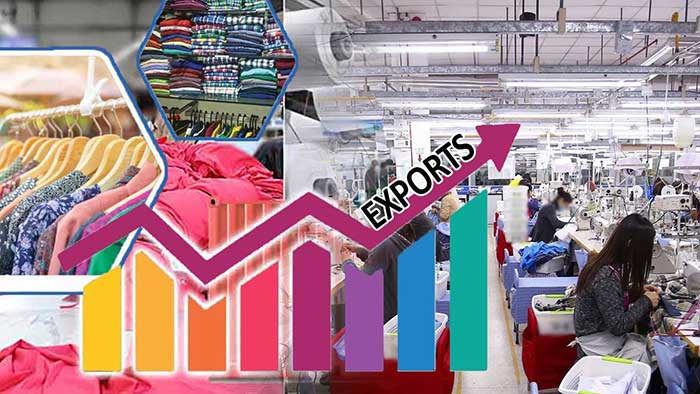
 Though India’s textile and clothing (T&C) exports grew 2.04 per cent to reach $37,497.18 million in FY 2018-19, apparel exports declined 3.38 per cent in the last (FY 18-19) to $16156.27 million. Of this, woven apparels ruled the segment with exports of $ 8,335.91 and accounting for 22 per cent in the total T&C export of India.
MMF exports grow by 5.62 per cent
India’s manmade filament (MMF) exports grew 5.62 per cent in FY 2018-19 to $2291.70 million. Turkey was the top export market with exports totaling $296.26 million. Textured yarn of polyester was exported the most, with a value of $832.37 million in FY 18-19 over the corresponding period with a growth of 3.39 per cent.
MMSF exports register negative growth
Export of man-made staple fiber (MMSF) totaled $1905.16 million with a negative growth of 7.04 per cent and accounted for only 5 per cent share in the total T&C exports of India. Turkey was the top market for India’s MMSF products with exports totaling to $184.96 million. Even exports to Bangladesh witnessed a drop of 25.64 per cent to $167 million. Staple fiber of polyester is ruling the basket. Export totaled $320.90 million with a growth of 22.28 per cent in FY 18-19 over the corresponding period.
Declining demand in UAE causes apparel exports to fall
As demand for apparels declined in the UAE, India’s exports too fell for the second consecutive fiscal. In FY 18-19 apparel exports dropped 3.38 per cent to $16156.27 million over the corresponding period. Of this, exports of woven apparels dropped 4.45 per cent to $8335.91 million and accounted for 22 per cent share in the total T&C exports of India. The USA was top market for India’s woven apparels, exports totaled $2231.06 million, a growth of 4.86 per cent.
Demand for knitted apparels also dropped in the international market by 2.21 per cent to $7820.36 million in the last fiscal over the corresponding period. The US was the leading importer of knitted apparels with exports growing 11.41 per cent to $1394.89 million.
Knitted Fabrics
Demand for knitted fabrics grew by 28.37 per cent in FY 18-19 to $440.21 million over the corresponding period. Sri Lanka was the leading importer of knitted fabrics with exports totaling to $ 173.66 million, growth of 25.66 per cent in FY 18-19 over the corresponding period. Exports to the US, Bangladesh and Ethiopia too grew by 39.72 per cent, 33.09 per cent and 79.62 per cent respectively.
Countries-wise T&C Exports
Of all countries, the US retained its position as India’s leading export market with exports increasing by 7.13 per cent to $8297.40 million in the last fiscal. Exports to the US currently account for a 22 per cent of the total T&C exports from India. Though T&C exports to the UAE declined by 24.90 per cent to $2569.73 million in FY 18-19, the country is still the second largest market for India’s T&C products and accounts for 7 per cent in India’ total T&C exports.
Bangladesh too has retained its position as the third largest market with a growth of 2.66 per cent to $2377.19 million in FY 18-19. Cotton was the top product exports growing 3.02 per cent in the last fiscal year. Exports of knitted fabric also increased 33.09 per cent to $71.76 million.
CEA supports the Egyptian Cotton project
Cotton Egypt Association (CEA), an independent body responsible for the global brand, has been supporting the implementation of ‘The Egyptian Cotton Project’ activities that include innovative training, education and awareness across the cotton supply chain. These efforts fall under the CEA’s collaboration with the United Nations Industrial Development Organization, implementing ‘The Egyptian Cotton Project,’ and working with the Cotton for Life program and Better Cotton Initiative (BCI) to enhance and advance sustainability of Egyptian cotton, while reducing contamination.
The CEA’s cooperation with BCI has allowed the deployment of pilot cotton plantations supported by cotton traders, manufacturers and brands to pave the way for a BCI startup program in Egypt planned for the 2020-2021 cotton season.
Besides adopting organic production methods, reducing water consumption and pesticides, the Egyptian Cotton Project is implementing education programs that promote farmers’ and workers’ health and welfare, gender equality, and entrepreneurial opportunities for young people, and through awareness training sessions addressing topics such as child labor, the importance of education, and qualified employment to serve as a positive alternative for youth in rural areas.
The project’s stakeholders will continue to work toward enhancing the sustainability, inclusiveness and value addition of the long- and extra-long staple Egyptian Cotton by developing the economic, social and environmental performance of cotton manufacturers, and strengthening support institutions.
India: Tirupur units look forward to relief measures
The government has launched some relief measures for the textile industry. Pending GST refunds would be cleared within the next 30 days. Every refund for future GST matters will be solved within 60 days. CSR violations will not to be treated as criminal offence. There will be one definition for a medium and small enterprise. A one-time loan settlement through a check box approach will help medium and small enterprises and retail borrowers.
Banks have agreed to link their interest rates to repo rates. A sum of Rs 70,000 crores will be infused upfront into public sector banks to enable them release Rs 5 lakh crores liquidity in the market. All old tax notices will be addressed by October 1 or uploaded on the system again to increase transparency. Faceless scrutiny of I-T returns will happen from Vijayadashmi 2019. In labor laws, fixed-term employment is being facilitated. Web-based jurisdiction is being done for a free inspection. Inspection has to be uploaded within 48 hours. Compounding of offences will be a priority. The decision of banks to pass on rate cuts through MCLR reduction to benefit all borrowers is expected to be a great relief to the financially stressed Tirupur knitwear garment exporting units in the small and medium sector.
Pakistan cotton production reaches record high
In 2019-20 season, Pakistan’s cotton production is likely to reach the high level of the 2011-12 season. In Pakistan, cotton areas have gained strong support from the high cotton prices and good rainfall during the planting period.
Cotton prices have been rising for four successive years. Cotton production may reach the level of 2011-12 this season. In addition, during the planting period, Pakistani cotton prices were relatively low compared with international cotton prices, stimulating domestic enterprises to choose local cotton, pepping up the domestic cotton prices somewhat and improving the growers’ enthusiasm.
Since the 2011-12 season, when cotton production hit a record high of 2,518 million tons, production has been constantly decreasing. In the 2015-16 season production was only at 1.814 million tons, down about 28 per cent compared with that in the 2011-12 season. Higher cotton areas are supportive to reach the target of cotton production. In the first half year of 2019, precipitation in Punjab has increased by 89.1mm to 133.2mm, and that in Sindh up by 29.5mm to 64.1mm. The favorable weather condition is also good for the growing of cotton. The good price and favorable weather conditions give strong support to reach the cotton target of the 2019-20 season.
Global supply chain undergoes change with tariff war continuing
Eager to avoid the higher costs associated with tariffs, several American consumer goods companies are considering shifting, or already have shifted, their supply chains away from China. They are in most cases seeking alternative manufacturers in countries that offer similar manufacturing capacity for a comparable cost.
However, rapid changes to supply chains also may expose companies to greater risks. Establishing compliant, reliable and secure supply chains takes time, and failure to properly vet suppliers can have material consequences.
One US company took 20 years to establish its supply chain in China. To cultivate a partnership, companies typically vet new suppliers by executing multiple inspections and verifying compliance with company-specific policies and codes of conduct. Once suppliers achieve these initial requirements, they have to be monitored on an ongoing basis and must comply with periodic audits. Companies have to invest a significant amount of time and money to establish and maintain a secure supply chain. As China and the United States continue to introduce new tariffs and exchange threats, companies may forego these precautions as they attempt to quickly redirect production. This situation could be exacerbated given that the factories with available capacity to accept new orders are likely to have lower standards.
Tariffs create sourcing problems for US brands
US fashion brands and retailers are deeply concerned about the negative impacts of the tariff war on their businesses. Prices of US apparel imports are rising, making increasing production and sourcing cost the top business challenge. As companies are moving sourcing orders to Bangladesh, Vietnam and India, the average price of US apparel imports from these countries – the main alternatives to China — has gone up quickly. Trade diversion effect has accelerated US fashion companies’ pace of reducing sourcing from China. About 83 per cent of respondents expect to decrease sourcing from China over the next two years, up further from 67 per cent in 2018.
US companies feel they have no option but to increase their retail prices should the US-China tariff war escalate further. The scheduled Section 301 tariffs on $300 billion Chinese products to take into effect on September 1, 2019, will be increased from 10 per cent to 15 per cent.
Unit price of US apparel imports across the board increased 10.7 per cent in the first five months of 2019. The unit price of US apparel imports in the first five months of 2019 from Bangladesh, Vietnam and India shot up 25.6 per cent, 23.4 per cent and 21.2 per cent respectively.
Global fashion trade increases by 35.1%
Last World Trade Organization (WTO), data shows, global fashion exports in the last decade increased by 35.1 per cent, while global trade increased 26.4 per cent. In 2007, two years after the Multifiber Agreement came into force, clothing exports increased to $349 billion. A decade later, these exports increased to $471 billion. Global trade in the same period increased from $14 billion in 2007, to $17.7 billion in 2017.
India registered the strongest performance in its international clothing trade during this period; followed by Brazil and other Asiatic countries excluding China and the ASEAN member. Exports by the United States increased by 28.6 per cent between 2007 and 2008, those by Japan increased by 20.1 per cent and the European Union by 33.5 per cent.
China, that entered the WTO in 2001, increased its garment exports by 93.3 per cent during this period. Middle East and Australia also positioned high in the list, with rises near 100 per cent.
Restrictive measures of world trade registered exceptionally high levels between October 2019 and mid-2019 as the value of trade affected by these countries was estimated to be $339 billion, the second highest number available, after the $588 billion registered the previous period.
4th Gartex Texprocess sees strong networking among stakeholders
New Delhi hosted the 4th edition of Gartex Texprocess from August 10 to 12.This is a one-stop selling and sourcing platform. It witnessed intense networking as it brought together 180 exhibitors from four countries and 10,390 trade professionals from 290 cities and six countries under one roof. Multiple zones and focused business segments on the show floor ensured that the fourth edition brought together stakeholders of the textile and garment industry for cross-sector, creative and collaborative interactions.
The dedicated segments at Gartex Texprocess India ensured dynamic synergy on the show floor and proved to be vital in highlighting the latest tech-advancements and trends that the textiles and apparel industry is moving towards. While smart and recycled fabrics, sustainable alternatives, advances in digital textiles, elegant embroideries and trims were among some of the highlights on the show floor that help manufacturers differentiate their products in the market, seminar sessions alongside the exhibits were tailored to provide insights on high-potential business segments.
As a one-stop selling and sourcing platform, the event lived up to its promise of a truly business-oriented platform for India. With high quality visitors and decision makers walking in over all three days, the trade potential at Gartex Texprocess proved to be strong for the sector.