FW
Levi Strauss revenue up five per cent
Levi Strauss revenue was up five per cent over last year. It has expanded into new categories and found new ways to make sales. Levi Strauss had near across-the-board growth, with men’s sales up six per cent, women's rising 16 per cent and higher sales in both bottoms and tops. It also saw its global direct-to-consumer business shoot up 14 per cent year over year. The denim specialist has invested heavily in its online business and made strategic pairings, such as being featured at the Coachella music festival, a spot that resulted in sales of its Levi 501 cutoff shorts rising 50 per cent in the quarter.
The company’s wholesale business is primarily tied to sales to US department stores. Because the shopping mall is declining and department stores are reducing their footprints, Levi Strauss’ ability to sell more goods at more doors becomes limited. Levi Strauss expects the wholesale business in the US to be challenged in the second half of the year with bankruptcies and door closures and tightening of customers’ budgets. To offset the weakness, the company is attempting initiatives, such as a new concession model. For fiscal 2019, Levi Strauss expects net revenue growth to be in the mid-single digits.
Lectra updates Modaris with 3D simulation tools
Lectra’s update to the original Modaris program comes with improved 3-D simulations and tools.
This will help product developers bring their visions to life—and reduce the need for costly samples. The update will allow patternmakers to reduce the need for physical samples by up to 50 per cent, addressing an expensive and time-intensive step in the product development process. Cutting down on the need for sampling and reworking allows brands to bring products to the market faster while capitalizing on rapidly shifting trends. The Modaris V8R2 offers greater capabilities in 3-D virtual prototyping, allowing patternmakers to share their creations with 360-degree videos. Through a module on the program, designers can comment on the patternmakers’ interpretations and collaborate on solutions. The program also features more advanced graphics, with a library of new fabrics, top-stitching effects, background scenes, lighting and colors. A new feature simplifies the process of adding darts to a garment’s rendering, which drastically increases patternmaking speed. The program can manage different units of measurement, and reconcile designs to ensure size compliance across countries.
With this, Lectra aims at catering to patternmakers who deal with consumers with different tastes, of all body shapes and sizes, and providing them the tools to streamline the development process and reduce the number of reworks to achieve the right fit the first-time.
Bossa organises programme on sustainable denim
Specialised denim manufacturer Bossa recently held it’s second of a series “A New World Sustainable Denim Program” in Stra, near Venice, Italy. This event followed the previous one held in Amsterdam in May 2019 and aimed to inform key Italian players and brands of denim market about the importance of taking action against conventional and highly polluting jeans industry practices. The event gathered 120 insiders in Villa Foscarini, a historic Venetian Villa from the 1600s, and involved speakers from the denim and jeanswear value chain.
Tayfun Akbay, Deputy General Manager, Bossa, inaugurated the working session along with Piero Turk, Denim Designer and Consultant for Bossa; Massimo Falaguasta, Denim Washing Expert and also Consultant for Bossa; Samuel Trotman, Denim Specialist, Denim Dudes; Andrea Rosso, Creative Director Licenses for Diesel and founder Myar; Alberto De Conti, Head of Fashion Division, Rudolph Group, and Serena Chironna, Membership Coordinator, BCI. The programme was moderated by Maria Cristina Pavarini, Senior Features Editor, Sportswear International Magazine.
Global supply chain undergoes changes
There are growing signs of the global supply chain — long reliant on China as the workshop to the world — is being permanently transformed. Heightened trade tensions between the US and China have disrupted global supply lines. There are no investments, no purchases. The trade war is causing people to stop investment because they don’t know where to put the money. China is expected to see more factory shutdowns as the trade war that’s roiled the global supply chain exacerbates an exodus. The era of ‘Made in China’ was over five years back because young Chinese workers no longer like working in a factory. Tariff-related uncertainty has made it difficult for clients to plan their supply-chain requirements, causing them to be more conservative in placing orders. American retailers have already taken up all the manufacturing capacity in Vietnam in their rush out of China.
While Chinese factories suffer, manufacturers in other Asian hubs are beneficiaries – but up to a point. But the rush to nearby Asian nations is also reaching a saturation point. Vietnam, for example, is completely full. There’s no extra capacity for US companies to get in. No nation is tariff-proof enough to serve as a global supply hub.
Vietnam: EVFTA to replace GSP rates with MFN tariffs
According to a report from Bảo Việt Securities Joint Stock Company (BVSC), textile, garment and footwear products made in Việt Nam will not enjoy immediate tariff cuts after the EU-Việt Nam Free Trade Agreement (EVFTA) comes into effect as the agreement will replace GSP rates with Most Favoured Nation (MFN) tariffs. The MFN rates for those products will be higher than GSP rates of 9 per cent for garment products and 3-4 per cent for footwear products at present. Specifically, most apparel products that Việt Nam has been exporting to the EU will see export tariffs eliminated gradually from the MFN tariffs of 12 per cent to zero in 3-7 years after the EVFTA comes into effect. Similarly, footwear products will be exempt from MFN tariffs of 12.4 per cent in 3-7 years.
Those that will enjoy the immediate tariff cut are products which are not Việt Nam's major exports to the EU such as fibre to make clothes and other materials to produce footwear. Under the deal, Việt Nam's footwear, textile and garment industries will have to make changes to meet origin conditions and take advantages of preferential tariffs.
For the textile and garment industry, fabrics used to make the products must originate from Việt Nam or the EU, and the cutting and sewing stages must be performed in either the bloc or Việt Nam.
Despite this, the EVFTA has some flexibility on product origin. For instance, local garment firms can use fabric imported from countries that have signed FTAs with the EU and Việt Nam, like the Republic of Korea (RoK).
Bestseller sets sustainability goals in sourcing products
Bestseller has committed to sourcing 100 per cent of its cotton from more sustainable alternatives by 2022. By working across its entire value chain, it believes these initiatives and goals will help transform the way its products are created, made and consumed. Last year, Bestseller made a significant commitment to reducing its greenhouse gas emissions and revealed plans to build its own solar power plant.
In connection with the launch of Invest FWD – Bestseller’s new investment platform to accelerate sustainable innovation and solutions for the fashion industry – Bestseller and its parent company Heartland announced a partnership with Better Energy in 2018 to build its own solar power plant. The solar power plant will produce the equivalent of Bestseller’s entire global energy consumption for owned and operated buildings. This will see Bestseller achieve its goal of using 100 per cent renewable energy by 2021 for owned and operated buildings. A location for the power plant is yet to be announced.
In line with its climate positive ambition, Bestseller, in 2018, committed to setting science-based goals on greenhouse gas emissions through the Science-Based Targets initiative. This aims at keeping global warming below a 1.5 degrees celsius temperature increase.
China's domestic brands launch collections on international stage
With China poised to become the world's largest fashion market in 2019, home-grown high-street brands are well placed to cash in. These brands, which have long occupied space in lower-tier cities barely penetrated by foreign affordable-clothing brands such as Zara, H&M and Uniqlo, have been launching collections on the international stage of late.
It may not be long before millions of consumers around the world know these Chinese brands as they open stores overseas, collaborate with well-known designers, and conveying messages that resonate with shoppers. The five Chinese high street brands to watch include: Urban Revivo, which opened a store in London in 2018, Peacebird, which made its debut at the New York Fashion Week in 2018; Bosideng which launched its capsule collections in October 2015; Ochirly which is known for its elegant and feminine dresses and everyday wear and Me & City which recently debuted in Shanghai.
Bangladesh exports to new markets up 21 per cent
Bangladesh’s apparel exports to non-traditional markets grew 21.77 per cent in the just concluded fiscal year. Australia, Brazil, Chile, China, India, Japan, Korea, Mexico, Russia, South Africa, and Turkey are the major non-traditional export destinations for Bangladesh. Japan’s imports of apparel goods from Bangladesh were 28.90 per cent higher from the previous year. China’s imports were up 29.33 per cent from the previous year. India’s imports of apparel goods were up by 79.09 per cent. This is the highest growth of apparel registered in the just concluded fiscal year.
Bangladesh’s export earnings from new markets are increasing faster due to diversification initiatives. Manufacturers are participating in global expositions to connect with new buyers, which has contributed a lot to enhanced exports to new markets. Besides, safety improvements in the apparel sector have expedited export growth as they have boosted investors’ confidence, leading to more work orders. Increased cash incentives from three per cent to four per cent for the last fiscal year encouraged exporters to go for new destinations.
Earnings from woven products were 22.91 per cent higher than in the previous fiscal year. Earnings from knitwear products were up 20.68 per cent from a year ago.
Vietnam’s FTA with EU to impact Bangladesh’s exports
As per BGMEA, Vietnam’s recent FTA with EU is likely to have a significant impact on its own business as around 11 per cent of Vietnamese apparel exports to EU will get a complete duty wiaver. The EU signed the free-trade deal with Vietnam on June 30 in Hanoi, paving the way for tariff reduction on 99 per cent of goods, traded between the bloc and the Southeast Asian country. The trade deal will be effective after approval by the European Parliament.
Bangla media reports, around 12.18 per cent share of Bangladesh’s apparel exports to EU competes with Vietnam on these items. These items—147 in number—will face stiff competition and the possibility of trade diversion is higher in this category Bangladesh apparel exports have lost 3.64 per cent value in terms of price per unit during 2014-2018, whereas Vietnam’s price has gone up. With the gradual elimination of tariff on Vietnam’s exports the price competition will be more intense.
Within five years, 49 per cent of Vietnam’s and 62 per cent of Bangladesh’s total exports to EU will be competing directly. Apart from erosion of competitiveness and resulting trade diversion, this FTA may take a severe toll on the price level of the Bangladeshi manufacturers.
CMAI launches the 69th edition of the National Garment Fair
 The Clothing Manufacturers Association of India (CMAI) is organising India’s largest apparel trade show – The 69th National Garment Fair” from July 15-18, 2019 at the Bombay Exhibition Centre in Goregaon , Mumbai.
The B2B fair will be spread over approx. 700,000 square feet, covering all the halls at the Bombay Exhibition Centre. It will feature 882 exhibitors, showcasing 1,062 brands. This will be India’s largest ever garment fair held so far. It will display leading brands in men’s wear, women’s wear, kid’s wear and accessories. CMAI will also publish the ‘Show Directory’, popularly known as the Fair Guide at the event. Approximately 50,000 retailers and trade visitors from all over India are expected to visit this air.
The fair will be held over four days from 10 am to 9 pm. It will  be open only to trade visitors and garment
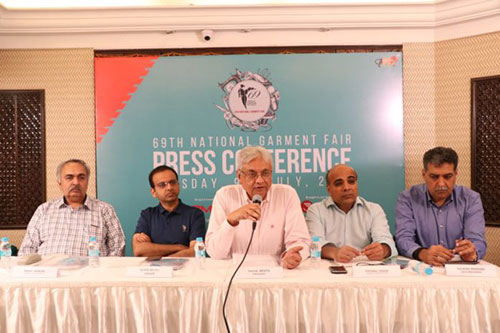 retailers. It will also hold business networking sessions between the exhibitors, agents and distributors. Products and machinery at the show, will be presented by national as well as overseas companies
According to Rahul Mehta, President, CMAI, through this fair, the association aims to generate the advancement of the large-scale garment industry across the globe. The association has been the pioneer of the Indian apparel industry for over four decades. It has around 20,000 members, including readymade garment manufacturers, exporters, retailers and ancillary industry. With its headquarters in Mumbai, CMAI also has branches in New Delhi, Bengaluru and Pune.
The association has been organising such domestic garment fairs since its inception. These fairs are widely acclaimed by participants as a means to diversify their distribution base, absorb new trends in product-mix, style-wise, design-wise etc. and increase domestic business.