FW
US commercialises a biotech version of edible cotton
The Texas A&M University, recently commercialised a biotech version of a cotton plant whose seeds can be eaten. Texas A&M Keerti Rathore started working on the project 23 years ago, and figured out how to silence a gene in the plant that produced a toxin, called gossypol. While gossypol protects the plant from insects, it made the seeds inedible to humans and most animals.
It will be several years before farmers can grow it commercially, as seed supplies have to be ramped up starting next season. US Food and Drug Administration approval is still needed, which the university expects within months. After that, farmers will be able to grow cotton for food as well as for fiber.
The cotton seeds contain proteins to meet the daily requirements of 600 million people should all cotton in the world be replaced with edible varieties.
Levi’s adopts automated solution for jeans finishing
Levi Strauss & Co. has patent protection for an automated laser solution for finishing its jeans that shortens the process from 20 minutes to 90 seconds. Prior to automation, the manual process for distressing a pair of jeans for Levi’s modeled after a designer sample required a factory worker to apply chemicals to the jeans, use sandpaper to distress them and introduce the holes and tears indicative of designer duds.
This laborious, inexact process typically took 20 to 30 minutes per pair.With the automation technology, the factory worker is removed from the process; a Levi’s designer creates a digital image of the distressed jeans with instructions the laser technology can understand, and the lasers can then replicate every element of the design—from fades to tears—onto a basic pair of jeans. And finishing that process takes just 90 seconds.
The technology allows the company to produce unfinished jeans in Asia, then send them to nearshore countries for finishing. This means that the company can test many different styles, quickly reproduce the best sellers, and have them in stores within days.
Levi’s is presently piloting the technology, which it expects to roll out to all of its factories by 2020.
CAIT urges government to extend GST return deadline
The Confederation of All India Traders (CAIT) has urged the FM Arun Jaitley to extend the deadline for filing GSTR-3B return for September, till the end of the current year, citing technical faults on the GST website being the main obstacle to file returns. Notably, the Ministry of Finance announced extension of deadline by five days to October 25, where Input Tax Credit (ITC) benefit for the period from July last year to March this year will also be made available for businesses, who can claim the benefits by the mentioned date.
In a letter issued to the Finance Minister, CAIT elucidated that there are various issues on the website that are creating a lot of problems for the dealers/consultants to file their returns for the month of September. Furthermore, the CAIT also marked out that the facts depict that the government is intending to raise its revenue with late fees income and termed the move by the government shameful.
The major issues being faced by the return filers are that the portal is unable to serve over 150,000 users at a time because of server failure and the entered figure automatically turns into zero along with numerous other errors while uploading any document. CAIT urged the Ministry of Finance to come up with a solution for this major problem and help to make GST a dream law rather than a nightmare.
Benetton chief Gilberto Benetton passes away
Gilberto Benetton, 77, co-founder of Benetton, is dead. Gilberto, along with siblings Carlo, Luciano and Giuliana, founded the Benetton knitwear company in 1965, transforming it into a global brand.
Italian brand Benetton is known as much for its shock factor ad campaigns as its colorful knitwear. The family-owned company has supported sports centers, building restoration and travelling art exhibitions that reflect the brand’s core values of social justice and sustainability.
Benetton is one of Europe’s most controversial fashion brands. Its shock advertising campaigns — whose memorable images included a priest and a nun kissing, and a baby still attached to the umbilical cord — made it a household name. It rose to fame in the 1980s and 1990s with its brightly colored clothing.
The group is facing challenges, both from newer competitors such as Zara, H&M and Uniqlo, and the explosion of e-commerce. The plan is to go back to Benetton’s original premise of mid-priced clothes for the long term.
The brand will see a reissue of its most iconic lines, harking back to the days when the family-owned company was selling its brightly colored jumpers in more than 100 countries. The brand is reissuing a unisex collection of T-shirts, logo-embroidered baseball caps and branded nylon bumbags.
Bangladesh: Accord moving slow in handing over charge
The Accord on Fire and Building Safety in Bangladesh has yet to hand over safety monitoring responsibility to the Remediation Coordination Cell, a government-formed body. Accord has expressed interest in handing over safety monitoring responsibility of 100 fully-remediated readymade garment factories without mentioning any time frame. Accord has not mentioned even the name of any factories in its handover document.
Following the Rana Plaza building collapse in April 2013 that killed more than 1,100 people, mostly garment workers, European Union retailers formed the Accord. This platform has so far inspected more than 1,600 readymade garment factories. Accord-listed factories have completed more than 89 per cent of remediation works while 172 factories have completed 100 per cent remediation.
The tenure of the platform ended in May this year and it was given a six-month transition period that will end on November 30 this year. Accord was an unprecedented, independent, legally binding agreement between trade unions and brands. The Bangladesh readymade garment industry is undoubtedly safer, and lives have been saved.
Global stakeholders, including buyers, trade unions and investors, have requested Bangladesh to allow the operation of Transition Accord till a national body is ready to take over factory safety responsibility.
Bangladesh Denim Expo to focus on simplicity in the denim supply chain
The 9th Bangladesh Denim Expo, to be held on November 7 and 8, 2018 at the International Convention City, Bashundhara, Dhaka, will be themed ‘Simplicity in the Supply Chain.’ The expo will define a simpler sustainability and ecology of the denim industry. It will display the latest denim products to global brands, retailers, and Bangladeshi manufacturers.
The expo will also focus on how to understand the demands of buyers, how to prepare for and negotiate these demands, and how the denim industry of Bangladesh can profit from this simplicity. Sixty-two exhibitors from all over the world will participate in the event—which is expected to attract the highest number of international visitors, ever, for an apparel event in Bangladesh.
An international exposition dedicated to the promotion of Bangladesh-produced denim, Bangladesh Denim Expo is will showcase the company’s strength and capability in manufacturing the material.
MBFW Russia focuses on Contrafashion
The fifth day of the Merdeces-Benz Fashion Week Russia started off with a collective show by the Contrfashion (standing for Contradiction Fashion) project, collecting young, artistic designers who showcased their unique and vibrant talent. The show contained four distinct parts, varying wildly in style, concept and method:
DimaKamma& Tata-Polina
This included a stunning collection of glittering fabrics, paired with a wild set of accessories - Art Deco collars, shoulderpads and breastplates of gold and shimmering material. The models stepped out in shocking headdresses, reminiscent of Fritz Lang’s Metropolis, and sporting giant silver eagle wings straight from a decoration on a NYC skyscraper.

Daria Fedunova
A stylish, rave-inspired collection, consisting of segmented fabrics - wool, plastic, neoprene, pleather, etc, combined together to form abstract garments. Models were accessorised with big geometric shades, small cubes adorning their heads. A silken cape of pure red finished off this exciting offering from the young designer.

Nicole Feller-Johnson
This collection included a gentle assembly of all-white garments, as though woven from purest spider silk. The dresses seemed to float in the air rather with the light, silk, mesh, muslin and tulle the fabrics adding to the ethereal nature of this collection.

Olga Chernoschekova
This collection was inspired by New York punk and avant-garde - Basquiat and Haring - with bright red, black and white being used profusely. It comprised large coats of leather and faux fur strapped with metal chains, accessories of bleeding-red hearts hanging from neckchains and large leather arms serving as scarves.

Import regulation remains disputed topic for economists and countries
Free imports not only expand production quickly but also boost the purchasing power of consumers by allowing them to buy high-quality goods at low price. If trade flow is unhindered, the law of comparative advantage forces countries to specialise and trade in products they have some competitive advantage in. This benefits consumers and producers of both exporting and importing countries.
 Economists across the world are at loggerheads with policymakers on whether countries should impose import duty on specific products to regulate imports? While many countries, including India, are actively considering such measures, economists argue governments should refrain from regulating trade flows.
Free imports not only expand production quickly but also boost the purchasing power of consumers by allowing them to buy high-quality goods at low price. If trade flow is unhindered, the law of comparative advantage forces countries to specialise and trade in products they have some competitive advantage in. This benefits consumers and producers of both exporting and importing countries.
Incentives for comparative advantage
China has repeatedly proved that comparative advantage, in most cases, can be developed in a short period by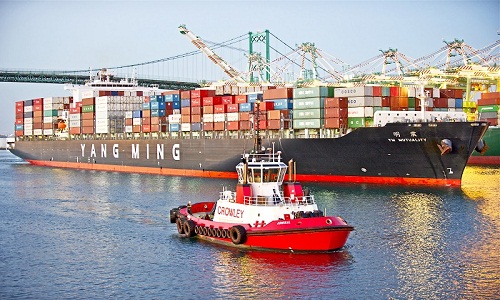 offering several incentives. In the 1980s, China had no domestic electronics and computer industry and imported everything for meeting local needs. The country decided to implement a shrewd production strategy. It attracted MNCs to set final assembly units in China by offering them low-cost land, power, water, labor, tax exemptions, and an efficient customs administration. MNCs were allowed to import all inputs through the ‘global value chain’ model of shared production.
Raw materials and low-end components for these units were sourced from ASEAN and while the components requiring advance manufacturing came from Japan, Korea and Taiwan. This model made China the leading exporter of electrical machinery, electronic items and telecom equipment by 2005. In the next phase of growth, the country reduced its dependence on the GVC model by manufacturing everything needed in-house. China applied a similar strategy for organic chemicals and electrical machinery to emerge a world leader.
High import duties impending growth
While average import duties are low for many developed countries, the US, the EU and most other developed countries charge high import duty on products of interest to developing countries and grant calibrated access only. The EU and the US charge 10-20 per cent import duty on Indian apparel and shoes. Japan charges 300 per cent duty on rice. Many European countries charge seasonal import duties on agriculture products.
Total import duty on some types of steel in the US and EU exceeds 100 per cent. South Korea is an excellent example of export-led development, but in most sectors it imposes high import duties and non-tariff barriers. The US is fast approaching a point where it would impose extra 25 per cent import duty on all goods coming from China. And, China is mechanically retaliating by doing the same.
Strategy need for import substitution
Action is also needed to reduce over-reliance on a country on products related to health, food or national security. For instance, India imports over 90 per cent of its requirement of Active Pharmaceutical Ingredients (APIs) from China. Realising this, China sharply increased prices in the past two years. India therefore, needs an urgent strategy for import substitution.
China accounts for more than 95 per cent of Indian imports for items such as blankets, bed linen, artificial flowers, kitchenware, baby carriages, clock movements, tricycles, festival items, combs, vacuum flasks, candles, etc. As these are low technology, labour-intensive products, they can be manufactured even locally.
No alternative to innovation
Indeed import substitution cannot be an option to innovation. For instance, a high-technology product like a driver-less car can only be produced in a country that has with in-depth institutional knowledge of precision fabrication, electronics, robotics, design, IT and many more streams, it cannot be manufactured in countries like Brazil, India or China. Quick comparative advantage cannot be developed in a short period for such products through import substitution.
KM.ON brand for digital solutions by Karl Mayer at ITMA ASIA
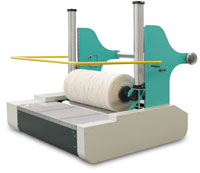 Karl Mayer launched KM.ON – a new brand for delivering digital solutions and also showcased its own software start-up at ITMA ASIA. Representing digital driven innovation KM.ON brought together the digital solutions portfolio of the Karl Mayer Digital Factory, a new software start-up, and the entire Karl Mayer Group.
Eight solutions to exploit KM.ON easily and securely
KM.ON’s digital portfolio comprises eight solution categories k.ey – a conventional industry PC together with an appropriate software – provides access to the solutions. The platform of hardware and software can be installed easily and links the machines securely to the protected cloud. This is based on the expertise gained by participating in Adamos with regard to the use of an open IIoT environment which is specifically focused on the needs of machinery and plant construction. This enables the benefits of KM.ON to be exploited easily and securely.
These eight KM.ON solution categories, alongwith the first apps and solutions covering the three areas of management, maintenance and service, were presented At ITMA ASIA 2018.
Improving process transparency
The system, made up of k.management enabled the customers to look at the current production process,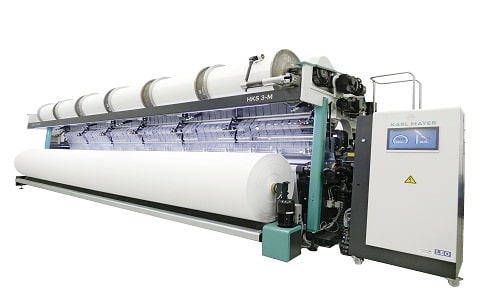 regardless of location and in real time. The production data was displayed clearly on a dashboard. This simple way of delivering information improved process transparency and acted as a valid database for decision-making and planning.
Supporting customers in maintenance operations
The solutions in the k.maintenance category were designed to support customers in their own maintenance operations. In the first solution, Karl Mayer showcased the Check Parts app for testing the authenticity of the spare parts, with expanded functions. The scan-to-order feature of the app makes it even easier to order spare parts online. Automatic data transfer improves the customers’ day-to-day operations when ordering on site, as well as for warehousing.
Managing communication between company and customer
The product portfolio of k.service will, in the long term, include all the functions that manage the communication between the customer and Karl Mayer, should the client require assistance. The ability to make contact quickly, together with efficient communication procedures, guarantees a high level of machine availability. The company is showcased the latest developments in this system, based on the tried-and-tested CONNECT app, in Shanghai.
Driving digitisation forward
Karl Mayer is systematically driving the topic of digitisation forward in order to seize the opportunities offered by the upheavals of the time. The Karl Mayer Digital Factory is a pioneering company operating alongside this innovative market leader. It employs a team of software specialists and technology experts in a new, creative environment away from the main company headquarters.
Another integral part of Karl Mayer’s digitisation strategy is its participation in Adamos, a strategic alliance of German global market leaders in machine construction and the Software AG. On the basis of the Adamos technology, and as part of this network for developments, Karl Mayer is living up with the product portfolio of the new KM.ON brand to its claim of being a global market leader also in terms of digital Solutions.
Innovative and sustainable Italian technology solutions displayed at ITMA ASIA
China is currently implementing several policies to reduce carbon emissions and adopt a low carbon economy with low energy consumption and low-pollution. To support this initiative, the country is procuring cleaning, dyeing and finishing machines, knitting, stitch-bond, lace and auxiliary machinery from Italy. Over the first six months of the current year, the value of Italian exports to China amounted to 156 million Euros. These Italian machines will foster China textile industry’s quality besides providing environmental conservation.
Quick production at low costs
The demand for machinery in China is focused primarily on technologies capable of saving production costs alongwith offering environmental sustainability. China’s textile industry is sensitive to innovative solutions that respond to the market’s changing demands; i.e. fast time-to-market and just-in-time production.
Innovative and sustainable solutions on display
To tap this growing demand for textile machinery in China, ACIMIT, the Italian Association of Textile Machinery Manufacturers and the ICE-Agency organised Italian exhibitors at ITMA ASIA 2018 on October 15, 2018 in Shanghai. The event, dedicated to textile machinery, featured innovative and sustainable solutions.
Around 130 Italian companies exhibited at the ITMA ASIA+CITME2018 in Shanghai. Of these, 63 presented their technology offerings within National Sector Groups. The total exhibition surface area occupied by Italian businesses amounted to roughly 6,300 sq m, placing Italy among the main exhibiting nations at the event.
Asia in focus for Italian manufacturers
Asia and China in particular, represented the primary foreign markets for Italian machinery manufacturers in the sector. Over the first half of 2018, fully 46 per cent of Italian exports of textile machinery were destined for Asia, compared to 37 per cent for European Countries, and 12 per cent to the Americas. Other major export destinations for Italian machinery manufacturers in Asia include India, Bangladesh and Pakistan.