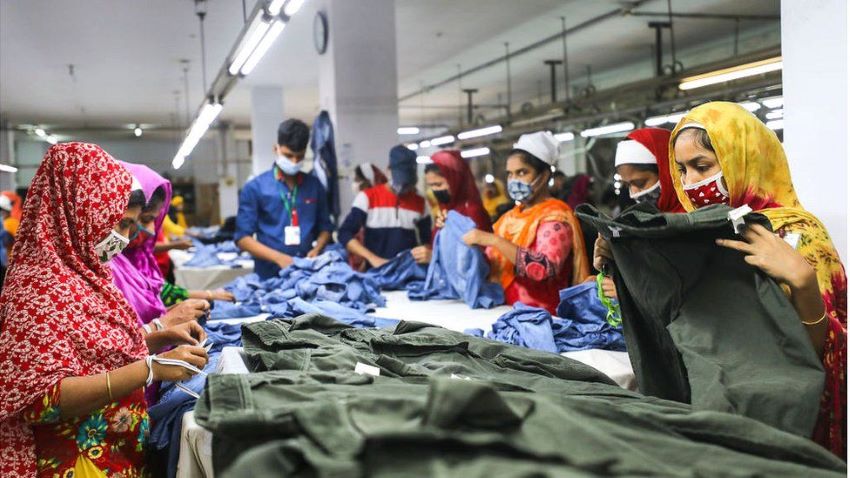
Bangladesh is looking forward to signing a Free Trade Area (FTA) with the US. Bangladesh hopes to benefit from the FTA. Readymade garment products made in Bangladesh currently attract a 15 per cent duty on an average in order to enter the US market. Because Bangladesh only imports capital machinery from the US, whose duty are comparatively low, by signing an FTA, the benefits which Bangladesh will be gaining will be obviously more.
Bangladesh has failed to get back the Generalized System of Preferences (GSP) facility from the US. GSP was suspended for Bangladesh in 2013 during the Rana Plaza collapse. After that, various human rights and safety issues have become a barrier in the relationship between Bangladesh and the USA. Bangladesh was confident significant progress had been made regarding workplace safety and workers’ rights. It tried convincing US decision makers that any previous worries should no longer prevent new trading ventures being created. The US remains Bangladesh’s largest export market. Bangladesh's exports to the US have doubled in the last ten years.
GSP is a US trade initiative designed to stimulate growth in emerging economies. This is achieved by offering duty free exports. Over the years, a number of countries have been suspended from GSP as they have failed to maintain GSP requirements. In most cases, countries regain their status once they take steps to address the issues.
- 1
- 2
- 3
- 4
- 5
- 6
- 7
- 8
- 9
- 10
The rise of localized luxury, MEA, North America, and India lead growth
The global luxury industry is no longer defined by relentless expansion. The ‘2025 Global Luxury Brandwatch Report’ highlights a sector... Read more
Hormuz blockade sends shockwaves through India’s textile chain as polyester cost…
What began as a geopolitical escalation in the Gulf has rapidly metastasized into a full-scale industrial disruption for India’s textile... Read more
India’s National Fibre Scheme decouples textiles from global supply risks
For decades the Indian dominated spinning, weaving, and garment exports while remaining paradoxically dependent on imported man-made fibres and specialty... Read more
From London to Tokyo, premiumization redefines retail and office markets
Global real estate landscape has changed. Gone are the cautious narratives of recovery that defined the post-pandemic years. Today, flight... Read more
Compliance drives India’s $176 bn textile shift
India’s textile economy is no longer selling fabric alone; it is selling proof. As compliance rules harden across export markets,... Read more
The second life economy gets a boost as resale outgrows traditional apparel reta…
For decades, resale existed in the margins of the apparel economy, thrift stores, peer-to-peer marketplaces, and charity bins quietly absorbing... Read more
Rising polyester costs shake India’s textile manufacturing hubs
India’s synthetic textile industry is confronting a sudden and destabilizing price shock that is reverberating across its vast manufacturing ecosystem.... Read more
Cotton markets hold firm as tariffs, higher supply reshape global fiber economic…
In a year marked by tariff escalations, geopolitical brinkmanship and a recalibration of global trade flows, the international cotton market... Read more
Beyond Cotton How Kapok could redefine sustainable insulation in textiles
In the lush, humid heart of Southeast Asian rainforests stands a giant, a silent sentinel of the forest canopy. Growing... Read more
Bharat Tex 2026: Redefining the global textile value chain
Union Minister of Textiles, Giriraj Singh, has officially unveiled Bharat Tex 2026, signaling a significant leap in India’s influence over... Read more