"Despite having enormous scope to gain from businesses shifting from China, Bangladesh apparel sector lost 0.1 percentage point in global export share to reach 6.4 per cent in 2018. The country’s earnings from the apparel sector grew 14.49 per cent to touch $34.13 billion in the past financial year. However, this growth was recorded mainly in physical stores. Of this, $16.88 billion revenue was generated from knitwear and $17.24 billion from woven garments."
 Despite having enormous scope to gain from businesses shifting from China, Bangladesh apparel sector lost 0.1 percentage point in global export share to reach 6.4 per cent in 2018. The country’s earnings from the apparel sector grew 14.49 per cent to touch $34.13 billion in the past financial year. However, this growth was recorded mainly in physical stores. Of this, $16.88 billion revenue was generated from knitwear and $17.24 billion from woven garments. Around $5.68 billion came from non-traditional export markets and the rest $28.44 billion from traditional markets, mainly the United States and Europe.
Need better business environment, policy support
As the Bangladesh Knitwear Manufacturers and Exporters’ Association (BKMEA) revealed, Bangladesh has set a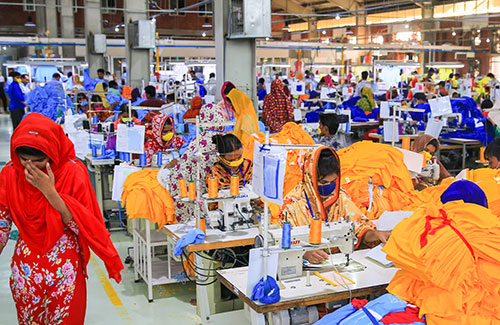 target of reaching $50 billion in revenues from apparel exports by 2021. However, to achieve, the country needs to tackle issues like establishing a deep-sea port in the country, reducing lead times, among others. The country also needs to improve its business environment to support private-sector development, create more jobs and foster a sustainable economic growth.
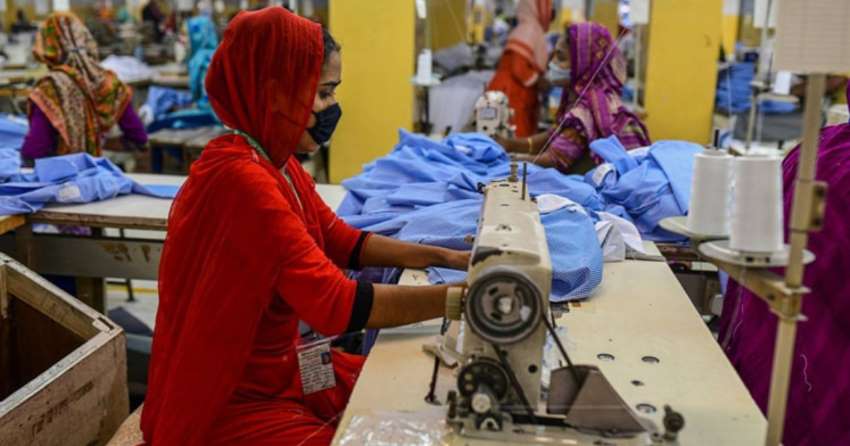
Another issue that the country needs to address is: making adequate policies and implementing them. Apparel sector in the country is dependent on the production of basic items as high-value apparels cannot be produced due to the absence of skilled workers. As the recent Fair Wear Foundation report reveals, not many buyers in Bangladesh are willing to pay more for apparels. Therefore, factories are accepting orders for low-priced garments in the hope that prices would increase someday.
Decline in buyer’s capacity, low productivity pose challenges
Apparel manufacturers are also facing other challenges like a continuous decline in prices at the buyer’s end, poor image in global market, lack of compliance to labor and environmental laws and lack of product diversification and low-value products, etc. The country’s productivity is less than all its major competitors. Therefore, it needs to address these issues to be able to compete in the globally.
As per Asian Productivity Organisation, per hour labor productivity in Bangladesh is lower than the average productivity of its competitors except Cambodia. The cost of apparel production has increased 30 per cent in the past four years. In fiscal year, 2015-16 and 2018-19, value addition in the sector declined 1.61 per cent though apparel exports increased during the period.
The situation is worsening with Bangladesh moving up from ‘least developed countries’ at a time when the WTO regime is turning bad because of increased protectionism in the international market. Unhealthy competition of selling products at lower prices by exporters has triggered a significant decrease in country’s export earnings.
The ongoing tariff war has led to a significant volume of trade relocating and Bangladesh has emerged as the safest garment exporting country in the world by the inspection of Accord, Alliance and the International Labour Organisation. The country exports 61 per cent of its apparels to five countries: Germany, United States, United Kingdom, France and Spain.
More focus on non-traditional market
However, it needs to expand this market beyond the European Union and the United States. For this, the Bangladesh government should formulate policies that focus on product diversification and more value addition. It should focus more on non-traditional markets by identifying products in demand.
Bangladesh should also respond proactively to the challenges of the Fourth Industrial Revolution by leveraging new technologies. The country should make a list of people required with certain skills and co-ordinate with entrepreneurs, policy makers, buyers and other development partners to develop these skills further.