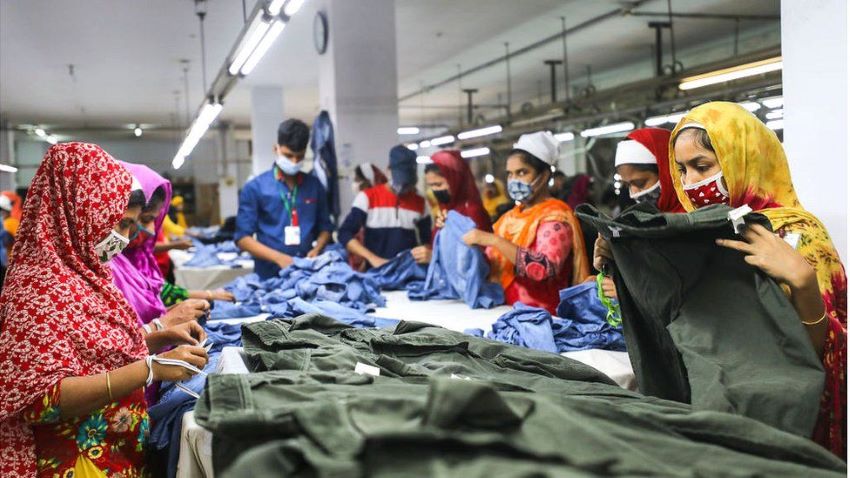
Bangladesh has emerged as the third largest readymade garment supplier to the United States after China and Vietnam. The country produces garment products that appeal to US consumers.
Trade volume between the two countries has doubled in 10 years. Garment products account for 95 per cent of Bangladesh’s total exports to the US market while US imposes a 15.62 per cent duty on garment imports. Despite sharing an uneven relationship due to labor issues, termination of Generalised System of Preference (GSP) benefits with the US, Bangladesh’s access to the US market continued to increase over time. The US is Bangladesh’s single largest export destination while as a least developed country 97 per cent of the goods originating from Bangladesh enjoy duty-free benefits in the US markets. However, US entrepreneurs are concerned about custom proceeding delays, difficulties in capital and profit repatriation as well as lack of transparency in issuing various trade related licenses.
Alongside the enhancement of product quality, improvement of workplace safety after the 2013 Rana Plaza setback helped Bangladesh regain the confidence of US importers. And tariffs have been no impediment in the country’s ability to access the US market.

- 1
- 2
- 3
- 4
- 5
- 6
- 7
- 8
- 9
- 10
Digital Dominance Redefined: Zara moves past H&M in $100 bn fast fashion bat…
The global fast-fashion sector has reached a inflection point in 2026 where the battleground is no longer only store shelves... Read more
Spykar accelerates offline expansion: plans 100 new stores across India
A titan of the Indian denim-first fashion scene, Spykar has officially unveiled an aggressive retail growth strategy. As consumer demand... Read more
The Inventory Illusion: Rethinking the Zara benchmark in a volatile retail era
For over a decade, the global fashion industry has treated the Zara playbook as the gold standard of inventory efficiency.... Read more
Retail Without Retail: How Walmart’s depot network is turning space into logisti…
Walmart is fundamentally rewriting the commercial real estate and retail logistics playbook with the rise of its ‘Walmart Depots’ a... Read more
Global textile regulation tightens, forcing realignment across fashion supply ch…
Global fashion and consumer goods supply chains are entering a decisive regulatory transition as Extended Producer Responsibility (EPR) frameworks for... Read more
Luxury’s new power axis, US dominance, China reset, Gulf surge
As the post-China luxury order takes shape, the US is emerging as the industry’s most dependable growth engine, while Japan,... Read more
India’s $9 Billion Landfill Blind Spot How trashed clothes hold the key to globa…
A massive economic windfall is sitting uncollected in India’s landfills, and the key to unlocking it lies in rethinking how... Read more
Red Sea crisis reshapes textile trade routes, challenges India’s export margins,…
Global apparel trade is now in a new operational phase where geopolitical stability and logistics reliability are as important as... Read more
EU’s textile waste rules enter enforcement phase, raising alarms across fashion …
Europe’s apparel and textile industry is approaching one of its most significant regulatory transitions in decades. As the European Union... Read more
Corporate fashion adopts reverse logistics to unlock the $367 bn resale market
Global fashion retailers are rapidly changing their business models around resale, repair, and textile recovery as the secondhand apparel market... Read more