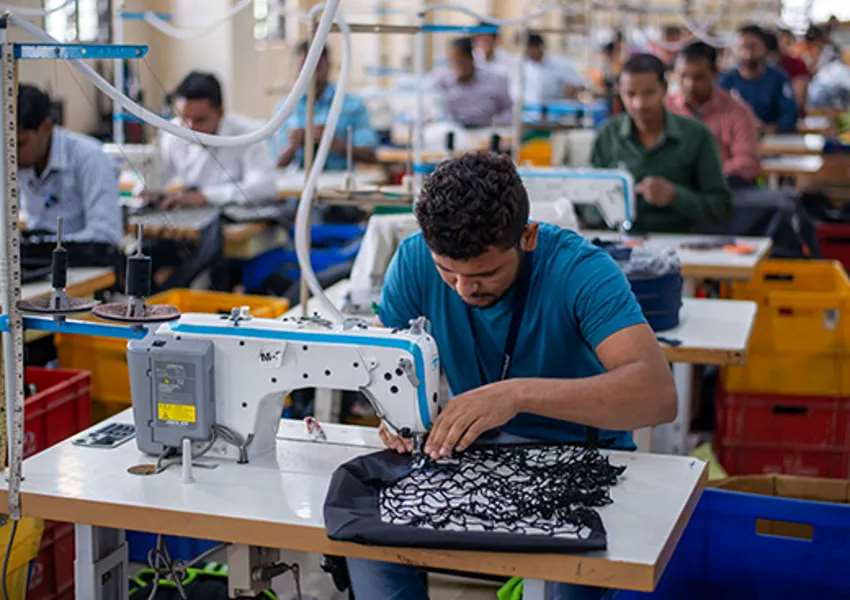
Silver Star Fashions makes use of simple but effective techniques to monitor inventory levels and control the non-conforming materials in the trims store and fabric store. Silver Star Fashions was founded in 1967. It makes dresses for women and children.
Trims are stored style-wise and issued on the basis of the trim card. Inventory levels of each trim are indicated on a board installed at the beginning of each row of racks for each trim stacked in that particular row of racks. The fabric store on the other hand is segregated in two parts – the fabric store and the bonded fabric store. While the fabric store is used to stock inventory that is either under inspection or to be inspected, the bonded fabric store stocks only the inspected fabric.
The bonded fabric store uses color coded racks to segregate ready to issue goods (green) and approval pending goods (yellow). These racks are kept covered using poly bags. The inventory level for ready reference is again monitored using the system of boards by each row of racks.
The factory has invested in Optitex CAD systems for pattern making and cutting floor management. Tracking an order’s introduction in the factory’s ecosystem, the first exercise is the feasibility analysis of the style. Technical feasibility is taken care of by the industrial engineering team. For execution of the orders, the production planning department calculates the productivity of the style based on its SAM, number of operations involved, fabric and order quantity.
- 1
- 2
- 3
- 4
- 5
- 6
- 7
- 8
- 9
- 10
The new Brussels rulebook, every EU apparel order is now a balance-sheet risk
The humble export order sheet is undergoing a transformation. What was once a straightforward commercial instrument: SKU, volume, FOB price,... Read more
Why 2026-27 could be a defining cotton year for India’s farm-to-fashion economy
The global cotton economy is entering a more constrained phase, and for India, the implications run far beyond the farm... Read more
Luxury resale’s next big battle is no longer digital, it is about who controls s…
For nearly a decade, the luxury resale story was written in the language of platforms. Market leadership was measured by... Read more
Digital Arms Race: Indian apparel giants deploy AI to neutralize tariff crisis
The Indian textile and apparel sector is in a digital survival phase in 2026, shifting from traditional labor-intensive models to... Read more
Europe’s Textile Endgame: Why Project FAE is becoming fashion’s most critical in…
Europe’s apparel majors are no longer treating circularity as a branding layer. With Project FAE or Feedstock Activation Europe, the... Read more
Engineering color at source, dye-free production is cutting cost, water, and tim…
For over a century, coloring has been anchored in wet processing, an energy-intensive, chemically saturated stage that happen post spinning.... Read more
The €11 bn deadlock, can Europe’s textile recycling catch up?
Europe is at a tipping point. Fast fashion consumption, led by rising incomes and a growing global middle class, has... Read more
From field to fiber, Bharat CottonNet is closing India’s cotton value gap
India’s cotton economy is entering a decisive phase of reform with the rollout of Bharat CottonNet 2026 along with the... Read more
US apparel imports drop 13.5% as Vietnam gains and China’s grip breaks
The US apparel sourcing market has entered 2026 with a sharp demand decline but an equally important shift in supplier... Read more
H&M finds growth below revenue line as margin discipline pays off
H&M Group’s latest quarter signals a decisive shift in global fast fashion: scale is no longer the primary reason for... Read more