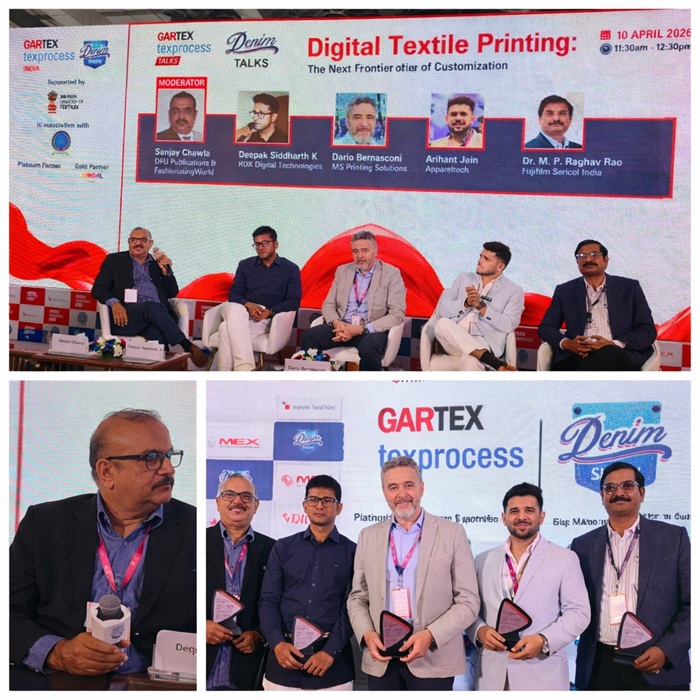
For decades, the global textile industry has been a game of high-stakes gambling: manufacture thousands of identical garments, ship them across oceans, and pray the consumer doesn't change their mind. But at the Bombay Exhibition Center this week, a panel of global experts and local disruptors officially called time on the "Produce-to-Pollute" era.
The session, titled "Digital Textile Printing: The Next Frontier of Customization," moved beyond machine specs to deliver a blunt message: The era of the mass-produced warehouse is being replaced by the "just-in-time" digital studio.
The Ford fallacy vs. The Gen Z reality
Moderator Sanjay Chawla (Founder, DFU I FashionatingWorld) set the stage by referencing Henry Ford’s 20th-century logic of "any color as long as it's black." In 2026, Chawla argued that logic is a financial death sentence.
"Today’s customer is individualistic. They don’t want a range you’ve decided for them; they want a design they’ve sparked, on a fabric they trust, delivered yesterday," Chawla noted. This shift from Mass Production to Mass Customization is the engine driving a global market now valued at $3–4 billion, yet in India, penetration remains at a modest 5-7%—a gap the panel identified as a massive "first-mover" opportunity.
The Global Strategy: Water, Pigments, and Politics
While India looks at digital through the lens of efficiency, the global perspective is increasingly driven by survival. Dario Bernasconi (MS Printing Solutions) highlighted that in Europe and Taiwan, "politics" and environmental mandates are the primary drivers.
The global frontier is no longer just about printing; it’s about chemistry. Bernasconi noted a decisive move toward pigment solutions that require zero water, effectively decoupling textile growth from environmental degradation. "We aren't just replacing screens; we are introducing a new type of pigment solution to reduce world pollution," he explained.
Table 1: The Efficiency Gap (Conventional vs. Digital)
|
Feature |
Traditional Rotary/Flatbed |
Digital Inkjet (DTP) |
|
Minimum Order (MOQ) |
20–30 kg / 1,000+ meters |
1 meter / Single Garment |
|
Setup Time |
Days (Screen/Film Prep) |
Minutes (Direct from File) |
|
Labor Requirement |
High (15+ people for volume) |
Low (3 technicians) |
|
Water Usage |
Intensive (Washing/Dyeing) |
Minimal to Zero (Pigment) |
The "Tirupur Dilemma": Can India compete with China?
A poignant moment in the session occurred when an entrepreneur from Tirupur—India’s knitwear capital—expressed fear over cheap Chinese DTF (Direct-to-Film) imports. The panel’s response was a rallying cry for "Atmanirbhar" (Self-Reliant) technology.
Deepak Siddharth K (CEO, RDX Digital Technologies) countered that the price gap is evaporating. By manufacturing both the high-speed machinery and the inks (in collaboration with experts like Dr. M. P. Raghav Rao of Fujifilm Sericol) within India, the "Razor and Blade" cost model is finally favoring domestic printers. "When we manufacture the ink and the machine 50 kilometers from your factory, the Chinese competition disappears," Deepak asserted.
AI: From sketchpad to screen in 20 seconds
The most radical shift discussed wasn't mechanical, but cognitive. AI is now acting as the "bridge" between human imagination and the printer head. Deepak Siddharth K described a world where AI-generated prompts allow anyone to become a designer.
When questioned about file sizes and "humanizing" AI prints, the panel was unanimous: Digital is the only technology that offers exact replication. Conventional methods require a "color master" to manually mix dyes for 20 screens; Digital sees millions of colors as easily as a desktop printer sees a PDF.
The Hybrid Roadmap: A pragmatic transition
For those hesitant to abandon their traditional roots, Arihant Jain of Apparel Tech and the wider panel proposed a "Hybrid Roadmap" as the most pragmatic transition for the Indian market. This strategy is not a total replacement of legacy systems but rather a sophisticated integration where digital and analog technologies work in tandem.
The process begins with the base, where traditional screens are utilized for cost-effective "discharge" printing or applying white under-bases, which remains significantly cheaper via screen than through digital inkjet. Once the foundation is laid, the detail is handled by digital heads, which effortlessly translate intricate, high-resolution AI designs and millions of colors—tasks that would require dozens of manual screens in a conventional setup. The roadmap concludes with the finish, using screens to apply tactile "special effects" like puff, glitter, or foil. Since these physical textures remain a challenge for digital jetting alone, this hybrid cycle allows Indian manufacturers to offer the best of both worlds: the infinite creativity of digital customization paired with the traditional "hand-feel" and special effects that the domestic market continues to demand.
The Narrative of the next five years
As the session concluded, the vision for 2030 emerged as a "Narrative of Uniqueness." The experts predict that packaging will be the next sector to be "digitized," and pigment technology will become the baseline for all ethical brands. Deepak Siddharth K ended with a bold forecast: within five years, digital will capture 30–40% of the Indian market.
The final takeaway for the Mumbai audience was clear: Digital printing is not a "different" way to print; it is a way to stop overproducing and start responding. India has the talent and now the domestic tech—the only missing ingredient is the speed of decision-making.