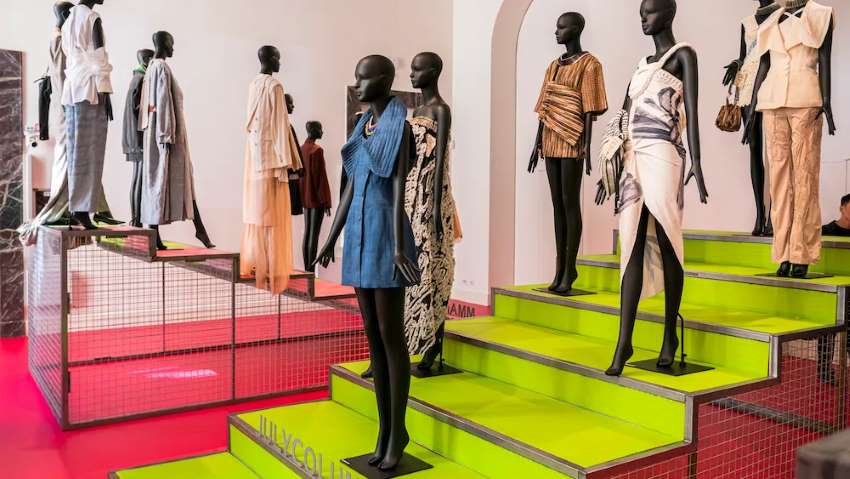
US companies don’t take a chance on new fashion or new ideas. They are all hiding behind tried and true apparel such as denim. The main problem is the lack of passion that pervades the industry. Executives are afraid to be on the forefront of creating a new look.
Outrageous new ideas come from Paris, London, and Milan. But no one puts these ideas to work and creates a new boutique with interpretations of what is seen in foreign lands. The US delights in selling secondhand clothes, denim, and markdowns. That little black dress is gone, cargo pants are a thing of the past. Macy’s, JC Penney, Madewell and Gap sell secondhand clothes instead of introducing new fashions. The merchandise has been cleaned and scrubbed, but all the same shopping in these stores is about buying hand-me-downs. These sell and they add to profits but they do not create an image that a store can be proud of. However Nordstrom has taken a different approach. Nordstrom is stocked with merchandise that has been returned by its customers. Each item is cleaned, refurbished, and sold at about half its original price. That makes sense, since it does not introduce new brands that the store did not carry, and it does not confuse the fashion message Nordstrom is trying to create.
- 1
- 2
- 3
- 4
- 5
- 6
- 7
- 8
- 9
- 10
The Hormuz Effect: Why a distant war is shaking Bangladesh’s garment exports
The immediate impact of the Iran- Isarel-US conflict is being felt in the logistics arteries that connect Bangladesh’s factories with... Read more
The rise of localized luxury, MEA, North America, and India lead growth
The global luxury industry is no longer defined by relentless expansion. The ‘2025 Global Luxury Brandwatch Report’ highlights a sector... Read more
Hormuz blockade sends shockwaves through India’s textile chain as polyester cost…
What began as a geopolitical escalation in the Gulf has rapidly metastasized into a full-scale industrial disruption for India’s textile... Read more
India’s National Fibre Scheme decouples textiles from global supply risks
For decades the Indian dominated spinning, weaving, and garment exports while remaining paradoxically dependent on imported man-made fibres and specialty... Read more
From London to Tokyo, premiumization redefines retail and office markets
Global real estate landscape has changed. Gone are the cautious narratives of recovery that defined the post-pandemic years. Today, flight... Read more
Compliance drives India’s $176 bn textile shift
India’s textile economy is no longer selling fabric alone; it is selling proof. As compliance rules harden across export markets,... Read more
The second life economy gets a boost as resale outgrows traditional apparel reta…
For decades, resale existed in the margins of the apparel economy, thrift stores, peer-to-peer marketplaces, and charity bins quietly absorbing... Read more
Rising polyester costs shake India’s textile manufacturing hubs
India’s synthetic textile industry is confronting a sudden and destabilizing price shock that is reverberating across its vast manufacturing ecosystem.... Read more
Cotton markets hold firm as tariffs, higher supply reshape global fiber economic…
In a year marked by tariff escalations, geopolitical brinkmanship and a recalibration of global trade flows, the international cotton market... Read more
Beyond Cotton How Kapok could redefine sustainable insulation in textiles
In the lush, humid heart of Southeast Asian rainforests stands a giant, a silent sentinel of the forest canopy. Growing... Read more