FW
Labor abuses continue to plague major global brands
"A new report by NGO KnowTheChain reveals the fashion industry lacks in its efforts to address forced labor. The NGO surveyed 43 of the world’s largest clothing and footwear companies’ efforts to address the issue. These companies scored only 37 out of a possible 100, with more than two-thirds scoring below 50. Be it slavery in cotton fields, human trafficking of factory workers or child labor, companies need to address a lot of issues to free their supply chains of labor abuses. The root cause of these abuses is the pervasive use of agencies to find workers for factories and workshops. These agencies often charge migrant workers large fees just to land a job, and there is ample evidence that these high fees push poor migrants into forced labor situations."
 A new report by NGO KnowTheChain reveals the fashion industry lacks in its efforts to address forced labor. The NGO surveyed 43 of the world’s largest clothing and footwear companies’ efforts to address the issue. These companies scored only 37 out of a possible 100, with more than two-thirds scoring below 50.
Right recruiting policy to curb abuses
Be it slavery in cotton fields, human trafficking of factory workers or child labor, companies need to address a lot of issues to free their supply chains of labor abuses. The root cause of these abuses is the pervasive use of agencies to find workers for factories and workshops. These agencies often charge migrant workers large fees just to land a job, and there is ample evidence that these high fees push poor migrants into forced labor situations.
In fact, companies that scored highest on the rankings, Adidas and Lululemon, employ their workers directly across the supply chain – a practice that KnowTheChain believes other companies should consider following.
Complex supply chain hampers growth
Another obstacle to progress is the complexity of supply chains, and the interconnectedness of the industry. Most major global brands engage the same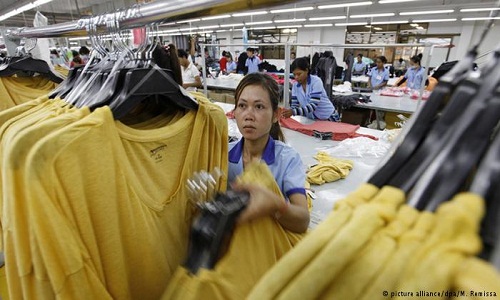 suppliers, or source from the same regions where textile factories and labor abuses are rampant, such as Bangladesh, Cambodia or Vietnam. Namely, one company can only do so much to solve this problem.
To address this issue, the American Apparel and Footwear Association, which represents more than 1,000 global name brands, retailers, and manufacturers, in October 2018, announced a commitment with the Fair Labor Association to address potential forced labor risks in their supply chains.
KnowTheChain will also continue to highlight relevant policies besides tracking progress on eliminating forced labor from the apparel and footwear supply chain. The NGO hopes to find a suitable solution to the issue by the publication of its next report.
USITC to investigate economic effects of duty-free imports
The US International Trade Commission (USITC) plans to investigate the probable economic effects of providing duty-free imports to the United Kingdom (UK) on US industries producing like or directly competitive products, and on consumers. The investigation was requested by the Office of the US Trade Representative (USTR) in November. The US president will be advised on the issue. USITC will prepare an assessment of the probable economic effects of eliminating tariffs on imports from the UK of certain agricultural products on US industries producing the products concerned and on the country’s economy as a whole. USITC, which will hold a public hearing related to the investigation on January 31, expects to submit its confidential report by May 8, 2019
Vinatex expects eight per cent rise in turnover
The Vietnam National Textile and Garment Group (Vinatex) expects export turnover to rise up to eight per cent in 2019. Vinatex is the largest textile maker in Vietnam. The group is striving for a five per cent increase in industrial production, seven per cent growth in revenue, and 12 per cent hike in profit. Its exports rose 10.9 per cent in 2018. Industrial production value was up 9.7 per cent against the previous year. Total revenue rose 6.6 per cent.
Although the group has secured orders until the end of the first quarter of 2019, input costs are a challenge. Minimum wage is forecast to expand 5.3 per cent, resulting in a rise in social insurance premium and labor cost. Meanwhile the group has paid due attention to the quality of orders and customers and aims at being among the top five producers in Vietnam. Besides investing heavily on modern machines and equipment that meet international standards to manufacture excellent products, the group will channel focus on improving labor productivity and increasing workers’ income. Garment and textile firms in Vietnam are encouraged to join hands with their customers and partners to set up a value chain to overcome difficulties.
US to focus on duty free towards textile, apparels in its FTA with Japan
The US and Japan are aiming at a free trade agreement (FTA). The US will seek comprehensive duty-free treatment for textile and apparel products, and other industrial goods. It will also aim at ensuring Japan avoids manipulating exchange rates to prevent an effective balance of payments adjustment or to gain an unfair competitive advantage and wants the agreement to have a mechanism to ensure transparency and take appropriate action if Japan negotiates a FTA with a non-market country.
The objectives also include strengthening procedures and creating new ones to address antidumping and countervailing duty evasion. The US goal is to improve trade balance and reduce the trade deficit with Japan, increase transparency in import and export licensing procedures, and discipline import and export monopolies to prevent trade distortions.
In the customs, the US wants to increase regulatory transparency and ensure more expedience in releasing shipments after determining compliance with applicable laws and regulations. This area would include streamlined and expedited customs treatment for express delivery shipments and simplified customs procedures for low-value goods, which would facilitate cross-border e-commerce.
US imports of apparel and textiles from Japan in the year through October increased five per cent over the year-earlier period.
Global textile mills market value up three per cent, Asia Pacific has highest share
The value of global textile mills market in 2016 was up 3.5 per cent from a year earlier. The compound annual growth rate (CAGR) of the market was 2.7 per cent between 2012 and 2015. Asia-Pacific region accounts for 59.6 per cent of the global textile mills market value. Europe and the United States account for a further 19.1 per cent and 10.8 per cent of the market respectively. The CAGR of the market between 2016 and 2021 is forecast to be 5.1 per cent.
Value of global apparel manufacturing market in 2016 was up 3.3 per cent from a year earlier. The Asia-Pacific region accounts for 61 per cent of market value in 2016 and Europe accounts for a further 15.2 per cent of the market. The CAGR of global apparel manufacturing market during the period of 2016 to 2021 is forecast to be 4.8 per cent.
Apparel manufacturing market covers all clothing except leather, footwear and knitted items as well as other technical, household, and made-up products. The market size is estimated based on the value of domestic production plus imports minus exports, all valued at manufacturer prices.
Texfusion to hold debut show in New York
The London Textile Fair will hold a new show called Texfusion-New York from January 16-17, 2019 at the Penn Plaza Pavilion in Manhattan. The show will feature 100 best international manufacturers featuring fabrics mostly for international fashion brands and designers’ Spring/Summer 2020 collections. International manufacturers to be present at the fair are: Etique from Italy, Halley Stevensons from Scotland, the men’s shirting mill Tekstina, Deveaux of France, the woven jacquard specialist EGR and women’s and girl’s fabric specialist Ercea.
Dedicated to the American fashion industry, Texfusion – New York will provide its buyers with a unique opportunity to source from the top international textile manufacturers.
Proof Collective launches water repellent denim jackets
Proof Collective has launched the world’s first water repellent denim jackets. These jackets, in addition to being water repellent, feature inside pockets to carry day to day essentials like a cell phone, keys and lipstick. The water and stain resistant feature adds to the jacket’s durability. Fewer stains mean fewer washes which saves on water waste.
The jackets are made with Italian premium denim finished with a unique blend of Bluesign© approved technology and produced in Los Angeles. The women's jacket has an oversized fit and is dropped shouldered and cropped, while the men's trucker style features a longer silhouette.
The brand also launched a core knit program of everyday tees and sweatshirts in solid colors and further plans to venture into accessories and footwear.
Moral Fiber recycling polyester to create new fiber
Moral Fiber wants to revolutionize fashion by recycling polyester to create a sustainable fiber that can be reused eternally. The company has developed a three-step chemical process that can extract polyester from mixed blend materials to create a new yarn, billed as the world’s first textile product made entirely from old clothing. The equipment needed for this transformation can fit into a small shipping container, making it easy to deploy.
The process involves taking a mixed material, which has some cotton and polyester, and extracting the polyester at the molecular level to produce a new yarn. The leftover material is incinerated to power the pilot plant but the final box could also be powered by solar panels placed on the roof. The process requires around 50 amps of power at peak consumption.
The technology can extract polyester from any blended material and will be suitable for recycling other plastics. As of now it starts with fabric but it can process packaging, bottles, containers, films, multilayer packaging. The company sees this box as the box that is tailor-made for textiles but in the future wants to make a box for packaging, a box for carpets and for all sorts of different materials.
Spinexpo: Promoting innovations in yarn and fiber
Spinexpo will be held in France from January 16 to 17, 2019. This is a trade fair dedicated to promoting innovation in the yarn, fiber and knitwear industry. It will present a preview of its collections and color ranges for the spring/summer 2020 season.
Spinexpo is the go-to venue for all fiber and textile yarn users and buyers of flat knit garments. The event brings together a selection of the industry’s key textile groups and is aimed at knitters, weavers, lingerie manufacturers and ready-to-wear brands and fashion houses with their own knitwear departments.
The fair will highlight sustainable developments. Shilead, a spinner, has made major investments that have helped to considerably reduce the contamination of the company’s dyeing process. Shilead reuses 60 per cent of the volume of its waste water. With organic cotton, recycled fibers and cationic modifications, recycled yarns have an important place in Shilead’s collections and are used to create innovative and varied fantasy yarns. And it has taken things a step further with the arrival of a recycled nylon thread that gives these products a much more modern twist.
Shilead is introducing Sorona and graphene fibers, which give the yarns a functionality while protecting the environment. Sorona is a corn-derived fiber that provides an alternative to oil, while at the same time protecting the textile’s appearance. Graphene provides heat insulation against infrared rays and has multiple properties: it is antibacterial, anti-ultraviolet and antistatic.
Low priced clothes not always low quality
Many articles of clothing that can be categorized as fast fashion are, in fact, longer lasting than their more expensive counterparts. So to blame the fast fashion industry for rampant waste is a bit unfair. A number of fast fashion products demonstrate significantly better value for money than other brands - especially when compared to designer brands.
So the inescapable conclusion is: people throw away clothes because they grow tired of them, not because they’re worn out. In fact, hardly anyone wears clothes to the point of wearing them out. Much of the clothing thrown away has nothing wrong with it. It has no holes in it; it's still functional. So the problem lies more with wearers than it does with the clothing producers themselves.
To automatically equate a price tag with quality is a mistake. Some of the longest-lasting clothes come from fast fashion retailers. While cheap fashion or fast fashion does raise legitimate questions about labor standards, expensive brands are notorious for unethical practices, too. It's a safe assumption that the people being paid to make those clothes are getting very little and likely working in hazardous conditions.
Burberry burnt unsold merchandise last year. Products of higher-end brands were made alongside cheaper ones in the Rana Plaza factory that collapsed in Bangladesh.