


FW
ColorJet displaying its best selling digital textile printer VASTRAJET at DTG-2019
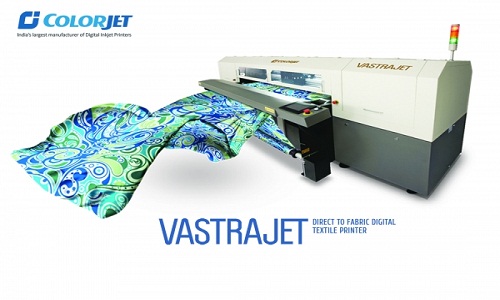
ColorJet participating at DTG for first time with best selling digital textile printer
VASTRAJET best suited for printing home textiles due to 320 cms width
ColorJet all set to repeat its Indian success story in Bangladesh
ColorJet India Ltd, India’s largest manufacturer and exporter of digital textile printing technologies will be launching and showcasing live demonstrations of its best selling direct to fabric printer, VASTRAJET at DTG-Dhaka which runs from January 9-12, 2019, at ICCB in Bangladesh in hall no. 6, booth no. 313.
ColorJet digital printers are an established name in, both textiles, as well as sign & signage applications. ColorJet digital printers are reputed to offer reliable performance year after year. Having firmly established itself as the biggest digital printer manufacturer in India, ColorJet is now all set to repeat its success story in Bangladesh and countries of Asia, Africa and Europe.
The consumers of Bangladesh share a common passion for colourful textiles with consumers of India and ColorJet brings to the table its experience and expertise, which includes a deep understanding of fashion sense in the sub-continent.
Fully realising that investment in digital printing requires a lot of support and hand holding in the initial stages, ColorJet has tied up with Universal Textile Machinery & Spares Ltd - Bangladesh to fully meet the need for making spares and consumables available to customers in Bangladesh.
To investors in digital printing, perhaps even more important than the technical support, it is the extensive and the holistic approach to selling a digital inkjet printing solution rather than a digital inkjet printing machine.
The VASTRJET is a workhorse with its robust Konica-Minolta print heads and for the production rate it delivers, it probably has the lowest carbon footprint. The printer is ideally suitable for home furnishing producers with a working width of up to 320 cms.
What’s more, it is also available in a hybrid version or two ink systems. Though reactive dye inks are the most popular choice in the sub-continent, pigment inks are preferred by some. ColorJet offers the VASTRAJET in the open system with both ink systems and also with direct disperse.
“Before the end of 2019, ColorJet hopes to install atleast five printers in Bangladesh, two of which are already in advanced stages of negotiations,” Jitender Pal Singh, Textile Head at ColorJet India said.
ColorJet maintains its No.1 position in India as per the latest IDC 2018 Q1 Super Wide Format report, while assiduously pursuing excellence in digital printing since 2004.
About ColorJet India Ltd:
ColorJet India Ltd, the largest manufacturer of digital inkjet printers in India, markets its products in 14 countries worldwide. Founded in 2004, the company maintains its operations via two manufacturing facilities and sales offices spread across seven countries, which include India, China, Bangladesh, UAE and Sri Lanka. To-date, ColorJet has installed and implemented over 4,000 of its printing solutions and products across 315 cities around the world backed by a strong 278 member team, of which almost 100 are in technical related
EFI unveils new Reggiani textiles printer
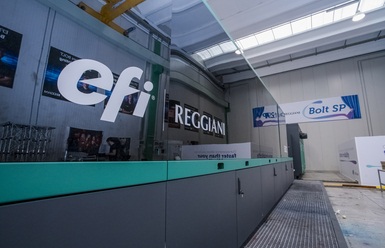 Available to order now, with units shipping in the first part of 2019, the Bolt is a 1.8m-wide machine that prints directly onto textiles at speeds up to 90m/min or 8,000sqm/hr.
It made its debut at an EFI Reggiani open house in Italy last week and, according to the company, it offers high uptime and reliability, outstanding performance, superior printing uniformity and accuracy, long printhead life and minimal maintenance needs.
EFI Reggiani vice-president and general manager Adele Genoni said: “The innovation of our new single-pass digital textile printer stems from a serious commitment of listening to and addressing our customers’ needs. Before kicking off this project, we completed interviews with customers across the world back in March and April 2017.
“The need for performance, uptime and productivity, printhead reliability, and printing quality were the key takeaways from these interviews. The Bolt is for customers who need high productivity with a short delivery or turnaround time, targeting textile manufacturers, but also apparel businesses.
“We have had a great level of interest for the printer and have already received several quotations. New and existing customers at the open house were extremely impressed with the printer’s speed, accuracy and output quality. There was a uniform sound of excitement and enjoyment when the printer was in action.”
Running with the EFI Fiery digital front-end, the Bolt’s headline features include a contactless wiping system to enhance the life of its printheads, which were developed specifically for the machine and print at 600dpi resolution. A premium setting increases resolution up to 600x4,800dpi.
It is intended to compete with a number of textile printers already on the market, including the MS LaRio, the Konica Minolta Nassenger and the SPG Pike.
According to Genoni, the initial Bolt machine is the first entry in an intended product line-up that will come with future developments and variations. She alluded to paper transfer and a wider 3.4m configuration as “on our product development roadmap”.
Epson to display home textile machinery at Heimtextil expo
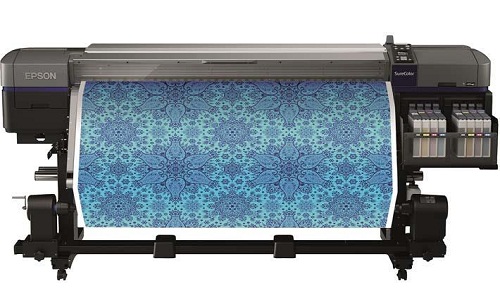
Epson will show its offer for the home textile market for the operators in the sector and visitors, at Heimtextil expo, in stand G81, hall 3. The show for home and contract textiles will be held from February 8-11, 2019, in Frankfurt, Germany. Epson is a leader in connecting people and information with its original, efficient, and compact technologies.
The company will be creating a living room in partnership with Brochier, the prestigious brand of top of the range furnishing fabrics. Some furnishing items will be displayed in this setting. Sofa, armchairs, poufs, curtains, and carpets have been made of fabrics printed by Monna Lisa, featuring the suggestive motif of the Utopian Philodendron, chosen from the company’s archive of furnishing fabrics. Demos will be provided by the printer SureColor SC-S80600, ideal, for instance, to print wallpaper, and by the printer SureColor SC-F9300 for sublimation textile printing, the ideal solution to personalise household items and to create 3D printed objects, such as plates, cutlery, and vases, Epson said.
The SureColor SC-F9300, 64” is a user-friendly economic printer. This highly flexible machine is the ideal choice to produce small volumes of quality fabrics and to sublime custom-designed motifs on hard substrates, such as, for example, anti-splash panels, table tops, cups, cutlery and vases. A 4-colour printer that uses UltraChrome DS ink with high density HDK black, the model SC-F9300 offers Epson PrecisionCore TFP double print heads for consistent and reliable results that feature exceptional colours and definition.
The SureColor SC-S80600 printer supports a wide range of substrates to meet all needs, from posters to graphic applications and interior decoration. With its advanced substrate management system, the printer ensures high precision for exceptional performance. Automated maintenance of print heads and the collection system for condensate produced by ink allow uninterrupted printing, thus ensuring high levels of productivity.
The SureColor SC-F2100 for direct printing on fabric can produce, in a few minutes, kitchen towels, aprons, cushions, and personalised bags. A printer that is highly appreciated by the market: Epson estimates that, from its launch until August this year, it has been used to print about 36 million t-shirts worldwide. (GK)
SPGPrints Presents Digital And Rotary Screen Solutions For Home Furnishing And Interior Decor Markets At Heimtextil 2019
BOXMEER, The Netherlands — December 3, 2018 — SPGPrints will showcase its digital and rotary screen printing solutions for home furnishing and interior decor markets at Heimtextil 2019 (Hall 3, Level 1, Stand B17), January 8-11, Messe Frankfurt, Frankfurt-am-Main, Germany.
PIKE 700 UV digital inkjet printer
The highlight of SPGPrints’ digital offering — shown by video presentation at the stand — is the PIKE 700 UV-inkjet hybrid printer, for decor laminates and other industrial applications, and based on the company’s Archer® inkjet technology.
With the PIKE 700, designers and decorators can have custom or mass-market products quickly and cost-effectively, no matter what the volume.
It is a 700-millimeter-wide roll-to-roll machine, featuring up to 10 color positions around a central cylinder, with CMYK plus white as standard. The printer features LED pinning between color stations to ensure image sharpness. It uses SPGPrints’ own inks that are optimised for the machine’s print heads and treatment processes.
The PIKE 700 printer can print on the full range of textiles, papers, films, foils and boards at resolutions of up to 1200dpi. It produces vignettes with tonal gradations that are smoother than conventional printing technology and achieves consistent color uniformity on both supported and unsupported paper and film materials up to 450µm thickness.
Furthermore, the printer may incorporate rotary screen printing units for added value high-impact “look and feel” effects, as well as priming, corona treatment among other complementary technologies, to form a complete single-pass production line.
Complete, customized rotary screen printing workflows
SPGPrints’ complete, custom-designed rotary screen printing workflows provide the platform for productive, cost-efficient and high quality wallcover manufacturing.
The company’s programme includes complete printing lines, such as the PD5 hybrid printing line, which are available for use with SPGPrints’ nickel rotary screens and direct laser imaging systems.
SPGPrints’ SpecialScreen®seamless nickel rotary screens combine a high mesh-count with a large hole size, enabling fine and detailed printing with large particles, without risk of blockage. SpecialScreen screens provide precision reproduction with smooth tonal gradations, fine outline printing, as well as puff, 3D tactile, glitter and reflective effects for enhanced sensual appeal.
The SpecialScreen range includes the 100SP/ 40 per cent and 130SP/ 33 per cent customised screens for water-based paste, suited for creating 3D designs. The 250SP screen, achieving rasters of up to 60 l/cm, is ideal for fine detail and halftones. Multiple colour runs that use special effects, like metallic gold and silver or Iriodine for a high-lustre finish, add value and create the unique looks that are favoured by high-end designers and retailers.
Truetzschler IDF2 technology scores at Jyoti Cotspin, Samana
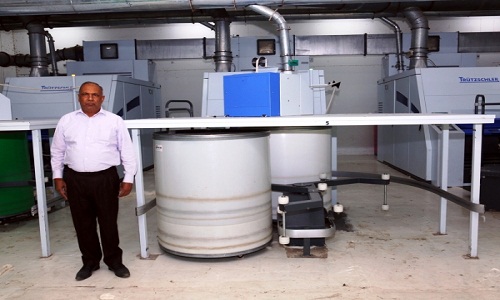
Jyoti Cotspin Ltd was established in 2006 by Mr Madan Singla, its Chairman and Managing Director. This open end unit manufacturing 100% cotton yarn started with 960 rotors and now has grown to 2240 rotors. The mill is located at Samana, one of the biggest cotton yarn producing regions in India. Jyoti Cotspin’s emphasis is on carded yarn in the count range from Ne 10s to Ne 28s. Jyoti Cotspin has always tried to produce the best quality yarn as per the needs of its customers. Therefore, today the company is recognised as one that produces top quality cotton yarns meeting the needs of the international market.
Jyoti Cotspin is equipped with latest machinery from Truetzschler – it has two blow-room lines and 24 Truetzschler cards including 6 cards with IDF2 technology. Mr Singla is very happy with the IDF (Integrated Draw Frame) technology as it couples the drawing process with the card itself, thereby eliminating the need for one passage of the sliver through draw frames. He highlights the fact that process elimination is an excellent way to earn money; not only does it reduce investment, it also saves operating costs. The space saving in itself is a major advantage as the first passage breaker draw-frames are totally eliminated. He is also happy about the advantages of IDFs in terms of quality and efficiency.
With IDF 2, Truetzschler has combined the compactness of a simple drafting system with the performance of an auto-leveller draw frame. The important features include:
Maintenance-free, digitally controlled servo drives
High levelling dynamics through low mass
Draft up to 200% (2-fold)
Delivery speeds up to 700 m/min
Trouble-free can changing
Truetzschler quality sensors in the feed and delivery area
Permanent monitoring of sliver quality
Advantages of IDFs cards are:
Improved yarn quality and product quality
Improved running behaviour of the rotor spinning machines
Significantly reduced space requirement
Savings in energy costs, less cans
Reduced personnel requirement
Everything important about the IDF2 is summarised by Mr Singla in a single sentence – “Never before has a fully-fledged leveller draw frame been more compact!”
International Conference on “Technology & Machinery Innovations for Technical Textiles”
19th January 2019
Bombay Exhibition Centre, Mumbai, India
Technical Textile and Nonwoven Industry is the emerging area of the global Textile Industry, which
has an immense scope and potential in India. To enrich knowledge about the latest global
innovations on new technology & machinery on production of all segments of Technical Textile
through Nonwoven, weaving, Knitting and Processing, its market potential and future prospects
across the globe, ITTA is organizing this International Conference for the benefit of the Indian
Technical Textiles industry. It brings together participants from the machinery manufacturers &
suppliers, technology providers, product manufacturers, new entrepreneurs and investors in one platform.
US-China trade war fuels demand for Bangladesh denim
"Statistics from the Directorate-General of the European Commission Eurostat reveal Bangladesh denim exports to the EU, during January-August 2018, increased 4.23 per cent to reach €917.14 million compared to the same period last year. The country’s denim manufacturers saw a healthy rise in exports to the US and European Union (EU) markets, beating China as the world’s second largest economy posted only a moderate growth. As per the US Office of Textiles and Apparel (OTEXA), the country witnessed a 14.20 per cent rise in export earnings from January to September 2018. China on the other hand earned 1.3 per cent totaling up to $683 million in export earnings, while Mexico saw a 1.08 per cent increase from 2017 to $595.40 million."
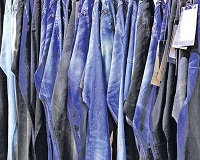 Statistics from the Directorate-General of the European Commission Eurostat reveal Bangladesh denim exports to the EU, during January-August 2018, increased 4.23 per cent to reach €917.14 million compared to the same period last year. The country’s denim manufacturers saw a healthy rise in exports to the US and European Union (EU) markets, beating China as the world’s second largest economy posted only a moderate growth.
As per the US Office of Textiles and Apparel (OTEXA), the country witnessed a 14.20 per cent rise in export earnings from January to September 2018. China on the other hand earned 1.3 per cent totaling up to $683 million in export earnings, while Mexico saw a 1.08 per cent increase from 2017 to $595.40 million. Vietnam earned 41.95 per cent more i.e. $205.43 million from $144.72 million in 2017. While the exports of Cambodia increased to 30.85 per cent to $88.34 million.
Rise in Bangladesh exports to EU
As per Eurostat Bangladesh earned 4.23 per cent higher revenue from exporting denim to EU countries between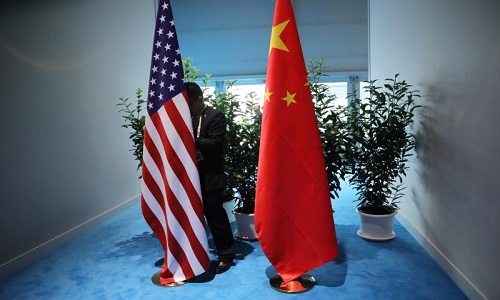 January to August 2018 compared to the corresponding period last year. Turkey recorded an 11 per cent deficit in earning to €687.28 million from €772.93 million in 2017. Pakistan saw a 4.83 per cent rise to €500.56 million, while China’s exports declined by 14.30 per cent to €304.79 million.
Improved technology, safety standards drive growth
Many factors have worked in favour of Bangladesh such as: improved technology in fabrics manufacturing; better safety standards in the apparel sector; and the ongoing trade war between China and the US. The Alliance for Bangladesh Workers, a platform of American buyers certified Bangladesh as a safe place, which boosted buyers’ confidence for sourcing products from the country.
In recent times, production costs in China and other countries have gone up due to an increase in wages. EU manufacturers are moving to Bangladesh for sourcing denim products. On the other hand, Bangladesh has increased its production capacity in both denim fabrics manufacturing and other denim products. Bangladeshi manufacturers have also moved to introduce latest technologies for improved quality of products.
Bangladesh has established state of the art denim fabrics manufacturing plants with increased production capacity. This attracted more work orders from buyers in the US and EU, as a result, manufacturers can supply orders within much shorter time compared to earlier.
Trade war boosts export earnings
The US is the single largest importer of clothing and China is the largest exporter of apparel goods in the world. The trade war between these two giants has brought in more orders for Bangladeshi manufacturers. As the trade war is a threat for the US importers over duty imposition, Bangladesh is benefitting the most from this conflict.
India wary of Chinese influx post RCEP
India has some reservations on the Regional Comprehensive Economic Partnership (RCEP). It is not prepared to let its domestic industry smothered by the deluge of cheap goods from the other members, particularly China. The impact of Chinese imports has been such that India is threatened to become a country of importers and traders with domestic factories either cutting down their production or shutting down completely.
The annual year-on-year growth in Chinese imports was about nine per cent in 2014, which soared to 20 per cent in 2018. The trade deficit with China constitutes more than 40 per cent of India’s aggregate trade deficit. In quantum terms, Chinese goods constitute about one-sixth of all imports into India.
Countries in diverse stages of development, from Australia, China, Japan and India to the ten members of Asean, are part of the RCEP, besides South Korea and New Zealand. Once wrapped up, RCEP would foster the largest regional trading bloc, making up 25 per cent of global GDP, 30 per cent of world trade and 26 per cent of cross-country foreign direct investment flows the world over.
A modern, comprehensive and mutually beneficial economic partnership agreement for an open trade and investment milieu in the Asia-Pacific region is the core objective of the Regional Comprehensive Economic Partnership.
India’s weavers prospects look bright with demand from China rising
The weaving sector of India is expected to improve in the coming months. Reason: positive signs from China, one of the leading importers of yarn from India. During October 2018, cotton yarn, fabrics and made-ups witnessed a growth of 25 per cent, while manmade fibers, textiles and apparel grew by 31 per cent, 28 per cent and 54 per cent respectively. All commodities witnessed a growth of 33 per cent during the same period. India is likely to outdo China in the textile sector.
Contributing factors are cheap labor and modernization. With quality and skilled labor and machinery, India can easily overcome Chinese competition in the textile industry as labor costs in China are very high compared to India’s. India aims at doubling the annual revenue from textiles by 2025.
Foreign direct investment is being encouraged in the textile sector, which has the potential to create millions of jobs. The textile sector in India is showing signs of recovery. The stressed advance ratio of the textile sub-sector has improved in March 2018 from the levels of September 2017.
The sector was heavily hit by demonetization, GST, rupee appreciation and high domestic cotton prices. Packages and incentives are expected to create a strong turnaround in the textile and clothing sector.
UK sourcing show Pure Origin opens on February 10
Pure Origin will be held in the UK from February 10 to 12, 2019. This is the UK’s number one destination for sourcing and manufacturing, knowledge and solutions. As a convenient and cost-effective way for buyers to meet with UK and international manufacturers, Pure Origin brings together over 200 exhibitors from 13 countries to create a wide range of business and networking opportunities, new thinking and innovation. Garment and fabric suppliers, denim and textile designers and technology brands attract buyers, sourcing, and technical personnel from the likes of Asos, White Stuff, Victoria Beckham, River Island, JD Sports, Marks & Spencer and Selfridges.
The event helps companies promote business amid global economic and political uncertainties like Brexit and the ongoing trade wars. It intends to do this by answering the market’s demand for newness, to create a platform for visitors to meet, network, discuss and hopefully find solutions to the biggest challenges facing them, and to inspire, showcase innovation and advocate best practice to enable growth and stability.
This edition of Pure Origin will focus on Italy. It will showcase some of the best of Italian fashion with leading fabric houses, manufacturers, labeling and packaging companies showcasing their collections.











