FW
Shri Ravinder Kumar Passi elevated as new chairman of EPCH
 Shri Ravinder Kumar Passi, Vice-Chairman-EPCH has been elevated as new Chairman of Export Promotion Council for Handicrafts (EPCH) during 164th meeting of Committee of Administration (COA) held on today informed Shri Rakesh Kumar, Director General – EPCH. Shri Passi has taken charge from Shri O.P. Prahladka. All members of Committee of Administration were present during the meeting.
Shri Kumar further said that Shri Ravinder Kumar Passi, representing M/S R.K. Arts, New Delhi is a leading handicrafts exporter from Northern region since last 26 years. He is associated with Export Promotion Council for Handicrafts (EPCH) since its inception and has served EPCH as its Chairman during 2001 and 2002.
He is very actively involved in various trade bodies. Shri Passi has also been the Co-Chairman of National Centre for Design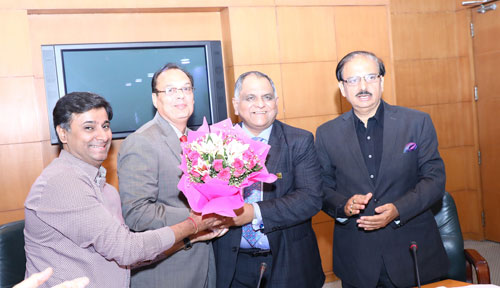 and Product Development [NCDPD] for many years.
Shri Passi expressed his gratitude to members of Committee of Administration of EPCH after taking over as Chairman of Export Promotion Council for Handicrafts, an apex organization for promotion of Exports of Handicrafts from the Country.
The exports of Handicrafts have shown an increase from Rs. 23029.36 crores (2017-18) to Rs. 26590.25 crores during the year 2018-19 [prov.] Showing an increase of 15.46% % over previous year. Shri Passi further said that in order to sustain this growth, the international marketing initiatives, cluster development projects, design and product development, new policy initiatives are needed to be pursued more vigorously.
Spring edition of IHGF-DELHI fair be held in April 2020
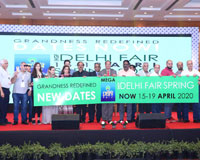 Shri Rakesh Kumar, Director General – EPCH informed that the dates of Spring edition of IHGF-Delhi Fair have been shifted from February to 15 – 19 April, 2020.
Shri Kumar stated the reasons behind shifting of dates of Spring edition of IHGF-Delhi Fair by elaborating that after conclusion of IHGF-Delhi Fair Spring 2019, the Council carried out a survey amongst exhibitors and buyers so as to take their feedback to consider shifting the show dates from February to April i.e. before China and Hong Kong fairs and found that 90% of the participants of this edition of the show expressed that dates should be shifted to April. Another reason for shifting dates cited was to give proper time to manufactures to prepare and develop new products lines to encourage buyers to visit the show in April enroute their way to the shows in China and Hong Kong. Shri Kumar informed that EPCH availed the opportunity of availability of buyers from more than 50 countries who are in India to source their requirement from Home Expo India being held at India Expo Centre & Mart and exhibitors as well to share and popularize the new dates of IHGF-Delhi Fair Spring to be held from 15 – 19 April, 2020.
As EPCH is an apex organisation of handicrafts exporters, the feedback received from the members was to be welcomed so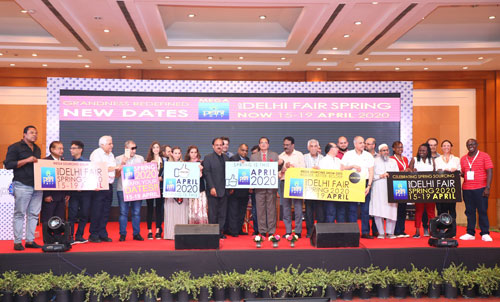 accordingly Members of the Committee of Administration have took the decision to shift the dates of Spring edition of IHGF-Delhi Fair from February to 15 – 19 April, 2020.
Shri Kumar elaborated that EPCH had been organising Spring edition of Indian Handicrafts & Gifts Fair 1994. The first edition of this fair was held in January, 1994 at Pragati Maidan, New Delhi with 313 exhibitors in an area of 5500 sq. mtrs. at Pragati Maidan with visit of 515 buyers. From 2006 onwards the fair is being held at state-of-the art exhibition centre i.e. India Expo Cenre & Mart, Greater Noida. The Indian Handicrafts & Gifts Fair was revamped and renamed as IHGF-Delhi fair with bigger, bolder and for five days during in 2014.
Spring edition of the show have registered fast growth in terms of exhibitors, display area, visit of buyers and generation of business enquiries. The fair which was started with display area of 5500 sq. mtrs. in 1994 has acquired 1,90,000 sq. mtrs in February, 2019 with 3189 exhibitors with visit of 6737 buyers and business enquiries of Rs. 2900 crores.
Shri Kumar hoped that with new dates of the show from 15 – 19 April, 2020 more buyers would be able to visit the show before going to attend fairs in China and Hong thereby enhancing business enquiries and earning of foreign exchange for the Country.
Vietnam’s apparel shipments to the US up seven per cent
Vietnam’s apparel shipments to the US rose seven per cent in February 2019 compared to February 2018. China continues to lose its footing as the major supplier of apparel to the US, and Mexico’s standing is on shaky ground, too.
Apparel goods coming from China to the US fell 2.9 per cent in February. Shipments reaching US ports from Bangladesh increased 13.6 per cent. Imports from India were up 6.3 per cent, from Pakistan it went up 14.8 per cent. US imports from Philippines rose six per cent; Sri Lanka 4.7 per cent. However, Indonesia’s shipments fell 1.2 per cent and from Mexico dropped 23.2 per cent in February. Imports from Honduras increased 14.12 per cent in value. Imports from the Dominican Republic rose 3.4 per cent. But they fell 6.69 per cent from El Salvador and 4.74 per cent from Guatemala. Apparel imports from Jordan jumped 21.61 per cent year over year in February, and shipments arriving from Egypt rose 13.2 per cent.
These developments came in a slow month for US apparel imports. Global shipments to the US fell 0.4 per cent in volume. For the year to date, imports were up 5.12 per cent in value compared to the same period in 2018, thanks to a surge in January.
Tirupur knitwear exports up eight per cent
Tirupur knitwear exports have grown 8.3 per cent this fiscal compared to the previous fiscal. Domestic sales were Rs 24,000 crores, taking its total business during the fiscal to Rs 50,000 crores. Exports picked up in the last six months of fiscal 2019 after a sluggish growth in the first half. The annual average export growth in the last fiscal was seven per cent. In the last six months, the average export growth was 31.15 per cent.
Factors like changing design patterns across the globe, changing lifestyles both in India and abroad, availability of cotton, skilled workforce, a fashion-oriented world, more per capita spending on garments and China’s non-aggressive push are among the host of things that have benefited Tirupur exporters. For the past two years, the industry was struggling due to various reasons, including demonetisation, implementation of GST and the overall volatile global economy.
Children’s and women’s garments continue to drive Tirupur exports. Together, this segment garners 70 per cent of the total business while the rest comes from men’s wear. Traditional markets such as the US, Europe, Africa and Latin America continue to be the major export destinations for the cluster. The Tirupur cluster’s target is Rs 1,00,000 crores (both exports and domestic sales) by fiscal 2022.
Online shopping, secondhand stores combat fashion waste
Speaking at the University of South Florida, as a part of a series of Fashion Revolution Week events in Tampa, Taryn Hipwell, Founder of the educational/advocacy group Beyond the Label and author of How to Shop for Shift noted that around 60 per cent of clothing made around the world ends up destroyed or in landfills within a year of production.
Hipwell discussed the importance of clothing labels being more transparent about their products and practices, including the large amount of waste created by the industry. She noted that the high-fashion landscape thrives on constant change with the internet is making runway cycles shorter than ever.
Brands such as Burberry and Louis Vuitton burn unsold merchandise worth billions of dollars. Labels often destroy products to avoid sales that devalue their brand. With new products constantly being released and consumer interest fading, there are few other options for companies. Fast fashion stores like Forever 21 also produce cheap clothing to match consumers’ obsession with staying on-trend.
According to the Natural Resources Defense Council, such habits contribute to the fashion industry being one of the biggest polluters in the world. The clothing production is responsible for 20 per cent of the globe’s industrial water pollution, as well as the emission of greenhouse gases into the atmosphere. To deal with these issues Hipwell advises consumers to opt for online shopping. She also thinks consumers should consider shopping secondhand at thrift and vintage stores.
Sri Lanka’s textiles and apparel industry turns to automation to boost exports
Automation can help Sri Lankan firms stay competitive with regional peers such as Bangladesh, who are relying on cheap and abundant labor as their competitive edge.
With automation, they can do precision cutting, manufacture high quality, which means they can get higher prices. With a small number of people, it’s possible to produce higher quality apparels. Automation would help fast track the export targets of Sri Lanka’s apparel industry. As of now it’s mostly the top apparel manufacturing firms in the country that have been utilising automation. Lower end firms can rely on automation for high value addition while bringing down their costs affiliated to labor-intensive manufacturing.
Automation solutions have revolutionised the fashion industry, enabling firms to develop their fashion ideas into products within a few days, compared to traditional value chains, which take 42 weeks on an average. Automation has also enabled firms to develop new ideas into products at a considerable lower cost allowing these firms to supply new designs to the changing fashion industry at a faster pace.
Sri Lanka’s apparel industry has an export target of $8 billion by 2025. The country’s apparel exporters are exploring developed markets such as Japan and Australia to diversify their markets.
Redress Design Awards picks semi finalists
Redress Design Award has chosen 30 semi finalists. These 30 designers are from across six continents and are applying circular thinking, presenting innovative ways to minimise textile waste. This is the world’s largest sustainable fashion design competition. For the first time in the competition’s nine-year history men’s wear designers were included alongside unisex and women’s wear designers, expanding the scope of Redress’ global search for talent.
Ambitious young designers are working to tackle the environmental challenges of fashion industry. As the world wakes up to the enormity of fashion’s negative footprint, from carbon emissions, water pollution and chemical use to spiraling over-consumption and waste, the Redress Design Award showcases the critical role designers can play in finding solutions.
Redress is a NGO working to cut waste out of fashion. It is an environmental charity with a mission to prevent and transform textile waste to catalyse a circular economy and reduce fashion’s water, chemical and carbon footprints. Their programs work to change mindsets and practices to stop the creation of textile waste now and in the future, as well as creating systems and partnerships that generate and showcase value in existing waste. Working directly with designers, manufacturers, brands, educational bodies, government and consumers, Redress aims at creating lasting environmental change in fashion.
Bangladesh makes massive investments in garment accessories
Bangladeshi garments accessories and packaging makers have made massive investments of around Tk. 1,000 crore to push up export and meet the demands of the apparel sector. This investment is driven by the accessibility of the workforce at reasonable wages, duty-free market access in major export destination and preferential location in the heart of the Asia-Pacific region.
Bangladesh is the second largest exporter of apparel products in the world after China, and offers a huge investment opportunity. The sector, last year, attracted investments worth Tk. 1,200-1,500 crore with more projects waiting in the pipeline. The government’s decision to reduce corporate tax rate from 15 per cent to 12 per cent in the RMG sector has also spurred investments in the sector.
Since demand for accessories is growing at a faster rate in Bangladesh, around 100 new factories started operations this year. Presently, around 1,200 factories produce accessories in the country. The accessories produced include woven labels, leather badges, stone and metal motifs, rubber patches, gum tapes, satin and cotton ribbon hangers, price tags, buttons and zippers.
These accessories contribute to $7.10 billion worth of exports in the country. Of this, $1.42 billion are directly exported to the Middle-East, South Africa, Sri Lanka, Malaysia, Europe, Vietnam, Cambodia, and Laos.
Turkish denim brand ISKO to create a sustainable landscape in the industry
Turkish denim specialist ISKO has joined Textile Exchange to further expand its vision of a responsible and sustainable landscape in the industry. ISKO plans to support Textile Exchange in developing more sustainable ways to tackle textile production. ISKO is already a member of several industry bodies and regulators, including ZDHC, SAC, SEDEX, Ethical Trade Initiative and Social & Labour Convergence Project. It now joins its parent company Sanko in joining Textile Exchange.
The Turkish firm desires to engender and maintain an open dialogue with all the different stakeholders, in order to shape and develop more sustainable business models and more efficient practices. It also aims to create a sustainable business model based on tangible proof and actual. ISKO also praised Textile Exchange for ensuring the authenticity of its sustainability and their effects on the society.
Interfilière Paris in July
Interfilière Paris will be held July 6 to 8, 2019. This is a trade fair for fabrics and accessories for lingerie, swimwear and active wear. This edition with 260 exhibitors will present latest trends, including a sporty athletic take on swimwear. The show will also present a new wave of creative young designers who have created eco-friendly collections. Around 20 exhibitors will participate in a specialised swimwear fashion show that will bring their most beautiful collections to life and make iconic garments out from them. The theme is the perfect wardrobe for elegance at sea, from morning through to evening.
International suppliers, including swimwear, sport and lingerie market specialists, will present a preview of autumn/winter 2020/2021 trends. The show will provide a new space to learn about the latest technical innovations from expert manufacturers and discover student projects or start-ups inspired by uses and functions that are essential to water sports. The technical zone will reveal expertise and test exhibitors on rare water sports. The challenge is to define the ideal sport swimsuit using criteria such as hand-feel, comfort, and look. The fast-forward zone will offer visitors a future-focused vision of the swimwear and sport markets by presenting new raw materials, new processes (connected or 3D), new tools, and more.