


FW
Coimbatore to host machinery show Texair in August
Texfair will be held in Coimbatore from August 9 to 12, 2019. This is an exhibition of textile machinery, spares and accessories. Participants are manufacturers and suppliers of textile machinery and spares, ginning, spinning, weaving, processing, power looms, handlooms, knitting and garmenting, textile testing equipments, pneumatic equipment and accessories, humidification plants and accessories, lubricants, energy saving equipments, electrical and electronic items, sizing materials, dyes and chemicals, and packaging materials.
The objectives of the fair is to provide a platform for stakeholders to zero in their investments and expenses prudently, showcase their inventions and cost-effective items and other products, enable technocrats and shop floor technicians to update their knowledge on the latest technology and create an awareness of cost cutting, and encourage micro, small and medium entrepreneurs also to showcase their products.
Texfair is organized by the Southern India Mills Association (SIMA), representing the organised textile industry in South India. SIMA has so far successfully conducted 11 such exhibitions since 2001. Response to the fair is getting better every fair. Conducting the event during August 2019 enables suppliers and users to plan their investments and renew their business. Coimbatore is the hub for the textile business in India and the fair would be an ideal platform to showcase and market the products.
Americans want transparency from brands: Study
Four in five Americans believe clothing brands should provide information on their environmental commitments and the measures they are taking to minimize pollution in their supply chain.
Around three quarters of the American public also believe that clothing brands should be responsible for what happens in the manufacturing process, and that they need to take measures to ensure clothes are produced in an environmentally friendly way.
About half would be put off buying from a brand that does not pay workers a fair living wage. The majority of consumers are also willing to pay 2-5 per cent more for their clothing to allow factory workers to earn a fair living wage. These are among the findings of a Ipsos MORI poll, carried out in the United States, France, Germany, Italy, Poland, Spain and the UK.
American consumers want more information on working conditions in fashion supply chains and would be put off buying from brands that are not paying a fair living wage. Most American consumers are sceptical about the credibility of information communicated by brands, with only a quarter of Americans saying they would trust the sustainability information provided by clothing brands themselves. US consumers make up the biggest apparel market worldwide.
GTTES 2019 to discuss trending industry topics, expand customer networking
"New opportunities and prospects for the textile industry will emerge as over 400 exhibitors and 48 countries participate in the 2nd edition of Global Textile Technology & Engineering Show in Mumbai from January 18 to 20, 2019. This year, GTTES has seen 26 per cent growth by attracting about 168 companies. It has mainly attracted start-ups and small, medium companies from non-metros due to its low cost participation charges and focused exhibit chapters."
 New opportunities and prospects for the textile industry will emerge as over 400 exhibitors and 48 countries participate in the 2nd edition of Global Textile Technology & Engineering Show in Mumbai from January 18 to 20, 2019. This year, GTTES has seen 26 per cent growth by attracting about 168 companies. It has mainly attracted start-ups and small, medium companies from non-metros due to its low cost participation charges and focused exhibit chapters. Sri Lanka and Slovenia will participate for the first time, while repeat participation from countries like Belgium, China, France, Germany, Italy, Japan, Spain, Turkey, UK, USA, Taiwan, Algeria, Djibouti, Kuwait, Azerbaijan, Kyrgyzstan, Senegal, etc, is a testimony to global reach of GTTES.
GTTES 2019 will facilitate interaction with all Export Promotion Councils which will help industry know more about export opportunities, various government subsidies, market initiative schemes available for Indian manufacturers and help to gain information and develop new opportunities for exports from India
Increase in exhibitors and visitors
GTTES has over the last six months, conducted 18 promotional activities across India and overseas. This year, visitor registration is much higher than the first edition also the number of countries sending business delegates too increased. Apart from regular business delegates from Bangladesh, Egypt, Sudan, Ghana, Nepal, Tanzania, Uganda, Rwanda, Egypt, Brazil, Morocco etc., there will be first-time delegates from Chile, Abu Dhabi & Palestine. Ministerial delegation from Ethiopia will be available for one to one discussion on investment and incentives offered by Ethiopian government.
India ITME Society addresses trending and urgent topics at GTTES 2019 by holding sessions by Indian Technical Textiles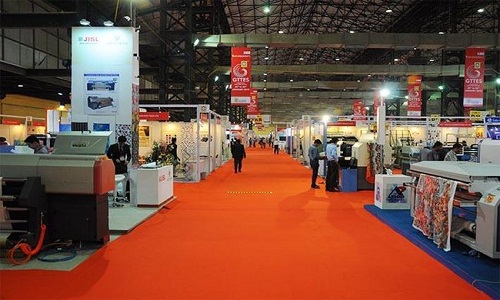 Association Society on ‘International Conference on Nonwoven Technical Textiles’ & by Society of Dyers & Colorists International India on ‘Educating the Technology Innovations in Textile Coloration’.
Facilitating government-industry interaction
There will also be industry interactive sessions on January 18, 2019 to facilitate government/industry interaction with Surina Rajan, IAS, Director General, Bureau of Indian Standards (BIS). This interaction will help the industry to directly represent formulation of policy for standardisation, promoting exports/imports and control proliferation. The main points of discussion include: overview of standardisation work done by BIS in the field of textile machinery and accessories. It will also include issues related to noise emissions and safety aspects of textile machinery and adoption of related ISO standards and inputs required for identified new subjects such as embroidery machines and baby diaper making machines.
An apt platform, GTTES 2019 connects exhibitors with many new markets which have never looked at India as a sourcing opportunity. These new and developing markets shall offer new business opportunities to both Indian and foreign exhibitors to expand their customer networking in an unprecedented way.
Additional US tariffs on China to make production expensive
"While the trade truce between the US and China gave brands and retailers some time to plan their counteractions if President Trump levies tariffs on the remaining goods imported from China, it also extended the uncertainty over the future. Every time a new set of tariffs are announced, soft goods brands and retailers anxiously wait to hear the fate of their products. Though apparel and footwear have been primarily been left thus far, the next round of tariffs are surely likely to include these goods."
 While the trade truce between the US and China gave brands and retailers some time to plan their counteractions if President Trump levies tariffs on the remaining goods imported from China, it also extended the uncertainty over the future. Every time a new set of tariffs are announced, soft goods brands and retailers anxiously wait to hear the fate of their products. Though apparel and footwear have been primarily been left thus far, the next round of tariffs are surely likely to include these goods.
If these tariffs are indeed levied, the trade war will cost $915 per person in 2019 or $2,357 per household, as per a new ImpactEcon report. It will also result in lower wages and higher joblessness. The trade war, according to the authors of the report, Terrie Walmsley and Peter Minor is likely to benefit all countries, except the US and China.
Search for new options as China’s production drops
Two countries that might benefit the most from trade war are: Vietnam and Cambodia as brands like Vera Bradley might increase production there to reduce exposure to the volatility in China.
Production in China is expected to drop from 57 per cent this year to 25 per cent in 2019. Companies are searching for new  options with Abercrombie & Fitch even prepared to leverage sourcing partners in any of the 17 countries. The mall-based retailer currently imports 25 per cent of its goods from China. It has already reduced production in China from more than 50 per cent to 40 per cent or lower.
Tariffs to increase import costs
Currently, 40 per cent of US apparel and 70 per cent of footwear is imported from China. If the tariffs are implemented, import costs for goods produced in China will increase. This, according to Steve Lamar, Executive Vice President, will result in higher prices for consumers.
Lamar estimates 25 per cent tariff would result in a 15 to 25 per cent increase in retail prices over time, which would cost shoppers $500 for a family of four. Already, brands like Carter’s believe the tariffs would translate into price increases. If these tariffs are implemented, the company plans to shift their operations to Vietnam, Bangladesh and Indonesia.
GIII Apparel Group, which has brands like Calvin Klein, DKNY, Kensie, Tommy Hilfiger and Karl Lagerfeld Paris in its portfolio, is already dealing with price pressure due to tariffs. The pressure has affected its handbags and leather outerwear business, which represents approximately 7 per cent of its total net sales. In response, the group plans to diversify out of China. The company’s partners in China have offered to help the company recoup lost margins. And, some retailers have agreed to share in the increases that we might impose on pricing.
However, Manny Chirico, CEO and Chairman of PVC Corp believes if apparel and footwear tariffs materialise, prices will increase irrespective of where companies shift production.
Piece rate or partial pay, garment workers look for the best option
Some factories in Vietnam, Indonesia, Jordan, Haiti and Nicaragua pay workers by piece rate. The piece rate system pays workers according to the number of units they produce. Compared with hourly or salaried workers garment workers who are paid piece rate are more likely to be weighed down by concerns about sexual harassment, verbal abuse and workplace injuries.
There is yet another system called partial pay, a hybrid of hourly and piece rate. Workers typically receive an hourly base salary—usually very low—along with an output-based incentive pay that activates only after a certain threshold has been achieved.
Piece rate workers can earn more on an hourly basis compared with their fixed-rate counterparts because this type of contract induces higher level of effort. However the base salary may be very low and the incentive pay, based on the output, is obtained only if a certain output threshold is reached.
Workers who are on a combination of pay types are concerned by the variability of their wages and a lack of transparency in how their wages are put together. These concerns can lead partial piece rate employees to work much harder, sometimes making their employment more strenuous and impacting their emotional and physical health.
SAC named convergence host of Social & Labor Convergence Project
The Sustainable Apparel Coalition (SAC) has been named an accredited host of the Social & Labor Convergence Project (SLCP). The SLCP Converged Assessment Framework consists of a data collection tool and a verification methodology. The project has more than 180 signatories committed to using converged assessment in their operations. The SLCP began in Amsterdam in 2016 as a multi-stakeholder effort to collectively improve the working conditions for garment workers in the global apparel and footwear supply chain. By uniting under a converged assessment, organizations can move beyond individually-driven programs, unlocking funds previously used on proprietary audits to be applied towards the development of scalable industry-wide solutions.
Sustainable Apparel Coalition is the leading association for the apparel, footwear, and textile industry. As an SLCP Accredited Host, the SAC has incorporated the converged assessment framework into the Higg index suite of tools as the Foundation of the Higg Social and Labor Module (FSLM). The SAC is one of just three organizations to be recognized as an SLCP Accredited Host.
By using Higg FSLM at scale, brands, retailers, and manufacturers can assess their social impacts and strategically direct valuable resources towards efforts that meaningfully improve conditions for garment workers globally.
May edition of Techtextil to showcase latest innovations in Germany
Techtextil will be held in Germany from May 14 to 17, 2019. Every two years, Techtextil mirrors a range of applications for textile materials. Leading international experts from the most diverse industries – be they from architecture, the automotive industry, medicine, the fashion industry or personal protection – come together at Techtextil in search of lightweight, durable and sustainable materials.
The fair will take a look ahead to see how technical textiles will shape urban life in the future. Suppliers at Techtextil represent the complete spectrum of technical textiles and nonwovens. There is a significant increase in the number of suppliers in the fields of technology, as well as fibers and yarns. Suppliers of woven fabrics, coated textiles and functional apparel textiles will also be strongly represented. All areas of application for textile materials are being covered. In particular, representatives from industry, architecture and construction, the fashion and clothing industry, the automotive sector, aerospace, medicine, sport, and hazard protection will find a more comprehensive range of products than before.
Trade visitors can look forward to contributions in the following thematic areas: sustainability, digital transformation, smart textiles, urban textiles, composites, and technical textiles in medical technology. Awards will be given for outstanding new and further developments in the field of technical textiles, nonwovens and functional apparel fabrics.
Myanmar wishes EU continues GSP
Myanmar hopes EU does not withdraw its GSP status as the decision can have a big impact on Myanmar’s reforms and growth momentum. Thousands of workers would lose their jobs if factories close and foreign businesses leave. It is estimated more than a million workers from the garment and fishery industries could be affected if the EU decides to revoke the trade preference.
It can become hard for Myanmar producers to export their goods to European countries. The EU is planning to stop trade preferences for Myanmar for reported human right violations in three of the nation’s states where ethnic people reside.
Currently, Myanmar exports enjoy tariff-free and quota-free access to the European markets, with the exception of arms and ammunition. Myanmar says maintaining GSP privileges would speed up its pace of development. The country’s businesses need trade preferences to export their goods to European countries, IT is the third largest export market of Myanmar, absorbing nearly ten per cent of the nation’s total exports in 2017.
The value of Myanmar’s garment exports to the EU has significantly increased from 2013 to 2017. The EU has become Myanmar’s largest trade partner for garments, purchasing more than 47 per cent of the products.
Sourcing at Magic in Vegas to focus on sustainability and new technologies
Sourcing at Magic will take place in Las Vegas from February 4 to 7, 2019. This episode will focus on sustainability through technology and feature innovative VR experiences as well as the latest in production and design tech and sourcing tools. It will explore both smart design and advanced manufacturing and ways of making the fashion industry more efficient and sustainable, displaying new devices presenting breakthroughs in 3D to 2D digital pattern rendering, virtual inventories, digital direct-to-garment printing and on-demand manufacturing.
Sourcing at Magic will also use technology to think about sustainability in a different way, through the X Ray Fashion VR Experience, which uses a VR headset to take participants from the catwalk back to apparel sweatshops and cotton fields, encouraging them to think critically about the fast fashion industry and adopt a more sustainable attitude.
The installation will be accompanied by the X Ray Fashion Tool Kit, which will provide information about the negative environmental and social impacts of fast fashion as well as descriptions of the industry’s mechanisms and processes, and advice on how to be a more sustainable consumer.
Seminars on recycling, relaunching and the impact of ongoing trade wars between the US and China on sourcing are lined up at the fair.
Lack of regulatory coherence in EU leads to use of hazardous chemicals in textiles
A Norwegian study reveals, the absence of coherent regulation in the EU is leading to potentially hazardous chemicals being continuously used in all stages of the production process in the textiles industry. This leads to more use of chemicals and less sustainable waste management.
Smart, funded by EU research and innovation program Horizon 2020, focuses on the environmental and social footprint of global supply chains for clothes and mobile phones. It comprises researchers from 25 institutions from around the world. It started in March 2016 and will run until February 2020.
Reforms adopted by the EU to promote sustainability often give a broad scope to member states on how to implement these. Unfortunately, member states tend to aim for minimum implementation, out of fears of jeopardising their own competitive position or that of their businesses.
That, however, does not mean a responsible business would use more chemicals within the current EU regulatory framework. On the contrary, ample set of high level industry standards have for decades ensured strict levels of protection.











