

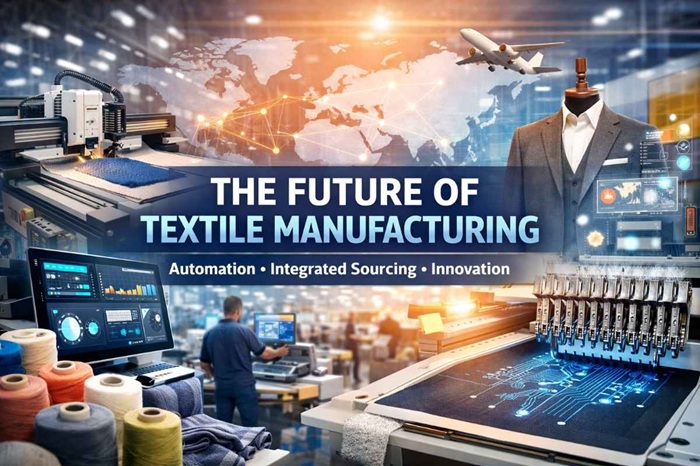
The global textile sector has entered a new era. Early 2026 saw the industry breach a $1.06 trillion valuation, reflecting a transformation that goes far beyond production volumes or labor cost arbitrage. Today, technical sophistication, regulatory navigation, and material intelligence define competitive advantage. While the Big Four: China, India, Vietnam, and Bangladesh remain production anchors, the internal dynamics of these economies are undergoing a shift, highlighting that the next decade will belong to markets that innovate at both fiber and process levels.
Southeast Asia emerges as the new trade gravity
China continues to dominate exports, generating an estimated $170 billion annually. Yet its supremacy faces mounting pressure from high-growth corridors in Vietnam and Bangladesh. Vietnam, in particular, is targeting $50 billion in export revenues for 2026, driven by a 17 per cent increase in US-bound apparel shipments and the launch of 65 new greenfield textile projects.
Bangladesh, long celebrated for cost advantages, is grappling with wage inflation and narrowing margins. With average Vietnamese garment wages now around $300 per month, manufacturers are compelled to invest in AI-driven design and automated spinning to stay competitive against lower-cost neighbors such as Cambodia. In this environment, price alone is no longer sufficient, operational sophistication and digital agility have become decisive factors.
Synthetic fibers confront regulatory boundaries
The dominance of synthetic fibers is being tested by emerging environmental regulations. Synthetics still hold nearly 69 per cent of the market due to unmatched durability and versatility, particularly in technical textiles. However, initiatives like the EU’s Digital Product Passport and California’s Responsible Textile Recovery Act are imposing new compliance costs. Brands are increasingly allocating 2 to 4 per cent of landed costs to meet these requirements. The recycled-content polyester segment is expected to grow at a 6.5 per cent CAGR through 2031, as manufacturers hedge against regulatory risks and the threat of microplastic penalties.
Fiber innovation becomes the competitive edge
Material science is now the frontline of commercial strategy. Traditional spinning and weaving are giving way to bio-based and carbon-negative textiles. Japan, Italy, and Germany are leading the innovation curve, particularly with PEF polyesters and hemp-based fabrics. Hemp is projected to capture nearly 30 per cent of the carbon-negative textile market this year alone. For buyers in Europe and North America, these fibers are not just environmentally attractive they also offer higher margins per kg, offsetting rising logistics and freight costs amid persistent global supply disruptions.
Automation defines the Vietnamese success story
Vietnamese firms are showcasing that technological scale can outpace labor arbitrage. Viet Tien Garment Corporation, celebrating its 50th anniversary with consolidated revenues of VND 18.5 trillion, has moved beyond low-margin OEM operations into technical apparel for premium markets. Automated sewing lines, digital traceability, and high-value product lines have positioned the company as a preferred supplier to Japan and South Korea, exemplifying how 2026 rewards the technologically adept rather than the labor-intensive.
Asia-Pacific remains the epicenter, but strategy matters
Major textile players increasingly operate as integrated manufacturing and retail entities, blending apparel, technical textiles, and home furnishings under a single strategic umbrella. The Asia-Pacific region still commands 54 per cent of global market share, with growth initiatives focused on sustainable materials R&D and digital supply chain integration. Post-2020 volatility is giving way to renewed confidence, with the industry targeting a steady 7 per cent CAGR over the coming years. From handlooms to steam engines and now Industry 4.0, the textile sector has always evolved with the tools of its era today, data is as vital as the thread itself.











