FW
Unions step in to correct abuses
Global framework agreements are being used to boost union organizing, collective bargaining agreements and social dialogue. They are becoming a stronger tool for improving labor relations in the supply chain and combating violence and harassment in the garment sector. Gender-based violence, and particularly sexual harassment, is prevalent in the industry. Most garment workers are women and many are young and migrant workers, who are not aware of their rights. They have little access to safe housing and transportation, while the fashion industry generates excessive overtime, low pay, and long working hours.
Global framework agreements are negotiated at a global level between trade unions and a multinational company. They put in place the very best standards of trade union rights, health, safety and environmental practices, and quality of work principles across a company’s global operations, regardless of whether those standards exist in an individual country.
Trade unions are essential in ensuring that the global framework agreements are implemented in the global brands’ supplier factories. The increase of unionization rate in supplier factories is key to enable trade unions to monitor the agreements and to ensure that workers’ rights are respected in the global garment supply chain. Global fashion brands like Asos, Esprit and H&M have signed such agreements.
18 Italian companies to exhibit at Exootextil Peru
Around 18 Italian companies will exhibit at Expotextil that will be organised from October 24-27 in Peru by Italian Trade Agency and ACIMIT. These 18 exhibitors include Arioli, Biancalani, Bianco, Btsr, Danitech, Ferraro, Itema, Lawer, Marzoli, Mcs, Ms Printing Solutions, Proxima, Pugi Group, Ratti, Roj, Santex Rimar Group, Stalam and Ugolini.
In Peru, the textile and clothing industry is one of the leading sectors of the local economy. In fact, the country is the world's leading producer of alpaca fibers. It also cultivates cotton, especially in the northern area of the country. The sector is also supported by government programs aimed at increasing the quantity and quality of products made in Peru.
The textile industry in Peru has already benefited, over the years, from the partnership with Italian textile machinery manufacturers. Peru is the fourth largest market for Italian sales in South America. In 2018, sales of Italian textile machinery in the Country reached a value of around 10 million euros. Moreover, in the first four months of 2019 Italian exports to Peru increased by 8 per cent compared to the same period in 2018.
Monforts to showcase coating and finishing technologies at Techtextil India
"Monforts Textilmaschinen GmbH & Co. KG will showcase an extensive range of coating and finishing technologies for the production of nonwovens and technical textiles at the forthcoming Techtextil India exhibition. The exhibition will be held at the Bombay Exhibition Centre in Mumbai from November 20-22, 2019."
 Monforts Textilmaschinen GmbH & Co. KG will showcase an extensive range of coating and finishing technologies for the production of nonwovens and technical textiles at the forthcoming Techtextil India exhibition. The exhibition will be held at the Bombay Exhibition Centre in Mumbai from November 20-22, 2019.
Hans Wroblowski, Head-Denim, says, “India is a very important market for Monforts and there are exciting prospects ahead for Indian manufacturers of technical textiles, who are well positioned to capitalise on growth opportunities.”
“India has one of the largest working-age populations in the world and a complete textile value chain for both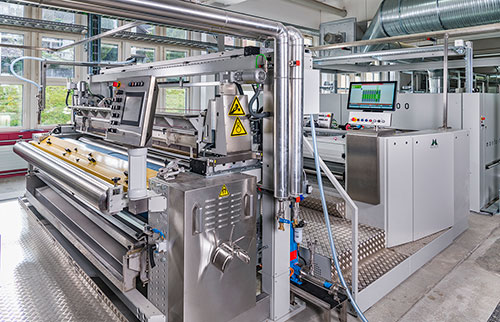 natural and synthetic fibres. In addition, its government has been actively promoting the growth of technical textiles through various programmes based on investment promotion, subsidies, the creation of infrastructure and the stimulation of consumption,” he adds.
As a result, India’s Ministry of Textiles forecasts technical textiles in the country to grow by over 18 per cent annually to US$28.7 billion in 2021.
Monforts texcoat range includes high value-added technical products such as wide-width digital printing substrates, carbon fabrics for high-performance composites, filter media, flame retardant barrier fabrics and heavy-duty membranes.
The texCoat user interface is equipped with the unique Monforts visualisation system and the magnetic doctor blade has greater power reserves. Options include a carbon fibre-reinforced composite coating drum with a more scratch-resistant surface and maximum rigidity and remote control which simplifies exact adjustment for the operator.
Montex stenters in special executions are ideal for the drying and finishing of both technical woven fabrics and nonwovens and characterised by high stretching devices in both length and width.
Pakistan exporters urge quick refunds
Pakistan’s textile exporters are facing a difficulty because of a delay in refunds. They are facing liquidity and cash flow problems and are unable to fulfill their export commitments. Exporters were given assurances the new refund system would be user-friendly and refunds would be processed without human involvement. A refund system for five export sectors was introduced by which sales tax refunds for exporters were be paid within 72 hours. However this system is a very cumbersome and complicated process.
As of now only 0.15 per cent of sales tax claims have been approved. The industry says the sales tax percentage may be increased gradually for the five export sectors, if refunds are paid within the specified time. In addition exporters want an enabling business environment and a level-playing field. Pakistan’s textile exports remained flat during the first five months of the current fiscal year as the value-added sector couldn’t perform up to the mark despite the constant currency devaluation against the dollar. This export sector is the backbone of Pakistan’s economy and earns a major amount of foreign exchange and revenue. Besides, the sector is also labor-intensive and the largest employment provider and generator. Value-added textile exporters say they are battling for their survival in the global market due to costly inputs and high cost of manufacturing.
Tamil Nadu to set up mini textile parks
The Tamil Nadu government has issued an order on providing subsidy of Rs 2.5 crore to set up mini textile parks in Karur. The government would either bear 50 per cent of the cost for building basic infrastructure in the park such as laying of roads, setting up of sewage treatment plant and captive power plant, training centre or offer subsidy to the maximum of Rs 2.5 crore to the manufacturers.
The government aims to motivate apparel manufacturers to set up new units in the state, thereby increasing job opportunities in various process of textile making including spinning, weaving and marketing. These manufacturers will launch a Special Purpose Vehicle for these parks which will set up on 2 acre each. They will get a subsidy of maximum Rs 2.5 crore per park.
These mini textile parks would enable the garment manufacturers to set up various units at the same place. It would reduce overhead and transportation cost. Moreover, 50 per cent subsidy on building infrastructural facilities in the textile park would offer a great support to the entrepreneurs.
Bangladesh export receipts fall seven per cent
Bangladesh’s receipts from merchandise exports declined 7.3 per cent year-on-year. This is the second consecutive month export earnings declined. September’s earnings were also 7.78 per cent lower than the month’s target. The decline of exports in September was mainly due to the non-utilisation of full production capacity on the occasion of the holidays. A significant number of factories have also been shut down since February 2019, resulting in job losses.
Overall, export earnings in the first quarter of the current fiscal year declined 2.94 per cent year-on-year. Earnings from almost all major sectors, such as garment, leather and leather goods, and frozen foods fell. Garment shipments between July and September fell by 1.64 per cent. Earnings from garment shipments, which account for more than 80 per cent of national exports, were 11.52 per cent below the quarter’s target. Shipment of cement, pharmaceuticals, terry towel, ceramics and home textiles also performed poorly.
Shipments are expected to rebound as international retailers and brands are coming over with a lot of work orders because of the ongoing trade war between the US and China. Apparel retailers and brands are also coming to Bangladesh for the brighter image created through a lot of improvements at factories and strengthening of workplace safety.
US to impose 25 per cent tariffs on EU imports
The US is set to impose 25 percent duties on imports from the European Union (EU), including a considerable amount of apparel from the U.K. According to the UK Fashion and Textile Federation (UKFT), the list of products that will face a 25 percent tariff will range from cashmere jumpers to swimwear. This is in addition to the normal duties that will apply. They will be introduced on October 17, 2019 and will apply even if the UK leaves the EU.
For the year to date through July, the US imported $60.94 million in apparel from the UK, an increase of 9.83 percent from the prior-year period, according to the Commerce Department’s Office of Apparel & Textiles (OTEXA). Wool apparel imports rose 13.94 percent to $19.36 million. UK apparels already face among the highest tariffs charged on any product and adding more tariffs will inject more costs into the system which will result in reduced sales, higher prices or lost jobs.
The EU Trade Commissioner Cecila Malmstrom has termed these tariffs “short-sighted and counterproductive and expressed a desire to find a fair settlement.
Bangladesh Business Forum focuses on sustainability in the RMG industry
The Annual Bangladesh Business Forum, held on October 2, 2019 in Dhaka focused on sustainability in the RMG industry. The theme of the forum was ‘Driving Sustainable Change.’ It was organised by the Better Work Bangladesh (BWB) program, a joint collaboration between the International Labour Organization (ILO) and the International Finance Corporation (IFC).
Discussions at the forum centered on the need for a globally competitive garment industry supported by improved labor market governance, effective social dialogue and responsible sourcing practices to ensure decent work and generate long-term prosperity for the industry. A number of speakers also highlighted ongoing issues facing the industry, including how BWB and its brand partners can continue to address gender and OSH non-compliances.
Over 350 RMG stakeholders, including representatives from the government, employers’ and workers’ organisations, development partners, global brands and retailers, manufacturers, civil society and academia attended the high-level event.
Through its core services— assessments, advisory and training—Better Work works to improve compliance practices and deliver beneficial outcomes to both factories and workers.
The Better work program currently works with more than 1,700 factories and 2.4 million workers in eight countries and engages 60 global brands and retailers. Better Work brings together all levels of the garment industry to improve working conditions and respect for labor rights for workers and boost the competitiveness of apparel businesses.
Global fashion exports up 35 per cent in last ten years
Global fashion exports in the last decade increased by 35.1 per cent while global trade increased 26.4 per cent, says the World Trade Organization. India registered the strongest performance in its international clothing trade during this period followed by Brazil and other Asiatic countries excluding China. Exports by the United States increased 28.6 per cent between 2007 and 2008, those by Japan increased by 20.1 per cent and the European Union by 33.5 per cent. China, that entered the WTO in 2001, increased its garment exports by 93.3 per cent during this period. Middle East and Australia also positioned high in the list, with rises near 100 per cent.
Restrictive measures of world trade registered exceptionally high levels between October 2019 and mid-2019. The focus of the global fashion sector is turning to the environment, and the industry’s impact and role. Fashion falls just behind energy production and food as the most polluting industry, with a disturbingly large ecological footprint. It is incredibly wasteful. It takes at least 10,000 liters of water to produce a kg of cotton (enough for a pair of jeans and a shirt) and more than 75 per cent of clothes go to landfill.
Amouve uses organic cotton for bed sheets, boosts organic cotton farmers
Amouve, based in Bangalore, helps organic farmers become sustainable and profitable. The cotton the start-up uses to make bed sheets, pillow covers, cushion covers, comforters and quilts is sourced from about 500 farmers, who are part of a cooperative. Middlemen are cut out. Cotton from organic farms goes to the factory and is woven into soft linen that gets softer with each wash. In this way Amouve provides eco-friendly bedding options to consumers. The company works with farmers in Telangana and surrounding regions and sells only single-ply 300 thread count sheets and its towels are super soft in 700 grams per square meter, crafted with a low-twist proprietary weave.
Amouve has stepped into offline retail and is present at Danube Home in Hyderabad. The plan is to be present in five more stores in the next one year and achieve a year-on-year growth of 25 per cent.
Most of the linen available in the market is plastic packed with no information on what the material is and conventional cotton uses pesticides, which are not good for the skin. On the other hand, polyester fabric releases plastic microfibers into waterways and these persist indefinitely, contaminating lakes and oceans, getting ingested by animals, and indirectly by humans.