FW
Heimtextil 2019 showcases leading innovations in home, contract textiles
"Heimtextil 2019 displayed key trends in structure, graphic patterns and health-promoting materials. The leading trade fair for home and contract textiles, held from January 8 to 11 in Frankfurt, offered an attractive backdrop for the innovations of 3,025 exhibitors from 65 countries. Graphic patterns dominated all segments at Heimtextil 2019. These included variations in geometries, checks, diamonds and diagonal stripes as well as inspirations from the 50s, 60s and 70s, elegant style elements from Art Deco and designs à la M.C. Escher."
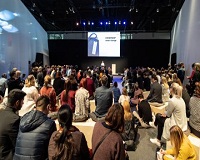 Heimtextil 2019 displayed key trends in structure, graphic patterns and health-promoting materials. The leading trade fair for home and contract textiles, held from January 8 to 11 in Frankfurt, offered an attractive backdrop for the innovations of 3,025 exhibitors from 65 countries. Graphic patterns dominated all segments at Heimtextil 2019. These included variations in geometries, checks, diamonds and diagonal stripes as well as inspirations from the 50s, 60s and 70s, elegant style elements from Art Deco and designs à la M.C. Escher.
Health-promoting and sustainable fabrics on display
Furniture and decorative fabrics including upholstery and imitation leather, carpets and contract business were displayed in halls 4.0, 4.1 and 4.2. Innovators such as Trevira CS and Antex presented recyclable yarns made from marine waste such as fishing nets and PET bottles. Froca presented a Teflon-free upholstery fabric line that can be cleaned with pure water. Suppliers such as Toucan-T presented PVC, latex and bitumen-free solutions that save around 12,600 ton of waste and 70,000 barrels of crude oil per 10,000 ton of raw material. In addition, exhibitors such as Tecnografica, Cerda Fabrics and Essegomma 0 also displayed their innovations. Suppliers such as Höpke marked the paradigm shift in the elderly and care sector with their display of easy-care and attractive fabrics.
Sustainable solutions in digital printing, wall decorations
The exhibition also focused on sustainable solutions in digital printing. Here, international market leaders such as HP and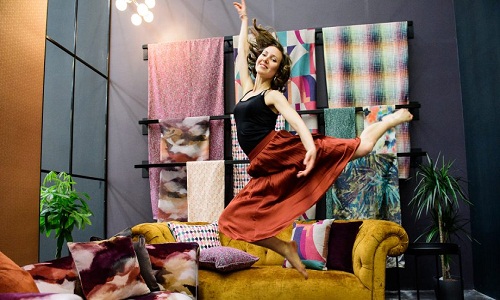 Mimaki demonstrated their skills in adapting these works of art on canvas, wallpaper and textile.
In Hall 3.1, suppliers A.S. Création, ATT Rotex, Rasch, Grandeco, Architects Paper and Galerie Limited focused on wall decorations. These ranged from industrial and rustic-natural to sophisticated Art Deco. Designs from European metropolises, from London club chic to Amsterdam tile styles (AS Design), provided fresh impetus to these decorations. Technical innovations were displayed in the field of fire protection and odorless materials.
Exploiting creative strength of decorative textiles
Exhibitors such as Apelt, Eustergerling, Heco, IFI Design, Saum & Viebahn and Style Library exploited the creative strength of decorative textiles at the new Interior Decoration hotspot in hall 8.0. Graphic designs dominated these displays. These ranged from simple geometric patterns such as diamonds, checks and stripes to complex, multi-coloured optical illusions.
Solutions for improving nightly regeneration were also on display. These ranged from hotel beds that can be individually adjusted and smart sleep sensor mats from Withings Sleep to technical materials from Outlast Technologies. Sustainability was also focused by Ecobel/Belnou, Traumina and OBB in the form of increasingly mature recycling and cradle to cradle approaches or the conscious focus on organic qualities, origin and tradition.
Trends from Hall 12 supported sweet dreams. Here, HG Hahn presented sustainable bed linen that does not use plastic in its packaging. Major brands including Bierbaum, Christian Fischbacher, Cawö, Esenza, Estella, Irisette, Lexington, Schlossberg and Vossen presented their coherent collections here. In hall 12.1, suppliers such as Estamparia Textil Adalberto, Altinbasak, Bestitch, Casa Soft, Doksan, Erteks, NLG – Nile Linen Group and Makroteks presented contemporary collections for e.g. the hotel industry.
Vietnam expects 10 per cent rise in export turnover
Vietnam is aiming for a 10.8 per cent increase in export turnover of garment and textile products this year. In 2018, export turnover from garment and textile products saw a year on year increase of 16 per cent. This level of growth would make the nation among the top three largest exporters of textiles and garments in the world.
In addition, the Comprehensive and Progressive Agreement for Trans-Pacific Partnership (CPTPP) is expected to help the economy grow 1.3 per cent and boost export turnover by four per cent. The CPTPP is expected to cut import tariffs and diversify products available in CPTPP member countries.
The sector has gradually completed the supply chain thanks to increasing flow of capital invested in the textile and dyeing industry, making its products more competitive. Order statuses for 2019 are also very positive. Many businesses already have orders for the first six months of this year and even the whole year.
However, Vietnam has to depend on raw material imports. Enterprises have to import over 60 per cent of the raw materials they need. If the dependence on imported materials is not reduced, the industry may not be able to enjoy the benefits of CPTPP.
Pakistan: APTMA recommends measures to double exports in five years
Pakistan textile and clothing exports, which fetched $13.5 billion or almost 60 per cent of total export earnings last fiscal, continue to struggle. The industry’s total shipments remain flat at $6.64 bn during the first half of 2018-19 on an annual basis. This raises questions about the rationale for the subsidy worth billions of rupees given to the country’s largest manufacturing industry that contributes 8.5 per cent to GDP and employs 46pc of non-farm labor.
Ali Ahsan, Chairman, All Pakistan Textile Mills Association (APTMA) believes textile and clothing exports can easily double to $26 bn in the next five years if the government continues to support the industry through a long-term policy. He advocates removal of upfront incidentals on the import of manmade fibers, which is short for industry consumption. This will enable the industry to diversify into products that are in high demand in foreign markets.
Further, the government must liquidate all outstanding refunds of the industry on account of sales tax, duty drawbacks and previous textile policies, withdraw gas infrastructure development cess (GIDC) arrears of pre-GIDC Act 2015, allow the payment of the post-GIDC Act arrears in installments, and expedite new gas and electricity connections and tagging for the zero-rating of the industries by departments concerned.
UBM’s Magic marketplace to open tommorrow
UBM’s Magic marketplace and Agenda, each proposing a range of events addressing everything from conscious fashion to the history of streetwear, will open tomorrow in Las Vegas. Spread over the Las Vegas and Mandalay Bay Convention Centers, Magic will play host to 12 trade shows, among which WWDMagic, Project Women’s and Stitch @ Project Women’s will be dedicated exclusively to womenswear.
Project Women’s is partnering with the Conscious Fashion Campaign to recognise brands that seek to work towards the UN’s Sustainable Development Goals through their production or business practices. The collaboration is the continuation of the trade show’s Conscious Collections initiative and will spotlight a broad variety of brands, including organic cosmetics label Bitchstix, female-led skate brand Doyenne and Korean upcycled accessories start-up Pleatsmama.
For the latest in the menswear industry, Magic attendees can seek out a comprehensive overview of the sector at Project, home in on the high-end luxury market at The Tents or explore branded and licensed apparel for men and young men at Magic Men’s.
Along with industry staples, Magic’s menswear shows will also feature a line-up of upcoming brands. At Project, these include Casual Scandi label Redefined Rebel and Montreal-based steel jewelry brand A.R.Z Steel, while The Tents will welcome men’s swimwear specialist Nine + Eight and North Carolina-based apparel brand Lords of Harlech, and Magic Men’s will host South Africa’s Carducci and high-end menswear label Baqchi.
Greenpeace cautions, fast fashion creates waste
The rise of fast fashion has not only changed shopping habits but has led to the creation of more waste as people are discarding clothes at twice the rate as in 2000. In addition, people on an average have 60 per cent more clothing items than they did 19 years ago.
With that trend, the strain on environment is increasing because the fashion industry -- from garment production to disposal -- causes environmental damage. The garment industry is the world’s second largest source of pollution, after the petroleum sector. Modern clothing is made mostly from either cotton or polyester fibers. The latter is a byproduct of the petroleum industry, while cultivation of the former requires huge amounts of water, land and pesticides.
The garment industry impacts the environment because production of synthetic fibers indirectly increases carbon emissions, while the disposal of clothing produces greenhouse gases, whether they are burned or buried. With the rise of fast fashion -- inexpensive clothing produced rapidly by mass-market retailers in response to the latest trends -- the volume of recycled clothes has increased but the quality has dropped, which reduces their life expectancy. These are the results of a Greenpeace survey published in June 2016.
Bangladesh apparel exports to new markets up 36 per cent
Bangladesh’s garment exports to non-traditional markets grew 36.21 per cent year on year in the current fiscal year's first six months. This was made possible by a stimulus package and duty-free market access. Apart from the US, European Union and Canada all others are considered non-traditional or emerging markets for Bangladesh. Of those, eleven are performing stronger than others. Australia, Brazil, Chile, China, India, Japan, South Korea, Mexico, Russia, South Africa and Turkey are the eleven stronger markets.
Garment exports to non-traditional markets have been growing since 2010-11 with a five per cent cash incentive as a stimulus package to offset the fallout of the financial recession that affected the global economy in 2007 and 2008. The stimulus package has encouraged exporters to start exploring new markets. Most of these new markets have duty-free access facility for Bangladeshi exporters.
Japan extends duty-free trade privilege to garments imported from least developed countries to reduce overdependence on China. Similarly, China, the largest apparel supplier worldwide, has also been turning into a major export destination for Bangladesh. China also allows duty-free access to over 5,000 Bangladeshi products, most of which are garment items. India, Brazil, Mexico and Chile are also turning into major export destinations for Bangladesh.
Brazil: Buyers at Texbrasil form partnership
From January 14 to 17, three international buyers invited by Texbrasil carried out through a partnership between Apex-Brasil and Abit. The buyers fulfilled a business agenda in Sao Paulo and made purchases worth $50,000, with expectations to spend an additional $2,00,000 over the next 12 months.
The group includes Colombia’s María Clara Suescún, representing Agua Bendita and Per’s Narciza Victoria Huerta and Jimmy Moreno Hurta, of Mundo Moda, who took part in meetings at the Lunelli, Kalimo and Rosset companies, in addition to visiting the Inspiramais, focused on innovation in materials.
Texbrasil is the Brazilian Textile and Fashion Industry Internationalization Program. Apex-Brasil is the Brazilian Trade and Investment Promotion Agency. Abit is the Brazilian Textile and Apparel Industry Association.
The companies at the show were also visited by buyers. A total of 12 Texbrasil member companies showed their launches to the public and to international guests. For María Clara Suescún, a buyer for the boutique beachwear label Água Bendita, the thing that most caught her attention was Brazilian companies’ innovation. She was unfamiliar with this side of Brazilian industry and saw lots of technology and interesting products over these last few days.
ASEAN, EU to enhance bilateral cooperation
ASEAN and the EU confirmed their commitment to enhance bilateral cooperation at the 22nd ASEAN-EU Ministerial Meeting on in Brussels. Both agreed to harness cooperation in shared fields of interest and concern like economy, trade, investment, connectivity, climate change, counter terrorism, cyber security, sustainable development, maritime security and trans-national crime prevention, at the meeting.
On the basis of bilateral deals between EU and ASEAN countries, both sides agreed to step up efforts towards ASEAN-EU free trade agreement. They also reached a consensus of upgrading ASEAN-EU strategic partnerships based on relations and adopted a statement satisfying both sides during the meeting. The ministers also exchanged views on complex and unpredictable developments on global economic and political situations. They agreed to continuously coordinate in the promotion of multilateral, open, fair and rule based trade systems, while working closely on resolving challenges, enhance dialogue, prevent conflicts and build trust.
The European Union is the second biggest partner in trade for ASEAN with the bilateral trade reaching $261 billion in 2017, up 11.9 percent from previous year. It is also one of the largest sources of FDI to ASEAN with its direct investment hitting $25.4 billion in 2017, which accounts for 18.6 per cent of the total FDI in the ASEAN region.
Bangladesh: Accord asked for handover plan
Bangladesh has asked Accord to draw up a time-bound responsibility handover arrangement. The observations include Accord’s transition mechanism to be focused on a smooth transition of management of factories from the platform to the Remediation Coordination Cell (RCC). In September last year, the European Union-based platform submitted an exit plan to end its ongoing workplace safety activities in the country’s readymade garment sector in six phases. Accord’s proposed transition plan mainly put attention on remediation of the factories, RCC’s capacity building, including setting up a liaison office of Accord within it, handover of Accord’s safety committee, safety training program and its safety complaints mechanism.
Accord, a platform of more than 200 global apparel brands, retailers and rights groups based mostly in Europe, was formed immediately after the Rana Plaza building collapse to improve workplace safety in the country’s apparel industry for five years that ended in May last. Bangladesh allowed a six-month extension until November 30 while the platform wants to stay for more time. Accord has so far handed over responsibilities of its inspected 100 garment factories, which fully completed all the required remediation work.
In phases three and four, Accord has proposed gradual handover of its safety committee, training program and complaints mechanism.
British brands tackle Brexit with diversification
"With Brexit on a knife edge, many designers and small-time manufacturers doubt whether the bi-annual catwalk event London Fashion Week holds anything for them. A slowdown in customer spending has triggered cautiousness in the rag trade. Luxury retailer Harrods is increasing its spring/summer stock to protect the exposed areas of its business ahead of the March 29 deadline. As the Business of Fashion website points out, the UK fashion sector may face disruptions in key imports besides losing access to international talent if the UK fails to reach a deal to soften the country's exit from the European Union."
 With Brexit on a knife edge, many designers and small-time manufacturers doubt whether the bi-annual catwalk event London Fashion Week holds anything for them. A slowdown in customer spending has triggered cautiousness in the rag trade. Luxury retailer Harrods is increasing its spring/summer stock to protect the exposed areas of its business ahead of the March 29 deadline. As the Business of Fashion website points out, the UK fashion sector may face disruptions in key imports besides losing access to international talent if the UK fails to reach a deal to soften the country's exit from the European Union.
Custom clearances, increased prices cause concern
Meanwhile, Irish designers, manufacturers and retailers are dealing with new worries, such as customs clearance and the challenges around pricing, tariffs, sourcing production and fabrics that would come with a No Deal Brexit. There's the prospect of international customs and temporary export-import documents being reintroduced.
For the fashion-loving consumer, there's the annoying prospect of increased costs, potential shipping and customs delays hitting delivery times. For online shoppers, there's the added disappointment of an end to free delivery from some sites. Eddie Shanahan, retail consultant and founder of the Council of Irish Fashion Designers (CIFD), last season led a group of Irish designers to a show in London. Although initially their enthusiasm was high, it dampened after a hugely successful show in aid of the London Irish Centre in Camden. Their optimism about how they can now tap into in that market was tinged with concerns.
A direct blow to sales
Brexit could directly hit brand sales. For designer Heidi Higgins, sales through its online store would be the major challenge, while Designer Niamh O'Neill fears that tariffs could push up prices. The prospect of increased costs on favorite British labels is enough to dampen the dreams of those harboring dreams of entering the industry. The graduate collection of for student could be hit too, a reason why many students are buying fabrics through wholesalers in Britain.
Exploring new avenues
The FeeG label has successfully diversified its business outside UK. It has established a foothold in Italy and Jewish markets in Israel and New York. Dublin designer Jennifer Rothwell is focusing on exporting to the Middle East, Dubai in particular. She says, Brexit would not massively affect the brand’s UK sales as it is a high-end luxury brand and plans to set up some US pop-ups later in the year to continue brand expansion in the US.
After 21 years of working with Fruit of the Loom in Co Donegal, Bernie Murphy’s skills as a garment technologist and product development were made redundant. Two years ago she launched her own fashion label starting with a distinctive smocked scarf followed by striking tweed pieces for which she sources her fabrics and yarns in her own native county. Her fashion tale is a positive one in an industry where so many designers have had their creative impulses cut to the quick by fear.