FW
A stable outlook in 2019-20 for Indian textile sector
India Ratings has maintained a stable outlook for the textile sector for 2019-20 following strong domestic demand, waning impact of the disruptions due to GST and demonetisation and rising exports aided by a weak rupee. Textile companies are likely to improve cash-flow from operations in FY20, as their working capital would stabilise as challenges related to demonetisation and the GST subside. The sector is likely to continue deleveraging gradually in FY20 in view of strong annual growth generation and some moderation in the debt level. Liquidity of the majority of players in the sector is likely to remain adequate, alongwith an improvement in operational cash generation, backed by steady raw material costs and strong demand from end-user segments.
The domestic and global stock-to-use ratios will remain under pressure during cotton year 2018-19. Global cotton production is likely to decline in cotton year 2018-19 owing to a low acreage and adverse weather conditions in key cotton-growing nations. Meanwhile, India's textile exporters are likely to continue to benefit from improved cost competitiveness due to a weak rupee, which would drive volume growth.
Messe Frankfurt launches four micro-factories at Texprocess 2019
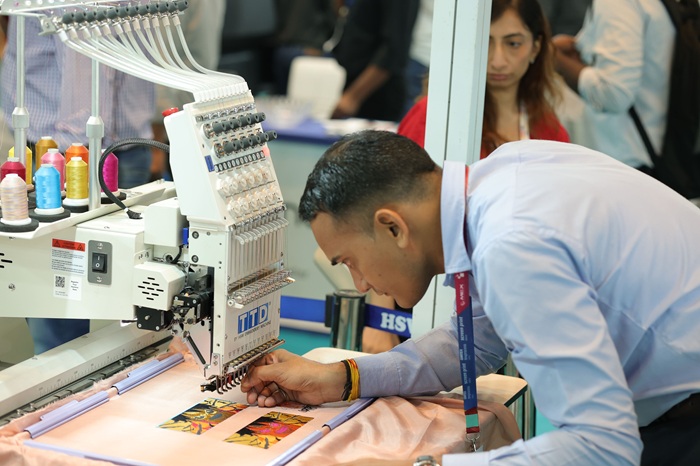
Messe Frankurt has launched four micro-factories at the 2019 edition of Texprocess, Frankfurt/Main, the international trade fair for processing textile and flexible materials held from May 14 to 17, 2019. One of the contemporary show highlights will be ‘Smart Textiles Micro-Factory’, located in the walkway between Halls 4.1 and 5.1 of Frankfurt fairground, the Institute for Textile Technology (ITA) at the RWTH Aachen University, along with partners from industry and research, who will be producing a ‘smart’ pillow which, with the application of integrated LEDs, provides a platform for new ways of interaction. With this demonstration, the partners in the project will present an exemplary, fully connected manufacturing process for a smart textile from design to finished product.
The Smart Textiles Micro-Factory will represent a double premiere: the operational implementation of an on-demand integrated manufacturing process and this a smart, in this conductive sewn end-product. Under the leadership of a team of dedicated engineers for various technologies and along the principals of agile project management the following partners are now developing concept and implementation for the ambitious Microfactory application: Gerber Technology, Korea Institute for Industrial Technology (KITECH), Vetron Typical Europe GmbH (sewing), Wear it GmbH, ZSK Stickmaschine
GTTES 2019 registers a 26 per cent growth in visitors
GTTES 2019 registered a 26 per cent growth in visitors. The visitors spanned a large number countries including: Algeria, Azerbaijan, Belgium, China, France, Germany, Italy, Japan, Spain, Turkey, UK, USA, Taiwan, Morocco, Djibouti, Kuwait, Kyrgyzstan, Senegal etc . Total number of visitors were 32,000, including 1,990 students from 35 institutes & high level delegations from 12 countries
GTTES 2019 created a new opportunities & prospects for various players from textile industry and encouraged students from the textile institute in multiple ways. One such outstanding benefit for students was from Callebaut de Blicquy (CDB), a manufacturing company which gifted an equipment for eco-friendly dyeing process optimisation – OptiLab of DKTE Textile and Engineering Institute, Ichalkaranji.
Many exhibitors bagged orders and sold machines. One such exhibitor was China’s Ziejiang Boretech Environmental Engineering which concluded a deal worth $1.3 million with Sutlej Textiles. Exhibitor Shreetex Engineers sold its machines to Savitri Textiles.
J Crew launches certified denim styles
J.Crew recently launched its first round of Fair Trade certified collections. The collection comprised 18 styles of denim and is included its eco collection. Made at its Saitex factory, a ‘zero-discharge facility; the collection uses 65 per cent less chemicals and 75 per cent less water than conventional fabric. The Saitex factory reports to have reduced their energy consumptions by 13 million kw of power per year and recycles most of its water waste.
The Fair Trade certification applies to the process of making the denim, not the materials themselves. Denim’s other problem is cotton, a water-intensive crop that’s been involved in countless GMO debates. Whereas some brands, such as Nudie Jeans, have become iconic for organic cotton denim made consciously, the bigger players have been slower adopters.
Future Fabrics Expo showcases natural, manmade fibers
Future Fabrics Expo was held in UK from January 24 to 26, 2019. The show highlighted the need for a more varied approach to material selection and manufacture, as current global fiber demand lacks in diversity. In order to inspire a broader textile fiber matrix, Future Fabrics Expo presented a carefully curated range of natural and manmade fibers and fabrics ranging from protein and cellulose-based natural fibers to manmade fibers derived from natural and synthetic polymers.
Organic cotton fabrics featured strongly. JJR Spin Textiles, based in India, showcased an eye-catching range of fabrics combining hand woven tweeds, stripes and checks, hand and machine embroideries and jacquards. The company uses handloom and manual techniques for some of its range to ensure that traditional techniques and skills are preserved. In addition, this approach offers more flexibility in terms of how many colors can be used as well as combining different yarn compositions and thickness.
Material recyclability and biodegradability was featured in a dedicated display, highlighting the urgent need to develop alternatives to single-use plastic packaging and pushing innovation on plastic waste recycling.
In line with the industry’s growing interest in cleaner and healthier materials, the dedicated innovation hub featured a variety of emerging bio-based materials made from agricultural food waste, mushroom mycelium, algae and wild rubber from the Amazon rainforest in Brazil.
US cotton builds bridges with Chinese mills
If the ongoing trade war is not resolved soon, mills in China could move away from US cotton permanently and toward Brazilian or West African cotton. The US cotton industry enjoyed a 46 per cent share of all imports going into China. But that changed when China issued a 25 per cent tariff on US cotton in retaliation for tariffs placed on Chinese goods by the US.
China accounts for one-third of total global mill use for cotton. For the 2018-2019 marketing year, China may increase its imports by at least seven million bales or higher to meet its mill needs and were it not for the tariffs, the US could have been in a strong position to cater to the demand. However, China is still seen as a key market for US cotton and the US will promote the benefits of its cotton. Chinese mills like US cotton for its quality, its consistency and its low contamination. China is the US’ most efficient market to ship to in the world so it keeps costs down.
China produced roughly 26 million bales last year, leaving a gap of 15 million bales where it turned to imports and stocks to meet the shortfall.
Invista develops EcoMade line
Invista has developed new products featuring EcoMade Technology. EcoMade technology is a key part of the company’s vision, in which product sustainability is a critical component. EcoMade technology is available in staple and filament forms, so that almost all fabric types and textile end-use can be served. This makes them easy to be adopted as performance fabrics in the active outdoor space.
EcoMade gives new life to recycled resources by transforming them into fibers through a controlled process. This means less waste is going into landfills, which appeals to millennials and environmentally-conscious consumers. Coolmax EcoMade fiber and Thermolite EcoMade fiber and insulation are made from certified amounts of recycled resources such as plastic bottles and are designed to offer the active/outdoor apparel industry a more sustainable alternative to virgin fibers.
EcoMade technology is available for Lycra T400 and Lycra Dual Comfort technologies as well as for Coolmax and Thermolite brand names. Thermolite T-Down EcoMade insulation is a sustainable alternative to down feathers at a lower cost that is GRS certified and made with recycled fibers. This insulation is designed to deliver lightweight warmth to cold weather outerwear, sleeping bags and accessories.
Invista has made a significant investment to develop differentiated recycled fibers that offer the same features, benefits, and quality as their virgin polymer equivalent, but will meet consumer expectations for more environmentally responsible products.
Sharecloth predicts fast fashion losing out if present production rate continues
Digital fashion solution company Sharecloth has released a report on the amount of wasted clothing produced by the fashion industry. One of the main focus of the report is the burning of unsold clothing by major brands. In 2017, H&M incinerated 15 tons of clothing while last year Burberry burnt products instead of selling them at a lower cost.
The report also claims companies which destroy their dead stock will almost never acknowledge this publicly. The report contains many figures on the extent of the problem with the current trend of fast fashion. The global fashion industry produces 150 billion garments a year, which equates to about 20 pieces per person.
More than 50 per cent of fast fashion produced is disposed in under a year. Also offered is a warning to the fashion industry, that by 2030, fashion brands will see a profit reduction of $52 billion if it continues operating the way it currently does. This it says is due to scarce resources, higher labor costs and overproduction. As to why companies overproduce clothes, one reason is fast fashion but other reasons are growing demand for clothing and also unit cost, with bigger orders equaling lower price per piece.
ISPO Textrends a platform for new fabrics and trims
ISPO Textrends will be held in Germany, February 3 to 6, 2019. This is a platform for designers and product managers to discover the latest fabrics, fibers, trims, and accessories for sports, and outdoor apparel. It will cover a host of topics from digitalisation, micro factories to the dawning of a new era in sustainability.
With micro factory becoming a more prominent feature in the industry, a session will show that a fully integrated, fully automated and adaptable workflow process from design concept to finished garment is possible with digital technology.
A textile trend consultant will share ISPO Textrends’ mega trends, color palettes and textile trend directions daily, which connects to the latest developments for fall/winter ’20/’21. There will also be a discussion of a borderless sports industry.
A view on the social and economic developments of the next decade and its impact on the industry will be another topic. The textiles chain is changing, driven by the demand of consumers, as transparency and traceability, to a renewed waste-less, recycled and reuse attitude, come to the forefront. A smart approach to textiles is also happening, from innovative sustainable solutions to artificial intelligence, illustrating how new technology can be introduced into the entire textile chain.
Apparel Sourcing Week to debate sourcing issues
Apparel Sourcing Week will be held in Bangalore from March 15 to 16, 2019. It will break the glass barrier on a key doubt that many manufacturers in Bangladesh are having. Is the Indian retailer/brand prepared for international sourcing?
The event will create an opportunity for discussion on a mature platform to enhance the future potential of mutual trade between natural partners – India and Bangladesh.
Besides being among the fastest growing retail markets of the world, India is also home to the best sourcing professionals in the global apparel network. All key positions in buying and sourcing are being handled by people who have years of experience in international business. These experts have brought in systems that are supporting a smooth transition from an unorganised buying/sourcing module to a very professional approach to the process.
H&M’s India office is buying huge quantities of undergarments from Bangladesh for its India stores. The Swedish global fashion giant which has committed Rs 700 crores towards FDI in India has 31 stores in India and last year H&M, which is also available online, did a business of Rs 940 crores in India. Indian retailers are aggressively increasing their sourcing from Bangladesh and many others are seeking the right partners to work with.