FW
New markets boost Bangladesh’s export earnings
Bangladesh’s apparel exports to new destinations grew 36.21 per cent in the first half of the current fiscal year. Among these are: Australia, Brazil, Chile, China, India, Japan, Korea, Mexico, Russia, South Africa and Turkey. Exports of knitwear products to these countries were 29.52 per cent higher than in the corresponding period previous year. Earnings from woven goods exports were up by 43.58 per cent. Traditional markets for Bangladesh apparel products are: the US and the European Union.
The main drivers for the sharp rise in exports from new destinations were policy support measures and increased cash incentives against exports. Apparel exporters now enjoy a four per cent cash incentives against exports to non-traditional markets, which encourage them to explore new destinations for their products. Additionally, these cash incentives allow apparel makers to practice competitive pricing in the global market.
Manufacturers are now participating in expos to establish contacts with buyers from non-traditional markets. This is also having an impact in terms of export earnings growth from new export destinations. Bangladesh’s export earnings from non-traditional export markets are expected to rise further as China and India are giving more importance in importing clothing products for local consumption and global retailers are opening new outlets in India.
With growing demand, brands increasingly focus on mothers-to-be
"Gone are the days when clothes for expectant mothers were limited to ill-fitting silhouettes and long overalls. Maternity wear today is growing market with designer’s investment on pregnant women increasing over time. The latest to jump in the bandwagon is Zara with its new maternity collection. The brand has introduced 25 maternity items – including knitted dresses, sweaters, overalls and jeans – styled with other pieces from the main Zara range, which are either oversized or made from stretchy, bump-friendly materials."
 Gone are the days when clothes for expectant mothers were limited to ill-fitting silhouettes and long overalls. Maternity wear today is growing market with designer’s investment on pregnant women increasing over time.
Dressing up expectant mothers
The latest to jump in the bandwagon is Zara with its new maternity collection. The brand has introduced 25 maternity items – including knitted dresses, sweaters, overalls and jeans – styled with other pieces from the main Zara range, which are either oversized or made from stretchy, bump-friendly materials.
Other high street and online retailers attempting to tap into the spending power of expectant and new mothers include H&M, Next, Topshop, Asos and Boohoo. Plus-size retailer Simply Be also launched its first maternity collection online in September. Retail analytics company Edited’s study shows the number of maternity items sold across 30 major US and UK retailers quadrupled between 2014 and the third quarter of 2017.
Maternity fashion influenced by high-street styles
As per estimates of GlobalData, the UK maternitywear market, which was worth £199 million in 2017, has seen a rise in the number of style-savvy ‘mum-fluencers’, as well as a spate of public royal pregnancies. The maternity fashion choices of the Duchess of Cambridge have boosted business for brands such as Séraphine. The brands are now focusing on Meghan Markle, the Duchess of Sussex, who is expecting her first child in the spring.
The influx of high street maternity styles is pressurising specialist retailers and brands to offer complete value to mothers investing in expensive, technical maternity and nursing clothing, which is not always as fashion forward. London-based maternity wear retailer Isabella Oliver plans to launch an activewear range in January 2019 for expectant mothers. The brand works with sustainable fabrics with fits and designs that can be worn throughout pregnancy without having to size up. The brand invests a lot of time fitting each product on various ‘bump’ sizes, to create designs that are practical, comfortable and stylish.
Exploring styles for nursing mothers
With most nursing styles being designed for pregnancy, the market for breastfeeding clothes is still relatively untapped. Sainsbury’s Tu, in August 2018 announced its plans to expand the number of styles suitable for nursing mothers, after one of its jumpsuits was recommended on the facebook group ‘Can I Breastfeed In It?’ and sold out online within four weeks.
Other brands such as SilkFred and Closet London, for example, have edits on their websites that show customers which of their dresses are suitable for breastfeeding. With more attention being paid to the pregnancy and post-childbirth fashion, the pressure on specialist players to set themselves apart in the comfort and technical design stakes will continue to grow– promising good times ahead for this group of consumers.
Macao, Malta to lead world economic growth
Global fashion industry faces a changing environment, with an economic downturn and protectionism threatening to mark the development of the two biggest world economies. Twenty years ago, China was the seventh biggest economy, post World War, globalisation led a move to the Western world. Twenty years later, China and India, the two largest powers in the world, threaten to revert globalisation and doctrines deemed to belong to the past come back to political speeches. Brazil and Russia, which alongside China and India promised to be growth motors at the beginning of this century, have wavered, only India reached the expected growth rates.
 Global fashion industry faces a changing environment, with an economic downturn and protectionism threatening to mark the development of the two biggest world economies.
Reversal of globalisation leads to new growth centres
Twenty years ago, China was the seventh biggest economy, post World War, globalisation led a move to the Western world. Twenty years later, China and India, the two largest powers in the world, threaten to revert globalisation and doctrines deemed to belong to the past come back to political speeches. Brazil and Russia, which alongside China and India promised to be growth motors at the beginning of this century, have wavered, only India reached the expected growth rates.
The five economies that will grow the most in 2019 are: Macao, Malta, Cyprus, Slovakia and Ireland, with peaks fluctuating between 4 and 6 per cent. The United States, however, will record moderate ascent of 2.5 per cent, four tenths below 2018, in part due to the tax reform driven by Donald Trump.
Europe’s growth to slow down
The Eurozone, will slow down at 1.9 per cent, one tenth below 2018 and, while Germany and France will maintain growth rates, Italy and Spain will slow down two and five  tenths, respectively.
As for emerging economies, the best growth perspective is for Yemen, where it is expected to rise 14.7 per cent. The country, deep into a humanitarian crisis due to civil war, will see its economy relatively lifted thanks to the increase in the price of oil. Libya, Dominican Republic, Ethiopia and Rwanda will complete the top five. India is placed in seventh position, with a rise of 7.4 per cent, while China falls to 22th position, with a growth of 6.2 per cent, below 6.6 per cent in 2018 and 6.9 percent in 2017.
Global commerce will slow down as well. In September, the WTO lowered its growing forecasts to 3.7 per cent for 2019, two tenths below 2018’s figure. The organisation, which expects a growth of the economy of only 2.9 per cent, underlines in its report that the hardening of monetary policies and protectionist threats affected predictions.
A year of change
This fiscal year will be the key for many countries. On one hand, Trump and Xi Jinping trade battle, even in the truce, will impact economic development of China and India. China’s manufacturing PMI closed below 50 points in December for the first time and Shanghai’s stock market suffered several corrections during the fiscal year.
The United States’ GDP, started to slow down, once the effects of Trump’s tax reform wear off, with an increase of 3.5per cent in the third quarter, compared to 4.2per cent in Q2.
Tensions in emerging markets like Brazil, Russia or Turkey, alongside the continue terrorist threat in Europe and the refugee crisis will mark the agenda during the year where many countries have their future at stake.
Péro teams up with Woolmark Company, Bhuttico Kullu Shawls for LFW
Péro by Aneeth Arora, The Woolmark Company, and Bhuttico Kullu Shawls have collaborated on a project entitled “Farm To Fashion” that will be unveiled at the upcoming edition of Lakmé Fashion Week. The event will hold another edition of its “Sustainable Fashion Day” on the second day two of Lakmé Fashion Week on January 31. As part of the showcase of sustainable fashion, Péro will present its summer/ resort collection on the runway.
The collection, titled “Farm To Fashion”, was created in collaboration with the international knitwear business The Woolmark Company and with the Kullu-based weavers cooperative, Bhuttico Kullu Shawls. The collection is "Grown in Australia, Made in India" and will include handmade merino wool textiles created sustainably and with a fully teachable supply chain. Lakmé Fashion week will run at Mumbai’s Jio Garden from January 30 to February 3.
London, New York, Milan to host Lineapelle’s 2019
Lineapelle London open on January 22, followed by New York on January 30 and 31 and Milan from February 20 to 22, 2019. The event sees the participation of exclusive European and international producers of leather, textiles and synthetics, components and hardware for shoes, handbags and leather goods, leatherwear, upholstery and car interiors. Lineapelle London, has always attracted the crème de la crème of creative British clientele. Around 42 exhibitors present (37 are Italian): 27 tanneries, 7 manufacturers of accessories and components, 8 of fabrics and synthetics. The seminar ‘Relationships Between Material, Designer & User’ will compare leather, craftsmanship and stylistic approach, with a view to customising the product within the field of interior design.
The high quality and variety of the cutting edge collections makes it a must-see event for producers and designers of luxury and contemporary items. The reference exhibition for the global leather area will have a renewed fashion matrix, starting from the concurrence with the fashion shows of Milano Moda Donna, through to the presentation of some fit-outs designed to create a stimulating stylistic path inside the Lineapelle spaces.
In particular, the lounge areas will be designed with the aim of formalising research from the trend area through thematic exhibition moments, to provide tangible examples of references to colour and concept from the 2020 summer season.
The event will thus strengthen its identity as a business experience around which the international supply chain of the fashion and luxury industry gravitates. From an economic perspective, Lineapelle will try to shed light on a complex and opaque market moment which requires particular attention in finding innovative product and service solutions.
British Fashion Council warns against Brexit
The British Fashion Council is against Brexit and says the decision to leave should come with a deal or it could have dramatic impacts. The council says a no-deal Brexit is a scenario that should be avoided at all costs. The ongoing uncertainty and confusion that a no deal creates would have a negative impact on the industry, where investment is already being impacted from the uncertainty being faced. A no-deal situation would also result in no transition period, and an industry that is predominantly small-medium enterprises would struggle to cope with the trade realities that it would bring.
That apart a multitude of challenges would be facing the industry. Delays in shipping, particularly from manufacturing and textile dominant locations such as Italy, Portugal and Romania, as well as the transfer of people in and out of countries, could be enough to sink some smaller or newer brands.
The British Fashion Council has established a Brexit technical working group which is analysing and making plans for the potential impacts that the industry would face when the United Kingdom leaves the EU. Individuals from a variety of areas in the fashion industry have been inducted into this group, all passionate about the future of fashion in Britain.
GTTES textile show attracts over 9,000 visitors
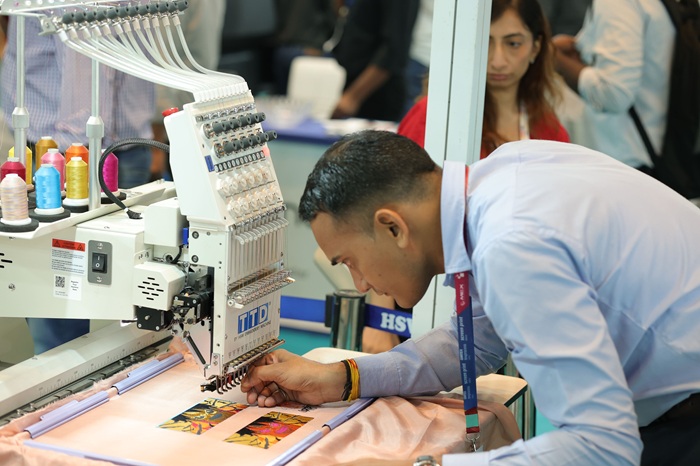
Global Textile Technology and Engineering Show (GTTES) was held in Mumbai, from January 18 to 20, 2019. More than 9000 people attended. Key brands, companies and business houses visited the event. The event was a platform to connect exhibitors with many new markets which have never looked at India as a sourcing opportunity. Both for Indian manufacturers and foreign exhibitors these new and developing markets can bring future opportunity for business and expand their customer networking in an unprecedented way.
The fair offered new optimism, opportunities and prospects for the textile industry with 400 exhibitors, 49 countries and 65 international business delegations. GTTES is a global relationship builder that provides a platform to the textile and textile technology segment to facilitate meaningful business relationships. These services inspire, empower and connect the most promising companies with latest technologies, corporations, investors, industry experts, and international media with the goal of increasing their chances of success and positive impact on the textile industry. GTTES is a platform that enables networking and exchange of ideas and brings together the latest technologies from around the world under one roof.
Ehtiopia to host ITME Africa next year
India ITME Society will host ITME AFRICA 2020 in Ethiopia in February next year. This is an unique, exclusive business event with the theme “Prosperity for AFRICA through Textile Technology”. The aim is to initiate a revolution in generating employment, encourage skills development, motivate entrepreneurship in textiles, ushering investment, economic growth and thus bringing new aspirations for a younger generation of African countries.
This business event, conceived and developed by India ITME Society, will showcase a complete range of textile and textile engineering with a total of 27 chapters. The broad categories covered are textiles, textile technology, textile engineering, financial institutions and allied segment.
ITME Africa hopes to be instrumental in establishing Africa’s textile footprint globally, to bring to the table complete solutions to textile industry development in the continent through affordable technology, international exposure, learning and experience, confluence of business houses, Investment opportunities, joint ventures, access to finance, networking with technocrats, educators, thus paving the way for a wave of knowledge, progress, growth and prosperity.
This event is expected to bring multiple growth effects for not only the textile industry but also airlines, hotels, transport, tourism etc. Despite an enormous untapped potential for trade expansion between India and Africa, India’s trade with Africa is concentrated in certain sectors and countries and is dominated by exports of primary commodities.
Vietnam needs to reduce import dependence
The Comprehensive and Progressive Agreement for Trans-Pacific Partnership (CPTPP) is expected to pose challenges for Vietnam. The garment and textile sector may suffer the most from goods origin regulations under the CPTPP. Vietnam has to import around 80 per cent of its materials for production. The heavy demand on imported material has become a serious problem for the industry.
Currently, Vietnam has to import up to 99 per cent of its cotton requirements, 70 per cent of fiber requirements and 80 per cent of fabric requirements. The biggest shortcoming is that only 10 per cent fabric is imported from Japan and countries that are part of the CPTPP. The biggest bottleneck is that Vietnam has been unable to produce fabrics for export.
Vietnam is the third biggest exporter of garments and textiles in the world following China and India. The country has an abundant labor force. To take advantage of the opportunities from the CPTPP, Vietnamese firms need to gain a deeper understanding of the sector, their advantages and markets in the CPTPP. In order to solve the bottleneck, policies need to be developed for the next ten to 15 years to take advantage of this agreement.
Raymond gets Sebi show cause for market violations
The Securities and Exchange Board of India (Sebi) has issued a show-cause notice to textile maker Raymond alleging multiple securities market violations. The allegations include failure to obtain necessary approvals for related party transactions in the JK House episode, corporate governance violation for non-disclosure of material information about litigations and non-compliance of shareholder reclassification norms.
Sebi says Raymond did not take necessary approvals for the related party transaction involving lease of JK House to some of the promoters for a decade between 2007 and 2017. Raymond had leased four duplex flats in JK House to an entity named Pashmina in 2003.Pashmina subleased the flats to tenants all of whom were part of the promoter group of Raymond.
Sebi rules mandate each company to decide the quantitative threshold for determining whether a transaction is a material development or not. Raymond had decided that any litigation that amounts to five per cent of the gross turnover of the company or 20 per cent of its net worth would be categorised as material development and needed to be disclosed to the shareholders. The lack of disclosure of the matter despite falling into its definition of a material development was a violation of the listing agreement.