FW
Pakistan: PRGMEA confident about PM’s focus on an export-oriented industry
The Pakistan Readymade Garments Manufacturers and Exporters Association is confident that PM Imran Khan and his economic team will bail the country out of the economic crisis by paying special attention to the export-oriented industry. PRGMEA pointed out that the incumbent government has fulfilled all its commitments made to the exporters within very short span, particularly lowering gas tariff to $6.5/MMBTU and reducing electricity rates to Rs 7.50 cents/kWh to the exporting industry.
Sales Tax refund payment has been cleared against RPOs while payment processing of Deferred Sales Tax refunds, which were pending for the last 15 years, has also been started. PRGMEA also appreciated the government to allow advance payments for imports of basic industrial raw material. Appreciating the government on taking serious notice of the severe issue, it said the move has raised the business community's confidence and such business friendly policies will definitely result in boosting the trade and industry. The facility's withdrawal had severely affected the export-oriented industries of the country. The move also delayed export shipments besides scaling up the cost of production.
The country's budget deficit was Rs 230 billion before this government, after coming into power it has reduced it by Rs 130 billion. This government has fulfilled its commitment to the nation by taking the country out of inherited financial crisis and is successfully managing the pending external payments.
DTG machinery show on in Bangladesh
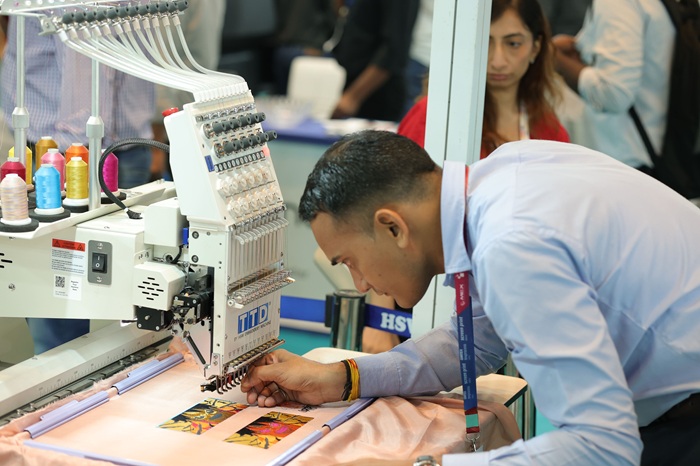
A textile and garment machinery exhibition (DTG) is on in Bangladesh from January 9 to 12, 2019. This is the largest textile machinery exhibition in Southeast Asia. Bangladesh has now emerged one of the potential markets for global textile and garment machinery manufacturers thanks to rising demands for locally made apparel items across the world.
Spinners, weavers and readymade garment makers have been investing billions of dollars in setting up new factories and expanding their existing capacity. Millers and exporters can buy machinery from the exhibition venue.
Some 1,200 textile and machinery manufacturing companies from 37 countries including Australia, China, France, Germany, India, Italy, Japan, Korea, Taiwan, UAE, UK and the US are displaying their products at 1,650 booths.
Textile machinery manufacturers value Bangladesh as the center of the textile and clothing machinery business hub. Local spinning millers meet 80 per cent to 85 per cent of the knitwear sector’s requirements while woven millers can meet 35 per cent to 40 per cent of the demand for woven fabrics by readymade garment exporters. Textile and apparel buyers see Bangladesh as a major sourcing destination. DTG is now in its 15the and participation rose by about 25 per cent.
Kitex Garments’ Rs 910 crore expansion on track
Kochi-based Kitex Garments, currently the third largest infant apparel manufacturer in the world, will raise production capacity over 3.5 times to produce 22 lakh pieces per day by 2025 from the current six lakh pieces of finished garments per day for 'just-borns' and babies up to two years.
The company will add capacity across the value chain by increasing knitting and processing capacity to 80 tons each and is expanding the sewing production capacity. It will also diversify into new product lines like socks for children, baby diapers and baby wet wipes, besides setting up a cotton spinning mill with a capacity of 80 tonnes per day as part of vertical integration. The ongoing expansion with an estimated Rs 910 crore will help the company reach revenues of Rs 2,165 crore by 2024-25 with an average growth of over 20 per cent every year from the Rs 559 crore revenues in 2017-18. While land identification is complete, machinery and supplier identification and building and infrastructure planning is going on.
M&S’ UK sales take a dip in December
M&S’ UK sales fell 2.2 per cent on a like-for-like basis and 2.7 per cent in total. International sales too fell, although the large size of drop was mainly due to the sale of its Hong Kong business to its franchise partner and the closure of stores in loss-making markets. Factoring those out, international revenue was down only 1.4 per cent. Reducing consumer confidence, mild weather, Black Friday, and widespread discounting by competitors made November a very challenging trading period for the company.
Improvements to its online proposition and operations helped it to mitigate lower footfall to stores resulting from, in part, the increasing pace of change in the store estate. Women’s wear online growth significantly outperformed, driven by areas including dresses and knitwear. Stock that went into its clearance sale was down around 25 per cent, as a result of a planned reduction in stock levels.
The company is still in the early stages of far-reaching changes in range, style, customer focus and channel mix. Its objective is to reshape its buy, deliver market leading value and focus on stylish and wearable wardrobe must-haves as it grows the business with family-aged customers seeking style, quality and value.
Kingpins New York reschedules show dates
The Kingpins New York show, originally scheduled for June 8-9, 2019 will be rescheduled for June 12-13, 2019. Additionally, Kingpins Transformers, the seminar series focused on sustainable innovation, will be moved to June 11, 2019 to coincide with the trade show. New York Denim Days—the annual consumer-facing denim festival—will be held on its originally scheduled dates, June 08-09, 2019.
The new dates also give vendors an extra week between Denim Premiere Vision’s roving show concept which will relocated from London to Milan from May 28-29, 2019. The next edition of Kingpins will take place in Amsterdam April 10-11, 2019
Hemp emerging a strong alternative fiber among US apparel makers
Hemp may become a huge factor in the US textile market as more and more people are becoming interested in using it as a fiber. Like bamboo fiber, hemp is known for a porosity and strength that make it great for breathable outdoor wear.
Hemp fiber is hypoallergenic and thermo-regulating, besides being stronger and longer lasting than most other natural fibers. It also has the ability to filter harmful UV rays up to SPF 15 and can be manipulated during manufacturing to increase that range.
Beyond benefits to the wearer, the planet could benefit from the hemp market as well. Hemp needs little rainfall, is drought-resistant and restores nitrogen levels and neutralizes pH levels in soil. Hemp’s performance features are innate to the fiber and brought to the surface during production rather than added as a treatment or finish. Hemp provides these benefits without contributing to microplastic pollution that result from washing and abrasion of synthetic fabrics.
Hemp is already a favorite among designers who use sustainability as a selling point for their collections. Thanks to innovations in production, hemp can be used to create a variety of fabrications. If hemp is abundant by 2022, it will be a crucial factor in its popularity in the US apparel market.
India: Gujarat government announces scheme for the textile sector
The Gujarat government has announced a support scheme spanning the entire textile value chain. Named ‘Scheme for Assistance to Strengthen Specific Sectors in the Textile Value Chain’, it will be operative upto December 31, 2023. The scheme provides financial assistance through credit-linked interest subsidy of 6 per cent for MSME and 4-6 per cent for large enterprises with an upper ceiling of Rs 20 crore per annum. A separate scheme for subsidy in power tariff allows up to Rs3 per unit for weaving and Rs 2 per unit for other eligible segments.
The scheme for assistance in compliance of energy, water and environment conservation covers all existing units in operation for more than three years. The scheme provides 20 per cent assistance on the cost of machinery with a ceiling of Rs 30 lakh and 50 per cent assistance for audit fees with a limit of Rs 1 lakh.
For technology upgradation and modernisation in textile value chain, the scheme provides one-time financial assistance of up to 50 per cent of the cost with a limit of Rs 25 lakh.
The State government has also extended support for setting up textile parks with financial assistance of up to 25 per cent of capital expenditure on common facilities and infrastructure with a limit of Rs15 crore. The park will also get financial assistance to create hostel facilities within park with minimum 100 workers domiciled in Gujarat.
GST council doubles exemption threshold limit of textile players
The Goods and Services Tax (GST) Council in its 32nd meeting, doubled the exemption threshold limit of textile players from the existing Rs 2 million to Rs 4 million effective April 1, 2019. For the north eastern states, the threshold has been doubled to Rs 2 million from Rs 1 million. This decision will help the small and medium sized businesses and will encourage growth in the textiles sector.
The GST Council has also raised the existing composition scheme turnover threshold from Rs 1 crore to Rs 1.5 crore for the financial year 2019-20. Businesses under the scheme will now pay tax on a quarterly basis but returns will have to be filed annually. The increase in threshold is set to boost domestic textile sector, said a senior industry official.
Fibers energise Invista’s new legwear collection
Invista’s latest legwear trends feature advanced fiber technology and offer a valuable source of inspiration for coverers, knitters, brands and retailers planning their legwear collections. Each of the looks in Invista’s exclusive capsule collection showcases a different fiber innovation that has been carefully selected for its ability to bring each trend to life, satisfy an unmet consumer need, and add value to legwear collections.
Whether it’s warming or cooling technology, enhanced comfort or compression to energize tired legs, consumers can depend on Invista’s innovations to deliver lasting performance wear after wear and wash after wash. Showy, sensual and sensational legwear designs are on offer that feature rock steady styling and dramatic don’t mess with me attitude fit for the dance floor.
One look features blocks of stripes that highlight ribbed areas of graduated compression provided by Lycra Energize technology. In order to keep the wearer cool, dry and comfortable, Coolmax technology has also been used.
Fashion brands upgrade smartwatches to add payment capabilities
Major fashion brands Kate Spade and Michael Kors recently upgraded their second-generation smartwatches that feature NFC capabilities to add payment capabilities. Kate Spade is launching the Scallop Smartwatch 2, its second touchscreen smartwatch that will include features like NFC payments, a GPS, and a heart rate monitor — all of which its first smartwatch did not include.
The watch runs on Google's Wear OS, its operating system for wearable devices, allowing users to access Google Pay, Google Assistant, and Google Fit. Michael Kors launched the Access Sofie 2.0, which offers NFC payment capabilities through Google Pay, a heart rate monitor, and a GPS.
Wearable payments are poised to take off in the US, but firms can take several steps to push adoption. Business Insider Intelligence expects US consumers to spend $3.5 billion on wearables by 2023. But some consumers are hesitant to buy payments-specific wearables, but would be interested in contactless payments that are integrated into existing devices, according to a Barclaycard study. Integrating payment functionality into an everyday watch, rather than making a wearable band specifically for payments, can appeal to consumers.